

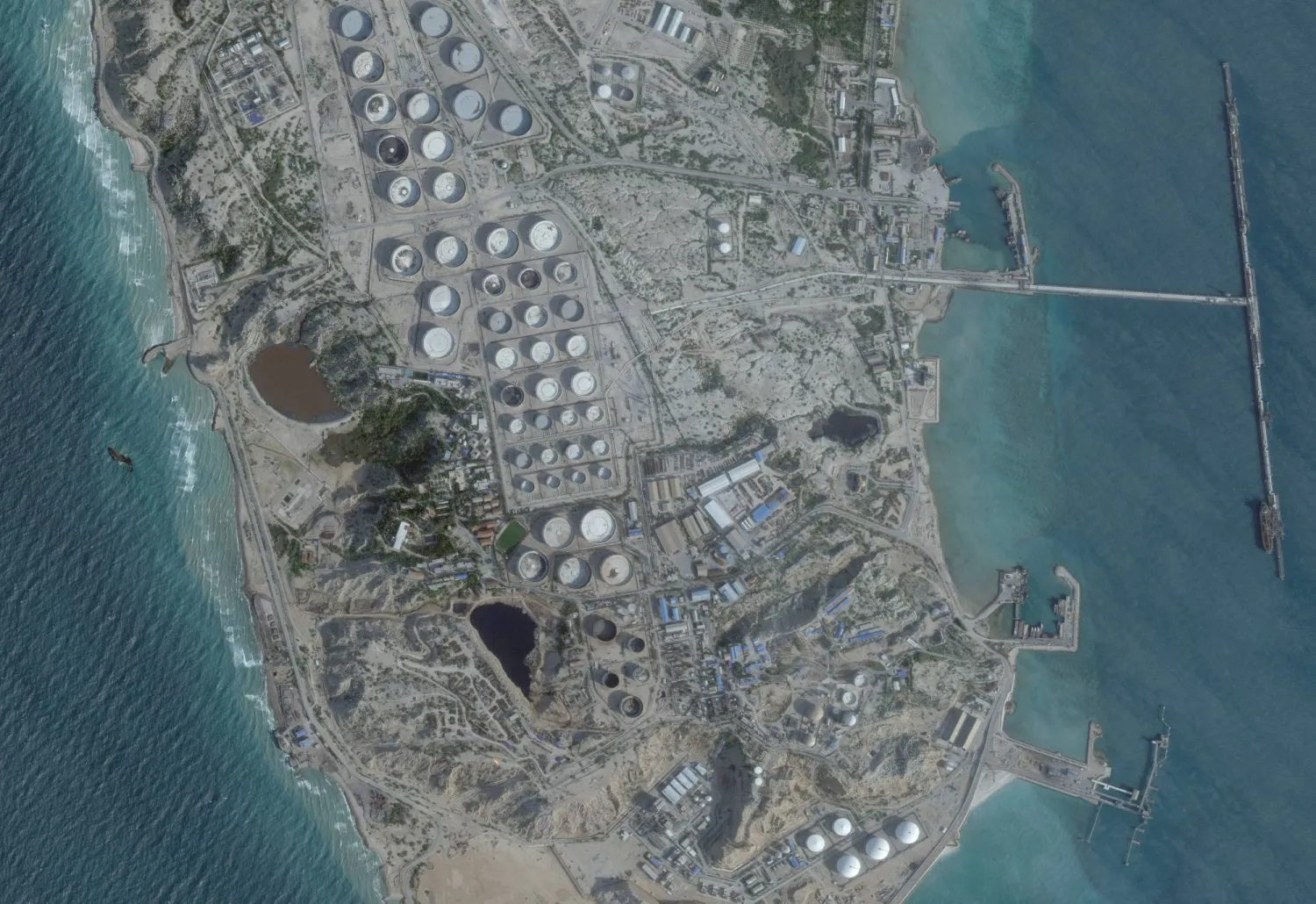

Iran Dismisses Trump’s Post of Attack on Key Energy Hub of Kharg

FILE PHOTO: A satellite image shows an oil terminal at Kharg Island, Iran, February 25, 2026. 2026 Planet Labs PBC/Handout via REUTERS
TT

Iran Dismisses Trump’s Post of Attack on Key Energy Hub of Kharg

FILE PHOTO: A satellite image shows an oil terminal at Kharg Island, Iran, February 25, 2026. 2026 Planet Labs PBC/Handout via REUTERS

An Iranian official dismissed as "laughable" on Monday a post by Donald Trump of an AI-generated video clip that the US president said showed Iran's oil hub Kharg Island being "blown to smithereens". 

Hours after Sunday's post, there was no evidence Kharg had been attacked. The White House and the US Defense Department did not immediately respond to Reuters requests for comment outside regular business hours. 

Trump's post came shortly after the US and Iran resumed hostilities for the first time since late July, further denting hopes for any early resolution of a conflict now in its sixth month and driving oil prices nearly 2% higher on Monday. 

US forces on Sunday struck two Iranian launchers on Iran's Larak Island, some 660 km (410 miles) east of Kharg, a US official said, prompting Iran to retaliate by attacking Jordan, according to Iranian media. 

"Kharg Island being blown to smithereens!!! President DJT," Trump had said on his Truth Social platform on Sunday, with no further details. 

Reuters confirmed that an accompanying video clip showing dramatic explosions was most likely synthetically generated, using software ‌that detects AI-manipulated imagery. 

"Trump’s ‌tweets are laughable and conditions in Kharg are calm and appropriate," Hamid Bovard, chief executive of government-run National Iranian ‌Oil Co, ⁠said on Monday. 

Oil ⁠operations have not stopped and workers were busy repairing previous damage and modernizing facilities, he added in comments cited by Nournews, a semi-official outlet close to Iran's top security body. 

IRAN VOWS TO RESPOND TO ANY ATTACKS 

Kharg handled 90% of Iran's oil exports before the war launched by US and Israeli attacks on February 28, and attacking it would severely disrupt energy trade and put huge pressure on the economy. 

Iranian President Masoud Pezeshkian said his country was not seeking war but would respond decisively to any aggression. 

"We will never remain silent in the face of any aggression...," state media quoted him as saying on Monday ahead of a visit to Kyrgyzstan. 

It was not clear if he was speaking before or after Trump's post on Kharg Island. 

A US official said forces had attacked the Iranian launchers on Larak Island on Sunday after "Revolutionary Guard Corps forces were observed preparing to launch rockets with sea ⁠mines into the Strait of Hormuz". 

Larak is a small island in the strait near the strategic Iranian port of ‌Bandar Abbas. The strait, which normally handles a fifth of global crude oil and liquefied natural gas ‌shipments, has been effectively blocked since the start of the war. 

In a statement, the US Central Command said it took "limited, precise" action against minelaying forces of the Revolutionary Guards that ‌posed an "imminent threat" in the strait. It gave no details. 

In retaliation, as well as attacking Jordan, Iran's army said it had also struck ‌the Al Menhad air base in the United Arab Emirates early on Monday. However, the UAE's defense ministry dismissed that report as false. 

The UAE defense ministry later said its air force engaged a drone that had come from Iran over its territorial waters. 

The Revolutionary Guards used air defense missiles to shoot down a US drone that crashed in Gulf waters, the Mehr news agency said ‌on Monday, citing a statement from the elite force. 

A supertanker caught fire and was brought to a complete halt after being struck by two naval mines in the southern Strait of Hormuz, Iran state TV said, citing ⁠a Guards' statement. 

PILING ECONOMIC PRESSURE ON IRAN 

Trump has yet to achieve the objectives he set out at the start of the war: dismantling Iran's nuclear program, curbing its ability to attack regional rivals and creating conditions for Iranians to overthrow their clerical rulers. 

Sunday's return to hostilities followed weeks in which his administration has stepped up efforts to punish Tehran and its business partners with costly economic sanctions, shifting away from military options. 

US Treasury Secretary Scott Bessent told Reuters on Sunday new secondary sanctions were likely to be unveiled weekly in the effort to pressure Iran, with an initial focus on banks. 

Amid threats to shipping, the number of visible commodity vessels transiting the Strait of Hormuz dropped to five a day over the weekend, shipping data showed. 

The actual number could be higher as some vessels have switched off automatic identification systems to evade attacks. 

The Guards said the supertanker on fire after being hit by mines had been attempting to pass through the waterway illegally, but gave no details of the vessel or crew, according to a statement cited by state television. 

Last week, Trump said all mines had been detonated or removed from the international waters of the strait and Iran had been warned that any vessel placing new mines would be destroyed. Iran denied Trump's assertion. 


2 Ships Ablaze in Romanian Black Sea Waters, 7 Sailors Missing

A screengrab from an aerial footage shows San Marino-flagged tanker ship that caught fire in Romanian territorial waters, released October 15, 2026. Romanian Interior Ministry/Handout via REUTERS
TT

2 Ships Ablaze in Romanian Black Sea Waters, 7 Sailors Missing

A screengrab from an aerial footage shows San Marino-flagged tanker ship that caught fire in Romanian territorial waters, released October 15, 2026. Romanian Interior Ministry/Handout via REUTERS

Rescuers were searching for seven missing crew on Thursday from one of two chemical tankers that caught fire overnight inside Romanian territorial waters in the Black Sea, after Russian drones strayed into Romanian airspace, Romanian officials said.

Romanian officials stopped short of explicitly linking the fires onboard the ships to the Russian drones. But the incidents follow drone strikes on at least five other cargo ships near the coasts of Romania and neighboring fellow NATO member Bulgaria over the past 10 days.

At least 23 sailors were lost from those strikes, which unlike the latest incidents took place ⁠just outside NATO's territorial ⁠waters.

The two ships hit overnight were both anchored in the Black Sea near the mouth of the canal leading into the Danube River, a major shipping route used by Ukraine as Russia has attacked Ukraine's own Black Sea ports.

Romania's naval authority said it received an emergency alert from the San Marino-flagged tanker. Seven of its 12 crew were missing and 5 were rescued, Reuters reported.

The interior ministry said it had sent two Black Hawk helicopters to the ⁠search and rescue mission, as well as two ships with medical staff on board.

"At the moment, the rescue cannot be done safely because of very big waves," it said in a statement.

Late on Wednesday, a Comoros-flagged chemical and oil tanker also caught fire. Romanian authorities initially said it was not clear whether it had been attacked. All its crew were safe.

Romania shares a 614-km (381-mile) border with Ukraine, much of it along the Danube. It has reported repeated breaches of its airspace by Russian drones over the past four years.

Both vessels caught fire near the mouth of the Danube River's Sulina Canal leading to the Black Sea, where ships often anchor waiting to pass because of ⁠delays from weather and ⁠congestion.

Increasing attacks on Black Sea shipping connected with the Russia-Ukraine war in recent months have threatened to cause a global food crisis, as both countries are major exporters of grain, as is Romania.

"We're looking at the Black Sea as a global food artery," Romanian Foreign Minister Oana Toiu told a security conference in Warsaw earlier this week.

"It is currently, unfortunately, the deadliest sea when it comes to the number of casualties of sailors in the last months. That means we need to increase our investments in deterrence, defense."

Bulgarian Prime Minister Rumen Radev said EU leaders would discuss on Thursday a proposed moratorium on attacks on civilian ships in the Black Sea.

Russia has been bombing Ukraine's Black Sea ports, forcing Kyiv to rely increasingly on Danube River ports and shipping routes close to the coasts of Bulgaria and Romania. For its part, Ukraine has targeted Russian ships near the mouth of the Don River in the Azov Sea.


Moscow Arrests Swede for 'Illegally' Crossing into Russia and Planning Attacks

People walk near the Kremlin, in Moscow, Russia, 25 September 2026. EPA/MAXIM SHIPENKOV
TT

Moscow Arrests Swede for 'Illegally' Crossing into Russia and Planning Attacks

People walk near the Kremlin, in Moscow, Russia, 25 September 2026. EPA/MAXIM SHIPENKOV

Russia's security services arrested a Swedish man they said fought for Ukraine for "illegally" crossing into Russia and allegedly planning attacks on military infrastructure, Russian media reported Thursday.
Russia's FSB security service, quoted by state news agencies, said an unnamed Swede was arrested in the northwestern Pskov region near the Lithuanian border, adding that "under the pretext of joining the Russian armed forces, he travelled to Russia to carry out acts of sabotage and terrorism on military facilities".


Washington Divided Over Renewed Strikes on Iran

US Secretary of War and CENTCOM commanders favor resuming the war against Iran, according to Axios. (CENTCOM)
TT

Washington Divided Over Renewed Strikes on Iran

US Secretary of War and CENTCOM commanders favor resuming the war against Iran, according to Axios. (CENTCOM)

Divisions have emerged within the Trump administration over whether to resume major military operations against Iran, with Defense Secretary Pete Hegseth and US Central Command (CENTCOM) leadership favoring fresh strikes while most presidential advisers advocate continued economic pressure, Axios reported.

The disagreement comes after President Donald Trump and Israeli Prime Minister Benjamin Netanyahu discussed a possible joint operation against Iranian military and nuclear facilities last week, according to US and Israeli officials and another informed source.

On Wednesday, Netanyahu warned that Iran’s proxies were seeking to launch missiles and carry out attacks.

Speaking to Israeli Army Radio, he said he opposed a preemptive strike on Tehran ahead of the elections, arguing that the timing was inappropriate. He nevertheless vowed to eliminate Hamas and Hezbollah and bring down Iran within two years.

Military Option Remains Open

The discussions suggest military escalation remains possible despite Trump’s insistence that he will not attack Iran before the US midterm elections, scheduled a week after Israel’s October 27 vote.

A US official said Netanyahu appeared eager to resume hostilities, but Trump had offered no firm commitment.

“Go ahead and prepare,” Trump reportedly told Netanyahu, a remark the official said could signal imminent action, a later operation or no attack at all.

A White House official denied that the leaders had discussed resuming the war, reiterating Trump’s position on the midterms.

Netanyahu’s office confirmed regular contacts with Washington but declined to discuss their substance.

According to the sources, Trump initially appeared inclined toward renewed strikes before becoming more hesitant.

Hegseth and CENTCOM leaders remain the strongest advocates of military action, while most advisers argue that sanctions and other economic measures are increasingly effective.

The debate pits military action aimed at disrupting Iran’s capabilities against sustained pressure intended to extract concessions without another round of fighting.

US and Israeli forces remain on alert, although preparations do not indicate that a final decision has been made.

Nuclear Concerns

Israel says intelligence indicates Iran is rebuilding parts of its nuclear program, concerns Netanyahu raised with Trump.

Israeli officials are particularly worried that Tehran could use the Pickaxe Mountain facility for uranium enrichment.

Senior Trump administration officials met for hours at Camp David on October 2 to discuss possible renewed strikes, including operations against Iranian military installations.

Whether the intelligence concerns will prompt military action or strengthen Washington’s negotiating position remains unclear.

The electoral calendar further complicates the calculations. A renewed offensive could provoke hundreds of Iranian ballistic missile launches toward Israel, potentially widening the conflict and disrupting its elections.

Diplomacy Continues

Meanwhile, Qatari mediators are awaiting Tehran’s response to Washington’s latest counterproposal to end the war, which demands nuclear concessions.

A US official said negotiations had not collapsed but were making little progress.

The official said Tehran had expected Trump to retreat under wartime pressure and with the midterms approaching, but the president had demonstrated that those calculations were mistaken.

On Tuesday, Trump again called Iran a “failed state” and said Washington would make a decision concerning Tehran “very soon.”
