


US Military Leaders Warn Against Prolonging Iran Operations

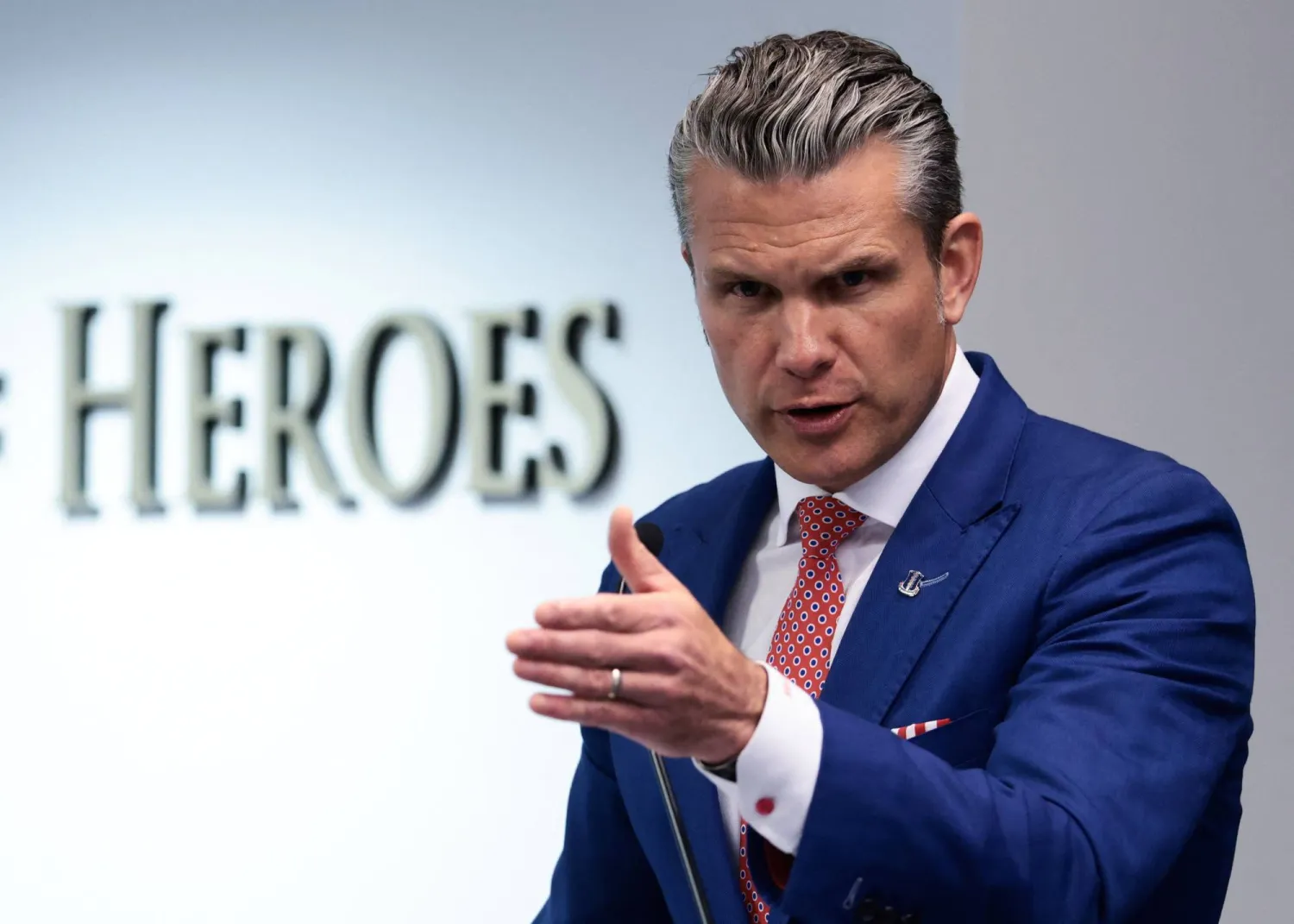
US Defense Secretary Pete Hegseth speaks during a ceremony to honor Marines who served at Abbey Gate at Hamid Karzai International Airport in Kabul during the August 26, 2021, suicide bombing that killed 13 US service members and roughly 170 Afghan civilians during the US military evacuation from Afghanistan, at the Pentagon in Washington, DC, US, August 26, 2026. (Reuters)
TT

US Military Leaders Warn Against Prolonging Iran Operations

US Defense Secretary Pete Hegseth speaks during a ceremony to honor Marines who served at Abbey Gate at Hamid Karzai International Airport in Kabul during the August 26, 2021, suicide bombing that killed 13 US service members and roughly 170 Afghan civilians during the US military evacuation from Afghanistan, at the Pentagon in Washington, DC, US, August 26, 2026. (Reuters)

Several US military leaders have advised Defense Secretary Pete Hegseth that prolonging large-scale operations against Iran is unsustainable and risks weakening their ability to confront threats elsewhere, including the US homeland, The Washington Post reported on Sunday citing people familiar with a recent assessment prepared for the Pentagon chief.

The warnings appeared in the August 14 edition of the Secretary of Defense Orders Book (SDOB), which is typically produced twice monthly to outline the worldwide availability of American warships, aircraft, personnel and weapons systems.

The warnings were detailed for Hegseth by the heads of the Army, Navy and Air Force and the four-state commanders overseeing US operations throughout Europe, Asia and Latin America, the people familiar with the assessment said.

One official familiar with the assessment described the overall message from the military leadership, which comes about six months of fighting with Iran, as “too much, for too long.”

US Central Command, the headquarters responsible for prosecuting the Iran war, has kept a force of more than 50,000 troops on alert for months in case US President Donald Trump orders additional attacks, according to the newspaper.

The orders book reportedly stated some US troops deployed in the Middle East to remain there through September, while others would remain in the region until 2027, sources familiar with the matter said.

The prospect of extending those forces further compelled military leaders to voice their concern, the sources noted.

Objections

The Post reported that the navy’s top admiral, along with the leaders from America’s European Command, Pacific Command, and the Southern Command, responded with “non-concur,” which means that they do not agree with Hegseth’s order, but will execute it regardless.

It was noted that the geographic combatant commands overseeing American operations in Europe, Asia and Latin America have had their ships, aircraft and other equipment pulled away to support the Iran conflict.

This has limited their ability to conduct missions and ensure proper training, those familiar with the assessment said.

When the Army and Air Force leadership concurred with Hegseth’s desire to extend their deployed forces, each emphasized that doing so would come with significant risk, these people said.

Admiral Samuel Paparo, the chief of Pacific Command, objected to continually supplying an aircraft carrier strike group and destroyers to the fight against Iran.

He disagreed with the level of support he was ordered to continually provide, including an aircraft carrier strike group and naval destroyers.

Ammunition shortages

Meanwhile, Admiral Daryl Caudle, the chief of Naval Operations, provided Hegseth with the dimmest picture, saying in the SDOB that the Navy cannot sustain its current pace without a defined end date and that only about one-quarter of the destroyer fleet is ready to deploy, a sharp drop from prewar levels, those familiar with the assessment said.

According to the assessment, if demands on the Navy remain at the same level, the impact on ship maintenance could jeopardize fleet availability in the event another conflict breaks out elsewhere in the world.

The Navy has been required to provide dozens of vessels for the campaign: initially for US strikes and defense against Iranian counterattacks, and later to enforce Trump’s blockade of Iranian ports as part of efforts to force Tehran to reopen the Strait of Hormuz. As a result, the deployments of several ships and their crews have been extended by months.

The aircraft carrier USS George Washington, permanently based in Japan and a central element in deterring China, was moved to the Middle East to replace the USS Abraham Lincoln, which has been on an extended deployment since November and is expected to complete more than 300 days at sea before returning to base.

The heads of the Army and Air Force did not oppose the deployment extensions requested by Hegseth, but they too warned of the risks involved.

About 2,000 soldiers from the 82nd Airborne Division, rushed to the region in March following the outbreak of the war, are expected to remain in the Middle East at least through September, and the Army assesses that their mission could be extended even further.

The division is considered a key force in the event of a US ground operation in Iran.

On the other hands, deployments for Army Patriot air-defense crews, whose interceptors have been depleted by the Iran war and previous transfers to Ukraine, are also slated to be extended.

Units operating Patriot air defense systems also are expected to remain in the region beyond the original plan. Interceptor stockpiles for the systems were depleted during the war, after interceptors had already been transferred to Ukraine, and the shortage is limiting the Trump administration’s ability to escalate the fighting again because Iran still retains the capability to strike US bases across the Middle East.

The war has also depleted stocks of THAAD interceptors and long-range Tomahawk cruise missiles.

According to The Washington Post, about 25% of the Pentagon’s Reaper drone fleet was lost during the fighting, while US bases in the region sustained billions of dollars in damage.

The Trump administration, for its part, says reports of ammunition shortages are inaccurate.

Tensions inside the Pentagon over the continuation of the campaign are not new. Even before the fighting began, Joint Chiefs of Staff Chairman General Dan Caine warned the White House that the United States did not have enough munitions — or enough support from its allies — to wage a large-scale, prolonged campaign.

This month it was also reported that European Command chief General Alexus Grynkewich warned the Pentagon that he did not have enough naval forces to defend Israel and the United States simultaneously against missile attacks.



Grand Canyon Flash Flood Leaves One Dead, around 15 Missing

This handout image released by the Grand Canyon National Park Service via X on August 30, 2026 shows remnants of stone bridge pylons along Bright Angel Creek following a flash flood that destroyed the footbridge on August 29. (AFP/ National Park Service)
TT

Grand Canyon Flash Flood Leaves One Dead, around 15 Missing

This handout image released by the Grand Canyon National Park Service via X on August 30, 2026 shows remnants of stone bridge pylons along Bright Angel Creek following a flash flood that destroyed the footbridge on August 29. (AFP/ National Park Service)

At least one person was killed and around 15 others are missing after a flash flood at the Grand Canyon, one of the most popular tourist sites in the United States, the National Park Service said in a statement Sunday.

The floods hit the Bright Angel Canyon and Phantom Ranch area on Saturday, forcing dozens of people to evacuate and damaging the sole water pipeline serving the park.

The body of a 46-year-old man was recovered on Sunday evening near Crystal Rapids along the Colorado River in northern Arizona, the park service said.

Video footage taken by hikers showed a torrent of muddy water rushing by trails and under footbridges as well as logs and other debris floating down swollen rivers, accompanied by a rumbling roar.

The park service said it was working with Arizona authorities to evacuate people and account for missing individuals.

As of Sunday morning, 62 people had been evacuated, with others scheduled for later, it said.

It said around 15 people were thought to be missing, revising an earlier figure of more than 20.

- Water pipeline damaged -

The flooding damaged the Transcanyon Waterline, a key water pipeline into Grand Canyon National Park, the park service said, announcing water restrictions in its most visited area and a ban on wood and charcoal fires.

The twelve-and-a-half mile (20 kilometers) pipeline runs from the Roaring Springs source on the North Rim to the South Rim, providing drinking water and fire suppression, according to the park's website.

The flooding also resulted in "significant impacts to infrastructure," destroying footbridges and blocking hikers from crossing Bright Angel Creek, the park service said.

Overnight accommodations were to be closed from Monday, it added.

"These measures are crucial for ensuring the safety and sustainability of water resources," the park service said.

The flash flood, which began about 2:30 pm (2130 GMT) on Saturday, was caused by rain on the Kaibab Plateau, it said.

More thunderstorms and heavy rainfall were possible through Monday, possibly leading to "additional flash flooding, debris flows, rockfall and changing trail and river conditions," the park service warned.

Flash floods are common in Northern Arizona because the arid, sparsely vegetated environments found in the area have little capacity to absorb rain, the park's website said, urging visitors to be especially cautious from July to mid-September.

The Grand Canyon -- considered one of the greatest wonders of the natural world -- is the result of the Colorado River eating away at layers of red sandstone and other rock for millions of years, leaving a chasm up to 18 miles wide and more than a mile deep.

Last year almost five million people visited the site.


North Korea Says Hostile US Policy Unchanged, Vows to Strengthen Nuclear Force

North Korean leader Kim Jong Un attends the 2nd Plenary Meeting of the 9th Central Military Commission of the Workers' Party of Korea, North Korea, August 29, 2026, in this photo released by North Korea's official Korean Central News Agency (KCNA). (KCNA via Reuters)
TT

North Korea Says Hostile US Policy Unchanged, Vows to Strengthen Nuclear Force

North Korean leader Kim Jong Un attends the 2nd Plenary Meeting of the 9th Central Military Commission of the Workers' Party of Korea, North Korea, August 29, 2026, in this photo released by North Korea's official Korean Central News Agency (KCNA). (KCNA via Reuters)

North Korea said on Monday the United States' hostile policy remained unchanged and vowed to continue strengthening its nuclear force, rejecting repeated US calls for its denuclearization.

In a statement carried by ‌state media KCNA, ‌a Foreign Ministry spokesperson accused Washington of maintaining ‌a confrontational ⁠stance through its ⁠commitment to the "complete denuclearization" of North Korea, criticism of the country's human rights record and planned joint military exercises with South Korea and Japan.

"The Trump administration has thus fully reconfirmed its invariable hostile policy to wantonly violate the sovereignty, political system and security interests of the DPRK," the spokesperson said, using the initials of North Korea's official name, ⁠the Democratic People's Republic of Korea.

The spokesperson said ‌North Korea's nuclear weapons were "an absolute ‌guarantee for defending its sovereignty" and that its nuclear status would not be ‌weakened by repeated US denuclearization demands.

The spokesperson also said expecting ‌any easing of regional tensions was "pointless".

There is likewise "no change" in North Korea's policy toward the US, the official said.

The statement came after US President Donald Trump this month ordered a major scaling back of the annual Ulchi ‌Freedom Shield exercises between the United States and South Korea.

Trump cited his "very good relationship" with North ⁠Korean leader Kim ⁠Jong Un and said the drills were costly and sent an unnecessarily hostile signal to Pyongyang.

Trump has been seeking a new summit with the North Korean leader. The two met three times in 2018 and 2019.

Despite the drills reduction, Kim Yo Jong, the North Korean leader's sister, said this month the exercises remained provocative and aggressive even if their scale and duration were reduced.

Separately, the US, South Korea and Japan are due to hold the Freedom Edge exercise, which is intended to improve coordination against nuclear and missile threats, from September 7 to 11, according to Seoul's military. North Korea has repeatedly denounced the trilateral drill as a threat to regional security.


Türkiye, Israel Trade Heated Accusations as Tensions Mount

Turkish President Recep Tayyip Erdogan. (Turkish Presidency)
TT

Türkiye, Israel Trade Heated Accusations as Tensions Mount

Turkish President Recep Tayyip Erdogan. (Turkish Presidency)

Tensions between Ankara and Tel Aviv continue to mount with Israel accusing Turkish President Recep Tayyip Erdogan of “antisemitism.”

Türkiye’s Foreign Ministry said the “lies and slanders” targeting Erdogan reflected the “cowardly and corrupt mentality” of Israeli government officials, foremost among them Prime Minister Benjamin Netanyahu.

Responding to an Israeli Foreign Ministry statement describing Erdogan as one of the “fiercest antisemites”, the ministry said Netanyahu and his “criminal gang” were beginning to lose their political and legal immunity after bringing “historic shame” upon the Israeli people by “committing genocide” in Gaza.

It also accused them of being chiefly responsible for regional and global instability by displaying “expansionism unprecedented in the modern history of the Middle East.”

Accusations

The Turkish Foreign Ministry statement, posted on X, said efforts by Israeli institutions “operating in a manner resembling the propaganda machine of Nazi Germany’s propaganda minister Joseph Goebbels” were no longer effective, stressing that the “international community no longer believed the Netanyahu government’s lies.”

It added that Türkiye, under Erdogan’s leadership, had taken a “sincere and resolute stand against crimes committed during Netanyahu’s tenure and would continue to defend and speak out for the truth”.

Israel’s Foreign Ministry accused Erdogan of antisemitism, saying: “Every few days, Erdogan seeks to escalate his wild incitement against the Jewish state in order to divert attention from his actions against his own people and the region.”

“He has destroyed Turkish democracy, imprisoned his political opponents, hosted and supported Hamas, and invaded neighboring countries. Like the most virulent antisemites in history, he tries to spread baseless blood libels to divert attention from his disgraceful actions,” it said.

Support for Gaza

In response, Turkish Presidency Head of Communications Burhanettin Duran said Erdogan would continue to defend the Palestinian people’s just cause, describing the Israeli statement as “an example of a mentality that resorts to slander and propaganda instead of confronting the facts.”

“As they always do, they are trying to hide behind the concept of ‘antisemitism’ to cover up their aggression, genocide, war crimes and crimes against humanity,” Duran said.

He added that Türkiye categorically opposed occupation, oppression, massacres and policies that disregard international law, and that Erdogan would continue to defend the Palestinian cause, be the voice of the oppressed in Gaza and work to support regional stability.

In a Sunday message marking the 104th anniversary of Victory Day on August 30, without naming Israel or its government, Erdogan said: “Despite the provocations of those who feed on instability, Türkiye, as a state and a nation, will continue to defend truth, justice, peace and stability.”

He added that Türkiye, which strives to prevent injustice regardless of its source and stand with the oppressed regardless of their identity, does not hesitate to pay the price when necessary.