


Nepal Rescuers Reach Remote Areas, Electricity Restored Nearly a Week After Devastating Floods

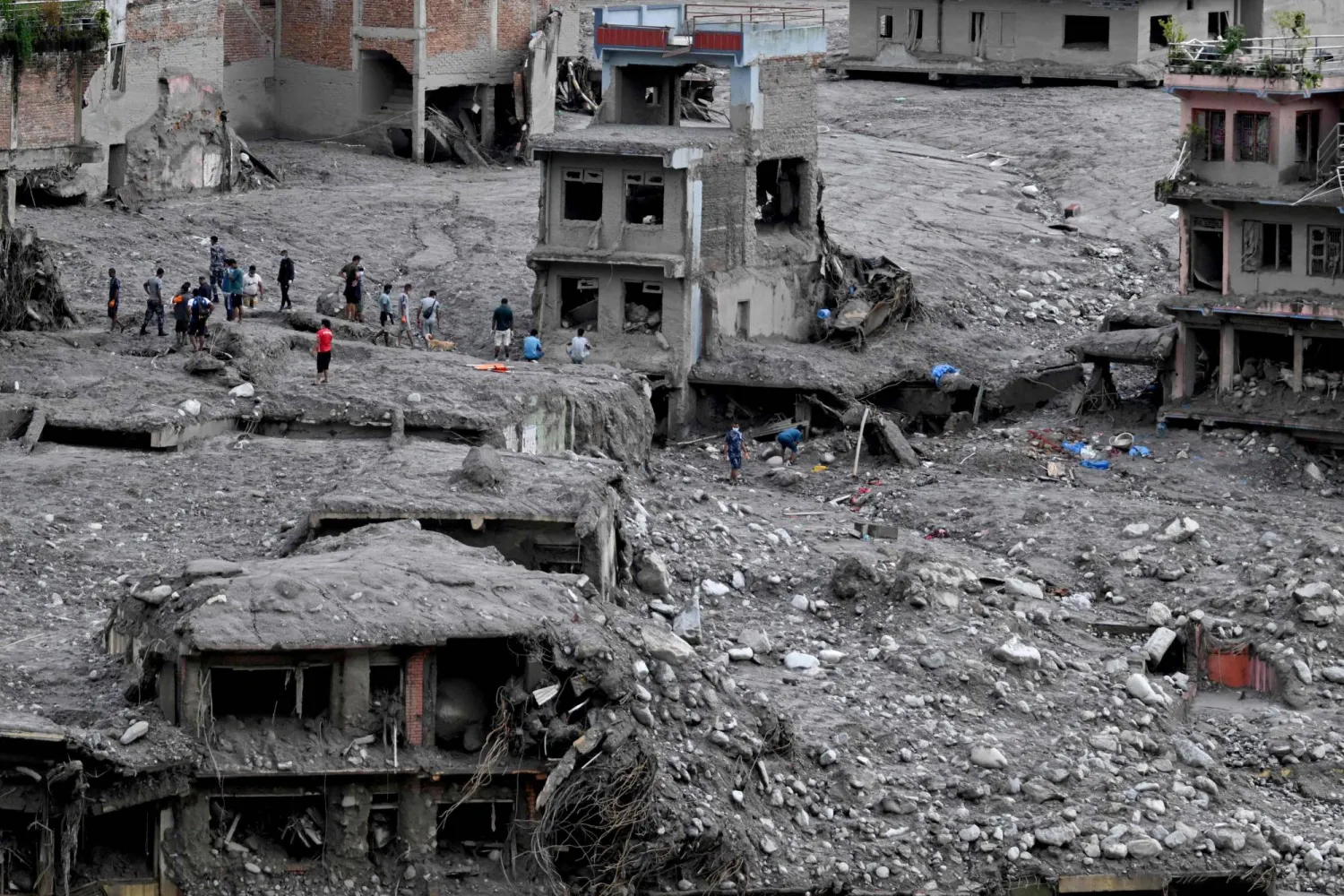
People scout for usable materials from debris after flash floods at Trishuli Center in Nepal's Nuwakot district on September 1, 2026. (AFP)
TT

Nepal Rescuers Reach Remote Areas, Electricity Restored Nearly a Week After Devastating Floods

People scout for usable materials from debris after flash floods at Trishuli Center in Nepal's Nuwakot district on September 1, 2026. (AFP)

Nepali rescuers built temporary bridges to reach remote areas and dug through the ruins of hydropower projects in the Himalayas to rescue close to 300 trapped workers, nearly a week after devastating floods left a trail of destruction across the country's towns and valleys.

About 600 people remain stuck in several devastated hydropower stations that have become the focus of rescue efforts, while Prime Minister Balendra Shah said over 11,000 people have been rescued across the affected region and power and communication lines had been restored in some areas.

At least 939 people have been killed in the destruction, Shah said ‌in a late-night ‌social media post.

"Thousands of citizens have lost their homes, families, loved ‌ones ⁠and property," he ⁠said.

"The government understands the immense pain they are enduring. The path ahead is to support them through this suffering and help them return to normal life through rehabilitation."

Rescue teams had managed to restore road networks to Nuwakot, one of the worst-affected districts, facilitating rescue operations and distribution of relief material, Shah said.

A glacier collapse triggered a deluge of ice, rock and mud which swept through the impoverished nation's border region with China, posing a massive challenge for Nepal's six-month-old government.

Police official Bipin ⁠Regmi said a search team recovered 24 bodies from a house ‌in Betrabati village in Nuwakot district.

"We are reaching ‌new areas and recovering bodies," Regmi told Reuters.

Aid worth more than $42 million had poured into the country after ‌the disaster, Shah said, and the government expected the contributions to increase.

Neighbors India and ‌China, between whom Nepal is wedged, were helping with rescue efforts, including building bailey bridges to reach remote affected areas.

RESCUE EFFORTS FOCUS ON HYDROPOWER STATIONS

Shah said 279 workers had been rescued from hydropower projects so far where authorities estimated that close to 1,000 people were trapped.

Pictures and videos shared by rescue ‌teams showed earth-moving equipment digging and shoveling mud and rocks under lights in the dark of the night as workers watched. Soldiers used ⁠torchlight in a ⁠big pit they had created to look for space to get into one tunnel.

There has been a boom in hydropower projects in Nepal since the turn of the century as the mountainous country sought to take advantage of its Himalayan water resources to address chronic domestic power shortages and exploit prospects for selling electricity to southern neighbor India.

Hydropower projects in Nepal's mountains need tunnels to carry water through the steep terrain, allowing developers to exploit the sharp elevation drop between Himalayan rivers and powerhouses to generate electricity.

CHINA BLAMES GLOBAL WARMING

Shah said the catastrophic event signaled the growing risks that the Himalayan region faces.

"The region must therefore remain vigilant. The time has come for us to strongly raise before the international community the disasters we are experiencing as a consequence of climate change," Shah said in his post.

Last week's flood was "caused by glacier instability under the long-term effects of global warming", China's state broadcaster said on Monday.



‘Massive’ Russian Missile, Drone Attack on Kyiv Kills 8

People walk on a field as smoke rises at the site of a Russian strike near Kyiv, Ukraine, 31 August 2026, amid the Russian invasion. (EPA)
TT

‘Massive’ Russian Missile, Drone Attack on Kyiv Kills 8

People walk on a field as smoke rises at the site of a Russian strike near Kyiv, Ukraine, 31 August 2026, amid the Russian invasion. (EPA)

A "massive" Russian attack killed at least eight people in Kyiv overnight, including seven at a railways depot, officials said Tuesday, as Moscow pressed its air campaign on the Ukrainian capital and surrounding areas.

The strikes came as children were set to return to school after summer holidays and as authorities tightened security measures following weeks of intensified Russian attacks on the capital.

Kyiv Mayor Vitali Klitschko said eight people were killed and five wounded, including two children, in the overnight bombardment, which included ballistic missiles and drones.

Oleksandr Pertsovskyi, chief executive of Ukrainian Railways, said a missile hit a railway depot and other railway facilities in Kyiv.

"The ballistic strike took the lives of 7 people, 6 of whom were our employees," he said, adding that another railway worker had been hospitalized.

Pertsovskyi said the attack caused "extensive destruction", including the complete destruction of a workshop, while fires continued to burn at some sites.

One person was killed in strikes in Boryspil, east of Kyiv, regional officials said.

Russia's defense ministry said its forces had carried out a "massive strike" using long-range weapons and attack drones.

It said the attack targeted military-industrial and fuel and energy facilities in Kyiv and the surrounding region.

The ministry also said it had struck infrastructure in the southern Odesa region and the ports of Odesa and Chornomorsk.

"Kyiv region came under a massive attack by Russian missiles and strike drones tonight," Kyiv regional military administration chief Tymur Tkachenko said on Telegram.

AFP journalists in the capital heard around a dozen loud explosions and saw flashes in sky early Tuesday moments after the air force warned of incoming ballistic missiles.

The Ukrainian air force had warned that the threat of "ballistic weapons and other means of attack against Kyiv and the region remains in effect", and urged residents to remain in shelters.

Ukrainian children return to school on Tuesday, and the Kyiv regional military administration has warned there must be no large events in areas with a high level of risk.

Kyiv and its surrounding areas have come under sustained pressure from Russian drone attacks in recent weeks, with jet-powered drones adding to the threat and triggering as many as a dozen air-raid alerts a day.

One weekend attack on an ammunition depot killed 38 people in the capital's suburbs.

Both sides have escalated long-range strikes in recent months, targeting infrastructure such as warehouses, businesses, and oil and port facilities, as well as ships, increasing civilian casualties.

Ukraine faces a shortage of interceptor missiles, particularly US-made Patriot systems used against ballistic threats.


Iran President Says Tehran Would ‘Immediately’ Reciprocate if US Returns to June Deal

Pedestrians walk past a wall mural along a street in downtown of Tehran on August 31, 2026. (AFP)
TT

Iran President Says Tehran Would ‘Immediately’ Reciprocate if US Returns to June Deal

Pedestrians walk past a wall mural along a street in downtown of Tehran on August 31, 2026. (AFP)

Iran's President Masoud Pezeshkian said Tuesday that Tehran would "immediately" reciprocate if the United States returned to a June deal aimed at ending their war.

"I state explicitly that if the United States returns to its commitments under the aforementioned memorandum of understanding, Iran will immediately take reciprocal action," Pezeshkian said at a Shanghai Cooperation Organization summit in Kyrgyzstan, according to the website of the Iranian presidency.


Report: Trump Considering Limited Strikes Against Iran in the Strait of Hormuz

US President Donald Trump, with Secretary of Defense Pete Hegseth at his side, speaks to reporters aboard Air Force One on a flight from Dover, Delaware, to Miami, Florida, US, March 7, 2026. (Reuters)
TT

Report: Trump Considering Limited Strikes Against Iran in the Strait of Hormuz

US President Donald Trump, with Secretary of Defense Pete Hegseth at his side, speaks to reporters aboard Air Force One on a flight from Dover, Delaware, to Miami, Florida, US, March 7, 2026. (Reuters)

US President Donald Trump and his senior aides have been considering launching limited strikes in the Strait of Hormuz to prevent Iran from reconstituting its radar and missile capabilities to attack ships, three US officials told Axios.

One official said the idea behind the plan is to reduce the risk of Iranian attacks on oil tankers, US Navy ships and Air Force aircraft — to “mow the lawn,” as this person put it.

The plan was developed over the past week by the US Central Command (CENTCOM) and supported by Secretary of Defense Pete Hegseth, who sent it to the White House several days ago, US officials said.

The officials said that last week the White House was leaning against approving the strikes to avoid escalating with Iran.

But Iran's ballistic missile attacks on US bases in Jordan on Sunday could change Trump's mind.

A US official told Axios that in recent days Iran launched an anti-aircraft missile toward a US F-35 fighter jet that was providing cover to ships in the strait.

While the missile didn't come close enough to be a threat, it was a signal that Iran is trying to reconstitute its military capacity, according to the US official.

CENTCOM told Hegseth, Chairman of the Joint Chiefs of Staff General Dan Caine and the White House in recent days that the military might need to strike Iran periodically in order to keep moving dozens of oil tankers out of the Gulf relatively safely every day.

The Axios report came after the US and Iran exchanged attacks in the first flare-up in violence since late July.

US forces struck two Iranian launchers on Iran's Larak Island on Sunday, a US official said, after “Revolutionary Guard Corps forces were observed preparing to launch rockets with sea mines into the Strait of Hormuz.”

Three people were killed in the attack, Iran's Tasnim news agency reported. The state-affiliated Nournews said two of them had been identified as members of the Revolutionary Guards Navy.

Larak is a small island in the strait near the strategic Iranian port of Bandar Abbas. The Strait of Hormuz, which normally handles a fifth of global crude oil and gas shipments, has been effectively blocked since the start of the war.

In a statement, the US Central Command said ⁠it had taken “limited, precise” action against minelaying forces of Iran's Revolutionary Guards that posed an “imminent threat” in the strait. It gave no details.

On Monday, Trump told Fox News that the US would hit Iran hard in retaliation for Tehran targeting US forces in Jordan.

“We're going to hit them hard,” Trump said. “There will be a response.”

A senior Iranian source to Reuters, “For every US attack on Iran, Tehran will respond dozens of times more forcefully, and no target in the region is beyond our reach.”