

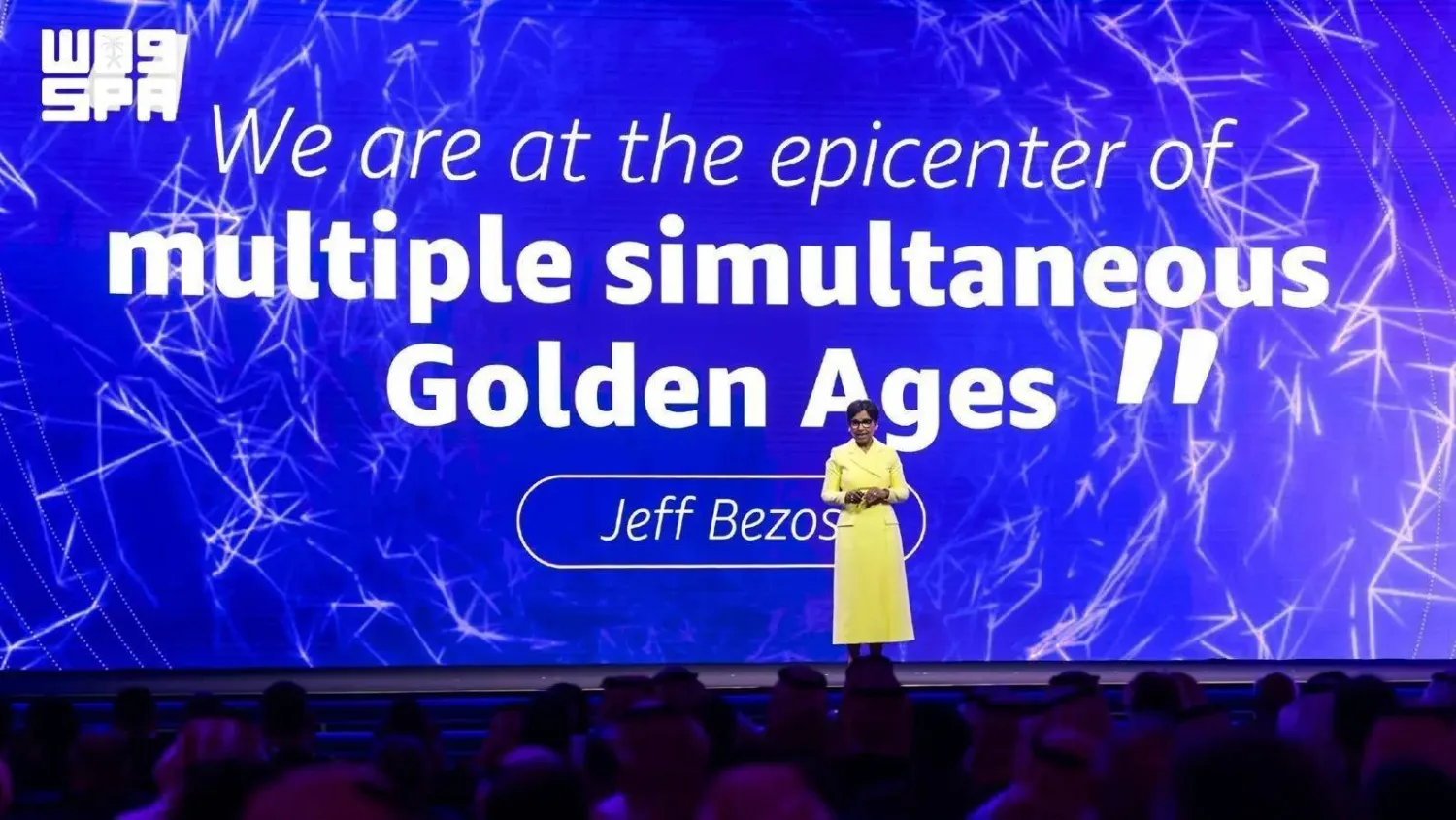

AWS to Launch First Cloud Infrastructure Region in Saudi Arabia in December

The AI Zone capacity will include AWS’s Trainium chips and the latest NVIDIA AI infrastructure for customers to run AI training and inference workloads. (SPA)
TT

AWS to Launch First Cloud Infrastructure Region in Saudi Arabia in December

The AI Zone capacity will include AWS’s Trainium chips and the latest NVIDIA AI infrastructure for customers to run AI training and inference workloads. (SPA)

Amazon Web Services (AWS) announced at LEAP 2026 in Riyadh on Monday that its first AWS Cloud Infrastructure Region in Saudi Arabia is on track to launch in December 2026.

Together with HUMAIN, a Public Investment Fund–owned company, AWS will also make up to 50 megawatts (MW) of capacity available in Saudi Arabia’s first AI Zone by 2028 as part of an expanded strategic collaboration.

AWS is HUMAIN’s preferred AI partner, driving AI innovation across the Kingdom and globally. The AI Zone capacity will include AWS’s Trainium chips and the latest NVIDIA AI infrastructure for customers to run AI training and inference workloads.

Increased cloud and AI capacity is key to growing the Kingdom’s AI leadership and supporting public and private sector organizations to build a future-ready economy in line with Saudi Arabia’s Vision 2030.

HUMAIN’s ALLAM Arabic large language model will soon be available through Amazon Bedrock, so customers can securely access advanced Arabic-language AI capabilities through a fully managed generative AI platform.

The expanded collaboration also includes the availability of HUMAIN Fabric, HUMAIN’s AI-native data infrastructure and a component of the HUMAIN ONE platform, via AWS Marketplace.

With the new region, developers, startups, and enterprises will have greater choice for running their applications and serving end users from data centers located in Saudi Arabia.

All AWS regions are sovereign-by-design, reflecting AWS’s commitment to offering customers advanced sovereignty controls and features available in the cloud.

“Saudi Arabia is home to some of the most ambitious and inventive builders, from startups and enterprises reimagining industries to public sector organizations deploying AI at scale, and the new AWS region in the country will help them to continue to innovate,” said AWS CEO Matt Garman.

“The launch of our new region and our partnership with HUMAIN will deliver the full-stack cloud and AI infrastructure to help power new industries, create jobs, and accelerate the goals of Vision 2030.”

Saudi Minister of Communications and Information Technology Abdullah Alswaha said Saudi Arabia is building the computing power needed for the Intelligence Age and strengthening its position as a global computing partner.

He said: “The launch of AWS’s new region and its expanded partnership with HUMAIN will help accelerate AI innovation, enable new industries, and advance the goals of Saudi Vision 2030.”

The region, first announced in March 2024, represents more than $5.3 billion (SAR19.88 billion) in planned cloud infrastructure investment. This launch will expand the AWS Global Infrastructure to 40 regions worldwide.

According to an IDC report commissioned by AWS, AI will contribute an estimated $130 billion to Saudi Arabia’s economy by 2030. The new region will help accelerate this potential by empowering organizations to innovate faster and operate more efficiently, while providing access to advanced AI services like Amazon Bedrock.

Saudi organizations including Abdul Latif Jameel, Almosafer, stc group, Red Bull MOBILE, and AWS Partners like ZainTECH, Accenture, and Tamkeen Technologies will be running AI workloads on AWS.

stc group has announced a strategic collaboration with AWS to accelerate the adoption of cloud and AI services in Saudi Arabia, while ZainTECH has signed a multiyear agreement to help organizations adopt AWS solutions and strengthen their security and compliance readiness.

Beyond infrastructure, AWS is making an investment in Saudi Arabia’s workforce development.

The Amazon Academy, launched with the Ministry of Communications and Information Technology (MCIT), provides free training in cloud computing, AI, logistics, and retail, aiming to train over 100,000 Saudi citizens for digital careers. AWS has also partnered with 11 higher education institutions in Saudi Arabia, and is training up to 10,000 women through the AWS Saudi Arabia Women's Skills Initiative at no charge.

Across the Middle East, North Africa, Türkiye, AWS commits to reaching two million people with AI and cloud training by 2030 and has already served more than 680,000 individuals to date.

Additionally, AWS is establishing two innovation centers in Saudi Arabia to provide technical mentorship and training to startups and entrepreneurs.



OpenAI Says Apple Has Only Itself to Blame in Trade-Secret Fight

The OpenAI logo in this illustration taken June 11, 2026. (Reuters)
TT

OpenAI Says Apple Has Only Itself to Blame in Trade-Secret Fight

The OpenAI logo in this illustration taken June 11, 2026. (Reuters)

OpenAI denied ‌Apple's allegations of trade secret theft on Monday, saying the iPhone maker failed to show any confidential information was stolen by former employees.

"This dispute is a mess of Apple's own making, and it is trying to blame everyone else," OpenAI said in a filing late Monday in US District Court in San Jose, California.

Apple sued OpenAI and former Apple employees Tang Tan and Chang Liu in July, accusing them of misappropriating trade secrets related to hardware design, manufacturing and supply-chain operations as the ChatGPT maker pushes into consumer devices.

The AI lab, led by CEO Sam Altman, contends Apple is using the lawsuit ‌to slow a ‌potential competitor and discourage employee departures. OpenAI has hired ‌roughly ⁠400 employees from Apple ⁠for its hardware initiative, the two companies have written in court filings.

California law allows employees to freely move between rivals, OpenAI said.

The lawsuit represented a dramatic escalation of tensions between the two companies, which just two years ago forged a partnership intended to boost ChatGPT's reach and help Apple gain a firmer footing in AI. But the relationship quickly soured as competition in the ⁠AI industry intensified.

In its original lawsuit, Apple argued ‌that OpenAI's hiring of Apple employees was ‌part of the AI lab's strategy to learn a competitor's secrets. Apple said Tan ‌and Liu both accessed internal Apple files after they left the ‌company.

OpenAI said on Monday that Apple encourages its employees to use personal iCloud accounts to access Apple work documents and perform their work functions, making it difficult for departing employees to separate personal and company information.

OpenAI said Apple's policy of immediately ‌escorting departing employees from its premises does not give them enough time to return company devices, transfer internal files ⁠back to the ⁠company or hand over responsibilities.

In the filing, Liu said any access to Apple documents after his departure was done to help former Apple colleagues locate files or answer questions related to Apple work. He said Apple employees repeatedly contacted him for assistance after he left.

Tan, who spent 24 years at Apple, said he returned Apple prototypes before departing and only retained non-confidential materials, including an employee departure checklist that was not confidential.

Employees "can leave a company like Apple that has struggled to adopt AI and move to an exciting startup that builds innovative products," OpenAI wrote. "Apple may not like those choices. But it cannot claim those choices are unlawful, and it cannot use its own sloppy procedures to blame others for its own mess."


SDAIA Opens DeepFest AI Event at LEAP 2026 with over 100 Speakers from 17 Countries

DeepFest is a platform dedicated to artificial intelligence and deep technologies. (SPA)
TT

SDAIA Opens DeepFest AI Event at LEAP 2026 with over 100 Speakers from 17 Countries

DeepFest is a platform dedicated to artificial intelligence and deep technologies. (SPA)

DeepFest kicked off on Monday alongside LEAP 2026 at the Riyadh Exhibition and Convention Center in Malham, bringing together more than 100 global speakers.

DeepFest is a platform dedicated to artificial intelligence and deep technologies.

In his opening remarks, Director of the National Information Center at the Saudi Data and AI Authority (SDAIA) Dr. Esam Alwagait said DeepFest explores the future of AI and its applications in the business sector.

The platform addresses the potential of agentic AI, rapid advances in robotics, and the integration of AI into the core of enterprise systems, Alwagait noted. It also examines global shifts reshaping approaches to building trust, promoting responsible AI governance, and deploying large models.

Alwagait confirmed that the coming days of DeepFest will feature high-level sessions, discussions, and dialogues. He said the event is more than just a gathering; it is a platform for collaboration, innovation, and progress that drive impactful steps toward a smarter and more interconnected world.

With SDAIA as a key partner, DeepFest features more than 50 sessions this year, bringing together over 100 speakers from 17 countries and 100 global brands.

Alwagait stressed that Saudi Arabia continues to play a leading role in AI advancement, supported by national talent, global partnerships, and strategic initiatives that help build a promising, more interconnected future.

He emphasized that AI is no longer merely a technological capability to be deployed, but has become a force shaping how people think, make decisions, and work.


Saudi Communications Ministry, HUMAIN Sign Agreement to Strengthen Kingdom’s AI Infrastructure

The agreement focuses on exploring opportunities to establish strategic partnerships in the AI infrastructure sector and strengthening coordination among relevant stakeholders. (SPA)
TT

Saudi Communications Ministry, HUMAIN Sign Agreement to Strengthen Kingdom’s AI Infrastructure

The agreement focuses on exploring opportunities to establish strategic partnerships in the AI infrastructure sector and strengthening coordination among relevant stakeholders. (SPA)

Saudi Arabia’s Ministry of Communications and Information Technology (MCIT) and HUMAIN signed a partnership agreement to strengthen collaboration on the development and enablement of AI infrastructure in Saudi Arabia, explore partnership and investment opportunities, and develop specialized studies and solutions, supporting the growth of the AI sector and enhancing the Kingdom’s readiness to scale AI applications. 

Head of the Cloud Computing and AI Enablement Office Eng. Bassam Albassam signed the agreement on behalf of MCIT, while HUMAIN CEO Eng. Tareq Amin represented the company. 

The agreement focuses on exploring opportunities to establish strategic partnerships in the AI infrastructure sector and strengthening coordination among relevant stakeholders. This will support the development of the sector’s regulatory and operational environment, help attract local and international investment, and contribute to achieving national objectives in AI and the digital economy. 

The two parties will also collaborate on preparing and developing specialized studies and solutions for AI infrastructure, exchanging technical expertise and knowledge, and developing innovative solutions that address the requirements of government entities and align with national standards. These efforts will enhance infrastructure efficiency and support the growth of the Kingdom’s AI ecosystem. 

Areas of collaboration include supporting the development of AI data centers by strengthening coordination and integration with relevant government entities to facilitate the enablement and expansion of infrastructure projects. The two parties will also collaborate on knowledge transfer and national capability building in coordination with the HUMAIN Academy. 

The agreement builds on national efforts to develop advanced AI infrastructure, enable strategic investment in the sector, develop specialized national capabilities, and advance innovative technology solutions. These efforts will further strengthen the Kingdom’s position as a leading global hub for AI and support the continued growth of the digital economy. 

Adobe partnership 

Adobe announced at LEAP 2026 the expansion of its partnership with the Ministry of Communications and Information Technology and HUMAIN, a Public Investment Fund company, to support the growth of Saudi Arabia's creative sector. 

Adobe's commitment to the partnership exceeds $4 billion. The company plans to offer more than 27 million eligible Saudi citizens and residents aged 13 and above 12 months of free access to Adobe Firefly Standard and Adobe Express Premium features by the end of 2026. 

The partnership includes the development of an image generation model jointly designed by HUMAIN and Adobe. It is the first image generation model developed with Adobe Firefly Foundry and tuned to Saudi culture. The model will enable individuals, organizations, and creative teams to produce high-quality images reflecting Saudi culture using Arabic-language prompts. 

Minister of Communications and Information Technology Abdullah Alswaha affirmed that the partnership with Adobe and HUMAIN reflects the Kingdom's commitment to empowering talent, accelerating the growth of the creative economy, and expanding the benefits of artificial intelligence (AI) for innovators, creators, and entrepreneurs. 

Adobe Chairman and CEO Shantanu Narayen explained that the partnership combines the company's creative tools with Firefly Foundry's image and video models, tuned to Saudi culture, the ministry's local expertise, and HUMAIN's understanding of the cultural context. He said the partnership will help accelerate the growth of the Kingdom's creative economy and expand creative opportunities for all segments of society. 

Adobe Firefly, the integrated AI-powered creative studio, is among the solutions the company provides to support creativity and productivity. It combines AI models, professional editing tools, and AI agent capabilities, covering all stages of the creative process, from idea generation and visualization to creating, editing, and producing images, video, audio, and design assets.