
Iran Defiant as Bessent Says US Likely to Announce Bank Sanctions This Week

Pedestrians walk past a wall mural along a street in downtown of Tehran on August 31, 2026. (AFP)
TT

Iran Defiant as Bessent Says US Likely to Announce Bank Sanctions This Week

Pedestrians walk past a wall mural along a street in downtown of Tehran on August 31, 2026. (AFP)

US Treasury Secretary Scott Bessent said on Tuesday Washington was likely to announce bank sanctions against Iran this week, stepping up an attempt to "economically asphyxiate" Iran's leadership after six months of conflict. 

Oil prices rose further after the first exchange of direct attacks since July and reports of two tankers being hit leaving the Strait of Hormuz, the global oil supply waterway that Iran has effectively closed to shipping. 

Tehran remained defiant, warning that it would prevent oil being exported from the Gulf, despite a threat by US President Donald Trump to hit Iran "hard" in response to the renewed Iranian strikes, and Bessent's warning that Washington was about to impose new sanctions. 

'ZERO TOLERANCE' 

"We are probably going to announce a bank sanction this week, and we will announce one the week after. We are speaking to our allies here, who have all come forward, and we have had a great show of support," Bessent said at a G20 finance leaders' meeting in Asheville, North Carolina. 

He said the US was also looking ‌at targeting airline leasing ‌companies and other entities that did business with the Iranian Revolutionary Guard Corps (IRGC). 

"We have zero tolerance. We ‌are ⁠going to economically asphyxiate ⁠this regime," he said. 

Iran's leaders have defied decades of US sanctions, many of which have been aimed at curtailing Tehran's oil revenues and acquisition of weapons components. 

"If the enemy wants us not to export oil from the Gulf, no one will be able to export oil," Iranian parliament speaker Mohammad Baqer Qalibaf was quoted by Iranian media as saying. 

Bessent has also warned that countries doing business with Iran could face US sanctions. 

The six-month-old conflict had shifted into an economic standoff before the weekend strikes, in which US forces attacked Iran's Larak Island on Sunday and Iran responded by launching missiles at two US air bases in Jordan. 

Although he warned of a US response to the Iranian strikes, Trump also told reporters on Monday that they did not signal a return to full-scale war, ⁠and a senior Iranian source told Reuters they were a "limited and contained confrontation". 

But pledges by both sides ‌to respond to further attacks have highlighted how quickly a conflict that has increasingly been fought ‌through sanctions, blockades and economic pressure could spill back into military action. 

IRAN'S DEFIANCE 

Before Bessent's latest remarks, Iranian President Masoud Pezeshkian said Tehran would reciprocate immediately if Washington honored ‌its commitments under a June Memorandum of Understanding that was intended to halt the conflict. 

The MoU declared an end to fighting that has ‌now killed thousands in Iran and Lebanon since US and Israeli strikes began on February 28. But it also deferred many of the most difficult issues and paved the way for a broader 60-day negotiation period - which passed without further agreement. 

"I am stating clearly that if the US returns to its commitments under the Memorandum of Understanding, Iran will immediately reciprocate," Pezeshkian said in the Kyrgyz capital Bishkek at a summit of the Shanghai Cooperation Organization, which includes Russia and China. 

But ‌Iranian officials show no public sign of bowing to pressure, with Qalibaf quoted by Iranian media as saying Tehran would respond militarily if the US intensified its "siege". 

Foreign Ministry spokesman Esmaeil Baghaei told a press conference ⁠in Tehran that Washington was "addicted to ⁠making excessive demands and has mistaken negotiations for dictating terms". 

"As long as they act in this manner, they will certainly get no result other than what they have achieved so far," he added, warning that Tehran would "use all our capabilities, whether on the battlefield or through our diplomatic apparatus". 

FEARS THAT IRAN CONFLICT COULD 'RUN AND RUN' 

The heightened tensions have renewed fears of oil supply disruptions from the world's key crude-producing region, with Brent futures rising more than 2% on Tuesday. 

"The tit-for-tat missile exchanges between the US and Iran bring validation to those who believe that even if not a ‘forever war’, this conflict will run and run," said PVM analyst John Evans. 

Despite the US economic war, Iran's central bank governor, Abdolnaser Hemmati, said on Tuesday that Tehran had sufficient foreign currency reserves. 

The central bank was ready to inject up to $2 billion into the foreign exchange market to calm recent volatility, Hemmati was quoted as saying by the semi-official Tasnim news agency. 

"I am telling the president of the United States: Iran has (foreign) currency and it has enough," he said. 

His comments appeared partly aimed at reassuring markets after Iranian officials, including Pezeshkian, pointed to growing difficulties for Iran's economy. 

Iran’s currency plunged to a record low in August, crossing the psychological threshold of 2 million rials to the dollar, while annual inflation reached 66% in July. 


US Republicans, Democrats Want Trump to Reverse Course on Russia Diesel

US President Donald Trump and his Russian counterpart Vladimir Putin (AFP) 
TT

US Republicans, Democrats Want Trump to Reverse Course on Russia Diesel

US President Donald Trump and his Russian counterpart Vladimir Putin (AFP) 

Republican and Democratic US senators called on President Donald Trump on Sunday to “reverse course” on his diesel supply deal with Russia, saying it runs counter to US law barring imports of energy until Russia ends its aggression against Ukraine.

“Congress explicitly banned Russian energy imports in 2022 to prevent American dollars from financing (Russian President Vladimir) Putin’s brutal war against Ukraine,” the seven senators – four of Trump’s fellow Republicans and three Democrats – said in a statement, according to Reuters.

They also said that the administration failed to consult with Congress or submit any explanation of its decision, something also required by law.

“The United States should not provide Putin with a financial lifeline while Russia continues to kill Ukrainian civilians. The Administration must immediately reverse course,” the statement said.

It was only the latest bipartisan criticism of Trump's deal, a shift from his party's near-unanimous support for Trump's foreign policy decision weeks before November 3 midterm elections that will determine whether his Republicans will retain their control of Congress.

It was issued by Republican Senators Susan Collins of ⁠Maine, Lisa Murkowski of Alaska, Thom Tillis of North Carolina and John Curtis of Utah and Democrats Jeanne Shaheen of New Hampshire, Richard Blumenthal of Connecticut and Ron Wyden of Oregon.

Tillis had said earlier on Sunday that the diesel deal may be illegal and would put American lives at risk.

Trump said on Friday that Russia had agreed to supply diesel to global markets, and his administration temporarily lifted US sanctions on Russian fuel designed to deprive Moscow of revenue for its war on Ukraine.

“I do believe there’s a legitimate case for saying the president’s not following the law,” Tillis, who is retiring from the Senate in January, told NBC's “Meet the Press.”

Prices for diesel — used for agriculture, heating homes and trucking — are near record highs and could hurt Republicans in next month's congressional elections.

Analysts have said that Trump's agreement with Moscow was unlikely to lead to sustained lower fuel prices.

US Treasury Secretary Scott Bessent told Fox News on Sunday that the Trump administration will follow through with the deal using existing legal authority, and the agreement was good for the American people and would bring prices down.

“We're going to do it with all the legal authorities ‌we have. ⁠So, you know, anyone in Congress who says whether it's an old bill or the current Lindsey Graham bill (that) prohibits us from doing it is wrong,” Bessent told “Fox & Friends.”

Trump last month signed a sweeping Russia sanctions bill into law, called the “Lindsey O Graham Sanctioning Russia and Iran Act of 2026,” to honor the South Carolina Republican and longtime Russia hawk who died in July.

Some other Republicans had also criticized the diesel plan. Retiring Representative Don Bacon of Nebraska said on X on Friday that “propping up Putin's war economy is morally wrong as he uses that money to bomb cities.”

Mike Pence, Trump's former vice president, called his decision to lift ⁠sanctions on Russian oil a “betrayal" of Graham’s legacy and urged the president to “rescind” it.


Top NATO Commander Set to Issue Warning to Russia over Any Attack

The move from the top military commander comes as NATO seeks to send a message to Moscow to halt what Western officials say is a 'hybrid' campaign of sabotage and interference against Ukraine's backers. NICOLAS MAETERLINCK / Belga/AFP
TT

Top NATO Commander Set to Issue Warning to Russia over Any Attack

The move from the top military commander comes as NATO seeks to send a message to Moscow to halt what Western officials say is a 'hybrid' campaign of sabotage and interference against Ukraine's backers. NICOLAS MAETERLINCK / Belga/AFP

NATO's top military commander is expected to deliver a warning to Russia on Monday over the alliance's ability to counter any attack, as worries grow over the threat from Moscow.

NATO officials have said US General Alexus Grynkewich -- the alliance's Supreme Allied Commander Europe -- will elaborate his "theory of victory" over any potential attack at a security conference in Warsaw, reported AFP.

The move from the top military commander comes as NATO seeks to send a message to Moscow to halt what Western officials say is a "hybrid" campaign of sabotage and interference against Ukraine's backers in the war against Russia.

Fears have grown in recent months that the Kremlin is stepping up its actions after high-profile incidents including the discovery of an explosive-laden drone at a German airport.

"The Supreme Allied Commander Europe's theory of victory is simple: maintain NATO's advantage, which is consistent with and grounded upon the alliance's deterrence and defense plans," Colonel Martin O'Donnell, a spokesman for the US general, said last week.

"But given the unsettled and complex global security environment, we need to set conditions now to deter aggression and, if necessary, win if attacked," O'Donnell said, noting the theory sets out a framework to do just that.

NATO -- which was founded in the wake of World War II to counter the Soviet Union -- traditionally closely guards its defense plans to counter any attack by Russia.

Grynkewich's intervention looks unlikely to divulge many new details on NATO's strategy and is intended to both send a signal to Moscow and reassure members on the alliance's eastern flank.

NATO insists it remains a defensive alliance and has no intention of attacking Russia.

Western officials say that Moscow's "hybrid attacks" have become more reckless as the Kremlin's forces are stalled in Ukraine, and that they risk causing significant loss of life.

The alliance -- whose primary purpose is deterring an armed Russian invasion -- has struggled to work out how to cope with incidents in the grey zone beneath open conflict.

NATO civilian head Mark Rutte has urged countries to keep "calm, carry on and support Ukraine".

"We should not be naive... about Russia, but they know we are stronger," Rutte said last month.

But the uptick in Russian activity comes at a time of potential vulnerability for Europe. Allies are currently bracing for possible cuts to US forces in Europe as the Pentagon conducts a review of its deployments on the continent.

The results of the process are expected to be announced towards the end of the year.

European countries are already rushing to bolster their militaries as doubts have soared over the reliability of the United States under President Donald Trump.


Israeli Media: Israel Threatened to Cut Intelligence Cooperation with Britain Amid Jerusalem Consulate Crisis

A Jerusalem municipality worker hangs an Israeli flag next to the British flag, the Union Jack, as he stands on a platform near Israel's presidential residence in Jerusalem ahead of the upcoming visit of Britain's Prince William, June 25, 2018 (Reuters)
TT

Israeli Media: Israel Threatened to Cut Intelligence Cooperation with Britain Amid Jerusalem Consulate Crisis

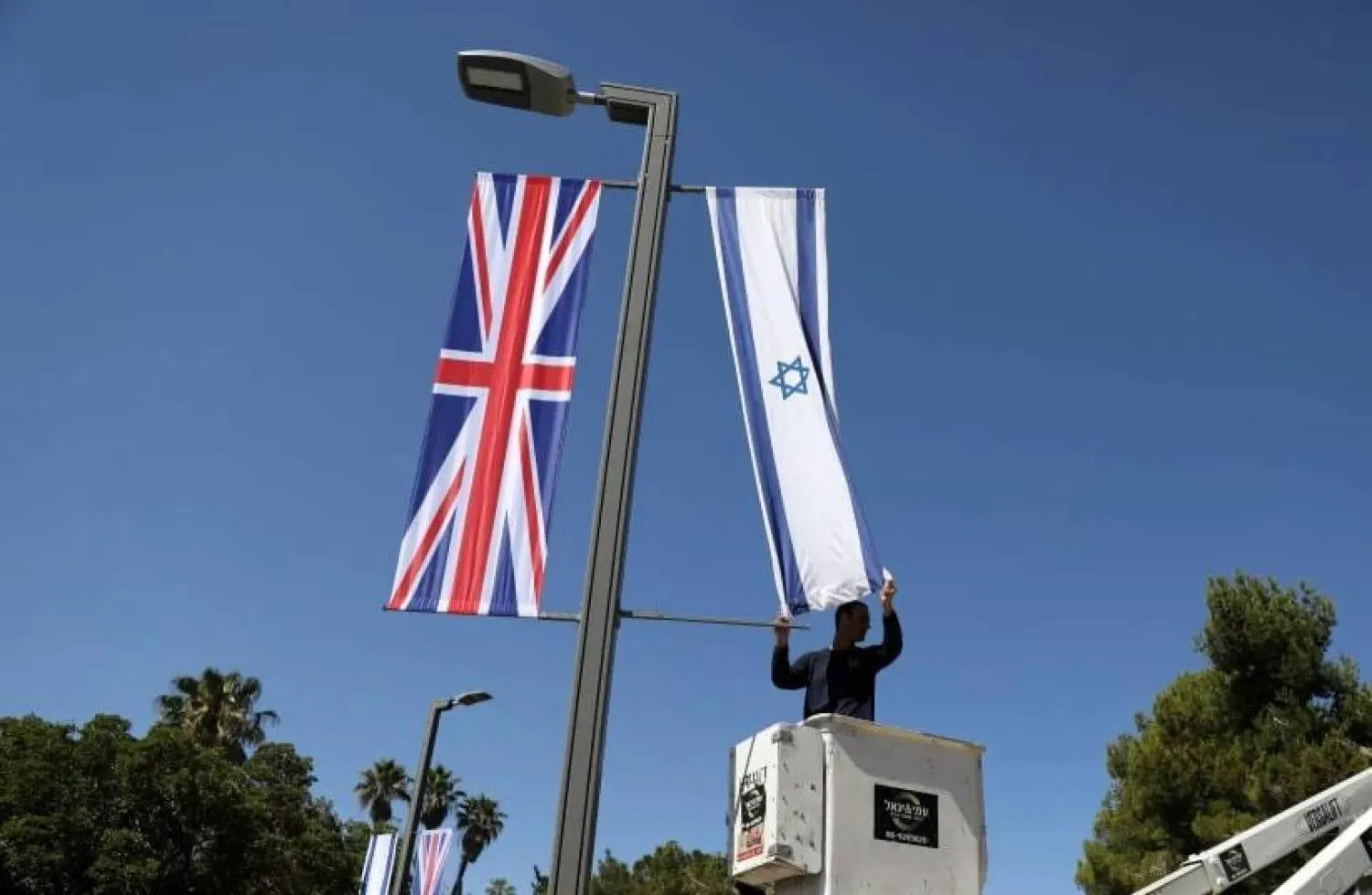
A Jerusalem municipality worker hangs an Israeli flag next to the British flag, the Union Jack, as he stands on a platform near Israel's presidential residence in Jerusalem ahead of the upcoming visit of Britain's Prince William, June 25, 2018 (Reuters)

The right-wing Israeli newspaper Israel Hayom revealed on Sunday details of an agreement reached between Israel and the United Kingdom following a diplomatic row over Tel Aviv’s decision to suspend operations of the British consulate in Jerusalem, which handles Palestinian affairs.

“Israel and the UK have reached a compromise over Britain’s diplomatic presence in Jerusalem, ending a standoff that had threatened to further strain relations between the two countries,” the newspaper wrote.

It said Britain had backed down from imposing measures against Israel, including the expulsion of Israeli diplomats from the UK.

The decision came after security agencies in London warned the government of the risks of further escalating the crisis. The agencies informed the government that Israel was threatening to sever security cooperation with British intelligence, a move that would seriously undermine national security, according to Israel Hayom.

Last Thursday, Britain announced its consulate in Jerusalem, which began operating in the city nearly 200 years ago, would continue its work on a more limited scale under the title “UK Mission, Jerusalem.” The decision came after Israel ordered the closure of the British consulate in response to the UK's sanctions on Israeli settlements.

Israel Hayom, which is close to Prime Minister Benjamin Netanyahu’s government, claimed that “in recent weeks, Israel has shared highly sensitive intelligence that enabled the foiling of Palestinian and Iranian terrorist plots in Britain, including at the military base hosting US fighter jets.”

Therefore, the two countries agreed to continue a dialogue to address the points of contention and prevent further deterioration in relations, while Israel backed down from imposing tough conditions.

Also under the reached agreement, the British consul general and 19 other diplomats will leave, while seven diplomats will remain, Israel Hayom wrote.

Although the British Consulate General in Jerusalem will no longer have a sign at the building's entrance bearing that title, it will retain its status as an official diplomatic mission serving Palestinians with a scaled-down presence, rebranded as “UK Mission, Jerusalem” and reporting directly to the UK Foreign Office.

The newspaper said the remaining consular services that will no longer be provided at the Jerusalem office will be made available to Palestinians through the British Embassy in Jordan, where most of the diplomats have relocated.

Israel on September 8 ordered Britain to close the East Jerusalem consulate within 30 days and remove its diplomats from the city, after Britain said it would impose a ban on trade of goods made in Israeli settlements in the occupied West Bank, including a ban on trade in goods produced there.

Israel had been adamant that the consulate will close even as Britain sought to keep it open, including sending the country’s top national security adviser to Israel last week for talks.

Britain’s consulate was founded in 1839, more than a century prior to the establishment of the State of Israel in 1948. The closure order does not affect Britain’s embassy in Tel Aviv, which handles diplomatic relations with Israel’s government.

The consulate, in the Sheikh Jarrah neighborhood of East Jerusalem, handles Britain’s relations with Palestinians in Jerusalem, as well as in the West Bank and Gaza. It also provides consular services to Palestinians.

Shortly before the 30-day deadline for Britain to close the consulate ended last Thursday, Reuters said Britain was likely to expel Israeli diplomats if Israel carries out its order to shut the British consulate in East Jerusalem.

It noted that if the consulate is closed, Britain is likely to respond ‌by expelling ⁠a similar number ⁠of Israeli diplomats from Israel's embassy to the United Kingdom, the sources said, speaking on the condition of anonymity.

But the two sides reached an 11th-hour compromise after the Israeli Foreign Ministry authorized the British to operate a reduced task force of just seven diplomats at the site.

The two countries also agreed to continue a dialogue to address the points of contention and prevent further deterioration in relations, with Britain, under the understandings, refraining from taking any further response measures, according to Israel Hayom.

In a post on X, Israeli Foreign Minister Gideon Sa'ar announced an agreement with London on the continuation of dialogue between the governments, within which both sides will be able to raise issues important to them.

“We believe in dialogue and will continue to believe in dialogue. Unfortunately, in recent years, no genuine dialogue has taken place with the Labor Government. This is despite good relations with Britain, reflected, among other things, in security and intelligence cooperation,” he wrote.

The minister added that “relations between Israel and Britain are important and have repeatedly proven their value also in protecting the lives and interests of British citizens.”