


In a Scorching Spain, the Traditional Folding Hand Fan Is Having a Moment

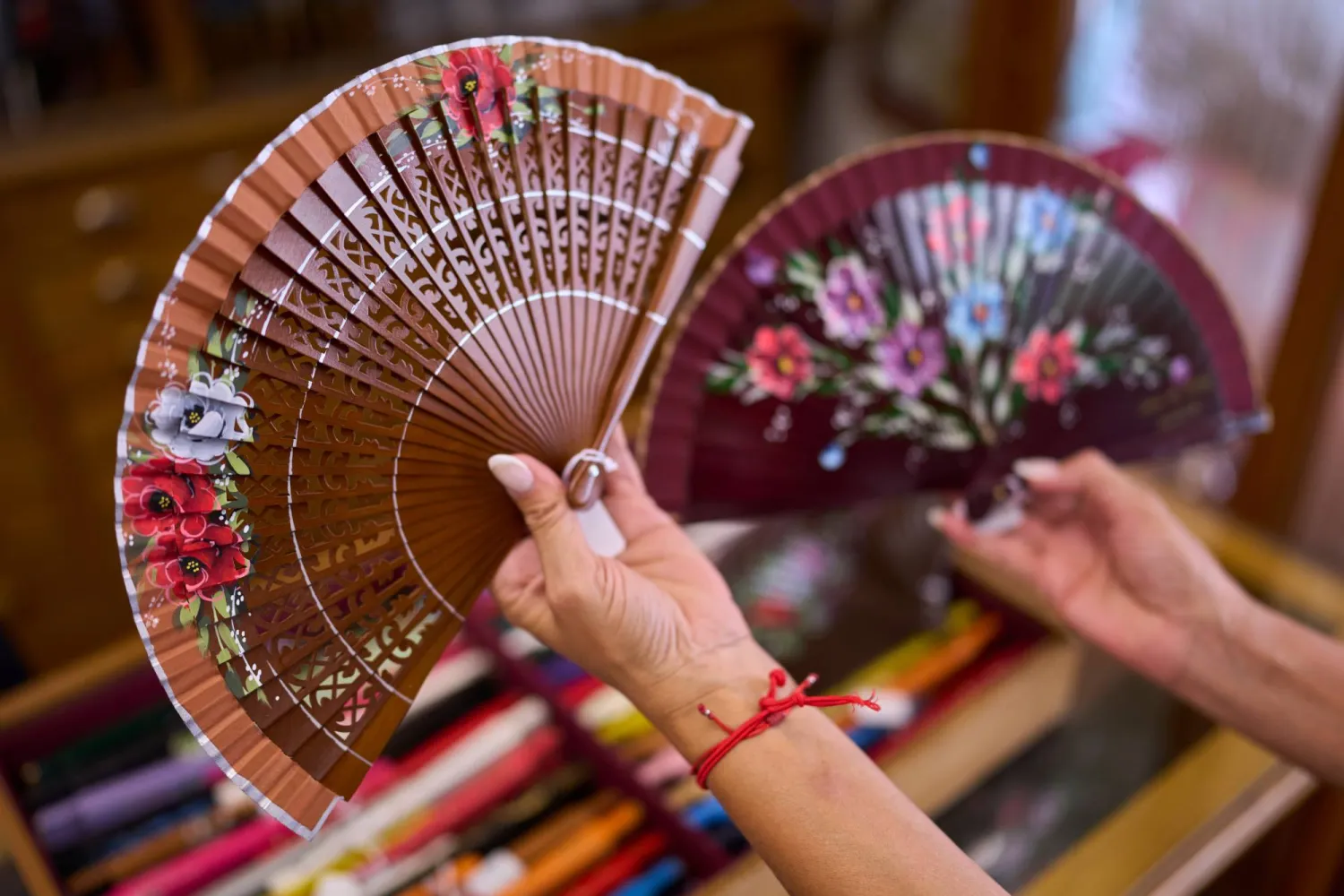
Fans are displayed at Casa Diego, a fan shop in Madrid, Spain, on Aug. 18, 2026. (AP)
TT

In a Scorching Spain, the Traditional Folding Hand Fan Is Having a Moment

Fans are displayed at Casa Diego, a fan shop in Madrid, Spain, on Aug. 18, 2026. (AP)

In crowded subway cars and sun-drenched plazas, an old-fashioned accessory in Spain has been everywhere thanks to the blistering summer heat.

Small enough to fit into a purse, the traditional Spanish folding hand fan, or abanico, snaps open into a semicircle. With little more than a flick of the wrist, it creates a surprisingly strong breeze.

As successive heatwaves in Western Europe pushed temperatures this summer to punishing levels, the accessory has become an essential, embraced by the young and old from Spain and elsewhere. Women and a growing number of men unfurl them on public transport, at concerts and at music festivals.

On a recent August day, 20-year-old Ana Feliu blocked the sun with a paper abanico she was gifted during a Valencian festival. She carries it everywhere in the summer, she said.

“This one is my favorite, but I have many,” she told The Associated Press near Madrid’s Puerta del Sol square. Temperatures in the Spanish capital are forecast to climb to 39 degrees Celsius (102 Fahrenheit) on Thursday and Friday.

Historians believe the folding fan reached Europe through Portuguese maritime trade with Asia in the 15th and 16th centuries.

As early as the mid-17th century, the Spanish painter Diego Velázquez made his enigmatic "The Lady with a Fan," in which a woman, possibly French, poses with what appears to be a delicate wooden abanico.

As they grew fashionable in European courts, Spain developed a taste and industry of its own. Madrid became an important center of production, and by the 18th century, Valencia had emerged as the Spanish fan-making capital.

So embedded was the abanico in Spanish aristocratic society by the 1800s that women used them to discreetly express flirtation, interest or disapproval through what was called “the language of the fan.”

From Spain, the hand fan traveled to Latin America. In the 19th century, flamenco dancers began using the abanico as an expressive prop, as Cuban song and dance styles such as the guajira influenced the dance form. Over time, the fan’s association with flamenco helped turn it into a quintessential Spanish symbol.

For more than a century and a half, Javier Llerandi’s family has sold abanicos out of Casa de Diego, a wood-paneled shop in Madrid.

“We live from the heat,” Llerandi told the AP.

The fans at Casa de Diego are made in Spain and range from simple two-tone wooden ones to elaborate, hand-painted items crafted from mother-of-pearl with intricate floral patterns. They start around 30 euros ($35), while others cost 200 to 500 euros (up to $580) and some high-end pieces reach 6,000 euros (nearly $7,000). Prices vary based on the materials used and, even more so, the workmanship involved, he said.

As Madrid has grown into a tourist hotspot, foreign visitors are also snatching up his fans, which Llerandi notes are more reliable than their portable, electric counterparts.

“Battery-run items eventually run out of power, and always at the worst possible moment,” Llerandi said, adding with a smile: “Without a doubt, heatwaves are good for this business.”

And for the less discerning customer, plastic fans with printed designs are sold for a few euros at souvenir kiosks, including one a couple hundred meters from Llerandi's store. There, too, a salesperson reported strong sales this summer.

Outside a towering bullfighting ring in Madrid, Juani Duran sells wooden hand fans with traditional floral designs for five euros apiece at a stall. Bullfights take place in open-air stadiums, and spectators traditionally dress up to attend them, making the elegant fans a fitting accessory.



‘Literally Tasting the Smoke’: Malaysians Suffer as Haze Worsens

Haze shrouds the Kuala Lumpur skyline on August 26, 2026, amid high levels of air pollution from regional wildfires. (AFP)
TT

‘Literally Tasting the Smoke’: Malaysians Suffer as Haze Worsens

Haze shrouds the Kuala Lumpur skyline on August 26, 2026, amid high levels of air pollution from regional wildfires. (AFP)

Air quality in Malaysia's Sarawak state deteriorated further on Tuesday as smoke from Indonesian forest fires drove up respiratory complaints and sent residents scrambling for protective masks.

Six districts in Sarawak, on Borneo, recorded hazardous Air Pollutant Index (API) readings, including the state capital, Kuching, where the API hit 407.

Under national guidelines, levels above 300 are classed as hazardous, while readings beyond 500 could prompt consideration of a local emergency.

Schools in Kuching shut two weeks ago, and the state has seen supplies of haze-rated masks dwindle.

Resident Ivana Mason, 37, said five pharmacies she visited had sold out of respirators designed to filter fine particles.

"The only ones available were standard medical masks, which aren't effective at protecting against fine haze particles," she told AFP.

Mason said the worsening air had also affected her health, causing a sore throat and aggravating her asthma.

"I've been sneezing non-stop, and my eyes are constantly watery," she said, adding that the haze had forced her to stop going to her usual non-air-conditioned gym and limit trips outside.

"If I do, I can literally taste the smoke in my mouth."

Local pharmacist Dawi Bakri, 31, said demand for masks had risen significantly since the haze worsened, making it difficult to maintain sufficient stocks.

"All types of masks have been selling faster than usual," he said.

Md Khairulanwar Asri, 33, an occupational therapist at Sarawak Heart Centre, warned that poor air could hit people with existing heart or respiratory conditions, as well as elderly patients with multiple ailments.

"People exposed to poor air quality could experience coughing, throat and eye irritation, and shortness of breath.

"These symptoms can also affect a person's endurance and ability to comfortably carry out daily activities, particularly activities that require physical exertion," Khairulanwar said.

Sarawak has been among the worst-affected areas in the latest haze episode, as smoke from Indonesian forest and land fires drifts across the border.

Malaysia's health ministry has reported rising cases of asthma and conjunctivitis nationwide as air quality worsens.

Sarawak authorities said cloud-seeding operations could begin as early as Thursday if the weather allows.


Can Pineapples Thrive in Africa’s Sahel? A Burkina Faso Farmer Says the Answer Is Yes

A pineapple grows on Djoda Farm in Matourkou, near Bobo-Dioulasso, Burkina Faso, Thursday, May 7, 2026. (AP)
TT

Can Pineapples Thrive in Africa’s Sahel? A Burkina Faso Farmer Says the Answer Is Yes

A pineapple grows on Djoda Farm in Matourkou, near Bobo-Dioulasso, Burkina Faso, Thursday, May 7, 2026. (AP)

The soil beneath Oumarou Compaoré's boots is sandy and stony. It’s hardly the lush setting usually needed to support growing pineapples.

But this farm in landlocked Burkina Faso is part of national efforts to reduce overall reliance on imports and adapt to an ever-harsher climate in the dry heat of Africa’s Sahel region. Pineapples have long been seen as exotic fruit grown by richer coastal neighbors, and more expensive than the mangoes that grow outside many Burkinabe homes.

“People told us that here we could only grow cotton, maize or sorghum,” Compaoré said at the farm he founded in 2018 outside the western city of Bobo-Dioulasso, where he drives around in a van with an inscription that reads, “Pioneer in pineapple production in the Sahel.”

His pineapple initiative, inspired in part by border closures during the COVID-19 pandemic, is one of the more unusual projects challenging the idea that people in Burkina Faso must rely on neighbors for much of what they eat.

“Because the fruit was in short supply, we were able to sell it easily,” said Compaoré, who also had been growing papayas with little profit. Now his pineapple field has grown to about 50 hectares (124 acres).

The country's military leaders have taken note. Their economic growth plan is tied heavily to agriculture. Pineapples are now part of the government's formal development plan as it seeks to boost food self-sufficiency for the country of 24 million people.

While there are no available government data on pineapple production, farmers say more of them are venturing into it.

As of November, pineapple fields had expanded to around 100 hectares (248 acres) in the administrative region that includes Compaoré's farm, the regional director of agriculture, Adanabou Eric Pascal, told local media at the time. Kola Jean, the agricultural engineer at Compaoré's farm who helps to train others on pineapple farming, estimated that over 100 farmers are now getting into production.

Under Capt. Ibrahim Traoré, who took power after a coup in 2022, Burkina Faso has presented food production as a sovereignty issue.

It suspended rice imports in April this year with a stated goal of facilitating local production. It inaugurated two factories for tomato paste, a local staple, in 2024.

And at a major supermarket in the capital, Ouagadougou, there is a section dedicated to locally grown food — like shea butter, corn and cassava flour and drinks like mango juice — labeled, “Let’s consume what we produce."

All are steps toward shaking off the dependence on imports that for decades has exposed millions of people to shifting transport costs and other price shocks.

Hunger remains widespread. A decadelong security crisis that has left extremists in control of large swathes of territory has disrupted access to farmland and markets. Many people have been displaced. UN agencies have said some 2.7 million people face acute food insecurity during the annual lean season when stocks from the previous harvest run low and market prices peak.

Other farmers are being inspired

Mdme Kaba Séré, a pineapple farmer in Houet Province, said she used to work in the nonprofit sector but switched to farming in 2023 following international aid cuts.

She recalled being told at a young age that pineapples cannot grow in the Sahel, the dry strip of land south of the Sahara. Then she was trained on pineapple cultivation by Compaoré.

“We saw what Oumarou was doing and thought: It is possible, why not?” said Séré, who has expanded her farm to about 60,000 seedlings.

"With pineapple, there is profit,” she said. “It has impacted my entire family because thanks to this I have been able to support them.”

Because pineapples had long been seen as rare in Burkina Faso, farmers say the business is lucrative because it's easy to find buyers even before the fruit hits the market.

But hurdles include investments in everything from fertilizer to irrigation and reliable transport.

Pineapples require a lengthy growing period of up to two years, plus reliable access to water. Compaoré said he irrigates part of his land from a well, but digging wells is an investment many farmers cannot afford.

The climate can be problematic, too. Farmers are finding ways to adapt, including by irrigating with cool water in the evening during intense heat, said Pascal Bazongo, a professor of soil science and natural resource management at Burkina Faso’s University of Fada N’Gourma and an expert involved with Compaoré's farm.

Compaoré is upbeat about future innovations and better yields. On recently acquired plots, about 30 workers moved through the field as music played from a loudspeaker. Their goal that day, he said, was to plant roughly 60,000 pineapple seedlings.

He expects the new fields to produce between 60 and 75 metric tons (66-83 tons) of pineapples, with a projected revenue of about 35 million CFA francs, or roughly $62,000.

“We could even make the country self-sufficient in this fruit,” he said.


Rare Vintage 1930s Watch Sells for £59,000

The rare Patek Philippe & Co Calatrava Reference 448 belonged to the vendor's grandfather who passed it to his daughter. (Hansons Auctioneers)
TT

Rare Vintage 1930s Watch Sells for £59,000

The rare Patek Philippe & Co Calatrava Reference 448 belonged to the vendor's grandfather who passed it to his daughter. (Hansons Auctioneers)

A rare vintage Swiss watch found in a late mother's jewelry box has fetched £59,000 at auction, according to the Daily Mail.

The 1930s Patek Philippe timepiece defied expectations after experts originally valued it at just £5,000.

It was unearthed during a house clearance at a property in Camborne, Cornwall, before selling at Hansons Auctioneers in Penzance on Tuesday.

The stainless-steel wristwatch had been sitting among old jewelry for years. The owner's daughter said she remembered her mother had told her she possessed an expensive watch, but never knew its true value.

She added nobody expected the treasured family heirloom to be worth almost 12 times its estimate.

Darren Ashley, senior valuer at Hansons Cornwall, said: “When I finally had the watch in my hands and was able to examine it properly, I knew we had something extremely rare.”

He added that Patek Philippe produced very few stainless-steel watches during this period and that rarity makes surviving examples incredibly desirable to collectors.

“But one of the things I loved most was its mechanical perfection. This was a watch dating back around 90 years which had spent decades within the same Cornish family and, when it was placed in my hands, it was still finely ticking away,” Cornwall said.

He noted that “combined with its wonderful provenance, it was an absolute pleasure to be entrusted with selling such an incredible timepiece.”

The rare Patek Philippe & Co Calatrava Reference 448 belonged to the vendor's grandfather who passed it to his daughter.

It is believed their grandmother, who had a love for designer clothes and luxury items, bought it as a gift for her husband decades ago.
