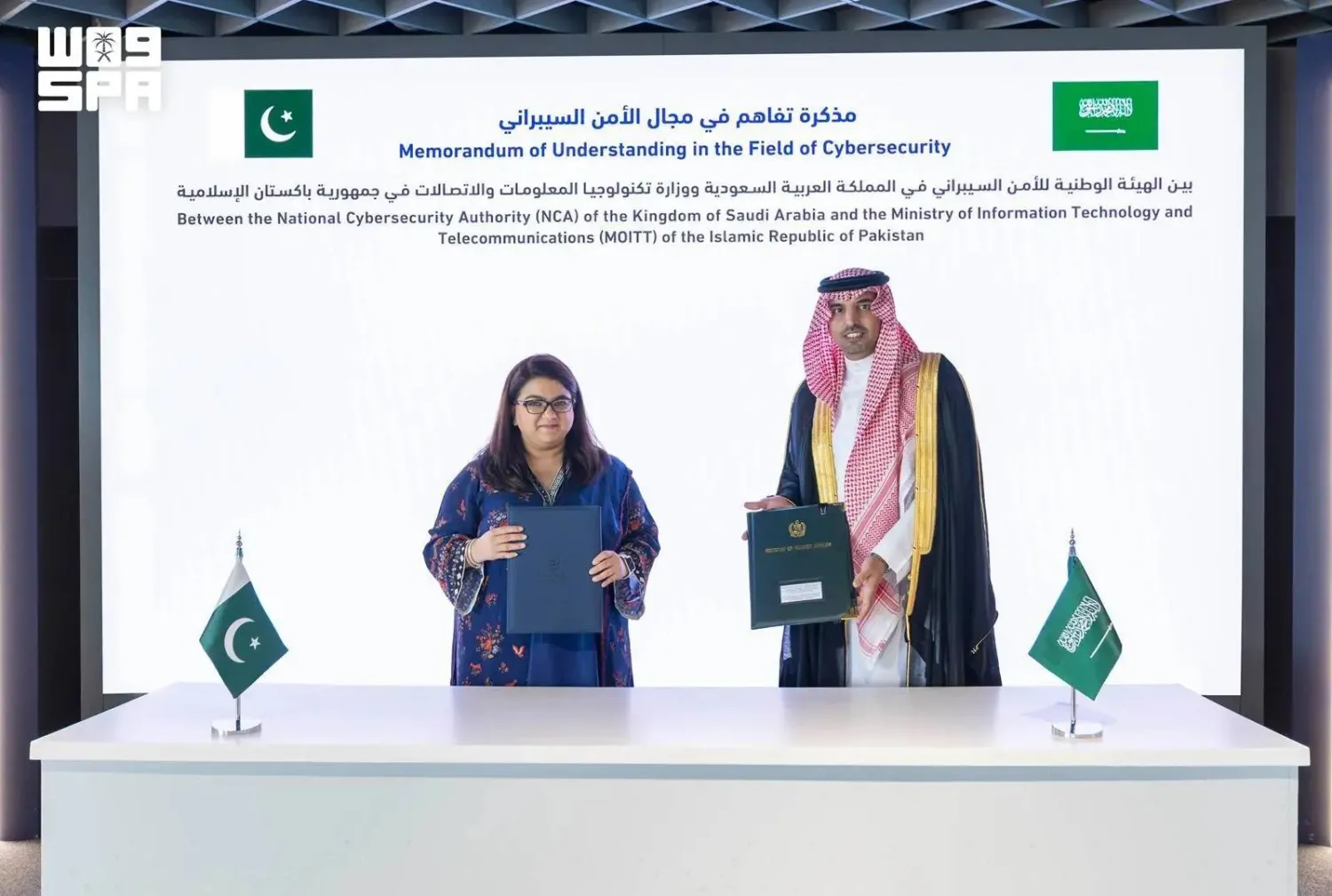
Saudi Arabia, Pakistan Sign MoU to Strengthen Cybersecurity Cooperation

The MoU was signed by NCA Governor Eng. Majed Al-Mazyed and Pakistani Federal Minister for Information Technology and Telecommunication Shaza Fatima Khawaja. (SPA)
TT

Saudi Arabia, Pakistan Sign MoU to Strengthen Cybersecurity Cooperation

The MoU was signed by NCA Governor Eng. Majed Al-Mazyed and Pakistani Federal Minister for Information Technology and Telecommunication Shaza Fatima Khawaja. (SPA)

Saudi Arabia’s National Cybersecurity Authority (NCA) signed on Tuesday a memorandum of understanding (MoU) with the Pakistani Ministry of Information Technology and Telecommunication to strengthen bilateral cybersecurity cooperation.

The MoU, signed by NCA Governor Eng. Majed Al-Mazyed and Pakistani Federal Minister for Information Technology and Telecommunication Shaza Fatima Khawaja, aims to protect cyberspace and the vital interests of both nations by facilitating the exchange of expertise and best practices to address emerging cyber threats.

The agreement aligns with the NCA's ongoing strategic efforts to solidify Saudi Arabia's global leadership in the cybersecurity sector by building robust international partnerships and integrating with global counterparts.


From Technology to Impact: Saudi Interior Ministry Showcases Future of Security at LEAP 2026

The Saudi Interior Ministry's pavilion at LEAP 2026 in Riyadh. (SPA)
TT

From Technology to Impact: Saudi Interior Ministry Showcases Future of Security at LEAP 2026

The Saudi Interior Ministry's pavilion at LEAP 2026 in Riyadh. (SPA)

Technology does not begin with a device, nor does it end at a screen. At LEAP 2026, the Saudi Ministry of Interior is presenting an integrated approach to harnessing modern technologies, data, artificial intelligence (AI), and digital solutions, reported the Saudi Press Agency on Tuesday.

The approach transforms standalone tools into interconnected capabilities that enhance security and safety, empower security personnel, improve institutional efficiency and services, and strengthen decision-making.

The ministry’s participation highlights six interconnected systems that reflect the broader digital transformation of the security and services ecosystem. These include field security and safety, where technology enhances readiness and accelerates response; rapid response, which strengthens early intervention capabilities; and road safety, which uses technology and data to make roads safer.

The systems also include security cameras, which provide broader visibility and more advanced monitoring capabilities, and digital services, which make users’ interactions easier, faster, and more integrated. Institutional services serve as the overarching intelligence connecting the various components of the system.

Together, the six systems encompass 36 services and projects: seven in field security and safety, eight in rapid response, three in road safety, seven in security cameras, nine in digital services, and two in institutional services.

The figures reflect the breadth of the Ministry of Interior’s digital transformation and the diversity of its applications across the ministry’s ecosystem.

At LEAP 2026, the Ministry of Interior is demonstrating more than a collection of technologies. It is presenting an integrated ecosystem in which technology translates into capability — from the field to command centers, from roads to communities, from monitoring to response, and from digital services to institutional operations.

Assistant Minister of Interior for Technology Affairs Thamer Alharbi stressed that the Ministry of Interior has harnessed modern technologies and artificial intelligence to deliver reliable security, humanitarian services, and public safety. 

Inaugurating the ministry's pavilion at the LEAP 2026 conference, Alharbi stressed that the ministry's core mission remains protecting people, fostering trust, and empowering service providers through robust digital capabilities. 

He highlighted key achievements, noting that the national digital identity platform "Nafath," developed with the National Information Center, serves over 32 million beneficiaries across 1,245 linked platforms, facilitating more than 6.5 billion transactions. 

Alharbi outlined field-support innovations, including the "Maidan Companion," which builds situational context and coordinates specialized emergency capabilities, alongside "Absher Open Services," enabling governed multi-entity integration. 

He added that "Absher Companion," developed with the Ministry of Communications and Information Technology and the Digital Government Authority, has processed over 3.3 million interactions and executed more than 348,000 transactions with a 96% completion rate. 


Palestine Signs Digital Cooperation Organization Charter at LEAP 2026

Palestinian Minister of Communications and Digital Economy Abdul Razzaq Al-Natsheh and DCO Secretary-General Deemah AlYahya at LEAP 2026 in Riyadh. (SPA)
TT

Palestine Signs Digital Cooperation Organization Charter at LEAP 2026

Palestinian Minister of Communications and Digital Economy Abdul Razzaq Al-Natsheh and DCO Secretary-General Deemah AlYahya at LEAP 2026 in Riyadh. (SPA)

The Digital Cooperation Organization (DCO) announced on Tuesday that the State of Palestine has signed the DCO Charter, becoming a signatory member.

The announcement was made on the sidelines of LEAP 2026 in Riyadh.

Palestine’s accession is expected to strengthen cooperation in building an inclusive, resilient, and sustainable digital economy and expand opportunities for individuals, businesses, and communities to benefit from digital transformation.

Palestinian Minister of Communications and Digital Economy Abdul Razzaq Al-Natsheh officially handed the DCO Charter to DCO Secretary-General Deemah AlYahya.

The move follows the DCO’s announcement that its council had approved the nominations of eight new countries for full membership. Once accession procedures are completed, the DCO’s membership will expand from 16 to 24 countries, collectively representing around 980 million people.

Palestine’s information and communications technology (ICT) sector comprises around 400 active establishments and employs more than 13,500 specialists. It generates more than $500 million in annual value added and contributes around 5% to GDP.

The sector also produces around 3,000 ICT graduates each year, reflecting its growing role in economic development and digital innovation.


US Urges Hands-off Approach to AI Regulation at G20 Tech Meeting

 White House Office of Science and Technology Policy Director Michael Kratsios (C) speaks to the G20 Innovation Ministerial delegation in Chapel Hill, North Carolina, on September 1, 2026. (AFP)
White House Office of Science and Technology Policy Director Michael Kratsios (C) speaks to the G20 Innovation Ministerial delegation in Chapel Hill, North Carolina, on September 1, 2026. (AFP)
TT

US Urges Hands-off Approach to AI Regulation at G20 Tech Meeting

 White House Office of Science and Technology Policy Director Michael Kratsios (C) speaks to the G20 Innovation Ministerial delegation in Chapel Hill, North Carolina, on September 1, 2026. (AFP)
White House Office of Science and Technology Policy Director Michael Kratsios (C) speaks to the G20 Innovation Ministerial delegation in Chapel Hill, North Carolina, on September 1, 2026. (AFP)

The US on Tuesday pressed G20 members to take a hands-off approach to AI regulation and avoid creating new rules for the technology at a gathering of industry titans and commerce ministers in North Carolina.

The US goals largely align with the thinking of the world's biggest AI companies, nearly all of which are American. They want less regulation around the world for their rapidly growing businesses, or to shape the rules as they are written. Federal government requirements could hurt the industry's profits if they slow the release of new models or prompt the companies to change how their products perform to address security concerns.

US tech adviser Michael Kratsios, who is co-hosting the two-day meeting, advocated for countries to adopt the "Carolina Principles."

Countries that sign on ‌agree to "reserve new ‌regulation for novel considerations" when writing rules for AI, Kratsios told the G20 officials ‌at ⁠the meeting. They also ⁠will invest in "foundational research to accelerate discovery" and strengthen commercial opportunities for new technology, he said.

"Policymakers do not need to approach each innovation in isolation and should not treat every emerging technology as a first-of-its-kind policy problem," he said.

The G20 leaders are convening at a key moment in the AI sector's development and the global debate over how to govern it, and as the US faces an increasing threat from China for AI supremacy.

A United Nations panel recently warned that AI's developments are outpacing scientific understanding and government policy. Recent events, including a hack triggered by a rogue OpenAI agent that compromised the infrastructure ⁠of AI company Hugging Face, added to concerns about how closely leading AI companies are ‌monitoring tests of their products.

AI agents are programs that run with ‌minimal human supervision.

INDUSTRY LEADERS

SpaceX CEO Elon Musk on Tuesday morning criticized the European Union's tech regulations, saying that the EU's policy "inhibits progress" for ‌companies. He also urged leaders outside China to develop new energy sources to power data centers.

Meta CEO Mark Zuckerberg ‌will address the ministers by video chat, a US Commerce Department spokesperson said, in lieu of company president Dina Powell McCormick, who had previously planned to speak. Google DeepMind co-founder Demis Hassabis was also added to the list of speakers who will address the ministers by video chat, a Google spokesperson said on Monday.

Reuters previously reported that OpenAI CEO Sam Altman and Nvidia CEO Jensen Huang ‌will separately appear before the delegates with Commerce Secretary Howard Lutnick, who is also hosting the meeting, on Wednesday.

The US at the G20 tech meeting will press ⁠member countries not to set up ⁠new regulatory organizations to oversee AI development, a White House official said.

The meeting is one of a series of gatherings taking place over the next few months in US cities leading up to the G20 leaders' summit in Miami in December.

US-CHINA AI RACE

Chinese open-weight AI models, systems with publicly accessible core elements, are becoming increasingly capable when compared to proprietary systems from American AI giants such as Anthropic and OpenAI. Chinese-made open-weight models are gaining ground with US companies, also posing a potential security risk if the country's leaders decide to interfere.

"It has increased urgency for this administration to make sure that the rest of the world stays within the American tech ecosystem and doesn't seek alternatives," said Vivek Chilukuri, a technology and national security fellow at the Center for a New American Security.

The Chinese Embassy in Washington did not respond to a request for comment from Reuters about attending the North Carolina meeting.

Canadian officials are slated to attend, a spokesperson for the Canadian government said, adding that the delegation will advocate for countries to balance innovation with "public trust and safety." The US and Canada are embroiled in a trade war, started by the US president.