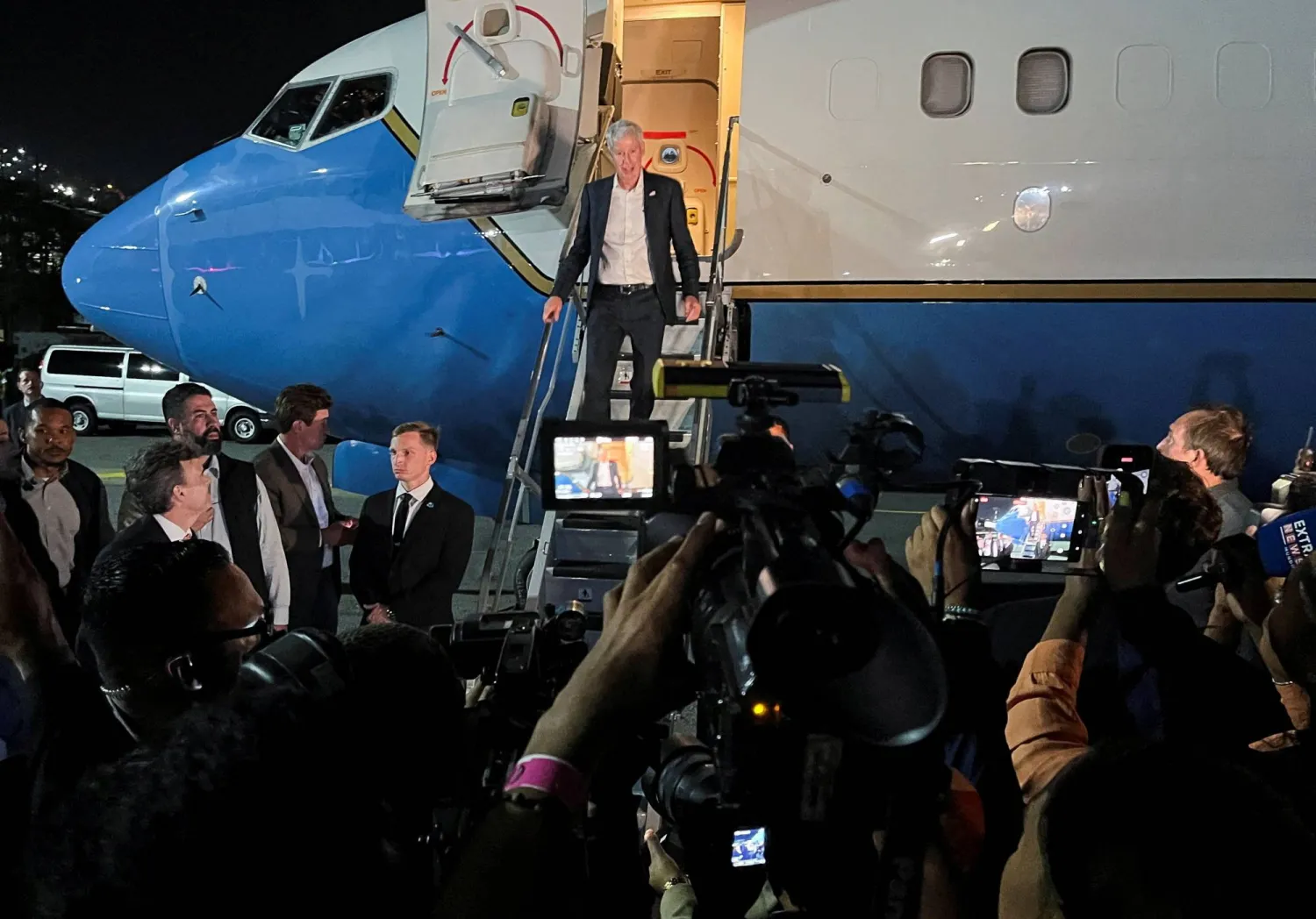
US Defends Trump Venezuela Oil Deal as Energy Secretary Lands in Caracas

US Energy Secretary Chris Wright disembarks a plane as he arrives in Maiquetia, Venezuela, September 1, 2026. (Reuters)
TT

US Defends Trump Venezuela Oil Deal as Energy Secretary Lands in Caracas

US Energy Secretary Chris Wright disembarks a plane as he arrives in Maiquetia, Venezuela, September 1, 2026. (Reuters)

US officials on Tuesday defended President Donald Trump's oil deal with Venezuela, saying it would lower oil prices for Americans and counter Russian and Chinese influence on Washington's doorstep.

Venezuela's government-dominated National Assembly on Tuesday backed the multibillion-dollar agreement that grants the United States control of about one-fifth of Venezuelan reserves.

But there have been major questions about the deal, which comes as Washington maintains an unprecedented grip on the government in Caracas after toppling Venezuelan president Nicolas Maduro in January.

Late Tuesday, US Energy Secretary Chris Wright arrived in Venezuela, with a signing of the agreement set for Wednesday.

Oil giant Chevron is expected to announce a major expansion in Venezuela on the same day.

Trump earlier met oil executives at the White House as he tries to tame gas prices that are spiraling because of the Iran war, with his administration hoping the Venezuela deal could help.

"We are unleashing American Energy Dominance!" Trump said on his Truth Social network after the meeting.

In a Spanish-language interview posted Tuesday to YouTube, Secretary of State Marco Rubio told US-based Venezuelan journalist Sergio Novelli that a private company is working with the United States to "normalize the Venezuelan economy."

"Essentially, this is now an agreement with the US government -- specifically involving the Defense Department, which holds a special account allowing it to take possession of a certain percentage of these assets," Rubio said.

"Now, we have a system where this company will increase production. With US support, it will be able to attract the private investment needed to develop the productive capacity of these fields," Rubio said, adding that the "vast majority" of the 17 fields were "in Chinese and Russian hands" until now.

- Under US control -

In Caracas, some opposition lawmakers abstained from the show-of-hands vote to approve the US deal, arguing they should first be able to view the written terms.

"We need and are obliged to know what is written in the fine print," opposition lawmaker Luis Emilio Rondon said.

But National Assembly chief Jorge Rodriguez said the money from the deal would help Venezuelans.

"Who benefits from this oil if it stays underground?" said Rodriguez.

Venezuela's Defense Minister Gustavo Gonzalez Lopez gave the deal full military backing, describing it as "prosperity and well-being for the country."

"Turning a political difference into an economic cooperation agreement is simply a decision to choose peace; it is not subordination," he stated.

The deal granting the US preferential access to 17 oil fields will notably see the takeover of facilities previously run by Russian and Chinese companies.

One of the most controversial aspects is the involvement of Alejandro Betancourt, a Venezuelan businessman linked to shady dealings under the late Hugo Chavez's socialist administration.

Betancourt runs North American Blue Energy Partners (NABEP), Venezuela's second-largest private oil company, in which the US government is taking a 35 percent stake under the deal.

He was accused of involvement in a corruption scheme at Venezuela's state-run PDVSA oil company.

But a US official said Betancourt was a "proven operator," while acknowledging that geopolitics sometimes involved dealing with "imperfect" characters.

"I'm not nominating anyone for sainthood here. What I am telling you is that this is a person that, in the past, has been helpful to the United States government," the official added.

Under the deal, NABEP will grant Washington the right to buy 20 percent of the oil pumped by the firm at production cost, the White House said.

US citizens must constitute a majority of the firm's board of directors, giving Washington effective control, and the US government will have veto power over its members.

The official said US control would end corruption in the run-down Venezuelan oil industry, while stopping Caracas from giving much of its supplies away to its ally Cuba.

"It was used as a personal piggy bank" by Maduro's government, the official said.

Cheaper oil is a priority for the Trump administration ahead of crucial US midterm elections in November, in which his Republican Party could lose control of Congress.


Military Helicopter Crashes in Southern Türkiye, Killing 4

Rescuers and security officers examine the wreckage of an ambulance helicopter after it collided with a hospital building and crashed into the ground, in Mugla, Türkiye, December 22, 2024. REUTERS/Kenan Gurbuz Purchase
TT

Military Helicopter Crashes in Southern Türkiye, Killing 4

Rescuers and security officers examine the wreckage of an ambulance helicopter after it collided with a hospital building and crashed into the ground, in Mugla, Türkiye, December 22, 2024. REUTERS/Kenan Gurbuz Purchase

A military helicopter crashed in southern Türkiye on Thursday, killing four personnel, the Turkish Defense Ministry said.

The aircraft crashed for unknown reasons in Samankoy, a neighborhood on the southern outskirts of the provincial capital Malatya in the early evening.

“As a result of an accident involving our S-70 helicopter in Malatya, for a reason not yet determined, 4 of our heroic comrades-in-arms aboard the helicopter were martyred,” the ministry said in a social media post.

“We pray that God will have mercy on our martyrs and offer our condolences and prayers for strength to their grieving families, our Turkish Armed Forces, and our noble nation.”

According to The Associated Press, TV images showed the wreckage of the helicopter burning near a cluster of buildings in an otherwise open area of land. The Demiroren News Agency reported that flames had spread to a nearby house but reported no casualties on the ground.

Police, firefighters and medical teams were dispatched to the crash.


Trump Says US Does Not Need Iran Deal

US President Donald Trump and Vice President JD Vance look on during a Veterans Day ceremony at Arlington National Cemetery in Arlington, Virginia, US, November 11, 2026. REUTERS/Kylie Cooper
TT

Trump Says US Does Not Need Iran Deal

US President Donald Trump and Vice President JD Vance look on during a Veterans Day ceremony at Arlington National Cemetery in Arlington, Virginia, US, November 11, 2026. REUTERS/Kylie Cooper

President Donald Trump said on Thursday the US does not need a deal with Iran and directed Vice President JD Vance, who has played a role in efforts to resolve the war, to focus "his complete and total attention" on alleged crime and corruption in Democratic-run cities and states.

Trump's directive came a day after the Wall Street Journal reported that Vance was considering face-to-face peace talks with a hard-line Iranian security official and a week after the vice president blamed the costly war with Iran for Republicans' midterm elections drubbing.

Trump's comments marked a shift in tone after he had suggested ⁠in recent weeks ⁠that Iran would be more willing to strike a deal in the eight-month conflict after the US elections.

"We don’t need a deal with Iran. Those days have long since passed. We’ve got their money, Hundreds of Billions of Dollars, and we’ve got their Strait!" Trump wrote on social media, referring to the Strait of Hormuz, the critical ⁠shipping route near Iran where the US military has been working to secure safe passage for international shipping.

Trump said he asked Vance to focus instead on a domestic issue the president previously put in his portfolio: leading an effort targeting alleged fraud in Democratic-run cities and states throughout the US.

"Our Budget could be quickly BALANCED with the correction of this large-scale criminal activity. CORRUPTION is in the Democrat Leadership’s blood!" Trump wrote on Thursday.

Vance's office did not immediately respond to a request for comment.

The Wall Street Journal reported on Wednesday that ⁠Vance was considering ⁠meeting with a senior Iranian security official, a move that would have put Vance at the center of peace negotiations. Reuters has not confirmed the potential talks.

Vance, who is viewed as a leading contender for the 2028 Republican presidential nomination, distanced himself from the war last week after Republicans' midterm election rout by Democrats.

The vice president blamed the costs of the Iran war in part for the party's losses. He also said an earlier recommendation to end the war was "sound advice."

Trump responded to Vance's position by defending the war as necessary to stop Iran from obtaining a nuclear weapon.


Iran: Four Tankers Struck by Explosions in Strait of Hormuz

Iran: Four Tankers Struck by Explosions in Strait of Hormuz
TT

Iran: Four Tankers Struck by Explosions in Strait of Hormuz

Iran: Four Tankers Struck by Explosions in Strait of Hormuz

Four oil tankers were hit by explosions in the Strait of Hormuz, Iran's military said on Thursday, adding that the vessels had ignored warnings and entered what it considers restricted areas of the strategic waterway.

Tankers are still facing attacks across the strait, despite a rebound in traffic and expectations of a de-escalation in the war between the United States and Iran that have been reflected in falling oil prices.

Iran's Revolutionary Guards Navy said two supertankers were disabled by explosions on Wednesday after they ignored ⁠warnings against using what ⁠it said was an "unauthorized route".

Reuters could not immediately verify the Iranian account.

The two vessels "exploded after hitting naval mines", Iranian state media reported, broadcasting what it said was video footage of the incidents.

Iran's army later said two other tankers had hit mines on Thursday afternoon while sailing through the eastern Strait of Hormuz after ignoring ⁠warnings and disabling their radar systems, state TV reported. The tankers entered a restricted area and subsequently caught fire, it reported.

Earlier in the US-Israeli war with Iran, which began in February, the IRGC Navy announced its attacks on tankers. More recently, however, it has instead reported that vessels have caught fire after hitting naval mines while traversing the southern part of the strait, which it has declared an unauthorized route.

In several of those cases, the United Kingdom Maritime Trade Operations agency (UKMTO) has said vessels had been struck by unknown projectiles.

The ⁠UKMTO said ⁠in reports on Thursday that a vessel was hit by an unidentified projectile about 14 nautical miles northwest of the UAE emirate of Ras Al-Khaimah on Wednesday while exiting the strait, causing a fire in its engine room.
Firefighting efforts were under way and all crew had been evacuated, it added.

At least 10 ships were hit in the first 10 days of November, after 37 attacks in October, which was the highest monthly tally since the conflict began in late February, according to data from the Washington Institute for Near East Policy.