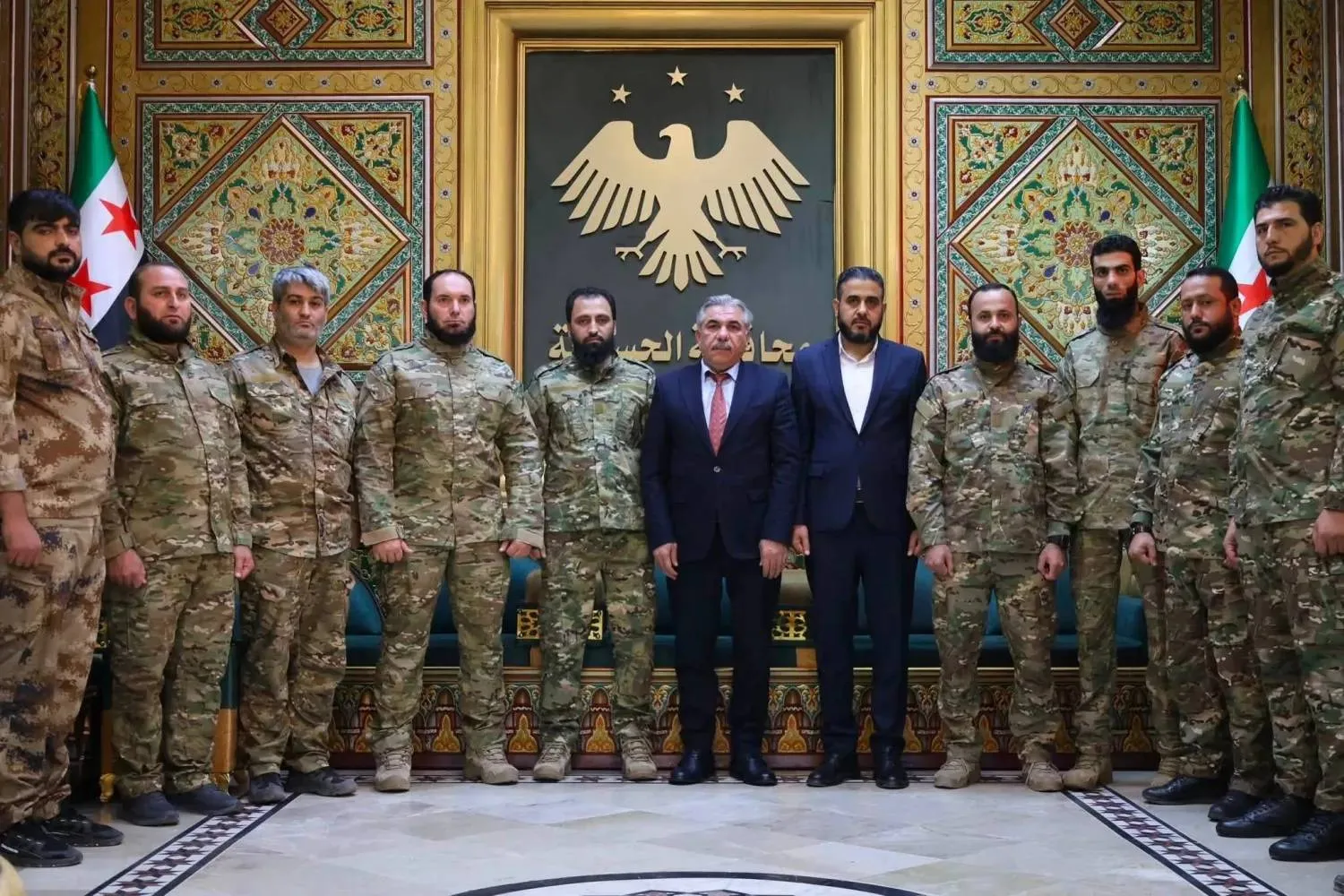
Damascus Begins Establishing its Authority in Hasakeh after SDF Dissolution

A Syrian Defense Ministry delegation in Hasakeh on Monday. (Hasakeh governorate media)
TT

Damascus Begins Establishing its Authority in Hasakeh after SDF Dissolution

A Syrian Defense Ministry delegation in Hasakeh on Monday. (Hasakeh governorate media)

The Special Task Forces of the Ministry of Interior took over a regiment on Tuesday from the disbanded Syrian Democratic Forces (SDF) in Hasakeh city as part of a plan to deploy Syrian security forces in the Hasakeh governorate in northeastern Syria.

The move is part of completing integration procedures and taking control of all security and military positions in the governorate, and hours after the arrival of a Ministry of Defense delegation to Hasakeh to discuss measures for completing the integration process.

Internal Security and Special Task forces are expected to deploy gradually across all areas of Hasakeh to extend state control, maintain security, and boost stability.

New appointments within the Syrian security apparatus are expected as part of an integration process.

Forces are also preparing to deploy to Hasakeh city center, Qamishli, Rumeilan, Al-Malikiyah, and border regions in the coming days.

A delegation from the Ministry of Defense arrived in Hasakeh on Monday and held a meeting at the governorate headquarters with local officials, including Governor Nour al-Din Ahmed, Military Security chief Thaer Obaid al-Bilal, and Military Police chief Imad Fawaz al-Ayesh.

The meeting addressed the procedures and steps required to finalize the integration of military and security institutions within the region, said a statement.

The meeting also addressed coordination mechanisms and the strengthening of cooperation between the relevant entities to unify efforts and ensure the smooth implementation of procedures related to the integration.

The executive bureau of the Hasakeh governorate also held its first meeting on Tuesday, chaired by the governor and attended by bureau members, to discuss mechanisms for boosting coordination across various sectors.

In a related development, displaced Arab families from Haskaeh city returned to their homes in the Al-Aziziyeh neighborhood after more than 10 years of displacement. A celebration was held in their honor attended by Internal Security Commander Marwan Al-Ali and Hasakeh Deputy Governor Ahmed Al-Hilali.


China's Xi Holds Talks with Sisi in First Egypt Visit in a Decade

 In this photo released by Xinhua News Agency, Chinese President Xi Jinping, second left, and his wife Peng Liyuan, left, are welcomed by Egyptian President Abdel Fattah al-Sisi, right, and his wife Entissar Amerupon on their arrival at Cairo International Airport in Cairo, Tuesday, Sept. 1, 2026. (Yin Bogu/Xinhua via AP)
In this photo released by Xinhua News Agency, Chinese President Xi Jinping, second left, and his wife Peng Liyuan, left, are welcomed by Egyptian President Abdel Fattah al-Sisi, right, and his wife Entissar Amerupon on their arrival at Cairo International Airport in Cairo, Tuesday, Sept. 1, 2026. (Yin Bogu/Xinhua via AP)
TT

China's Xi Holds Talks with Sisi in First Egypt Visit in a Decade

 In this photo released by Xinhua News Agency, Chinese President Xi Jinping, second left, and his wife Peng Liyuan, left, are welcomed by Egyptian President Abdel Fattah al-Sisi, right, and his wife Entissar Amerupon on their arrival at Cairo International Airport in Cairo, Tuesday, Sept. 1, 2026. (Yin Bogu/Xinhua via AP)
In this photo released by Xinhua News Agency, Chinese President Xi Jinping, second left, and his wife Peng Liyuan, left, are welcomed by Egyptian President Abdel Fattah al-Sisi, right, and his wife Entissar Amerupon on their arrival at Cairo International Airport in Cairo, Tuesday, Sept. 1, 2026. (Yin Bogu/Xinhua via AP)

Egypt's President Abdel Fattah al-Sisi on Wednesday received his Chinese counterpart Xi Jinping on his first visit to Cairo in a decade, as Beijing seeks a greater foothold in the region against the backdrop of the US-Iran war.

The 21-gun salute at Cairo's Ittihadiya Palace marked the start of a day of talks expected to cover the Middle East war and its fallout, including on maritime trade security, as well as boosting Chinese investment in the Arab world's most populous country.

The two BRICS members are expected to sign a slate of economic agreements, including on artificial intelligence, transport and manufacturing.

Egypt currently estimates Chinese investments at around $10 billion. Beijing has key stakes in the Suez Canal Economic Zone, which are only expected to grow as the US-Iran war threatens global maritime trade.

Beijing has also played a key role in Sisi's megaprojects, the crowning jewel of which is the New Administrative Capital 50 kilometers (30 miles) east of Cairo, large swathes of which have been bankrolled by Chinese investment.

China is a major exporter to Egypt, with its trade surplus reaching $12 billion in the first seven months of 2026, according to Chinese customs data.

Across Cairo, a megalopolis home to over 26 million people, major streets have been lined with Chinese and Egyptian flags, as well as billboards showing Sisi and Xi.

Street signs boast of "generations of Egyptian-Chinese friendship flowing like the Nile River", while residents have been warned to plan for substantial traffic delays on their commutes.

Xi is expected to traverse the entire capital during his visit Wednesday, including a stop at the Grand Egyptian Museum overlooking the Giza Pyramids.

- 'Independent foreign policy' -

According to analysts, Cairo will use the summit to underscore its strategic autonomy, showing it can leverage its close ties with both Washington and Beijing.

Sisi, in an op-ed published in Egyptian media on Tuesday, highlighted Cairo's "independent foreign policy".

He wrote that Egypt and China were partners in "strengthening the role of the global south" in an increasingly polarized world.

Washington vowed last month to isolate Iran economically, threatening expanded sanctions that could also hit Chinese banks, among others.

China, a major buyer of Iranian oil, has vowed to safeguard its interests.

In the lead-up to an expected meeting between Xi and US President Donald Trump this month, it has also sought to shore up ties with US-friendly regional nations.

Egypt is one of the largest recipients of US military aid, and historically a key Middle East mediator.

Last week, the US Treasury announced sanctions on the Emirati branch of Egypt's Banque Misr for alleged support to Iran.

Egypt hosted major joint air combat exercises with the Chinese military in August, featuring Beijing's powerful J-16 fighter jet.


16 Dead in Bus Crash in Egypt's Sinai

Ambulance vehicles in Egypt (Egyptian Ambulance Authority)
TT

16 Dead in Bus Crash in Egypt's Sinai

Ambulance vehicles in Egypt (Egyptian Ambulance Authority)

A bus crash in Egypt's eastern Sinai Peninsula on Wednesday killed 16 people and injured 28 others, the health ministry reported.

Twenty ambulances rushed to the scene of the accident, which occurred on the road between the popular tourist towns of Dahab and Nuweiba on South Sinai's eastern coast, the ministry said.

Authorities said the injured were receiving medical care but did not say what caused the crash, according to AFP.

The area is a popular tourist destination, known for its marine biodiversity, natural beauty and mountain hiking trails.

Car crashes are common in Egypt, and often blamed on reckless driving, poor maintenance and uneven law enforcement.

Last year, nearly 6,000 people died in road accidents across the country, according to Egypt's state statistics agency.


Yemen Announces Killing of ISIS Spokesman

Terrorist organizations in Yemen previously controlled vast areas before being mostly defeated. (Local media)
TT

Yemen Announces Killing of ISIS Spokesman

Terrorist organizations in Yemen previously controlled vast areas before being mostly defeated. (Local media)

Yemen announced on Tuesday the killing of the spokesman of the ISIS terrorist group Abou Huzayfah al-Ansari during an operation carried out by the Arab coalition special forces, with the support of Yemen's counter-terrorism force, "Force 22" in Seiyun city.

Informed Yemeni sources told Asharq Al-Awsat said the spokesman’s original name is Mithaq Thabet Haitham al-Hujaili, a Yemeni who hails from the Hajjah province.

Speaking on condition of anonymity, the sources said he was the spokesman of the entire terrorist organization, underlining the significance of the operation and his position in the group.

State security media in Yemen said the operation was carried out on Tuesday as part of the cooperation and exchange of intelligence between the State Security Service and Arab coalition joint command.

The forces were able to eliminate the target while he was hiding in a home in Seiyun, it added in a statement.

It said he was with eight civilians at the time, including a man, two women and five children. The forces managed to escort the women and children to a safe place. They were not harmed in the operation.

The other man was arrested. He was injured while resisting arrest.

The statement said that no one else was harmed and no property was damaged in the operation.

The forces discovered an explosives belt, which was detonated to avoid harming civilians, at the house. Also discovered were a laptop and five mobile phones.

The operation was declared a success. The statement did not provide more information about Abou Huzayfah or the details about how the forces were able to locate his whereabouts.

The operation took place as ISIS has lost its ability to maintain control over areas in Yemen following years of security and military operations against it.

The terrorist group had first emerged in the country in 2014, exploiting the collapse of state institutions in wake of the Houthi coup and the expansion of the war.

It managed to establish a presence in several regions, including al-Bayda, Hadramawt and Shabwa, before being dealt successive defeats that diminished its power.

The group then resorted to operating through limited cells and hiding in remote or residential areas and carrying out sporadic attacks using explosives.

The State Security Service vowed that the Yemeni government will continue to crack down on wanted terrorists and bring them to justice in cooperation with the Saudi-led Arab coalition and international partners.