


Global Warming Will Exceed Limit, UN Says as it Maps Path to Get Back Below Danger Zone

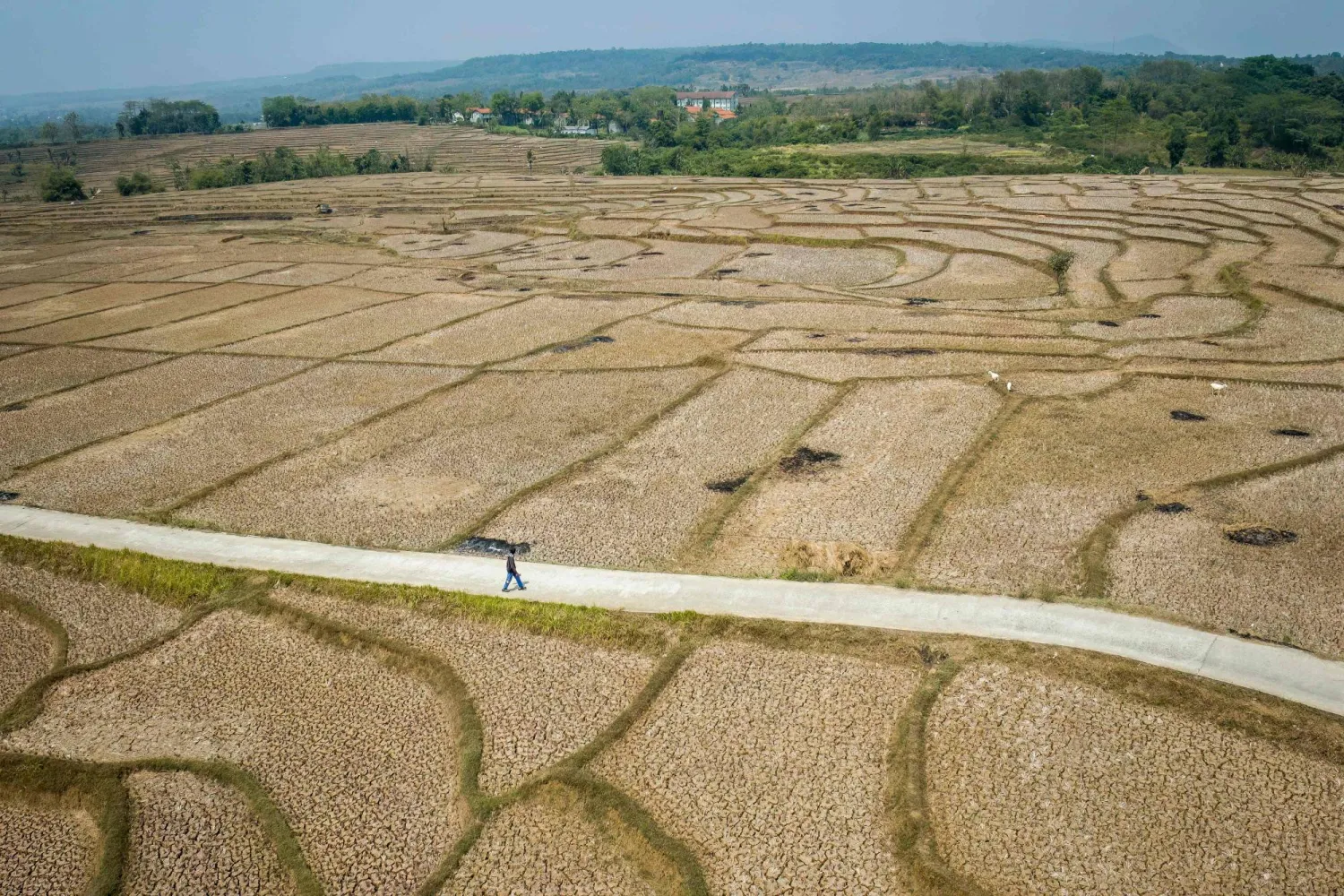
This aerial picture shows a villager walking between dried-up rice fields with cracked soil caused by a prolonged dry season at Wening Galih village in Bogor, West Java on August 28, 2026. (AFP)
TT

Global Warming Will Exceed Limit, UN Says as it Maps Path to Get Back Below Danger Zone

This aerial picture shows a villager walking between dried-up rice fields with cracked soil caused by a prolonged dry season at Wening Galih village in Bogor, West Java on August 28, 2026. (AFP)

In a strategic retreat in the fight against climate change, the United Nations has acknowledged that Earth has lost its chance to prevent some of the worst of global warming's harms. So now the world must figure out how to get temperatures below the danger zone and back to safety, officials say.

Earth is soon going to exceed the safe temperature threshold agreed upon by the world in the 2015 Paris climate accord because of warming from the burning of coal, oil and gas, according to a bleak first-of-its-kind report issued by the United Nations Environment Program Wednesday.

Instead of giving up, scientists and UN officials recommend trying to limit excessive warming and then bring the temperature back down to the agreed-upon threshold. But it still will mean decades of increased weather-related disasters, rising seas, extinctions and melting ice and glaciers.

“Humanity is speeding past the limit to avoid climate catastrophe,” United Nations Secretary-General António Guterres said.

After a period of over-the-limit warming, the new strategy envisions getting back below the limit by ending fossil fuel use and developing some kind of way to suck industries' carbon dioxide out of the air.

“It's a reality check. We have to live with this warmer world,” said report co-author Richard Betts, a climate scientist at the University of Exeter. “But there's still a lot we can do to limit warming.”
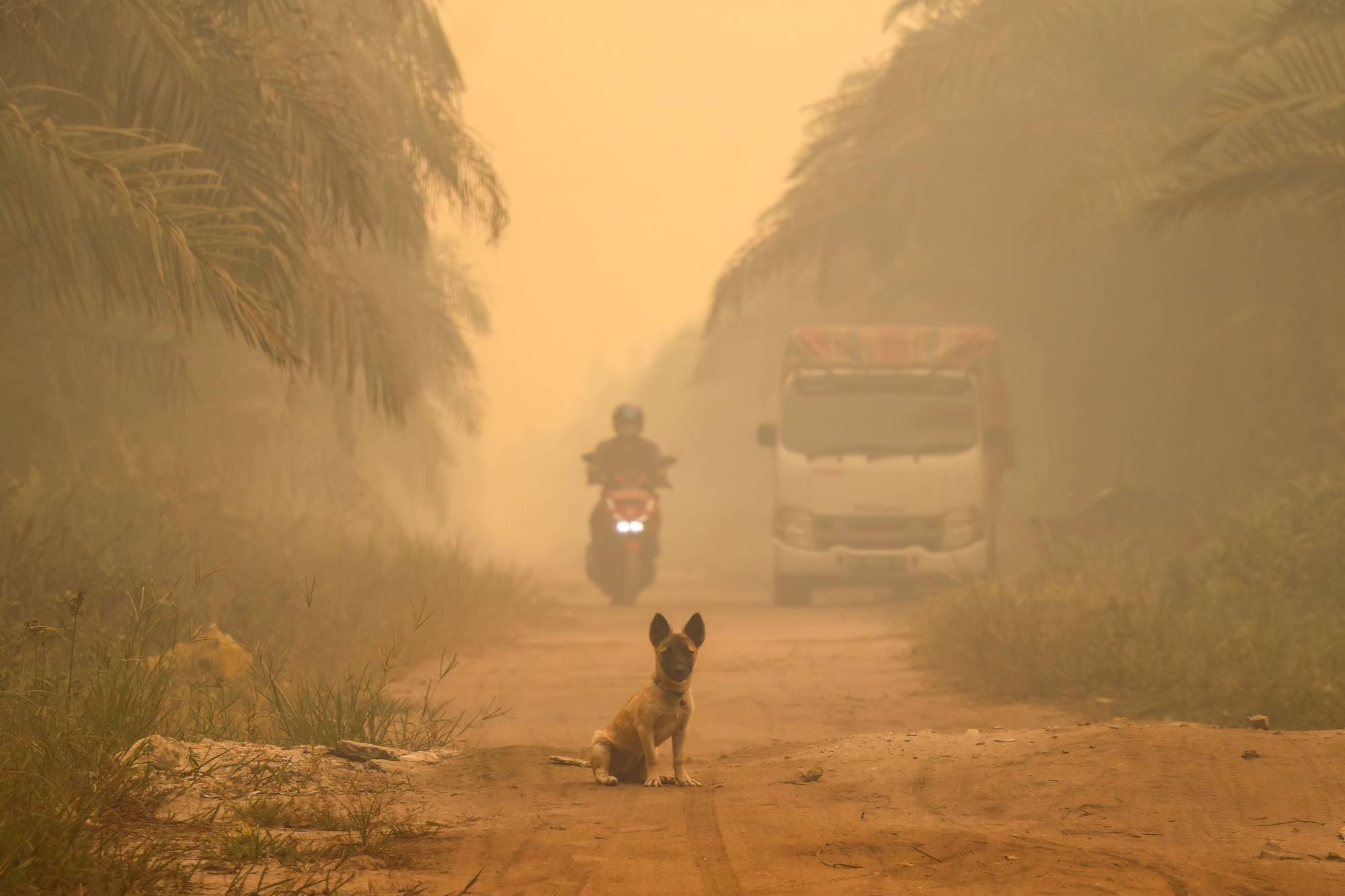
A dog sits in the middle of a haze-shrouded road caused by forest and land fires in Palangkaraya city, Central Kalimantan, on August 28, 2026. (AFP)

Passing the longtime warming threshold

After the Paris climate accord, the United Nations ordered its climate science arm to study different warming limits. A goal of 1.5 Celsius (2.7 Fahrenheit) above mid-19th century temperatures became generally accepted after the scientists found dramatic impacts that affect people and the planet at 2 degrees Celsius (3.8 degrees Fahrenheit) but not at 1.5 degrees.

The world is now at 1.4 C (2.5 F) above pre-industrial levels, some scientists have calculated. The measure is based on a 20-year average, rather than a single year's temperatures.

Despite experts saying there's no way to limit warming to 1.5 degrees, UN officials long maintained the 1.5 window was still open. Wednesday's report finally admitted that the world will cross the 1.5 threshold “in the next few years.”

The report said the most optimistic scenario has warming peaking at 1.8 C (3.2 F) around mid-century if countries pursue ambitious climate goals, but that governments' current policies should push temperatures to 2.6 C (4.7 F) above pre-industrial levels by 2100.

So instead of preventing warming of 1.5 degrees, now the UN said it wants policymakers to “prepare for and navigate a future” in which the globe crosses that limit and then corrects course and cools temperatures. The report envisions that global temperatures will pass 1.5 “within the next few years,” follow a hump-shaped path of more warming, peak, then gradually cool to below the 1.5 mark, ideally by the end of the century. The report and experts call it “overshoot.”

“Let’s be very clear, 1.5 target is still the goal. But now we need to approach it differently from above,” said UNEP Executive Director Inger Andersen.

The 1.5 limit is not “some magical climate cliff” where it’s just game over, said University of Victoria climate scientist Andrew Weaver, who wasn’t part of the study. “Every tenth of a degree we avoid still means less damage.”

Limiting how high temperatures go past threshold is key

It's most important to first limit the new peak temperature and then reduce the amount of time above 1.5 degrees, Andersen said.

But the world likely will be in that overshoot period for “many, many decades,” Betts said.

Every five years of delay in reducing emissions adds at least a tenth of a degree to peak warming, said report co-author Joeri Rogelj, a climate scientist at Imperial College London.

“If we act now we can limit overshoot,” the report said. “Not a safe world, but safer than remaining above” 1.5 degrees for the long term.

“This is among the bleakest UN climate reports I have read. It carries the unmistakable tone of desperation, frustration and urgency — but not resignation,” Weaver said.

Climate scientist Bill Hare, CEO of Climate Analytics, said that “although UNEP does a good job of describing the hole we've dug ourselves into, it does a poor job of showing us that there's a way out.”
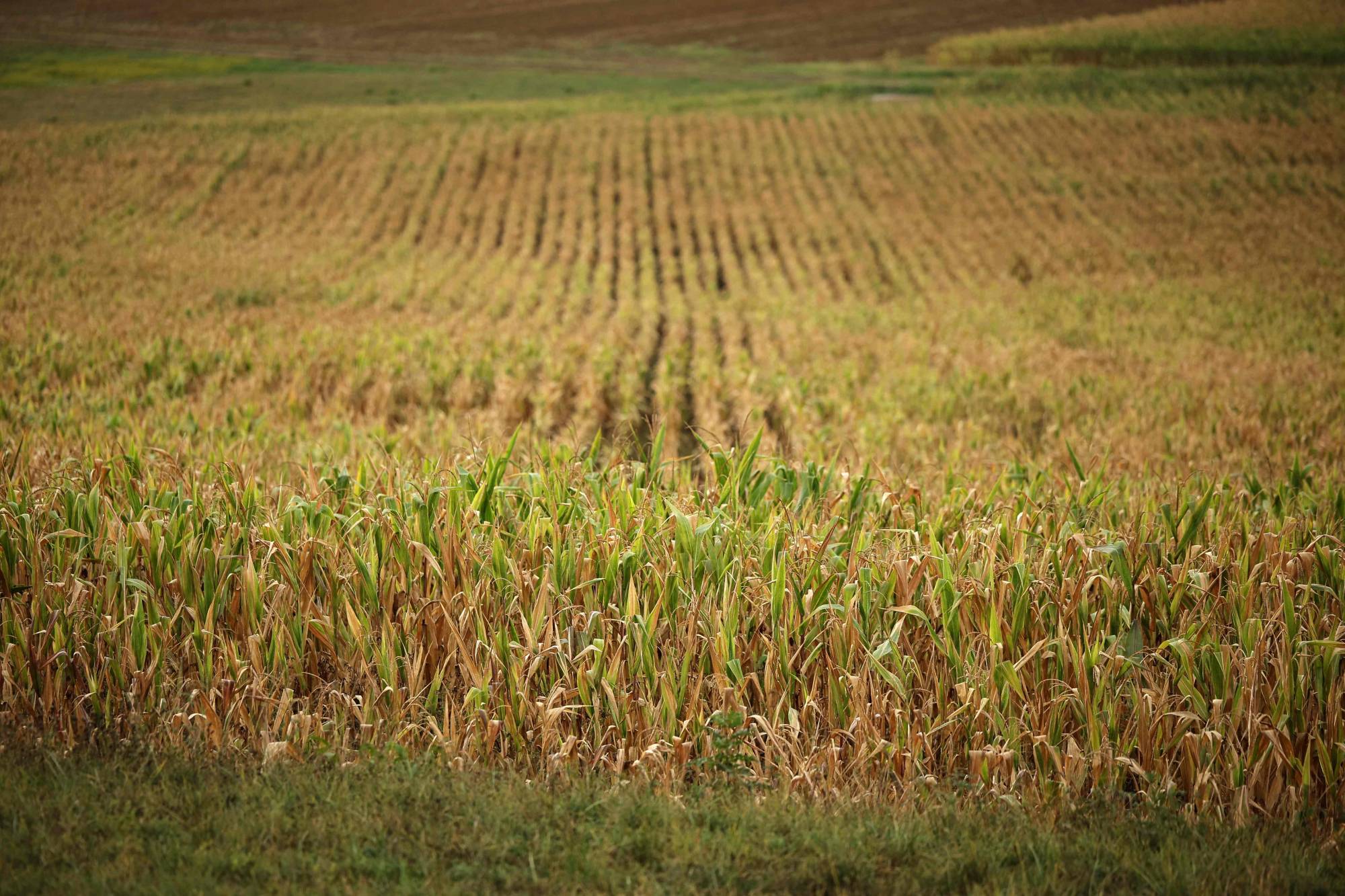
A photograph taken on August 24, 2026 shows a cornfield with dry ears, in Figarol, southwestern France. Due to the repeated heatwaves that have hit the south-west, Sébastien Maylin will be able to “barely cover the cost” of his fertilizer and seeds. (AFP)

Adapting to a deadlier, hungrier, thirstier world

Governments need to increase efforts to adapt to worsening warming, which hits the poor hardest, “because some impacts simply cannot be avoided,” Andersen said.

The report calls this phase “coping and containment.”

During this overshoot period, more people will die or get sick because of the worsening climate change and its extreme weather, the report said. Food production will drop, people will go hungry, water shortages will worsen, economies will be hurt and species like coral will go extinct, the report said.

Although the triggers behind the recent deadly Nepal flooding that came as part of a Himalayan glacier dislodging are complex, Betts said “unfortunately we do expect to see more of such things and this is exactly why we need to limit peak warming.”

The report warns of “tipping points” with irreversible and cascading effects, including the loss of the West Antarctic and Greenland ice sheets, the loss of the Amazon rain forest and the shutdown of the Atlantic Ocean circulation system that keeps much of Europe warm.

“Some locations might become more or less uninsurable or even uninhabitable,” the report said.

The last phase in overshoot is cooling the planet by removing carbon dioxide from the air and storing it somewhere. The report said the traditional approach of this is planting more trees, but it says planting trees could, at most, shave a tenth of a degree off global temperatures. So the authors said more novel carbon removal approaches will be needed.

Other scientists called that unreliable and expensive.

“We were unable to stop the runaway train of global emissions to avoid 1.5 C of warming,” said Stanford University climate scientist Rob Jackson, who wasn't part of the report. “Now overshoot scenarios require us to stop the train quickly and to back it up. Is it our best hope? Absolutely. Is it likely? Absolutely not.”



Bacteria Suspected in Deaths of Hundreds of Baby Whales off Argentina

Scientists suspect a bacterial infection to be behind the mystery deaths of hundreds of southern right whale calves washed up on beaches in Argentina's Patagonia region. MAXI JONAS / AFP
TT

Bacteria Suspected in Deaths of Hundreds of Baby Whales off Argentina

Scientists suspect a bacterial infection to be behind the mystery deaths of hundreds of southern right whale calves washed up on beaches in Argentina's Patagonia region. MAXI JONAS / AFP

A bacterial infection is suspected of killing hundreds of baby whales in the southern Argentine region of Patagonia, a marine mammal expert told AFP on Thursday.

This week again, dozens of dead southern right whale calves washed up on beaches in southern Chubut province, continuing a disturbing trend that began in June.

"The death rate (among young whales) is quite high this season in particular," Mariano Coscarella, a researcher at the Marine Mammals Laboratory of the national research council Conicet, confirmed to AFP.

Coscarella, who is based in Puerto Madryn, a major whale-watching destination on the Atlantic coast, said veterinarians suspected an outbreak of erysipelas, a serious disease caused by bacteria commonly found on the mammals' skin.

"It seems to be a natural cause however we cannot completely rule out the influence of human activity," he said.

The Chubut provincial government said Wednesday it was working closely with the scientific community to solve the mystery of the dying whales.

It said that preliminary research suggested it was caused by a "common marine bacteria."

Puerto Madryn and the nearby Valdes Peninsula are a major breeding ground for southern right whales, which grow up to 17 meters (55 feet) in length and weigh on average 40 tons, roughly the equivalent of four elephants.

A record 2,110 whales were counted in the area in 2025, including 800 young.

This year, authorities have counted 1,375 specimens, including nearly 400 calves, Coscarella said.

He added that the recent deaths "do not constitute a medium-term danger" for the area's whale population given the average life span of the southern right whale, which local authorities put at 60 years.


Cash for Nature Protection: Hotelier's Offer to Principe Islanders

Locals on the island of Principe are paid a financial dividend to preserve its natural beauty. Daniel BELOUMOU OLOMO / AFP
TT

Cash for Nature Protection: Hotelier's Offer to Principe Islanders

Locals on the island of Principe are paid a financial dividend to preserve its natural beauty. Daniel BELOUMOU OLOMO / AFP

On the paradise island of Principe, a lush jungle haven in the turquoise waters of the Gulf of Guinea, a South African multimillionaire is offering locals a financial dividend to preserve the natural beauty on which his luxury tourism business depends.
The initiative is the brainchild of tech entrepreneur Mark Shuttleworth, who for over a decade has been promoting a model of exclusive ecotourism aimed at an ultra-wealthy foreign clientele.
The dividend scheme, which Shuttleworth's charitable organization pays out individually to locals, aims to encourage them to preserve their natural environment -- a mountainous volcanic island, bordered by pristine beaches and whose tropical forest is home to a wealth of endemic species, AFP said.
In return for agreeing in writing not to engage in environmentally damaging activities like sand extraction or unregulated logging, adults can receive up to 6,250 dobras ($290) per quarter -- the equivalent of around $3.20 a day.
It represents a bonus in a tiny country where 45 percent of the population lives on less than $3.60 a day, according to the latest World Bank data from 2017.
But some critics say the initiative is a missed opportunity to work with the government to address the island's economic and social needs.
"I've just received the first quarterly payment. At 900 dobras it's definitely not a salary but it'll help," grinned 23-year-old technician Ermelindo Mendes, talking to AFP from his village of Monte Alegre in the lush hills.
The whole of Principe, part of the archipelago of Sao Tome and Principe, is an internationally recognized UNESCO biosphere reserve.
Staying in one of Shuttleworth's four hotels on the archipelago can cost up to $1,700 a night.
The hotelier promises his guests -- most of whom are European -- a luxury experience discovering a "hidden west African paradise".
- Nature's guardians -
His business model depends on preserving Principe's pristine natural environment.
So in February, to enlist the support of the island's 10,000 inhabitants, Shuttleworth began offering them a small nature dividend via his charitable organization, the Faya Foundation.
The locals are "nature's principal guardians. We need them on our side", said Vik Michau, a sociologist with the Foundation.
None have yet earned the maximum dividend of $290 per quarter.
"Data monitoring shows the natural environment isn't in an optimal state yet," Michau said.
To earn more, locals need to reforest the island and make what she described as "better choices regarding the natural environment".
Every year, 15,000 tourists visit the 140-square-kilometer (54-square-mile) island.
Many book the luxury package offered by Shuttleworth's HBD (Here Be Dragons) group.
"Most visitors are looking for nature, tranquility and peace -- everything the region has to offer," said Wander Dias de Sousa Pires, the head of the Principe tourist board.
- 'We see the suffering' -
But for the inhabitants of one of the world's poorest countries, the picture-postcard scenery masks a precarious daily struggle, beset by logistical difficulties and affected by distant geopolitical events over which they have no control.
"People who come here look at the scenery and say to themselves: 'This is paradise.' But those who live here see the suffering," said Conceicao Moreno, a 46-year-old member of parliament.
"We face utterly degrading social and economic conditions. The cost of living is very high, we have no access to quality healthcare or education and the roads and most of the infrastructure are in a state of disrepair," he said.
Moreno declined to take part in the dividend program, wary of the "relationship of domination" the grant might entail and unconvinced of its benefits to the recipients.
"The amounts paid out are too insignificant to have any impact on a family's survival," he said.
"They should have partnered with the government to offer social progress and infrastructure that would guarantee the island's development".
Michau said this view was to misunderstand the purpose of the foundation's "pioneering experiment".
The dividend is "not a salary" and charitable work cannot take the place of the state, she said.
"We are a private organization, not the government. We have drawn a very clear line between what falls within the government's remit, what we do here and where we can help."


Bats Originated and Took First Flight in Europe 65 Million Years Ago

FILE PHOTO: An Indian flying fox or fruit bat flies over trees at Kodiyathur village in Kozhikode district in the southern state of Kerala, India, February 2, 2022.REUTERS/Sivaram V/File Photo
TT

Bats Originated and Took First Flight in Europe 65 Million Years Ago

FILE PHOTO: An Indian flying fox or fruit bat flies over trees at Kodiyathur village in Kozhikode district in the southern state of Kerala, India, February 2, 2022.REUTERS/Sivaram V/File Photo

Scientists have long struggled to establish where bats first originated, with previous hypotheses proposing Africa, Asia and North America.

A new research has rewritten the evolutionary history of bats, providing evidence the winged mammals most likely originated in Europe during the late Palaeocene, some 65-60 million years ago.

By combining genomic data from all living bat families with ancient fossil records, an international team of 137 researchers from 64 countries working as part of the Bat1K consortium, a global initiative dedicated to sequencing the genomes of all living bat species have reconstructed the evolutionary history of the world's only mammals capable of true powered flight.

The landmark study published in Nature magazine analyzed 103 bat genomes, including 42 newly generated chromosome-level assemblies, representing all 21 recognized bat families.

This was combined with evidence from 44 fossil bats. The results provide a clearer picture of where and how this remarkable lineage emerged.

The researchers found that bats most likely first evolved in Europe during the late Palaeocene. And from there, their descendants spread into Africa.

As bats diversified, different groups then expanded independently into the Americas, Asia and Australia, eventually giving rise to the major bat groups found around the world today.

“The approach we used to model the evolution of fossil and living species together can do what other methods cannot - identify the oldest group of fossil bats while taking the genomic data into account, and uncover when and where bats originated,” said senior author Professor Liliana M Davalos from Stony Brook University.

Computationally reconstructing the genome of the ancient ancestor from which all living bats descended, researchers are able to offer a glimpse into the genetic make-up of one of the earliest flying mammals.

This new genomic resource will allow scientists to investigate the genetic changes behind bats' extraordinary diversity and adaptations, including flight, echolocation, longevity and resistance to disease, as well as their remarkable resistance to disease and exceptionally long lives, for their size.

Bats are among the most extraordinary mammals on Earth. They are the only mammals capable of true powered flight. Most bats orient and hunt in complete darkness using sound alone, and they account for one fifth of all living mammals, playing a vital role in maintaining healthy ecosystems across the globe.

Many bat species show remarkable resistance to disease and live exceptionally long lives for their size.

Yet despite their unique biology and ecological importance, scientists have struggled for decades to answer some of the most fundamental questions about their evolution.

“It is extraordinary, after decades of research and conflicting findings, we finally have a robust phylogenetic tree that we can now use to properly understand how and where bats’ unique traits evolved,” said leading senior author and co-founding Director of Bat1K Professor Emma Teeling, from the UCD School of Biology and Environmental Science.

“We also have the genomes to uncover the molecular basis of these spectacular mammalian adaptations and know where the fossil bats fall in this tree.”

This new study represents the largest combined bat genome and fossil study ever undertaken, drawing on samples collected over decades from bats around the world, including some of the rarest and unusual species found only in the most remote locations.
