

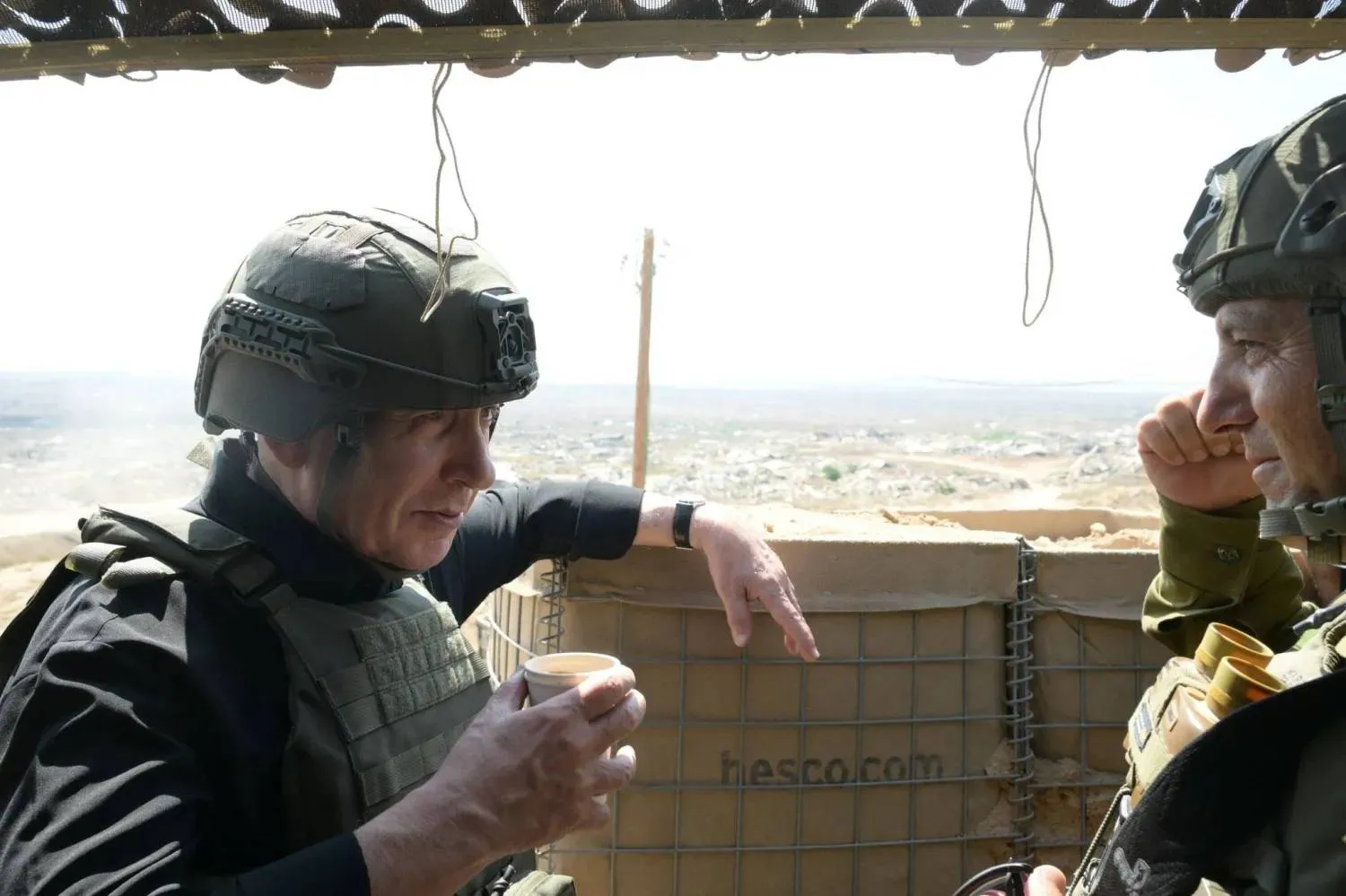

Netanyahu Says ‘We Are Not Retreating’ During Gaza Visit

Prime Minister Benjamin Netanyahu in Gaza on Wednesday. (Netanyahu on X)
TT

Netanyahu Says ‘We Are Not Retreating’ During Gaza Visit

Prime Minister Benjamin Netanyahu in Gaza on Wednesday. (Netanyahu on X)

Prime Minister Benjamin Netanyahu on Wednesday visited Israeli forces in the Gaza Strip, where he vowed not to pull back troops despite a recent push by mediators to advance a US-backed ceasefire plan calling for their withdrawal.

It was the first time Netanyahu has visited the war-shattered territory since the ceasefire between Israel and Hamas came into effect in October 2025.

"We control the area. We are not retreating. We are staying on this line," Netanyahu said near the so-called Yellow Line, which demarcates the areas under Hamas and Israeli military control.

"We control 60 percent of the Strip, and we are not stopping, because we are eliminating the terrorists who threaten us, day in and day out."

Israel has kept striking the Gaza Strip and its forces have made further inroads despite the US-brokered ceasefire, insisting it must eliminate threats from Hamas, which led the unprecedented October 7, 2023 attack against Israel.

International appeals to move to the next stages of the US-led peace plan have not stopped Israel targeting Palestinians it says are militants.

Netanyahu, facing tight elections in October, last month rejected a proposal for advancing to the next stage of the plan after Hamas said it had agreed to hand over its weapons.

The Israeli premier has vowed no military pullout until the Palestinian movement is "genuinely" disarmed.

On Tuesday, Israel said its forces and a Palestinian anti-Hamas militia captured the head of Hamas's internal security apparatus during a ground operation in Gaza City that Palestinian health officials said killed four people.

Hamas's Interior Ministry identified the man as Muein al-Arabid, and said he was an "officer in the internal security service", but did not mention whether he was its chief.

"We are doing everything to reach our goal -- disarming Hamas and demilitarizing Gaza. Gaza will no longer pose a threat to Israel," Netanyahu said Wednesday, adding that "there is still work left to complete -- and we will complete it".

Israel's defense minister on Wednesday said the country had plans to remove Palestinians from the Gaza Strip but was waiting for the United States to figure out where to take them.

"There is no real solution for Gaza in the end without this migration," Defense Minister Israel Katz told a conference hosted by Israeli news site Ynet and newspaper Yedioth Ahronoth.

The Israeli government "is organized and prepared to get them out -- by sea, by air, by every way possible", he said.

Similar suggestions in the past that Gazans could be displaced from the territory entirely have drawn international outrage, as well as condemnation from Palestinians themselves.

Announcing the Gaza war ceasefire in October, Trump laid out 20 points for the territory that included no forced displacement.

Forced displacement of civilians in occupied territory is considered a war crime under the Geneva Conventions.

Israeli operations in Gaza have killed at least 1,334 people since the ceasefire came into effect, according to the Palestinian territory's health ministry, which also operates under Hamas authority and whose figures are considered reliable by the United Nations.

The Israeli army has reported five deaths in its ranks over the same period, as well as the death of one civilian contractor.



Syria Tightens Public Spending Amid Rising Regional Tension

Syrian Finance Minister Mohammed Yisr Barnieh participates in the launch of an electronic link between the Popular Credit Bank and Al-Haram Transfer Company (minister’s account)
TT

Syria Tightens Public Spending Amid Rising Regional Tension

Syrian Finance Minister Mohammed Yisr Barnieh participates in the launch of an electronic link between the Popular Credit Bank and Al-Haram Transfer Company (minister’s account)

The General Secretariat of the Syrian Presidency has approved a series of measures to control and rationalize public spending, aimed at safeguarding the state budget.

Syrian Finance Minister Mohammed Yisr Barnieh said Monday that the measures would not affect salaries, wages or essential expenditures, particularly in the health, education, water, energy, security, public safety and operational maintenance sectors.

As Syrians fear a harsh winter that could revive memories of the difficulties they faced during the war and shortages of basic necessities, the Syrian government is increasingly concerned about continued regional escalation and rising energy production and fuel costs.

Sources close to the government told Asharq Al-Awsat that there was concern over continued escalation in the region, particularly the wars in Iran and Yemen, and its impact on Arab Gulf states, which have become Syria’s new financial lifeline.

They said the escalation was casting a dark and direct shadow over the country’s political and economic landscape and threatening recovery efforts, amid the possibility of declining support and investment.

Barnieh explained in a Facebook post Monday that the measures include limiting nonessential expenditures and reprioritizing spending and investment projects, while postponing projects that can be deferred according to their necessity, readiness and financial, economic and social impact.

The financial measures are aimed at improving the efficiency of public spending by directing available resources toward projects with a direct impact, strengthening the budget’s ability to withstand current pressures and preserving fiscal sustainability, according to the minister.

The launch of the public spending rationalization plan coincides with preparations for the 2027 budget, amid challenges related to containing the current year’s fiscal deficit.

Public spending during the first half of this year reached about $3.7 billion, compared with total public revenue of around $2.7 billion, according to the state budget’s fiscal performance report issued last August, which estimated the fiscal deficit at approximately $1 billion.

Compared with the first half of 2025, public revenue rose by about 111%, while public spending increased by around 331%.

The government says the increase in spending was primarily linked to higher salaries and wages, expanded spending on government priorities and higher costs for a number of goods, services and inputs as a result of regional developments and rising import prices.

The government is working to cover the budget deficit through financial instruments such as short-term bonds and efforts to attract foreign investment, as living conditions worsen and the gap between salaries and wages and the cost of basic necessities widens.

The government raised fuel prices on Sept. 13 by between 25% and 40%, covering gasoline, diesel and household gas.

More than 90% of Syrians live below the poverty line, while 65% live in extreme poverty, according to UN figures.

Estimates indicate that a Syrian family of five needs more than $500 a month — nearly 6 million Syrian pounds at prevailing valuations — to meet minimum basic needs. By contrast, salaries in the public and private sectors often do not exceed $100 to $150.


WHO: Houthi Attacks Leave More than 4,000 Victims in Yemen

A displaced Yemeni walks at Al-Firdaws camp in Ras Imran, on the western outskirts of Aden, Yemen, Monday, Sept. 28, 2026. (AP Photo/Abdulnasser Alseddik)
TT

WHO: Houthi Attacks Leave More than 4,000 Victims in Yemen

A displaced Yemeni walks at Al-Firdaws camp in Ras Imran, on the western outskirts of Aden, Yemen, Monday, Sept. 28, 2026. (AP Photo/Abdulnasser Alseddik)

The health and humanitarian situations in Yemen continue to deteriorate as fighting intensifies, with 809 new casualties recorded during the reporting period between September 19 and 26, including 164 deaths, the World Health Organization said on Monday.

The new figures brought the cumulative total since Aug. 6 to 4,481 casualties, including 838 deaths.

In its fifth Situation Report on the Conflict Escalation in Yemen, WHO said deaths represented 20% of newly reported casualties during the reporting period, compared with 24% in the previous period and 17% before that, while casualties continue to rise at roughly 100 per day.

It said Lahj remains the heaviest front where Al-Madharibah wa Ras Al-Arah and the Bab Al-Mandab coast accounted for the largest daily burden on both days for which detailed field reports were available, it said.

The area recorded 47 casualties on Sept. 21, including 18 deaths, and 34 casualties on Sept. 26.

The next highest casualty burdens were reported in Marib and Taiz, according to WHO.

Displaced Yemeni families from Al-Kadha, west of Taiz, gather at the Al-Akdaf camp in Taiz, Yemen, Saturday, Sept. 26, 2026. (AP Photo/Abdulnasser Alseddik)

Displacement Doubled

As the number of victims has risen in Yemen, the Situation Report said displacement has grown by more than half in eight days.

The Executive Unit for IDPs consolidated report of September 24 registered 27,413 displaced families (180,513 people) across ten governorates, up from 17,852 families (122,297 people) on September 15.

It said Marib and Al-Dhale have been added as governorates of arrival while Aden has more than tripled its caseload to 3,741 families.

WHO also noted that displaced families face rising risks of cholera, measles, malaria and dengue, and disrupted maternal, mental health and chronic care.

The UN agency warned that the Rapid Response Mechanism (RRM) registrations reached their highest daily levels of the crisis, with 1,315 households on Sep 21 and 1,470 on Sep 23.

Meanwhile, cholera alerts were registered in two displacement sites in Aden and suspected cholera cases reached 7,784 in a week.

Also, WHO said, around 40% of newly displaced households on the West Coast draw drinking water from unprotected wells or surface water, and nearly one third have no lockable latrine.

Volunteer Naseem Al-Adini, right, provides free meals to displaced people at the Al-Akdaf camp in Taiz, Yemen, Saturday, Sept. 26, 2026. (AP Photo/Abdulnasser Alseddik)

Hospitals Under Pressure

The UN report said the rise in injuries has placed further strain on the healthcare system, with some hospitals temporarily suspending emergency obstetric and neonatal services and referring patients to other facilities able to accommodate them.

Additionally, fewer facilities are reporting in Marib, Taiz, Al-Dhale and Aden, where only about 60% were fully functional before the escalation as verification is under way.

In an effort to strengthen response, the UN agency said it had sent 258 units of the Interagency Emergency Health Kit (IEHK) and the Trauma and Emergency Surgery Kit (TESK) to Yemen, worth more than $184,000.

It also provided additional supplies valued at around $656,000 to 40 health facilities across 10 governorates, alongside securing additional funding for surgical services, trauma care and the response to epidemic diseases.


2,300 Houthis Killed and Wounded Across Eight Fronts in Three Days

A structure appears in the crosshairs in an undated screengrab taken from a social media video released September 27, 2026, which the Media Center of the Yemeni Armed Forces said shows airstrikes against Houthi militia positions. Media Center of the Yemeni Armed Forces/via REUTERS
TT

2,300 Houthis Killed and Wounded Across Eight Fronts in Three Days

A structure appears in the crosshairs in an undated screengrab taken from a social media video released September 27, 2026, which the Media Center of the Yemeni Armed Forces said shows airstrikes against Houthi militia positions. Media Center of the Yemeni Armed Forces/via REUTERS

The Houthi militias have suffered heavy human and military losses across eight Yemeni battlefronts, according to figures released by government forces, as the fiercest clashes remain concentrated in Taiz and Lahj.

There, the group’s offensives have collided with preemptive government strikes aimed at consolidating front lines and disrupting supply routes from Houthi-controlled areas.

The Yemeni Armed Forces said they carried out 706 precision strikes on fronts in Kitaf, Al-Baqa, Alab, Al-Jawf, Marib, Al-Bayda, Lahj, and Taiz, using warplanes, drones, snipers, artillery, and rocket launchers. According to the military, these operations resulted in 2,316 Houthi fighters being killed and wounded over a three-day span.

Government forces said the operations targeted Houthi positions, personnel, and military capabilities, destroying or disabling troop carriers, vehicles, military reinforcements, missile launch platforms, weapons depots and equipment.

According to the military’s account, the figures reflect an expansion of targeting efforts from direct front-line engagements to the group’s logistical depth. This comes as the Houthis continue deploying additional fighters and reinforcements to maintain recent gains along the western coast.

Smoke rises following an airstrike targeting Houthi positions east of Taiz city (Reuters)

Battle for Taiz

Taiz has emerged as the most active front, with Houthi ground assaults coinciding with airstrikes targeting assembly points, storage facilities, and troop movements.

According to official military sources, warplanes carried out five airstrikes on Houthi positions east of the governorate, hitting Mawiyah Junction, the vicinity of Saleh City, and the Reception Camp belonging to the Engineering Corps.

Field sources said the strikes coincided with a meeting of Houthi military leaders and the arrival of reinforcements in the area, noting that some targeted locations were being used to store weapons and equipment.

Warplanes also targeted Houthi reinforcements in the Al-Marzam area of Al-Rubaie, west of Taiz city. Military sources said one of the strikes hit and destroyed a tank.

On the western fronts, government forces repelled a Houthi assault in the Al-Anin front. Local sources also reported that government troops and local fighters thwarted attacks launched by the group against Bani Bakari and Al-Anin in Jabal Habashi district after substantial Houthi reinforcements arrived in the area.

At the same time, government artillery targeted Houthi gatherings and positions in Al-Aqroudh, Al-Kadahah, Saila Ghurab, Al-Ja’sha, and Al-Zaybiyah. According to a briefing by the Taiz Axis Media Center, artillery also destroyed a gun emplacement in Al-Bahabah and struck a military vehicle in Dhahat Al-Rabah.

Government air defenses announced that they had shot down a Houthi drone over the Al-Kadahah front.

Meanwhile, Houthi artillery attacks continued. The group reportedly fired more than six shells toward villages in the Al-Dabab area west of Taiz, causing material damage to homes and spreading panic among residents, according to local sources.

Smoke rises from an area targeted in what the Media Center of the Yemeni Armed Forces said was an airstrike against Houthi militia positions, in an undated screengrab taken from social media video released September 27, 2026. Media Center of the Yemeni Armed Forces/via REUTERS

Supply Lines Under Pressure

The confrontation between Yemeni government forces and the Houthis is no longer confined to front-line positions. Routes used to transport fighters and military equipment have become major targets of government operations.

Local sources said the Houthis sent hundreds of fighters from the Al-Udayn district in Ibb province toward Jabal Ras in Hodeidah aboard dozens of buses to reinforce fronts in Al-Waziyah, Al-Barah, and Bani Omar.

The group has also dispatched substantial manpower reinforcements toward the Hayfan front in Taiz. Field sources report ongoing Houthi movements aimed at exerting pressure on the districts of Al-Shamayatayn, Al-Turbah, and Al-Maqatirah from multiple directions.

These movements indicate that the group is seeking to maintain military pressure west of Taiz while simultaneously advancing toward Hayfan and eastern and southern areas in an effort to create multiple avenues into the governorate.

Government forces, in contrast, are focusing on striking reinforcements before they reach the battlefield, using warplanes, drones, and artillery.

Military spokesman Majed Al-Nazeeli said government forces had killed four Iranian experts in Taiz province who, he claimed, specialized in operating and launching drones and missiles. He provided no details regarding their identities.

Pressure in Lahj

In Lahj, clashes continued along fronts connected to the western coast and areas overlooking the Bab Al-Mandab Strait, amid ongoing shelling and military movements in Al-Waziyah, Al-Mudarabah, Ras Al-Arah, Al-Aghbarah, and Kahbub.

Field sources said the Giants Brigades carried out drone strikes against Houthi gatherings and vehicles in Kahbub while simultaneously repelling another attack by the group.

The developments coincided with government military movements on the Al-Subaiha fronts, where Presidential Leadership Council member Lt. Gen. Mahmoud Al-Subaihi, accompanied by Fourth Military Region Commander Maj. Gen. Hamdi Shukri, inspected operations and readiness levels along front-line positions.

Al-Subaihi stressed the importance of maintaining a high state of readiness, vigilance, and preparedness to deal with field developments, praising the steadfastness of forces across various positions.