


China Restores Access to Tibet Disaster Zone as Highway Reopens

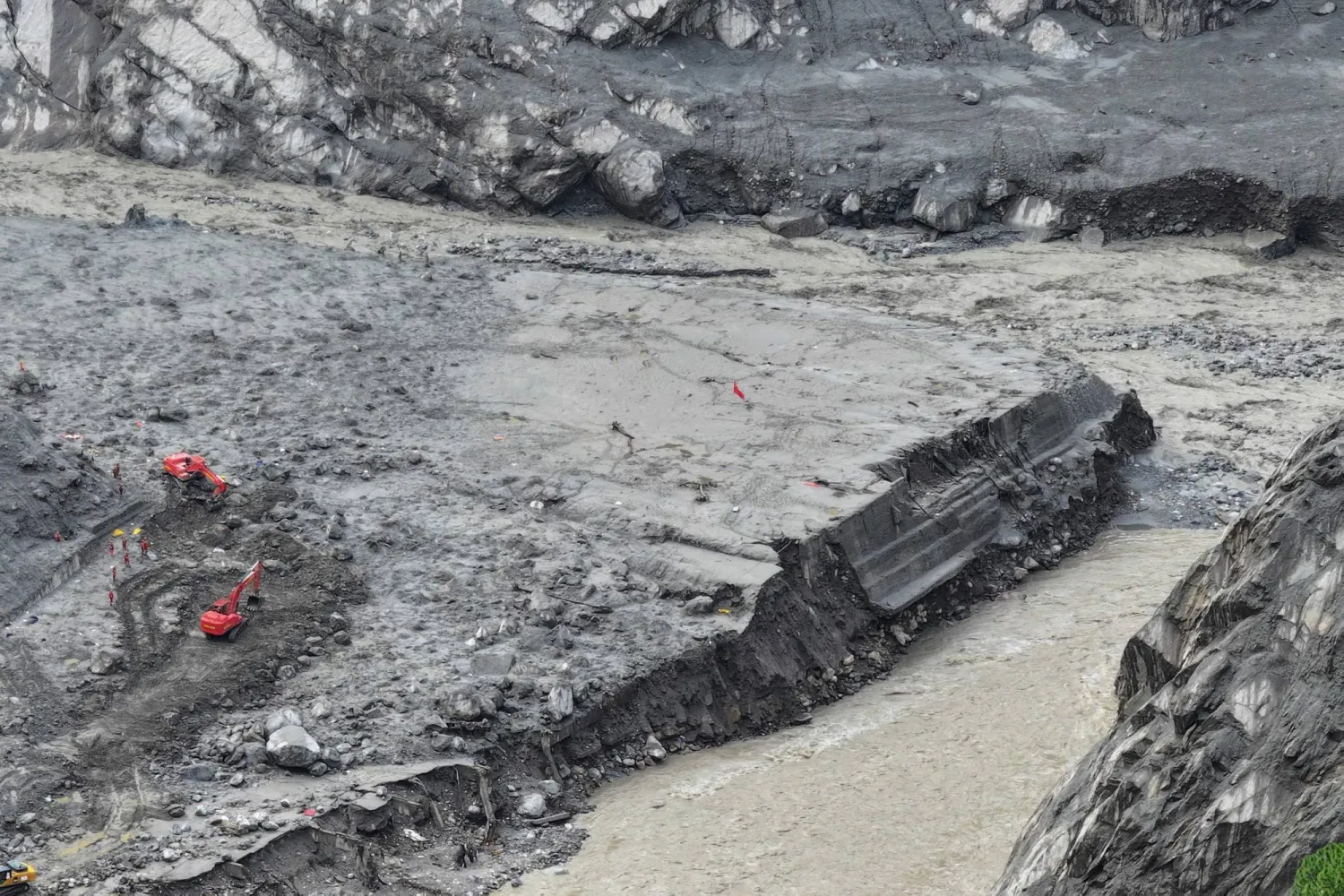
This aerial photo shows rescuers at the site of the Gyirong Port, which was destroyed by a mudslide on August 26, in Gyirong County, in China's western Tibet region on September 2, 2026. (CNS / AFP)
TT

China Restores Access to Tibet Disaster Zone as Highway Reopens

This aerial photo shows rescuers at the site of the Gyirong Port, which was destroyed by a mudslide on August 26, in Gyirong County, in China's western Tibet region on September 2, 2026. (CNS / AFP)

China has fully reopened the only road leading to the Gyirong border crossing into Nepal a week after sections were washed away by catastrophic flooding, allowing heavy machinery to reach the main disaster zone for the first time.

The extensive damage to the G216 national highway had meant that China had been airdropping equipment and supplies to frontline rescuers, some of whom trekked through the mountains to get to the site.

Large numbers ‌of heavy ‌machines have now reached the area where a Chinese border ‌inspection ⁠complex once stood, ⁠along with equipment to reinforce search operations, Chinese state broadcaster CCTV said.

Showing footage of rescue teams and excavators, CCTV said rescue crews equipped with life-detection devices and search dogs had been deployed.

Progress has been hampered by persistent rain and challenging terrain, as crews have to work in a narrow mountain gorge, hemmed in between unstable cliffs and a fast-flowing river.

Authorities, which have been monitoring upstream lakes that could cause more ⁠flooding if they burst, said those risks have diminished but ‌landslides were still a concern.

In Nepal, authorities ‌said hopes of finding more survivors were fading. At least 1,114 people have been killed ‌there and nearly 4,000 remain unaccounted for.

OVER 30 LATVIAN TOURISTS BELIEVED MISSING

Across ‌the border in Tibet, China's official death toll climbed to 21 on Wednesday, and 541 remained missing. Authorities previously said 104 Nepali citizens, 49 Indians, 33 Latvians and six Canadians were among the people missing.

Karlis Eihenbaums, Latvia's ambassador to China, said the country's embassy was ‌in permanent contact with the Chinese foreign ministry and authorities in Tibet for updates.

Embassy personnel have not sought to ⁠visit the ⁠Tibetan disaster site as information received from Nepal suggested the missing Latvians could have been swept away to the Nepali side, he said.

Canada said in a statement on Tuesday that its officials were in regular contact with representatives of China's foreign ministry, who have confirmed that response efforts continue to locate missing Canadians in Gyirong County.

Much of the information about the disaster in Tibet has only been made available through specific sources, mainly China's state-controlled media.

When asked on Tuesday why the Chinese government had not allowed foreign journalists to visit the disaster zone, the foreign ministry cited loss of access to roads and communication in the area as well as major safety risks from secondary disasters.

US Treasury Issues $1 Coin with Trump’s Face on It

The US Mint has started producing a new $1 coin featuring President Donald Trump's image. (AP Graphic/Treasury Department, File)
TT

US Treasury Issues $1 Coin with Trump’s Face on It

The US Mint has started producing a new $1 coin featuring President Donald Trump's image. (AP Graphic/Treasury Department, File)

The US Treasury on Wednesday issued $1 coins featuring the face of President Donald Trump, the latest move in an unprecedented campaign by the Republican billionaire to put his personal stamp on national institutions.

The coins were minted to mark the 250th anniversary of the founding of the United States celebrated this year.

A roll of 25 $1 coins was available for sale for $61 -- a mark-up of 144 percent -- with a 100-coin bag available for $154.50.

When the Treasury announced the plan it was unclear if the coins would have monetary value or would be purely commemorative, but on Wednesday the US Mint said the coins were "also in circulation."

The move to put Trump's countenance on a coin with monetary value runs counter to federal law that says no living president may appear on US currency.

Trump has aggressively defied precedent and legal challenges in his push to remake US institutions in his second term, putting his name on the Kennedy Center for the Arts and demolishing the East Wing of the White House to make room for a new ballroom, among other moves.

The new coin features Trump's face on one side, with the words "Liberty" and "In God We Trust." It also features the dates 1776-2026, marking 250 years of US independence.

The other side of the coin features a version of the US presidential seal, depicting an eagle clutching arrows and an olive branch while covered by a shield that says "250."

This is just the latest in Trump's campaign to put his face and name on US currency.

In May, Treasury Secretary Scott Bessent said his department was pursuing a plan to issue a new $250 bill with Trump's face on it.

He conceded that the move would require Congress to change the law barring living persons from appearing on currency.

The US Treasury did not immediately respond to a request for comment on whether the new $1 coin violates that law.

In March, the Treasury announced that US paper money would soon bear Trump's signature -- another first for a sitting US president.


Türkiye’s Relations with Russia, China Don’t Mean Turning Its Back on the West, Erdogan Says

Turkish President Recep Tayyip Erdogan meets with Russian President Vladimir Putin on the sidelines of the Shanghai Cooperation Organization (SCO) summit in Bishkek, Kyrgyzstan, September 1, 2026. (Murat Cetinmuhurdar/Turkish Presidential Press Office/Handout via Reuters)
TT

Türkiye’s Relations with Russia, China Don’t Mean Turning Its Back on the West, Erdogan Says

Turkish President Recep Tayyip Erdogan meets with Russian President Vladimir Putin on the sidelines of the Shanghai Cooperation Organization (SCO) summit in Bishkek, Kyrgyzstan, September 1, 2026. (Murat Cetinmuhurdar/Turkish Presidential Press Office/Handout via Reuters)

Türkiye is not backing away from the West as it seeks deeper ties with the East, Turkish President Recep Tayyip Erdogan said Wednesday as he headed back from a Shanghai Cooperation Organization summit.

The conference in Kyrgyzstan saw Erdogan hold a one-on-one meeting with Russian President Vladimir Putin at which they discussed further nuclear cooperation.

In comments made to journalists aboard the presidential plane, Erdogan reiterated Türkiye’s goal of becoming a full member of the Shanghai Cooperation Organization, or SCO, whose ten current members include Russia, China, India and Iran.

“I would also like to particularly emphasize that Türkiye’s membership perspective in the organization does not mean a break from a bloc or turning our backs on the West,” the president said.

Turning to the war in Ukraine, during which Ankara has maintained friendly relations with both Moscow and Kyiv, Erdogan said it was his and Putin’s “expectation ... that the war between Russia and Ukraine ends peacefully as soon as possible.”

He also underlined the importance of maritime security in the Black Sea, where civilian shipping has come under increasing attack.

“There is a need for a mechanism that will permanently ensure the safety of commercial maritime transport in the Black Sea,” Erdogan said, adding that it would be “beneficial” to prevent a “resurgence of the grain crisis.”

Türkiye brokered a grain deal in 2022 that opened Ukrainian ports and allowed the movement of Russian food and fertilizer. The agreement, which Putin pulled out of a year later, was vital for global food supplies, especially in Africa, the Middle East and Asia.

The SCO, founded in 2001, also includes Kazakhstan, Kyrgyzstan, Tajikistan, Uzbekistan, Pakistan and Belarus. The growing bloc has been billed as a counterweight to US global influence, although its goals and programs remain vague.


Apple Changes Lake Ontario Name to ‘Lake America’ for US Users of Its Maps, Following Trump’s Order

 The Toronto, Ontario skyline is seen across Lake Ontario from Fort Niagara State Park, Tuesday, Aug. 25, 2026, in Youngstown, NY. (AP)
The Toronto, Ontario skyline is seen across Lake Ontario from Fort Niagara State Park, Tuesday, Aug. 25, 2026, in Youngstown, NY. (AP)
TT

Apple Changes Lake Ontario Name to ‘Lake America’ for US Users of Its Maps, Following Trump’s Order

 The Toronto, Ontario skyline is seen across Lake Ontario from Fort Niagara State Park, Tuesday, Aug. 25, 2026, in Youngstown, NY. (AP)
The Toronto, Ontario skyline is seen across Lake Ontario from Fort Niagara State Park, Tuesday, Aug. 25, 2026, in Youngstown, NY. (AP)

Apple has relabeled Lake Ontario to “Lake America” for US users of its Maps app, following competitor Google days after President Donald Trump ordered a new name for the body of water amid his escalating trade war with Canada.

As of Wednesday morning, Apple Maps displayed “Lake America” for US users looking at the lake that sits between the state of New York and Canada’s Ontario province. Users outside of the US still saw the Lake Ontario name.

Apple did not immediately respond to a request for comment on Wednesday. Earlier this week, Interior Secretary Doug Burgum told Fox that Trump had reached out to the company “directly” about the change.

The president declared the new “Lake America” name last week, marking one of the latest provocations during his trade war with Canada that is now hiking tariffs on both sides of the border. His executive order on Friday directed the Interior Department to update the lake’s name in the US geographic naming service.

Google Maps rolled out the change over the weekend, citing Trump's order and its already-established practice of using names assigned by the US Geographic Names Information System (or GNIS).

“People using Maps in the US will see ‘Lake America,’ those in Canada will continue to see ‘Lake Ontario,’ and those outside of the US and Canada will see both names,” Google said in a brief statement on Saturday, reiterating that such updates “follow our long-standing policy for bodies of water with names that vary from country to country.”

Trump cannot force Canada to also change the name of Lake Ontario. And America’s northern neighbors quickly panned the idea.

“It’s Lake Ontario to Canadians and the rest of the world. Now and forever," Ontario Premier Doug Ford wrote on social media Friday.

Canadian Prime Minister Mark Carney also rejected the move last week, invoking the lake’s Indigenous roots and noting that the name predates both the Canadian Confederation and US Declaration of Independence. The name Lake Ontario comes from the Huron Indigenous people’s word “oniatarí:io,” which means “lake of shining waters.”

This isn’t the first time Trump has moved to rename water spanning beyond US borders. Last year, Trump ordered that the Gulf of Mexico be renamed the Gulf of America and both Apple and Google later updated the name on their maps in the US.

But not all map providers have followed suit. MapQuest, in particular, has declared it won't be changing Lake Ontario's label and gave users the option to name the lake “whatever you want" through a separate online tool. Both the Lake Ontario and Gulf of Mexico names still appear as default on its platform.