

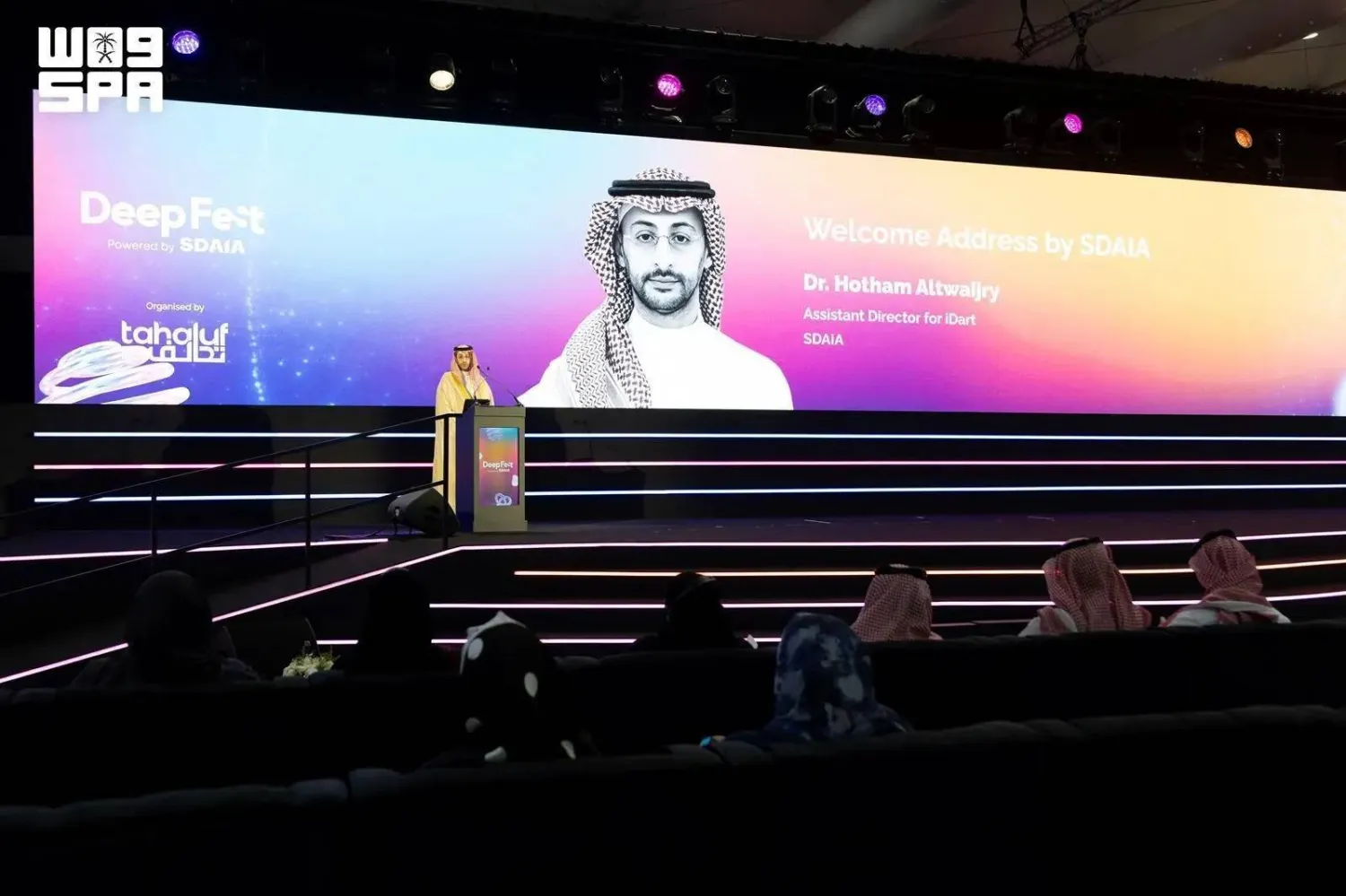

Deputy CEO of NCAI Highlights AI’s Future at DeepFest 2026

Deputy CEO of the National Center for Artificial Intelligence (NCAI) Dr. Hotham Altwaijry said the future of AI will be shaped by countries that can maximize the value of their technologies.(SPA)
TT

Deputy CEO of NCAI Highlights AI’s Future at DeepFest 2026

Deputy CEO of the National Center for Artificial Intelligence (NCAI) Dr. Hotham Altwaijry said the future of AI will be shaped by countries that can maximize the value of their technologies.(SPA)

Deputy CEO of the National Center for Artificial Intelligence (NCAI) Dr. Hotham Altwaijry said the future of AI will be shaped by countries that can maximize the value of their technologies. He explained that the current phase requires greater focus on using AI optimally and harnessing its potential to achieve tangible impact that benefits humanity and society, the Saudi Press Agency said on Friday.

His remarks came during the opening session of the fourth and final day of DeepFest 2026. He highlighted the evolving relationship between humans and AI, as well as technology's role in enhancing human capabilities and improving experiences.

Altwaijry explained that SDAIA recognized early on that a meaningful partnership between humans and AI cannot be achieved through algorithms, models, and technical concepts alone. Rather, it requires enabling individuals to experience AI’s potential firsthand.

He noted that AI has now become an integral part of today’s work environments, contributing to software development and testing, analyzing and preparing business requirements, and giving individuals greater space to focus on user experience, creativity, and exploring new ideas and solutions.



Abu Dhabi AI Institute Releases Fully Open-Source Models With Training Data, Code

A view of the UAE capital, Abu Dhabi (Asharq Al-Awsat)
TT

Abu Dhabi AI Institute Releases Fully Open-Source Models With Training Data, Code

A view of the UAE capital, Abu Dhabi (Asharq Al-Awsat)

Abu Dhabi-based research institute IFM on Thursday released six artificial intelligence models together with the data and methods used to build them, challenging an industry trend toward increasingly secretive AI development.

The K2 Horizon release includes model weights, training data, code, methodologies and intermediate checkpoints, allowing researchers to retrace the models' development process and reproduce results, IFM founder Eric Xing told Reuters.

The move goes beyond the "open-weight" approach used by some Chinese developers, which make models available for download but provide limited insight into how they were built, and contrasts with the more closed development practices of companies such as OpenAI and Anthropic, which neither release their models for download nor disclose the data and techniques behind them.

"Our goal with this release is to establish a reference point for what a truly open model release can look like," Xing said.

He said the release was also intended to show policymakers, regulators and public-interest advocates that "openness and competitive performance are not mutually exclusive."

The launch forms part of the UAE's push to establish itself as a global AI hub.

The model family ranges from one designed for smartwatches and other constrained devices to a 375-billion-parameter system for enterprise deployments.


Nvidia to Buy Hugging Face for $13 billion in Big Bet on Open AI Models

Nvidia's logo at its headquarters in Santa Clara, California (AFP)
TT

Nvidia to Buy Hugging Face for $13 billion in Big Bet on Open AI Models

Nvidia's logo at its headquarters in Santa Clara, California (AFP)

Nvidia will buy popular developer platform Hugging Face for $12.93 billion, betting that support for open AI models will drive future demand even as its biggest customers develop their own chips to reduce reliance on the semiconductor giant.

Shares of the company were slightly higher after the deal on Thursday, which ranks among its biggest.

The deal will cement Nvidia as a central player in the market for open models that users can freely download, run and customize, unlike the closed systems built by OpenAI and Anthropic.

Nvidia has already played an active role in backing the open AI industry with its widely used Nemotron model. Acquiring Hugging Face will give it direct access to a platform developers use to collaborate, test and share tools, potentially providing valuable insight and data that could help it narrow the technology gap with top American and Chinese labs.

Demand for open-weight models has surged from businesses balking at the steep bill of deploying the technology, with Chinese companies such as DeepSeek and Z.ai emerging as crucial players with models that can match the best from the US in tasks, including generating computer code at a lower cost.

That surge has fueled fears that some American firms could become reliant on Beijing's models even as both countries race to dominate a technology they see as crucial to their future.

"Hugging Face will remain an open platform for the entire AI ecosystem," Nvidia CEO Jensen Huang said, adding that his company's chips would not be required to build on or deploy through Hugging Face.

Under the deal, Nvidia will pay about $11.9 billion to Hugging Face investors, while offering an equity-based retention program of up to $1 billion for employees who join Nvidia.

The two companies already work together to help developers use Nvidia's computing services on the platform.

For Nvidia, building up open source may help it cushion a demand slowdown from customers such as Meta, OpenAI and Microsoft, which are developing their own AI chips to cut reliance on its costly and supply-constrained processors.

Hugging Face has also been in the news recently after a hack by rogue AI agents that escaped OpenAI's testing environment. Beyond hosting AI models, it offers datasets, software libraries and cloud services used to build and deploy AI applications.

The New York-based startup, which is backed by Intel , Advanced Micro Devices and Amazon, was founded in 2016 by French entrepreneurs Clément Delangue, Julien Chaumond and Thomas Wolf.


Robot Brings Cashier and Service-Host Functions to LEAP 2026

LEAP 2026 is showcasing an emerging Saudi experience in artificial intelligence (AI) and robotics through a robot named RoboNex, designed to combine cashier and service-host functions in the restaurant and café sector. (SPA)
TT

Robot Brings Cashier and Service-Host Functions to LEAP 2026

LEAP 2026 is showcasing an emerging Saudi experience in artificial intelligence (AI) and robotics through a robot named RoboNex, designed to combine cashier and service-host functions in the restaurant and café sector. (SPA)

LEAP 2026 is showcasing an emerging Saudi experience in artificial intelligence (AI) and robotics through a robot named RoboNex, designed to combine cashier and service-host functions in the restaurant and café sector. The robot interacts with customers in real time, takes their orders and provides smart recommendations, the Saudi Press Agency said on Thursday.

The robot’s development took place in Saudi Arabia, starting with structural design and component engineering and progressing to controller programming, AI algorithms, voice-processing systems and real-time interaction. It was also integrated with point-of-sale systems and electronic payment gateways.

The robot can handle sales transactions and take customer orders, while recommending additional products based on items already in the shopping basket. It can display specified discounts and promotional offers during the purchasing journey.

The presence of robots at LEAP 2026 highlights the growing adoption of AI and robotics across industries, as these technologies move beyond experimental concepts toward real-world applications in business, services and retail.