US Diesel Prices Hit New High amid Iran War Disruption

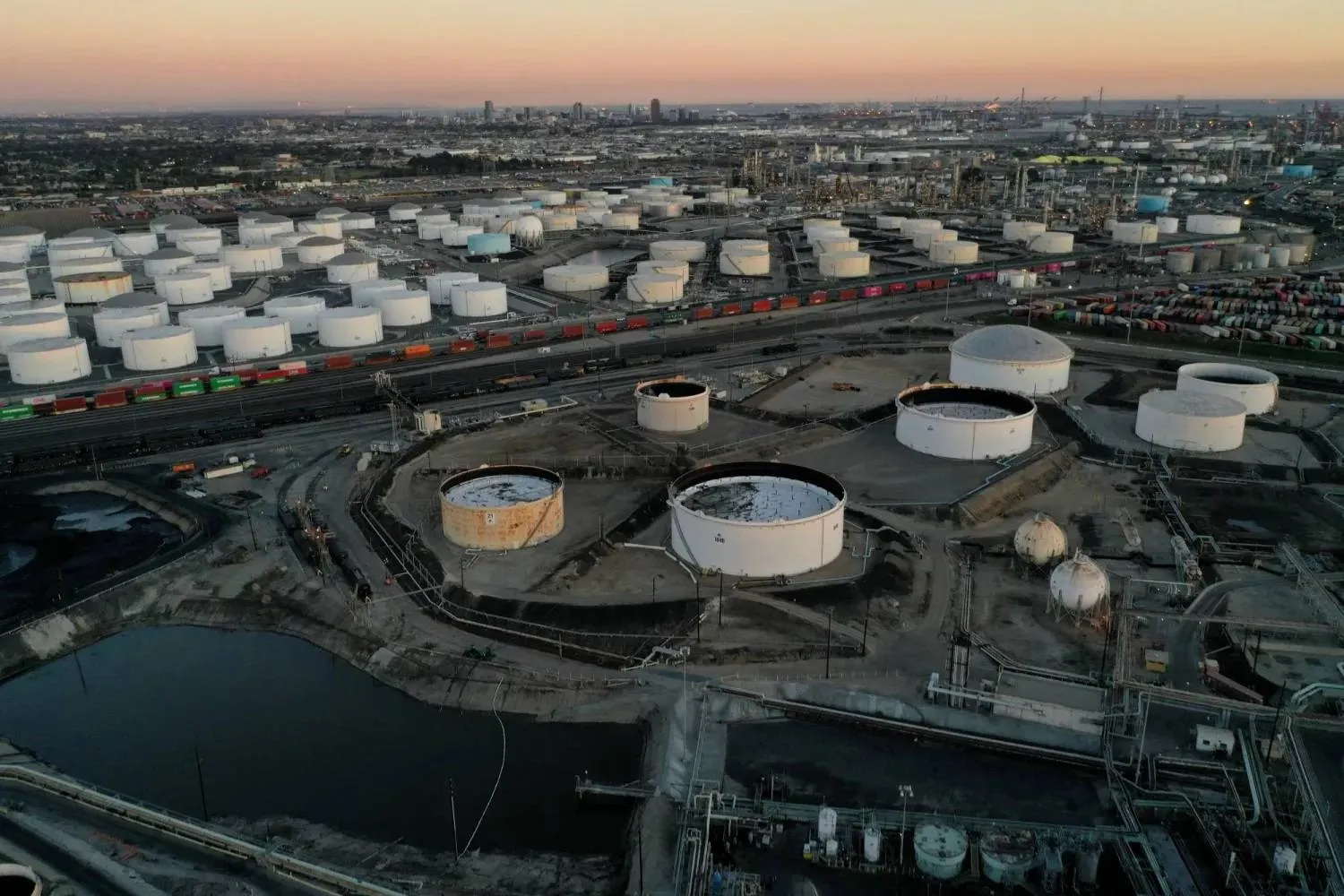
Crude oil, gasoline, and diesel storage tanks at the Kinder Morgan terminal in Los Angeles (Reuters)
TT

US Diesel Prices Hit New High amid Iran War Disruption

Crude oil, gasoline, and diesel storage tanks at the Kinder Morgan terminal in Los Angeles (Reuters)

The price of diesel -- the vital fuel used for road hauling, agriculture and construction -- hit a new record in the United States on Friday, the AAA motorists' association said amid disruption from the US war with Iran.

The price is now $5.85 a gallon, up from $3.71 a year ago, the AAA said.

Because diesel is used for many freight and delivery networks, higher diesel prices mean higher transportation costs for a long list of everyday goods.

This could add to Republicans’ political challenges ahead of November’s midterm elections, with voters already sour on President Donald Trump’s management of the economy. AP-NORC polling this summer showed two out of three U.S. adults disapproved of how Trump is handling the economy.

More expensive fuel is increasing bills for businesses across sectors — some of which have already passed on costs to consumers in the form of added fees on online orders and packages in the mail. And shoppers may see more and more sticker shock trickle down to store shelves.

One of the most immediate strains is being felt in the grocery aisle, particularly with produce, meat and other perishable foods that need to be hauled in and restocked frequently — or even harvested using diesel-powered farm equipment. It can take time for all of those costs to trickle down.

Still, experts warn that price hikes could mount the longer diesel remains expensive. A range of other products are also transported by diesel trucks, trains and boats, including clothing, cosmetics, furniture and more.

The price for regular gasoline has also been going up, although not as fast as the price of diesel. The average price was $4.15 a gallon, compared with $3.20 at this time last year, according to AAA, which says gas has never been above $4 a gallon on Labor Day. Prices for regular gasoline, however, are far from the record of $5.02 a gallon set in June 2022.


Gold Heads for Steep Weekly Loss as Oil Prices Fuel Fed Rate Concerns

British gold bars and Sovereign gold coins are displayed at Baird & Co. in Hatton Garden, London (Reuters)
TT

Gold Heads for Steep Weekly Loss as Oil Prices Fuel Fed Rate Concerns

British gold bars and Sovereign gold coins are displayed at Baird & Co. in Hatton Garden, London (Reuters)

Gold eased on Friday, headed for its steepest weekly decline in over four months as elevated oil prices bolstered higher-for-longer interest rate expectations, while investors awaited next week's Federal Reserve policy meeting.

Spot gold eased 0.1% to $4,021.04 per ounce by 0554 GMT, paring losses slightly after touching its lowest level since July 20 earlier in the session. The metal has fallen ‌3.6% so far ‌this week, putting it on track for ‌its ⁠worst week since June.

US ⁠gold futures for December delivery dropped 0.6% to $4,035.50.

Speculators are trying to defend the key $4,000 level for gold because a clean break below would signal that the market has stopped pricing rate relief and started pricing sticky inflation, elevated yields, and a stronger dollar, said Monte Safieddine, head of market research at Capital.com.

Oil ⁠prices rose on Friday after Houthi attacks in ‌Saudi Arabia stoked concerns of further ‌disruption to energy supplies from the Middle East.

Elevated energy prices bolster expectations ‌of higher-for-longer interest rates by the Fed, increasing the opportunity cost ‌of holding non-yielding bullion.

"Any further escalation on the geopolitical front risks pushing oil even higher. Higher oil is reviving inflation fears, lifting yields, and delaying Fed easing. That is a difficult cocktail for bullion," ‌Safieddine added.

Focus has turned to the Fed's October 27-28 policy meeting and next week's Personal ⁠Consumption Expenditures ⁠data, a closely watched gauge because it is the central bank's preferred inflation measure for its 2% inflation target.

Traders are largely expecting the central bank to leave interest rates unchanged next week, but expectations for an interest rate hike in December remain at 76%.

Meanwhile, analysts at HSBC cut their average 2026 platinum and palladium price forecasts in a research note on Thursday, citing shifting market fundamentals and investor liquidation.

Among other metals, spot silver slid 0.4% to $54.31 per ounce, platinum rose 0.3% to $1,574.33 and palladium gained 0.3% to $1,056.49.

However, all three metals were headed for weekly declines.


UK Govt Promises to Save Businesses £800 Million in Paperwork and Tariffs

 Britain's Prime Minister Andy Burnham meets pharmacy staff before receiving an annual seasonal flu vaccination at Kapoor Pharmacy Services in Chorlton-cum-Hardy in Manchester on October 22, 2026. (AFP)
Britain's Prime Minister Andy Burnham meets pharmacy staff before receiving an annual seasonal flu vaccination at Kapoor Pharmacy Services in Chorlton-cum-Hardy in Manchester on October 22, 2026. (AFP)
TT

UK Govt Promises to Save Businesses £800 Million in Paperwork and Tariffs

 Britain's Prime Minister Andy Burnham meets pharmacy staff before receiving an annual seasonal flu vaccination at Kapoor Pharmacy Services in Chorlton-cum-Hardy in Manchester on October 22, 2026. (AFP)
Britain's Prime Minister Andy Burnham meets pharmacy staff before receiving an annual seasonal flu vaccination at Kapoor Pharmacy Services in Chorlton-cum-Hardy in Manchester on October 22, 2026. (AFP)

British ‌Prime Minister Andy Burnham said on Friday his government would help businesses save almost £800 million ($1 billion) a year by cutting back on paperwork and extending the suspension of some trade tariffs.

Speaking ahead of his government's first annual budget statement ‌next week, Burnham ‌said the measures ‌would ⁠give businesses "breathing space to ⁠grow".

The changes would make compliance guidance simpler and easier for small firms, saving £290 million, and extend £155 million of import tariff suspensions on 250 products ⁠used by businesses, Britain's finance ‌ministry ‌said.

Another measure would reduce duplicative reporting ‌burdens for asset management firms, ‌saving £105 million, and remove £116 million in costs for businesses involved in residential property transactions, the government said in ‌a statement.

British finance minister John Healey is due ⁠to ⁠announce his first budget on Wednesday next week and he has promised to reduce the cost of business as well as help households with the high cost of living – though his ambitions will be limited by the fragile state of the public finances.


Oil Prices Rise as Supply Concerns Linger amid Middle East Attacks

Oil pumps operate after sunset outside Vaudoy-en-Brie, near Paris, France, March 18, 2026. (Reuters)
TT

Oil Prices Rise as Supply Concerns Linger amid Middle East Attacks

Oil pumps operate after sunset outside Vaudoy-en-Brie, near Paris, France, March 18, 2026. (Reuters)

Oil prices rose on Friday after Houthi attacks in Saudi Arabia stoked concerns of further disruption to energy supplies from the Middle East.

Brent crude futures climbed 58 cents, or 0.5%, to $113.75 a barrel as of 0439 GMT, while US West Texas Intermediate crude futures rose 66 cents, or 0.7%, to $100.13.

On a weekly basis, Brent, which settled at its highest since May 4 on Thursday, is set to close higher for a third ‌successive week, while WTI ‌is on track to finish lower, ‌following ⁠two weeks of gains.

"Markets are increasingly worried about renewed escalation in the Gulf, a scenario that could threaten oil ⁠flows that have so far remained remarkably ‌resilient," ING analysts said in a ‌note on Friday.

"Re-escalation seems the most likely path. Even ‌if tensions don't re-escalate, the mere possibility is likely ‌to keep a sizeable geopolitical risk premium embedded in prices."

"The key factors ⁠to monitor ⁠now are the extent of actual disruption and the time needed to restore operations, as these will ultimately determine how much of a supply risk premium the market is willing to pay," said Linh Tran, an analyst at XS.com.

"If attacks persist and delay deliveries, elevated prices will have a firmer foundation."

In Libya, an oil pipeline valve from the Hamada and Tahara oilfields to Zawiya port has been shut, leading to a reduction in production at both fields, the head of the National Oil Corporation told Reuters on Thursday.