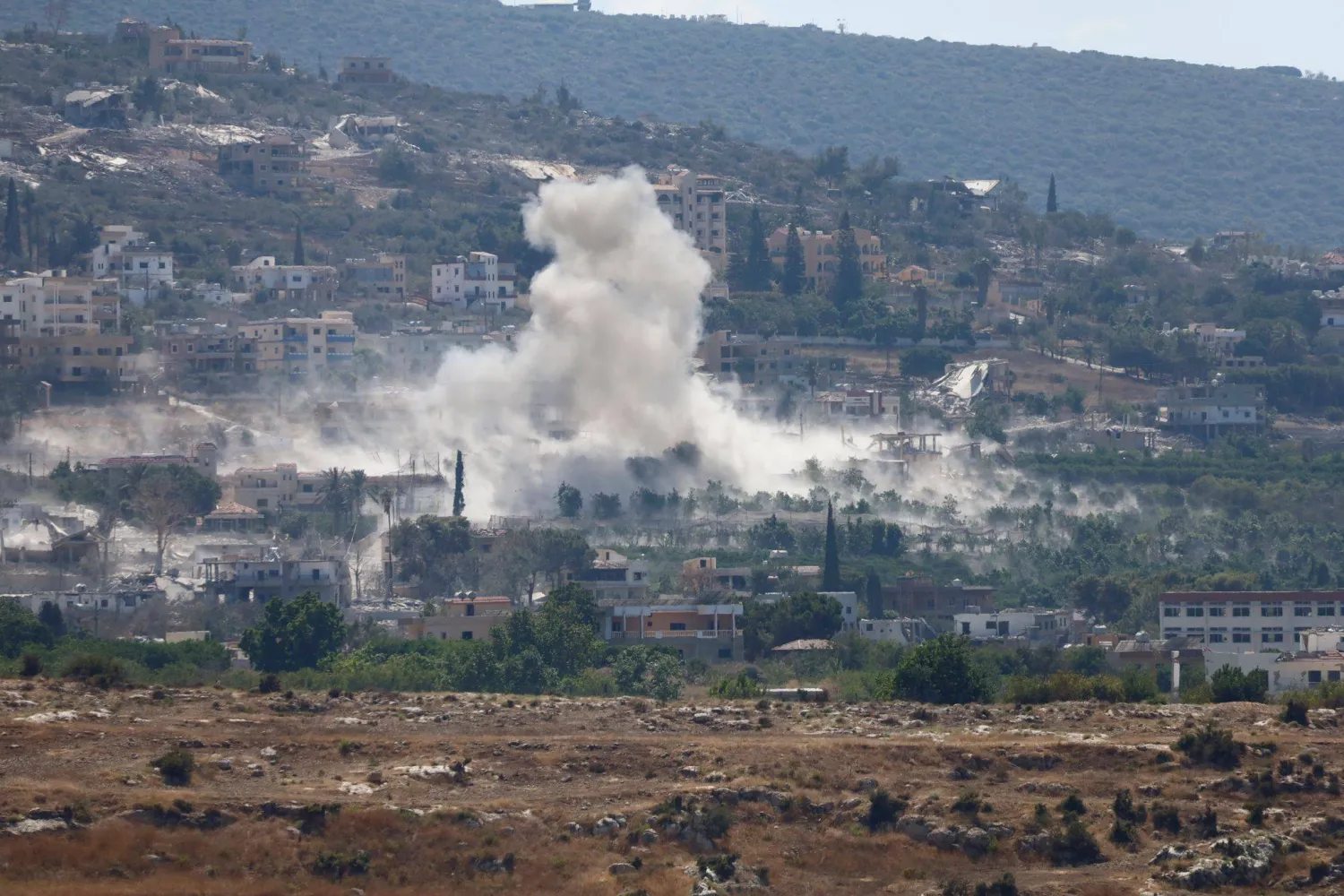
Lebanon Says Israeli Strikes Kill Four in South

04 September 2026, Lebanon, Tyre District: Smoke rises after Israeli forces carried out an explosion targeting homes in Mansouri, southern Lebanon. Photo: Abdul Kader Al Bay/ZUMA Press Wire/dpa
TT

Lebanon Says Israeli Strikes Kill Four in South

04 September 2026, Lebanon, Tyre District: Smoke rises after Israeli forces carried out an explosion targeting homes in Mansouri, southern Lebanon. Photo: Abdul Kader Al Bay/ZUMA Press Wire/dpa

Lebanon's health ministry said Israeli strikes on Sunday killed four people in the south, while Israel said it carried out raids after Hezbollah launched drones at its soldiers. 

The ministry reported two people killed in south Lebanon's Nabatieh al-Fawqa and two women killed in Arab Salim nearby. Twenty people were also wounded in several locations, including women and three children. 

The Israeli military earlier said it was carrying out strikes in southern Lebanon after Hezbollah launched drones at its soldiers, and urged residents of the town of Arab Salim to evacuate. 

The Israeli army said in statement that “terrorists from the Hezbollah terrorist organization launched two drones” towards the Israeli army “operating in the Security Zone in southern Lebanon” and that the military in response is now striking in southern Lebanon. It added that there were no reports of Israeli soldiers wounded.  

In another message, the Israeli military warned residents of Arab Salim to leave ahead of imminent attacks. 

"You are situated near a facility belonging to the terrorist organization Hezbollah, against which the Israeli army will be operating," it wrote in Arabic on Telegram. 

Lebanon was drawn into the Middle East war in March after Iran-backed Hezbollah attacked Israel, which responded with airstrikes and a ground invasion that Lebanon says have killed more than 4,300 people. 

Violence has lessened since a US-Iran memorandum of understanding on the broader conflict in June and a framework agreement between Israel and Lebanon later that month. 

Israeli forces are operating inside a self-declared "security zone" around 10 kilometers (six miles) deep inside Lebanon along the border. 

Authorities in Lebanon said on Saturday that Israeli strikes killed four people in the country's south and east. 


Syria Says Killed Leader of Armed Cell in Tartus

Members of Syria's Internal Security Forces. (SANA)
TT

Syria Says Killed Leader of Armed Cell in Tartus

Members of Syria's Internal Security Forces. (SANA)

Syrian authorities said on Tuesday that they had killed the leader of an armed cell linked to the former government and wounded another member during an operation in the countryside of Tartus.

In a statement, the Internal Security Forces said they had carried out a "carefully planned ambush" after monitoring the four-member group, which was allegedly planning to carry out "terrorist attacks and armed robberies".

The forces said the ensuing clash resulted in the "neutralization of the cell's leader" and the wounding of another member.

The forces confirmed that specialized units are continuing intensive sweep and pursuit operations across the surrounding rural areas to locate and apprehend the remaining fleeing members of the cell.

State security authorities reiterated their commitment to maintaining public order, eliminating remnants of illegal armed groups, and safeguarding civilian lives and property across all Syrian provinces.


Airstrikes, Artillery Fire Wear Down Houthis as Yemeni Army Seizes Strategic Positions

Yemeni army fighters on the Jabal Han front near the city of Taiz. (AFP)
TT

Airstrikes, Artillery Fire Wear Down Houthis as Yemeni Army Seizes Strategic Positions

Yemeni army fighters on the Jabal Han front near the city of Taiz. (AFP)

Yemeni government forces pressed ahead with Operation Dawn of Yemen on Tuesday, stepping up airstrikes, drone attacks and artillery fire against Houthi positions and reinforcements across several fronts, as troops seized more ground in Al-Jawf and fighting continued in Taiz, Dhale and Marib.

Government forces struck Houthi military vehicles and fighter concentrations on several fronts in Al-Jawf.

Combat units from the Emergency Forces and Nation's Shield forces also captured new strategic positions and commanding heights in the province, military spokesman Majed al-Nuzaili said.

The gains were part of an operation aimed at expanding government control in Al-Jawf, he added.

Houthi attacks repelled in Taiz, Dhale

Government forces in Dhale repelled a Houthi assault on their positions in the Hajar sector in the province's northwest, clashing with attackers below Jabal al-Hasha.

A military source said government troops beat back the assault, inflicting casualties and equipment losses and forcing the Houthi militants to retreat.

In Marib, artillery units shelled Houthi positions and vehicles on the northern front. Emergency Forces also struck Houthi fighters and gatherings, killing 16 and wounding others, according to military sources.

In the besieged city of Taiz, government troops and Popular Resistance fighters thwarted Houthi attacks on the Al-Aqroud and Al-Shaqab fronts southeast of the city on Monday.

A military source said Houthi fighters attempted to advance on army positions in Kahlan, but were repelled and suffered losses.

The Houthis also resumed shelling residential neighborhoods in east and north of Taiz, wounding a civilian and damaging homes and residential buildings.

Government forces retake strategic positions

Yemen's military said its latest operations included 17 airstrikes, 123 drone attacks, 60 rocket launcher strikes and 782 artillery attacks against Houthi positions and military assets.

Warplanes carried out 17 strikes against Houthi positions and military capabilities, while drones conducted 123 attacks across Al-Jawf, Marib, Al-Mudaribah and the southwestern front.

Rocket launcher units carried out 60 strikes, while field artillery launched 782 attacks targeting Houthi fortifications, artillery emplacements, sniper positions, troop concentrations and reinforcements.

Spokesman Al-Nuzaili said the strikes inflicted heavy casualties and equipment losses on the Houthis, forcing dozens of fighters to flee their positions in Al-Jawf, Marib and Taiz.


G7 Agrees on Need to Avoid ‘Security Void’ in Lebanon After UN Force Mandate Ends

Under US pressure, the UN Security Council voted last year to end UNIFIL's mandate on December 31, 2026. (AFP)
TT

G7 Agrees on Need to Avoid ‘Security Void’ in Lebanon After UN Force Mandate Ends

Under US pressure, the UN Security Council voted last year to end UNIFIL's mandate on December 31, 2026. (AFP)

G7 foreign ministers agreed on "the need to avoid a security void" in Lebanon after UN peacekeepers pull out, French Foreign Minister Jean-Noel Barrot said on Tuesday after a meeting of the group in Paris.

They also backed "the need to move quickly toward a new security architecture" after the mandate of United Nations peacekeeping forces in Israel's neighbor expires at the end of the year, he said.

But Barrot acknowledged there had been no breakthrough on what should replace the United Nations Interim Force in Lebanon (UNIFIL), which has been in place since 1978 and now counts some 7,500 personnel from nearly 50 countries.

Under US pressure, the UN Security Council voted last year to end UNIFIL's mandate on December 31, 2026.

EU foreign policy chief Kaja Kallas told AFP in October that the bloc favored a UN peacekeeping mandate in south Lebanon.

Lebanese group Hezbollah drew the country into the broader Middle East war by attacking Israel, which responded with massive airstrikes and a ground invasion that Lebanon says have killed more than 4,300 people.

"I am hopeful that we will reach a consensus," said Barrot. "The objective is widely shared: the withdrawal of Israel (from southern Lebanon), the disarmament of Hezbollah (which is pro-Iranian), and the restoration of a strong state that holds a monopoly on the use of arms -- a state capable of ensuring the security and prosperity of all the populations and all the communities in Lebanon."

Israel now maintains troops in a self-declared occupied "security zone" running around 10 kilometers (six miles) inside Lebanon along the border.

"We underscored the need for a robust, credible, and long-lasting security architecture in Lebanon in support of the Lebanese Armed Forces," the ministers said in their final communique.

US Secretary of State Marco Rubio said on Monday that he had discussed the issue with President Emmanuel Macron and suggested that what replaces UNIFIL "doesn't have to be a military mission, it could be a civilian mission."

"We need a verification system trusted by everyone and trusted by both sides that both sides are complying with their obligations under the agreements that are in place," Rubio said.

A transitional mechanism utilizing UNIFIL forces is among the options on the table, a European diplomat said, asking not to be named.

But this could require a UN Security Council resolution and thus run into an American veto, the diplomat warned.

The Europeans are also pushing a proposal for an international military coalition tasked with supporting the Lebanese Armed Forces in their mission to disarm Hezbollah.

However, the formation of such a coalition faces hesitation from Italy, which "remains strongly committed to its presence in Lebanon but appears reluctant to join an ad hoc coalition", partly due to cost concerns, as such missions are not funded by the UN, diplomats said.