


Chimpanzees Once Used for Vaccine Research Get Health Checks as Part of Long-term care

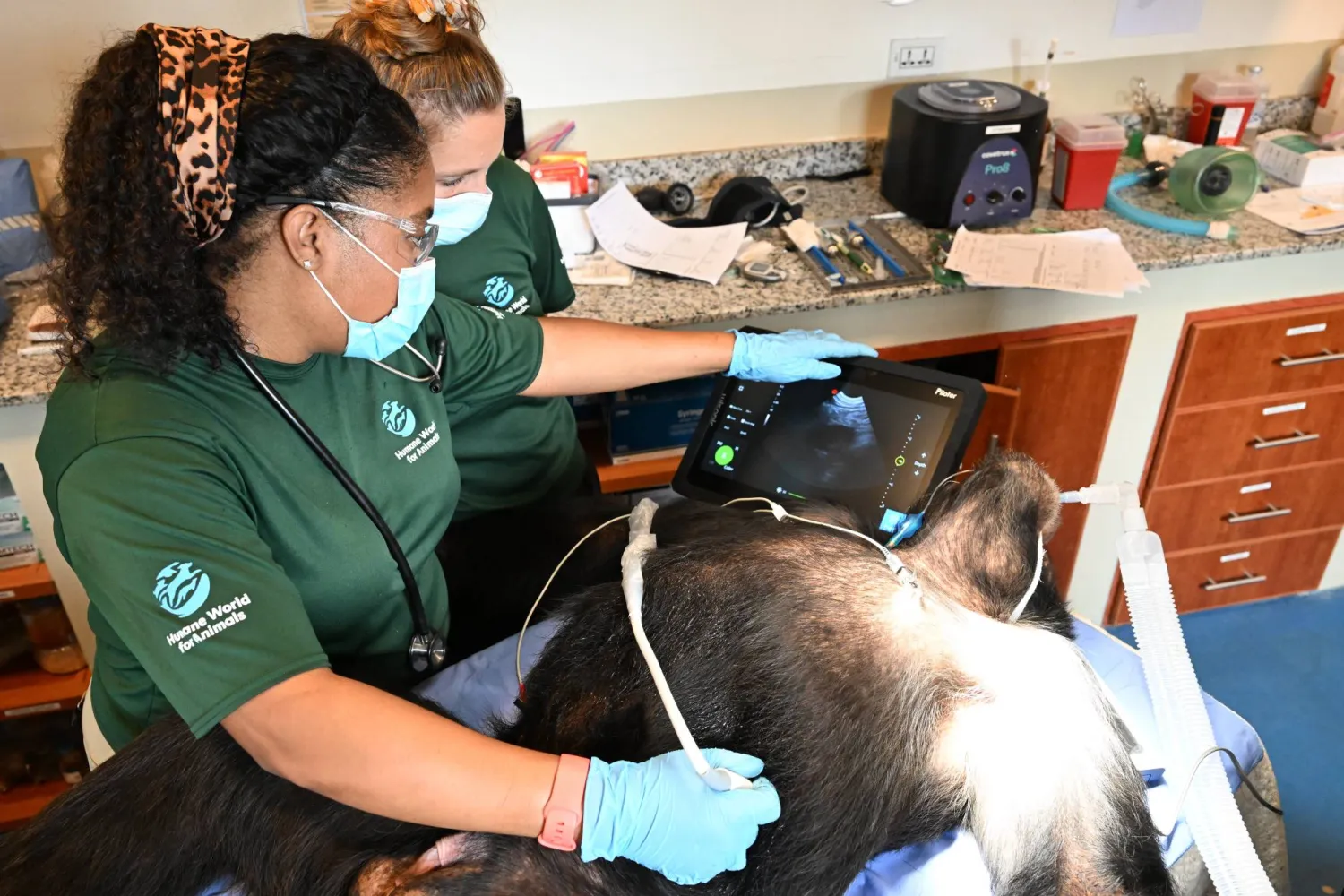
In this handout photo released by Humane World for Animals, a chimpanzee formerly used in research receives a comprehensive health check at a retirement sanctuary for chimpanzees, in Bapakwali, Liberia, on Aug. 25, 2026. (Humane World for Animals via AP)
TT

Chimpanzees Once Used for Vaccine Research Get Health Checks as Part of Long-term care

In this handout photo released by Humane World for Animals, a chimpanzee formerly used in research receives a comprehensive health check at a retirement sanctuary for chimpanzees, in Bapakwali, Liberia, on Aug. 25, 2026. (Humane World for Animals via AP)

A group of chimpanzees once used in laboratory hepatitis B vaccine experiments has received health checks at their new home in Liberia, in hopes of giving them a second chance at a normal life.

The West African chimpanzees received checks ranging from teeth cleaning to X-rays and pedicures at the Humane World for Animals’ Second Chance Chimpanzee Refuge in central Liberia, Liliana Pacheco Ricote, director of the sanctuary, told The Associated Press.

More than 400 of the chimpanzees had been used by American researchers in Liberia in the hepatitis B vaccine experiments from the 1970s until the early 2000s, Ricote said, many of them captured in the wild as infants.

Liberia has the second-highest number of chimpanzees in West Africa, after Guinea. The West African chimpanzees are classified as a critically endangered species because of their rapidly declining numbers.

“They were used in very invasive research ... (and) went through a lot of experiments and pain,” Ricote said.

Humane World for Animals said that in 2015, it assumed permanent responsibility for 60 of the chimpanzees that were remaining at the end of the research program. The chimps now mostly live at the sanctuary on a series of mangrove forest-covered islands.

The checks carried out under anesthetic gave the chimpanzees head-to-toe exams to assess their long-term health, detect any early signs of disease and tailor care plans as they age, Humane World for Animals said in a statement to the AP.

The tests included dental examinations, the heart, lungs, and nervous system, as well as blood tests. They get booster vaccinations and fingernail trims, it said, adding that plans are in place to carry out the checks on the remaining ones.

“The health checks are a vital part of caring for these chimpanzees who have been through so much,” said Belen Perez Hernando, the sanctuary’s veterinarian.

The chimpanzees’ experiences in the labs illustrate the broader risks animals face, according to Dr. Mark Ofua, a veterinarian and West Africa representative for the Wild Africa conservation group. “Animals used in research are rarely the intended beneficiaries, suffering confinement, social disruption, and lasting psychological and physical harm," he said.

Ofua called for strict regulations on animals used for experimental research, adding that reviews have found most chimpanzee experiments “made no significant contribution to developing treatments for human diseases.”

The extent of the experiments’ impact on the West African chimps, whose average age is 30 to 35, is unclear, as findings from the assessments are yet to be concluded. However, “for those who were under experiments, you could still feel the hurt and the pain that they went through,” Ricote said.

“Seeing how much they hurt about what we’ve done, it gives me a lot of pleasure ... to give them this second chance to live with dignity the life that they deserve,” she added.



Curtain Falls on the Romance of India's Single-screen Cinemas

Researchers estimate that India had around 14,000 single-screen halls in the 1980s. Only around 2,000 remain today. Idrees MOHAMMED / AFP
TT

Curtain Falls on the Romance of India's Single-screen Cinemas

Researchers estimate that India had around 14,000 single-screen halls in the 1980s. Only around 2,000 remain today. Idrees MOHAMMED / AFP

The demolition has begun at Bengaluru's Urvashi Cinema, once a 1,200-seat movie palace where generations of filmgoers cheered and whistled, another casualty of India's vanishing single-screen era.

"The theater came up in the 1970s... I was so happy when it opened," said Manjunath, watching as seats were ripped out and strewn outside.

Manjunath, who uses one name, recalled its glory days, when the shop he runs opposite was packed with customers buying snacks before and after shows.

"That was the rush... now I have a lot of free time," he said. "But what to do? There is barely any crowd."

The peeling facades, faded signs and cavernous auditoriums of such cinemas are remnants of a time when going to the movies was itself the main event.

"It is a completely different experience," said photographer Hemant Chaturvedi, 58, who has documented what remains during a seven-year odyssey, photographing 1,350 single-screen cinemas across 1,000 towns.

His photographs capture not only the movie houses but their ornate facades and decay -- a record of a cultural landscape disappearing as cinemas are demolished, converted into multiplexes or left to crumble.

- 'Ecosystem is fading' -

"People would be cheering, jumping on the seats, even throwing money at the screen," Chaturvedi said.

The old halls offered a collective, interactive experience, with fans applauding at the hero's entrance, clapping to romantic songs and shouting at dramatic twists.

"Now that old ecosystem is fading, and the charm is being lost," he said.

India's single-screen cinemas have been steadily squeezed by multiplexes, streaming, rising property costs and the expense of maintaining ageing buildings and equipment.

Researchers estimate that India had around 14,000 single-screen halls in the 1980s. Only around 2,000 remain today.

Many of the old halls could accommodate around 1,000 people, creating a communal atmosphere rarely found in today's multiplexes.

The decline has also changed the way Indians experience films. New halls offer air conditioning, reclining seats and food delivered to the seat.

"To me, the new cinemas have lost the charm," said Chaturvedi, a former Bollywood cinematographer who worked on hit movies during a three-decade career.

"The multiplexes are a generic, cold experience."

- 'Old times' -

Some of the old cinemas have been restored and renovated, and the single-screen experience still has its devotees.

In Bengaluru, Mukunda Cinemas still draws crowds -- even for early-morning shows before work.

Hundreds lined up before dawn for a recent 6:00 am screening of the latest release of film star Yash, who is hugely popular in India's Kannada-language cinema.

Santosh, a 47-year-old businessman who uses one name, queued with hundreds of others as crowds set off fireworks outside while waiting for the show.

"Only in the single screen theaters can they take the cinema to the next level, it increases the tradition of cinema," Santosh said, as cheers and whistles reverberated through the packed hall before the film began.

Veerain Reddy, the third generation of his family running the 50-year-old theater, said maintaining the establishment "was not an easy task".

Inflation, rising costs and "so much competition" have made business tough.

"But people who are really passionate are still trying to maintain these single-screen theaters, where people come to watch and celebrate cinema," he told AFP.

Another survivor in Mumbai -- formerly known as Bombay -- is the Regal Cinema, an Art Deco hall that opened in 1933.

"The rest of them feel very artificial, commercial, very blingy," said 23-year-old fan Vanshika. "But Bombay has little places which remind us of the old times."


GEA Chairman Announces October 21 Launch for Riyadh Season 2026

Turki Alalshikh, Chairman of Saudi Arabia’s General Entertainment Authority (Asharq Al-Awsat)
TT

GEA Chairman Announces October 21 Launch for Riyadh Season 2026

Turki Alalshikh, Chairman of Saudi Arabia’s General Entertainment Authority (Asharq Al-Awsat)

Chairman of the Board of Directors of the General Entertainment Authority (GEA) Turki Alalshikh announced that Riyadh Season 2026 will open on Wednesday, October 21, featuring a 10-week program of championships, concerts, performances, and entertainment experiences, the Saudi Press Agency reported on Saturday.

Alalshikh made the announcement in a promotional video previewing the season's sporting, entertainment, and arts events, which he said would reinforce Riyadh's standing as a destination for premier events and audiences from around the world.

The seventh edition's lineup includes world-class boxing and wrestling matches, UFC bouts, and the Six Kings Slam tennis tournament, alongside concerts, theatrical and comedy performances, and events designed for children and families.

Boulevard World returns as one of the season's principal zones, gathering global cultures and destinations in a single location, while Boulevard City opens with new content and Wonder Garden offers a range of rides and activities. Other zones and events include The Groves, the Farmers' Market, and the Ana Arabia exhibition at VIA Riyadh, with further programs spread across multiple locations in the capital.

The season runs under the theme "Big Time," drawing visitors from Saudi Arabia and abroad.


New Road Lanes Open in Makkah to Ease Congestion, Aid Pilgrims

The expansion includes an additional 1.5-kilometer stretch on the Third Ring Road connecting the Prince Mutib intersection to the Grand Mosque intersection via the Prince Sultan intersection - SPA
TT

New Road Lanes Open in Makkah to Ease Congestion, Aid Pilgrims

The expansion includes an additional 1.5-kilometer stretch on the Third Ring Road connecting the Prince Mutib intersection to the Grand Mosque intersection via the Prince Sultan intersection - SPA

The Royal Commission for Makkah City and Holy Sites has opened traffic on several newly developed lanes along the Third Ring Road and Prince Saud Al Faisal Road, reducing travel times by more than 90%.

The expansion includes an additional 1.5-kilometer stretch on the Third Ring Road connecting the Prince Mutib intersection to the Grand Mosque intersection via the Prince Sultan intersection, SPA reported.

Traffic flow was also inaugurated on the final section of Prince Saud Al Faisal Road, linking the Prince Mohammed bin Salman axis to Abdulqadir Koshak Street through the Prince Naif bin Abdulaziz intersection.

These openings are part of integrated infrastructure projects designed to ease traffic congestion, improve road safety, and streamline access for residents, visitors, and pilgrims during the Hajj and Umrah seasons.