


US Envoys Discuss with Putin 'Substantive' Plans for Steps to End Ukraine War

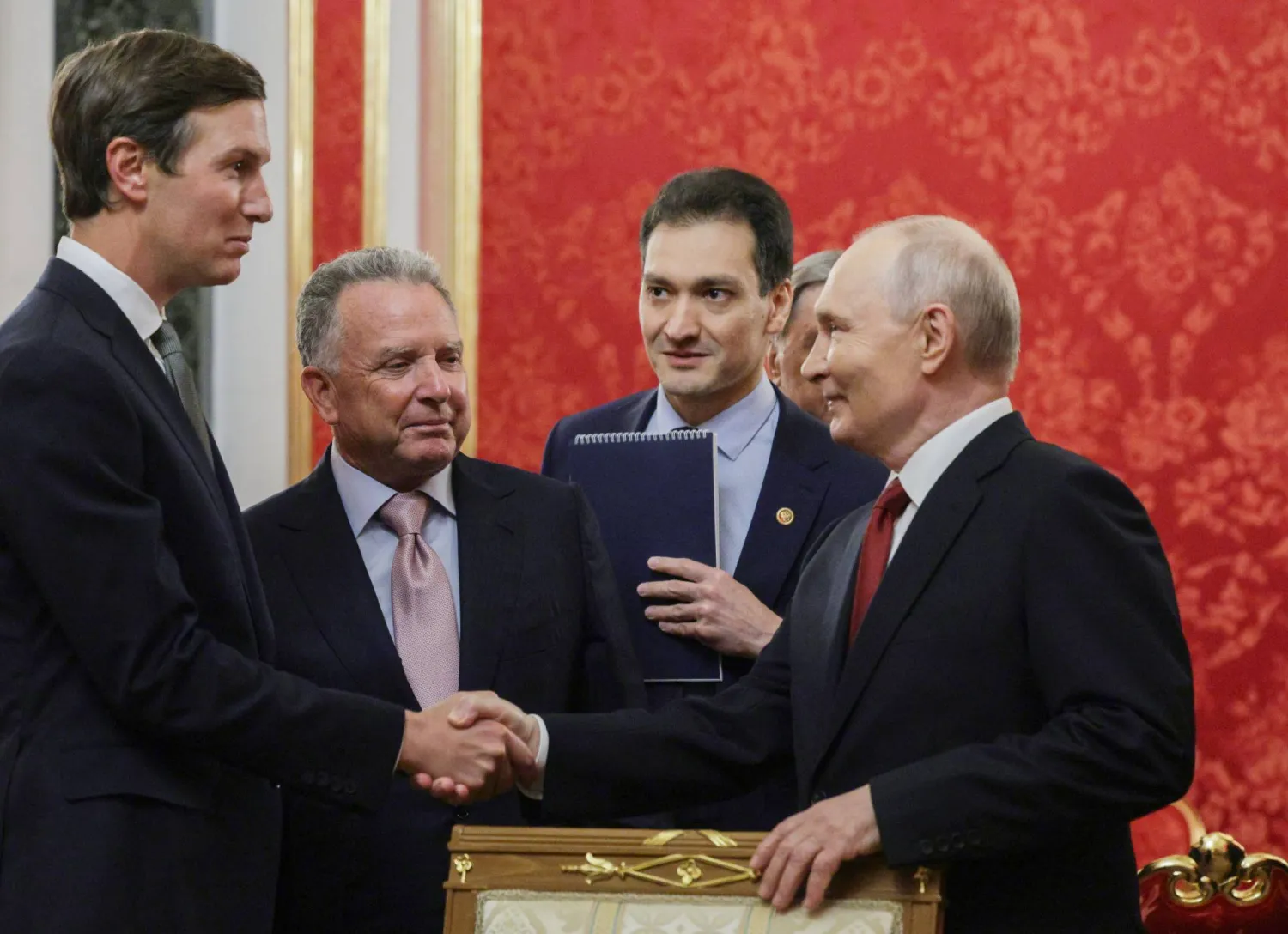
Russian President Vladimir Putin, right, greets US President Donald Trump's envoys Steve Witkoff, second left, and Jared Kushner prior to the talks at the Senate Palace of the Kremlin, in Moscow, on Saturday, Sept. 5, 2026. (Sputnik, Kremlin Pool Photo via AP)
TT

US Envoys Discuss with Putin 'Substantive' Plans for Steps to End Ukraine War

Russian President Vladimir Putin, right, greets US President Donald Trump's envoys Steve Witkoff, second left, and Jared Kushner prior to the talks at the Senate Palace of the Kremlin, in Moscow, on Saturday, Sept. 5, 2026. (Sputnik, Kremlin Pool Photo via AP)

American envoys discussed "substantive plans" for next steps to end the Ukraine war during their meeting with Russian President Vladimir Putin, the White House said, before they headed to Kyiv on Sunday.

US President Donald Trump's business partner Steve Witkoff and son-in-law Jared Kushner visited Moscow in hopes of reviving negotiations to end Europe's worst conflict since WWII.

The conflict began when Russia invaded Ukraine in 2022 and has already killed hundreds of thousands and displaced millions. It escalated this summer with a drastic rise in civilian deaths on both sides.

Witkoff and Kushner met with Putin on Saturday to "advance President Trump's agenda of peace in the Russia-Ukraine War," a White House official said in a statement to AFP.

"The two sides discussed substantive plans for next steps, which will be announced in the coming weeks, and look forward to equally productive meetings tomorrow in Ukraine."

Kremlin aide Yuri Ushakov called the talks "extremely frank", saying the Americans "put forward a number of ideas on possible routes to a settlement", but did not elaborate.

The Russian side told the Americans that Moscow was "confident" it could achieve its military goals of seizing the rest of eastern Ukraine, Ushakov added.

Both Russia and Ukraine have vowed not to strike each other's capitals for three days to allow for the negotiations to take place.

It was Kushner and Witkoff's eighth visit to Moscow during the war -- but it will be their first in the Ukrainian capital, hit by deadly Russian strikes throughout the war.

Russia's TASS news agency reported early Sunday that Witkoff and Kushner had arrived in Rzeszow in Poland on their way to Kyiv.

Ukrainian President Volodymyr Zelensky said he was expecting the envoys on Sunday.

Ukrainian airspace has been closed since Moscow launched the war in February 2022 and visiting leaders have been arriving by train.

- Putin thanks Trump -

In televised comments before the talks, Putin said Russia would ensure the safety of the envoys in Kyiv -- a city Moscow has pounded with deadly strikes throughout the war.

"We will do everything that depends on us to ensure the safety of the negotiation process and mediators such as yourselves," Putin told Witkoff and Kushner.

Earlier Saturday, Putin had thanked Trump for persisting in his efforts to end the war despite it being "not simple".

Of the envoys' trip to Kyiv, he said: "No matter what happens next, contacts of this kind are undoubtedly always beneficial."

Trump said on Friday his envoys were bringing a "proposal" to end fighting.

"We have an idea for peace," he said, without elaborating.

US efforts have so far not led to a breakthrough in the war, and peace efforts have stalled in part because of Washington's war with Iran.

Russia occupied large swathes of eastern and southern Ukraine, and Putin has insisted Moscow is intent on seizing the rest of eastern Ukraine.

- Limited truce -

Both Moscow and Kyiv committed to suspending strikes as the negotiations took place.

"The Russian president, the commander-in-chief, has given the order from midnight not to strike Kyiv for three days," Kremlin spokesman Dmitry Peskov said.

Zelensky said he had spoken to the US envoys and also promised Kyiv would not strike Moscow.

"From now through the end of Saturday, as well as on Sunday and Monday, Ukraine is ready to refrain from strikes on Moscow," Zelensky said.

On Saturday, Putin said he had "noted that the Ukrainian side significantly reduced" its strikes on Russia and Moscow.

However, Kyiv said that Russian strikes had killed 10 people across the country Saturday -- including a child and his family members in the Kharkiv region and two people outside Kyiv.

Zelensky accused Moscow of trying to disrupt the visit of the US envoys with overnight attacks on Kyiv's two airports, as well as on civilian targets.



Nepali Rescuers Buoyed by Miracle Finds but Tough Conditions Persist

Nepal Army personnel work to build an iron bridge across Tadi Khola river following the deadly flash floods and mudslide, in Devighat, Nuwakot district, Nepal, September 4, 2026. REUTERS/Adnan Abidi
TT

Nepali Rescuers Buoyed by Miracle Finds but Tough Conditions Persist

Nepal Army personnel work to build an iron bridge across Tadi Khola river following the deadly flash floods and mudslide, in Devighat, Nuwakot district, Nepal, September 4, 2026. REUTERS/Adnan Abidi

Nepali rescuers faced challenging conditions on Sunday as search operations after catastrophic floods entered their 12th day, buoyed by the extraordinary rescues of four survivors.

The glacial and mountain collapse on the China-Nepal border has killed at least 1,372 people and left more than 5,500 missing across the two countries, AFP said.

Rescuers found two more people alive on Saturday, joining two saved the day before in what have been described as miraculous tales of survival.

Three of those have been found in hydropower tunnels where the government initially said it believed more than 100 workers could be alive.

"Search and rescue is going on at the tunnels despite geography, adverse weather and lack of connectivity," Energy Minister Biraj Bhakta Shrestha told AFP.

Rescue workers were experiencing "multiple challenges", he said.

The wall of icy water and debris tore through mountain districts on August 26, destroying roads, bridges and other infrastructure.

On Saturday, rescuers pulled a Chinese man alive from deep inside a hydropower tunnel, and a 64-year-old Nepali woman, Chandrika Shrestha, from her mud-covered home.

Prime Minister Balendra Shah said the latter rescue had "given hope to the entire nation".

A day earlier, two Nepali hydropower workers were rescued at the Trishuli 3A tunnel, where searches continue alongside multiple other sites, with at least 12 hydropower projects affected.

Biraj Bhakta Shrestha said work was continuing to restore electricity in several areas.

"Places that have unreachable, we've tried to restore power with solar," he told AFP.

Foreign Minister Shisir Khanal has called the disaster a "Himalayan tsunami" and has warned reconstruction costs could run into the billions of dollars.

The United Nations has said the magnitude of the destruction makes delivering aid an immense challenge, and has launched a $50 million appeal to help more than 84,000 people.

With mortuaries overflowing, Nepal has buried hundreds of bodies in mass graves, after taking DNA samples for future identification, according to the police.

Only around 100 bodies have been identified and handed over to families.

Nepal will hold a national day of mourning on Monday, the 13th day since the disaster, in line with a traditional period of mourning in Hindu rituals.

While the exact cause of the glacial collapse is unclear, climate change is accelerating glacial melting worldwide, increasing the risk of such disasters.

In Nepal, rescuers have retrieved 1,341 bodies, while around 4,996 people remain missing, according to the disaster agency.

Chinese state media report that 31 people have been killed and 531 are missing in Tibet.

The combined toll is 1,372 dead and more than 5,500 missing, including around 800 foreigners, among them tourists and pilgrims.


Reports: Moscow Has Not Ruled Out Trilateral Meeting between Presidents of Russia, US, China

Russian President Vladimir Putin attends via video link the launch of the main pipeline of Rosneft's Vostok Oil project to the Sever Bay port terminal for tanker loading at the Kremlin in Moscow, Russia, 05 September 2026.  EPA/MIKHAIL METZEL/SPUTNIK/KREMLIN POOL
Russian President Vladimir Putin attends via video link the launch of the main pipeline of Rosneft's Vostok Oil project to the Sever Bay port terminal for tanker loading at the Kremlin in Moscow, Russia, 05 September 2026. EPA/MIKHAIL METZEL/SPUTNIK/KREMLIN POOL
TT

Reports: Moscow Has Not Ruled Out Trilateral Meeting between Presidents of Russia, US, China

Russian President Vladimir Putin attends via video link the launch of the main pipeline of Rosneft's Vostok Oil project to the Sever Bay port terminal for tanker loading at the Kremlin in Moscow, Russia, 05 September 2026.  EPA/MIKHAIL METZEL/SPUTNIK/KREMLIN POOL
Russian President Vladimir Putin attends via video link the launch of the main pipeline of Rosneft's Vostok Oil project to the Sever Bay port terminal for tanker loading at the Kremlin in Moscow, Russia, 05 September 2026. EPA/MIKHAIL METZEL/SPUTNIK/KREMLIN POOL

Russia's Deputy Foreign Minister Sergei Ryabkov said on Sunday that Moscow has not ruled out a trilateral meeting between the presidents of ‌Russia, the US ‌and China, ⁠state news agency TASS reported.

However, before moving on to the actual preparations for the meeting, it ⁠is necessary to understand ‌what ‌its agenda will be, Ryabkov ‌said.

"Here, the main ‌question boils down to how the substance of the meeting will be ‌formulated, and what we can expect as ⁠a result”, according to Reuters.

Earlier ⁠this month, Kremlin aide Yuri Ushakov raised the possibility of such a meeting between Vladimir Putin, Donald Trump and Xi Jinping at the Asia-Pacific Economic Cooperation summit in Shenzen, China, in November.


PKK Threatens to Halt Peace Process with Türkiye

PKK leaders in northern Iraq (Reuters)
TT

PKK Threatens to Halt Peace Process with Türkiye

PKK leaders in northern Iraq (Reuters)

PKK leaders in northern Iraq threatened to halt a peace process with Türkiye centered on the group’s dissolution and disarmament unless Ankara takes concrete steps toward democratic reform.

Cemil Bayik, a member of the Executive Council of the Kurdistan Communities Union (KCK), an umbrella organization that includes the Kurdistan Workers’ Party (PKK), said the initiative, which the Turkish government calls the “terrorism-free Türkiye,” would come to a halt unless democratic measures were introduced.

Bayik discussed the disarmament of the PKK as a condition for moving into the democratic political arena and integrating its members into Turkish society.

He criticized the National Solidarity and Social Integration Law, passed by the Turkish parliament on Aug. 10 and known as the “framework law,” saying it represented a beginning but remained “incomplete.”

Criticism and warning

Bayik said the rationale for enacting the law had not been made clear and that merely stating that terrorism would end had weakened it. He said the law’s purpose would have been clearer had it specified that laying down arms was linked to democratic measures.

“The language used in the law is deeply flawed,” Bayik said in remarks to the PKK-linked Firat News Agency that were carried by Turkish media on Saturday.

“We have made clear on every occasion that this process is not limited to disarmament. It is important to spell out the democratic steps that disarmament requires, because arms will be laid down in order to enter a democratic political arena,” he said.

Bayik said another important issue was the status of PKK leader Abdullah Ocalan and the group’s senior cadres.

Excluding the leadership and a large number of cadres involved in the process from the framework law was a serious problem, he said, adding that the issue must also be resolved for those who would return to Türkiye.

The law, approved by Turkish President Tayyip Erdogan on Aug. 18, provides for deferred sentences, the suspension of prosecutions and the conditional return of PKK members who surrender their weapons.

However, according to information that has emerged, it excludes 230 senior figures who will not be allowed to return and may instead be housed in a safe zone in Sulaimaniya in northern Iraq.

In an explicit warning that the process could be halted, Bayik said: “If the process falters because democratic steps are absent, the responsibility will lie with the Turkish government.

Democracy can provide a solution to the Kurdish issue, and through this law the government implicitly acknowledges these matters.

“If this process does not advance through democratic steps, it will be obstructed, and the government will bear responsibility.”

Bayik said parliament would “undoubtedly” be the decisive institution in resolving the Kurdish issue.

He called for constitutional and legal amendments recognizing the existence of the Kurds, their language, culture and political will, as well as their rights to local self-government, saying lasting peace could not be achieved without them.

Implementation steps

Bayik’s remarks came as work continued to establish four subcommittees approved at the first meeting of the National Solidarity and Integration Monitoring and Coordination Council on Aug. 24.

The council is chaired by Turkish Vice President Cevdet Yilmaz and includes the ministers of justice, defense, interior and foreign affairs, as well as the intelligence chief, the secretary-general of the presidency and the secretary-general of the National Security Council.

Sources in the ruling Justice and Development Party (AK Party) said the four subcommittees — Judicial and Legal Coordination; Follow-up and Monitoring; Social Consensus and Integration; and Disarmament and Strategic Coordination — would be formed, and their working mechanisms would be determined during September.

The sources, however, ruled out granting Ocalan formal status or direct membership in any committee.

They said Ocalan could contribute in particular to the work of the Disarmament and Strategic Coordination Committee because of his important role in the disarmament phase.

The Kurdish side and the head of the Nationalist Movement Party, an ally of the ruling party, have repeatedly called for Ocalan to be appointed as general coordinator for political participation and integration.

At the same time, Turkish media reports said a security mechanism established among Ankara, Baghdad, Erbil and Sulaimaniya would work intensively until the Turkish parliament begins its new legislative session on Oct. 1.

The mechanism will seek to confirm whether the PKK has withdrawn from 72 positions along the Turkish-Iraqi border and whether the Kurdistan Regional Government has been notified about underground depots containing weapons and heavy ammunition.

Turkish intelligence will verify the information.

Under the plan, camps and caves extending to the Qandil Mountains, including those in the Metina, Zap, Avasin, Basyan and Haftanin areas, will be evacuated by Oct. 1.

About 3,800 PKK members at 18 camps will surrender their weapons. Iraqi border guards and Peshmerga forces will be deployed, particularly in areas near the Turkish border, with the Baghdad and Erbil administrations cooperating in those locations.

Türkiye’s Nefes newspaper, citing unidentified sources, said weapons would be surrendered in the towns of Amedi and Kani Masi in Duhok; at the foot of Mount Qandil and in the town of Koy Sanjaq in Erbil; and in the Ranya district and the town of Said Sadiq in Sulaimaniya.