


Israeli ‘Gray Line’ Plan Would See Withdrawal from Most Occupied Lebanese Territory

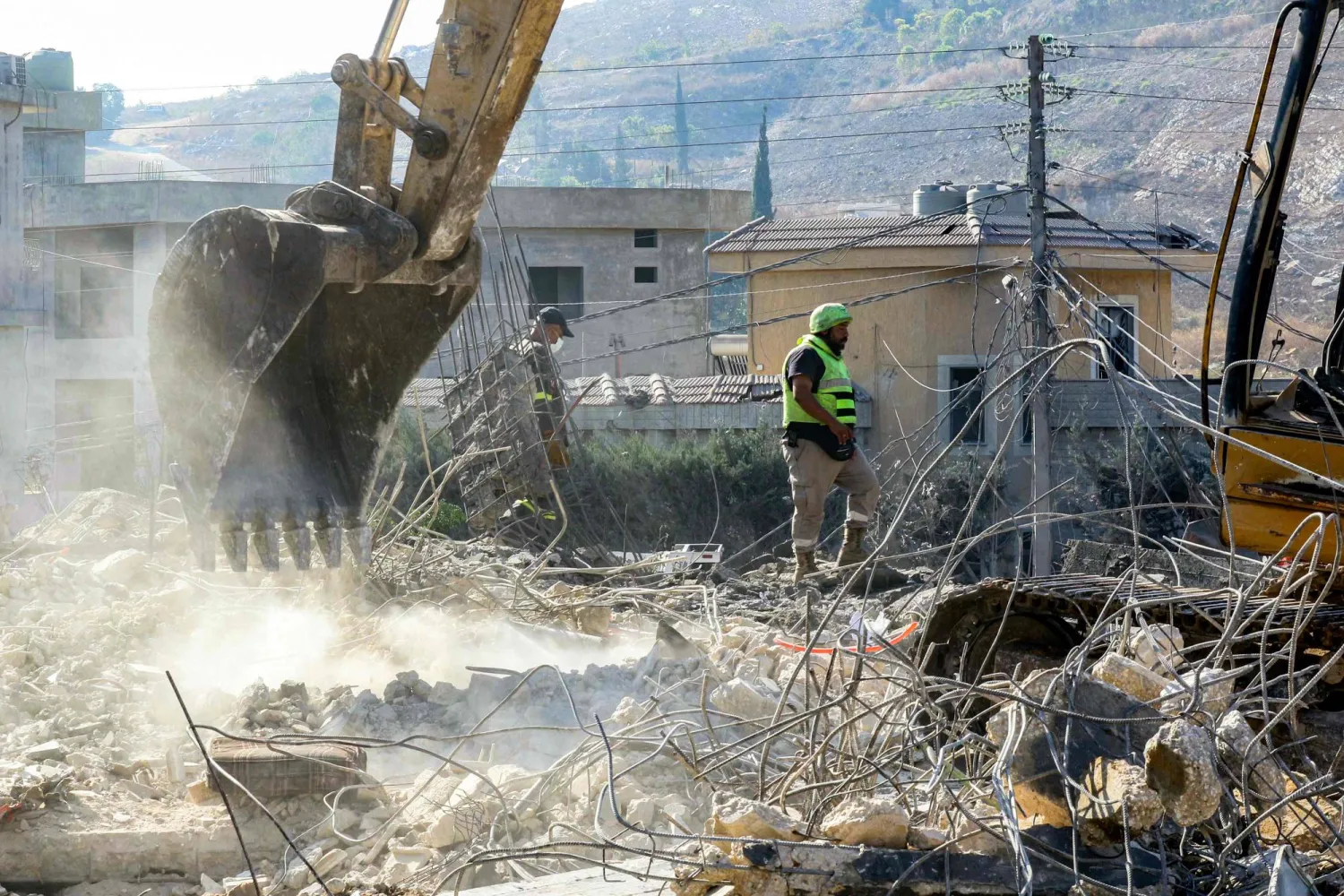
An excavator digs as rescuers search for survivors amidst the rubble following an overnight Israeli airstrike on the village of Kfar Rumman in southern Lebanon on September 7, 2026. (AFP)
TT

Israeli ‘Gray Line’ Plan Would See Withdrawal from Most Occupied Lebanese Territory

An excavator digs as rescuers search for survivors amidst the rubble following an overnight Israeli airstrike on the village of Kfar Rumman in southern Lebanon on September 7, 2026. (AFP)

An Israeli plan has emerged for a withdrawal from most occupied Lebanese territory, with troops remaining two to four kilometers inside Lebanon along what has been dubbed the “gray line,” replacing the currently occupied “yellow line.”

The plan comes after the Israeli military announced it had established operational control over the Ali al-Taher ridge in South Lebanon and begun destroying an underground tunnel complex built by Hezbollah.

Israeli officials are now speaking of “sensitive days” ahead on the northern front that could send the region down one of two sharply different paths: Hezbollah, and possibly Iran, could retaliate and reignite the war, or they could absorb the blow, allowing the Israeli military to withdraw from the ridge and the “yellow line” and establish a new security belt along the “gray line.”

Under that scenario, Israel would retain control of Lebanese territory extending two to four kilometers from the international border.

Israeli military sources cited by public broadcaster Kan 11 said that after establishing “operational control” and clearing tunnels and other underground infrastructure on the Ali al-Taher ridge, the military was preparing to reduce and redeploy its forces, pulling back to a new “security belt” closer to the Israeli-Lebanese border.

‘Gray line’

According to Kan 11, Israeli security officials have held discussions in recent days on establishing a new security zone closer to the border from which the military would protect Israeli border communities.

Under the proposal, Israeli forces would withdraw from the current “yellow line,” which encompasses a broader security zone and in some areas extends north of the Litani River, including Beaufort Castle and the Ali al-Taher ridge. Troops would instead deploy closer to the border.

Israeli military positions would remain inside Lebanese territory and could serve as staging points for operations deeper into Lebanon if Hezbollah activity were detected.

The military is expected to ask the Israeli government to capitalize on the new situation by reaching a political agreement with Beirut that would establish understandings on Hezbollah’s disarmament.

Hezbollah Secretary-General Naim Qassem has said the group would hand its weapons only to the Lebanese state as part of practical steps demonstrating an Israeli withdrawal from Lebanese territory, insisting there could be no disarmament without a withdrawal.

Israel is setting specific conditions, including that the Lebanese Army take control of evacuated areas and commit to preventing Hezbollah from returning to its positions in the south. Israel also wants an agreed mechanism allowing it to monitor the process and intervene militarily to prevent Hezbollah’s return if the Lebanese Army fails to do so.

Kan 11 reported that the plan remains incomplete and has not yet been approved by Israel’s political leadership. Questions remain, particularly over transferring control to the Lebanese Army and negotiations between the two countries, but the plan envisages a substantial reduction in Israeli forces inside Lebanon.



Hamas Members Struggle to Spend Cash Salaries

A Palestinian gives a child a sip of water from a bag bought for one shekel amid extreme heat in Gaza City in August 2025 (AP) 
TT

Hamas Members Struggle to Spend Cash Salaries

A Palestinian gives a child a sip of water from a bag bought for one shekel amid extreme heat in Gaza City in August 2025 (AP) 

Until three weeks ago, merchants in the Gaza Strip were still accepting cash from residents, even though much of it consisted of worn-out banknotes. But they began gradually refusing cash more than 10 days ago, hardening their stance over the past four days and turning instead to banking apps and electronic wallets.

The shift has coincided with intensified Israeli targeting and killing of Hamas financial officials in recent weeks, including some involved in delivering salaries to the group’s members.

Hamas employees told Asharq Al-Awsat that most government workers and members of its military wing, the Al-Qassam Brigades, receive their salaries in cash.

Several Hamas sources said government employees receive part of their salaries roughly every 100 days, amounting to only about 1,000 shekels ($328), often in worn banknotes. Al-Qassam members, meanwhile, are paid every 40 to 50 days, receiving up to around 60 percent of their salaries and no less than approximately 1,200 shekels, generally in banknotes in good condition.

People dealing with Gaza’s markets told Asharq Al-Awsat that some merchants had recently begun accepting cash from individuals and transferring the equivalent electronically through apps and e-wallets in exchange for commissions of up to 10 percent.

The crisis marks a reversal from the peak years of the war that began in October 2023, when Gazans struggled to convert money held in electronic wallets into cash. Commissions started at 10 percent and at times reached 60 percent before electronic transactions became more widespread.

In August, an Israeli military spokeswoman warned Palestinians in Gaza against using a category of old shekel banknotes marked with the letter “B,” in a move aimed at economically squeezing Hamas.

What Do We Do With Worn Banknotes?

Ahmed al-Najjar, 39, an employee of the Hamas-run government in Gaza, angrily questioned what employees were supposed to do with the worn banknotes they received.

“How long will things remain this way?” he told Asharq Al-Awsat. “We are the ones paying the price with our lives, and we find no one standing with us — neither officials nor merchants — while others fight us in different ways to make huge profits and gains.”

Israel has barred cash from entering Gaza since Oct. 7, 2023, while banks suffered major thefts during the war. Israeli security authorities also sought to impose conditions on Gaza merchants after periodically allowing goods into the enclave, requiring payments through electronic applications in a move aimed at restricting Hamas.

Under the new circumstances, Hamas appears to be facing a serious cash shortage affecting its members and employees, coinciding with repeated Israeli killings of funding sources, money changers and prominent figures in its financial apparatus.

Hamas Warns Merchants

The Hamas-run police in Gaza issued a general directive warning shopkeepers and others against refusing cash. It stressed that they must accept different types of banknotes, old and new, provided they are not damaged, and threatened violators with strict legal measures.

A Hamas police official told Asharq Al-Awsat that the issue did not affect only government employees or Hamas members, but also families of orphans, war victims, wounded Palestinians and prisoners who receive financial assistance from various relief organizations but cannot find merchants willing to accept their cash.

Hamas-affiliated media in Gaza have also launched a campaign against banks operating under the Palestinian Monetary Authority in Ramallah, accusing them of encouraging merchants to switch exclusively to electronic payments and of closing hundreds of residents’ bank accounts. Some banks have repeatedly denied the allegations, reiterating days ago that no decisions had been made to close accounts.

The dispute has fueled an unprecedented social media campaign warning people against giving up cash in favor of banking apps and other electronic wallets. The campaign has included warnings that a new war between Iran and the United States could soon engulf the entire region again, potentially causing people to lose money held electronically.

An official banking source rejected those claims, telling Asharq Al-Awsat that funds held in banks would remain secure and that a shift toward electronic transactions was underway.

The source said banks were routinely updating customer information and identifying account holders’ activities amid concerns that some funds could be linked to money laundering. Banks, the source added, had instructions to facilitate Palestinians’ access to accounts as part of financial inclusion efforts taking place in both Gaza and the West Bank.

Israel recently killed Jabr Moqbel, the owner of a currency-exchange shop and a prominent Al-Qassam Brigades member in Gaza City, in a strike on a vehicle in Deir al-Balah. Mohammed Abu Alwan, a Hamas financial official, was killed in a strike in Khan Younis. A Palestinian Islamic Jihad financial official was seriously wounded Sunday in an attempted assassination west of Gaza City.

The Israeli military said in a recent statement that throughout the war it had killed 16 prominent financial operatives involved in transferring funds and financing Hamas’ military activities. It said the operatives had managed transfers worth more than $1 billion through a network of dozens of money changers in Türkiye and Gaza.

The military said it and the Shin Bet were focusing their efforts on damaging Hamas’ financing capabilities and preventing the rebuilding of its infrastructure and military capabilities.


Yemen: Taiz Fronts Drain Houthis, Target Reinforcements

The Houthis suffer heavy losses during attacks on Yemeni government forces (AFP)
TT

Yemen: Taiz Fronts Drain Houthis, Target Reinforcements

The Houthis suffer heavy losses during attacks on Yemeni government forces (AFP)

Yemeni government forces have intensified air and artillery strikes against the Houthis in Taiz governorate as fighting continues along the province’s western, southern and eastern fronts, with no major change in territorial control reported in recent hours, according to military sources and government media.

Government warplanes on Sunday targeted Houthi positions, gatherings and reinforcements across Taiz. Forces involved in the fighting said they had thwarted Houthi infiltration attempts on several fronts, while strikes extended to other positions in Lahj near Bab al-Mandab.

Military and local sources reported that airstrikes hit Houthi positions and gatherings east of Taiz city after the group brought in personnel and military reinforcements. The raids also targeted a Houthi camp and vehicles at Mawiyah Junction, positions on the Al-Akboush front to the southeast, and a reinforcement convoy on 60th Street north of Taiz.

Government forces had earlier announced strikes on a supply convoy on 60th Street, reinforcements in the Hanna area of Al-Wazi’iyah district west of the governorate, and positions and weapons, ammunition and missile depots at the Mawiyah and Al-Dhikra junctions to the east. A Houthi gathering in Al-Suwayda in Hayfan district to the south was also targeted.

Military sources said the raids destroyed vehicles and killed and wounded Houthi fighters, including field commanders, but provided no independently verifiable figures for the losses.

Government forces also used drones to target Houthi positions, vehicles and gatherings on several fronts, indicating an intensified use of airstrikes to counter the group’s military movements and reinforcements.

Infiltration Attempts

On the ground, the Taiz Military Axis command reported that government forces thwarted a Houthi infiltration attempt on the Al-Ahtoub front in Jabal Habashi district west of Taiz and targeted Houthi fighters as they tried to approach government positions in the Hazran area.

Government forces also struck a Houthi vehicle with a mortar round on the Al-Kaddahah front and targeted gatherings on the Al-Aqroudh front southeast of the city.

The developments came as the Taiz, Lahj and Bab al-Mandab fronts remained on high alert, with attacks and counterattacks continuing around high ground and forward positions, particularly along the Jabal Numan, Kahbub, Al-Alaqma and Rasin axes.

Available battlefield information showed no signs of a new Houthi advance. Fighting remained concentrated in forward areas and on the high ground surrounding Jabal Numan, while the Houthis continued attempts to retake parts of positions they had lost along that axis.

At Kahbub, on the road leading to Bab al-Mandab, the Southern Giants Brigades said they targeted Houthi gatherings and vehicles and destroyed an armored vehicle, killing those aboard. Fighting continued on the Al-Wazi’iyah and Al-Mudaraba fronts.

Fighting Expands

The pattern of strikes over the past two days shows the fighting extending from front lines to supply positions, gathering points, camps and weapons depots as Yemeni government forces seek to limit the Houthis’ ability to send fresh reinforcements to the Taiz and Lahj fronts.

Targets have included Mawiyah and Al-Dhikra junctions east of Taiz, Al-Hawban, 60th Street north of the city, Hayfan to the south and Al-Wazi’iyah to the west, as well as positions in neighboring Ibb governorate.

The fighting is therefore no longer confined to direct clashes over high ground, with Houthi supply lines and military movements repeatedly targeted by airstrikes.

The Houthis, meanwhile, continued attempts to pressure several fronts, particularly the western axes, which are important because of their proximity to the road leading to coastal areas and Bab al-Mandab, where they are seeking to secure their gains.

The intensified military operations come amid indications of rising Houthi casualties. The group acknowledged the death of Majd al-Din Hamid al-Hamzi, whom military sources said was head of operations for the Third Missile Brigade, along with several of his escorts following fighting on the western coast fronts.

Yemeni monitoring data indicated that Houthi media outlets and affiliated platforms announced funerals for 422 members of the group in September, including officers and military commanders.

Sources that compiled the figures said the number did not represent the Houthis’ total losses because the group does not regularly announce all its dead. Some funerals are delayed, while others are buried without media coverage, and bodies remaining in hospitals or combat zones are not included in the tally.

The sources reported that 60 Houthi fighters were buried last Friday alone after being killed on various fronts. Losses were particularly concentrated on the Taiz and Lahj fronts, according to local reports.

The fighting was also accompanied by reports of fighters’ bodies remaining in some combat areas, prompting local appeals for the Red Cross and Red Crescent to retrieve them amid fears of humanitarian and environmental consequences.


Dutch FM Regrets Israel's Decision to Revoke Diplomats' Accreditation

Dutch Minister of Foreign Affairs Tom Berendsen arrives for a Council of Ministers meeting at the Ministry of General Affairs in The Hague, the Netherlands, 18 September 2026.  EPA/KOEN VAN WEEL
Dutch Minister of Foreign Affairs Tom Berendsen arrives for a Council of Ministers meeting at the Ministry of General Affairs in The Hague, the Netherlands, 18 September 2026. EPA/KOEN VAN WEEL
TT

Dutch FM Regrets Israel's Decision to Revoke Diplomats' Accreditation

Dutch Minister of Foreign Affairs Tom Berendsen arrives for a Council of Ministers meeting at the Ministry of General Affairs in The Hague, the Netherlands, 18 September 2026.  EPA/KOEN VAN WEEL
Dutch Minister of Foreign Affairs Tom Berendsen arrives for a Council of Ministers meeting at the Ministry of General Affairs in The Hague, the Netherlands, 18 September 2026. EPA/KOEN VAN WEEL

The Netherlands said Monday it regretted Israel's decision to revoke the diplomatic accreditation of Dutch officials based in the West Bank over the country's sanctions on goods from Israeli settlements.

"I deeply regret this unnecessary decision," Foreign Minister Tom Berendsen said, adding that the decision by The Hague to suspend imports from the occupied territories in the West Bank was "not directed against Israel.”

Israel earlier this month ordered the closure of the British Consulate in East Jerusalem, which is Britain's representative with the Palestinian Authority, after London announced similar sanctions banning the import of goods from settlements.

Israeli Foreign Minister Gideon Saar said on X that Dutch diplomats operating in Ramallah ⁠must return their ⁠Israeli-issued diplomatic documentation within seven days, when their diplomatic privileges and immunities are due to expire.

"Any country that acts in a hostile and unilateral manner against Israel will lose influence and relevance in the region," Saar said.