AI Data Centers Are Less Thirsty Now, Tech Giants Say

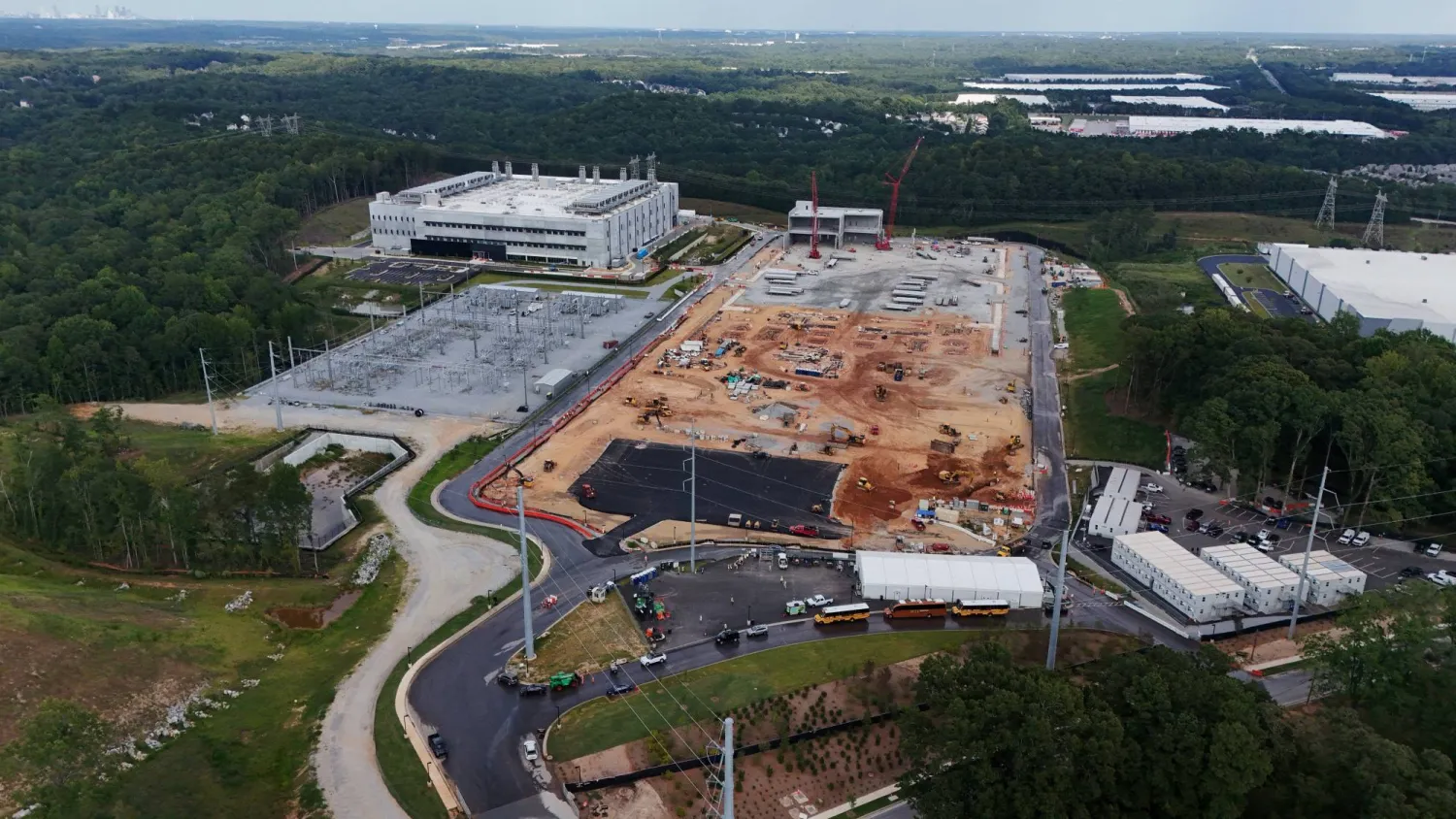
 A drone view shows construction underway on Microsoft's ATL11 data center in Union City, Georgia, US, September 1, 2026. (Reuters)
A drone view shows construction underway on Microsoft's ATL11 data center in Union City, Georgia, US, September 1, 2026. (Reuters)
TT

AI Data Centers Are Less Thirsty Now, Tech Giants Say

 A drone view shows construction underway on Microsoft's ATL11 data center in Union City, Georgia, US, September 1, 2026. (Reuters)
A drone view shows construction underway on Microsoft's ATL11 data center in Union City, Georgia, US, September 1, 2026. (Reuters)

Data centers are running into a wall of public anger in the United States over their thirst for water and power.

The tech giants spending billions of dollars on them say the water part, at least, is solvable.

Data centers are the warehouses full of computer servers that run the internet and increasingly artificial intelligence.

The computers get hot, and keeping them cool takes water.

American chip giant Nvidia said in a June report that it can eliminate water consumption almost entirely at some facilities when deploying DSX, its newest system for designing and managing AI data centers.

It's a bold claim, and one the industry is under mounting pressure to make good on.

In 2025, data centers consumed 222 billion liters (59 billion gallons) of water worldwide for cooling, according to consultancy Rystad Energy.

Without adaptive measures, the figure could nearly triple to 644 billion liters by 2030, Rystad estimates. Steps to limit the growth could keep it under double.

Nvidia's new method uses a closed-loop cooling system in which liquid flows directly through the servers, as close as possible to the chips, whose temperature can rise above 80C (176F).

The problem is that "there's a pretty direct trade-off between how much water is used and how much energy is used" for temperature control, said Andy Masley, an independent researcher who covers AI and data centers.

Cutting back on water use usually means more power as the liquid in those sealed pipes still has to be cooled down somehow, usually by blowing air over it -- and that takes electricity.

Nvidia gets around some of this by letting the liquid enter the servers warmer than usual, at 45C.

Most other closed-loop systems ran at about 32C in 2024, according to the Uptime Institute, which certifies data centers.

By starting with warmer water, Nvidia does not need to pump in cooled air year-round.

"Simple fans circulating the air" are often enough, though sometimes a mix of methods is needed, said Josh Parker, Nvidia's head of sustainability.

At sites in extreme climates, or during a heatwave, chill airflow or water evaporation is still necessary.

- Public relations -

Microsoft, Amazon Web Services (AWS) and Meta told AFP that they also use closed-loop systems, which they said involve no net water loss.

The two cloud computing giants, which have been expanding their already huge data center footprints, used more water overall between 2022 and 2025, but their water use efficiency improved by 25 percent at Microsoft and 37 percent at AWS, according to their most recent sustainability reports.

There is no industry-wide consistency, however, in how companies report data on so-called environmental, social and governance (ESG) efforts.

Elon Musk's SpaceX, now a major player in data centers after it acquired his artificial intelligence company xAI, has never published an ESG report.

In June, ratings agency MSCI gave SpaceX its lowest ESG score.

"Because water is generally much cheaper than electricity," companies have less incentive to cut water use on cost grounds alone, said Shaolei Ren, an engineering professor at the University of California, Riverside.

"There are incentives," Ren said, but they have more to do with public relations amid the growing backlash to data centers across the United States.

Another obstacle is that upgrading an older data center to newer, less thirsty technology is expensive.

That may matter less than it sounds.

Older data centers are smaller and less powerful than the enormous new ones being built now, so they need less cooling in the first place, said Minh K. Le, who leads data center and hydrogen research at Rystad.

And the water a data center uses directly is only part of the story.

Water is used to generate the electricity that powers the data center, and to manufacture its chips and servers.

In the United States, that hidden water use can be twice the amount a data center consumes on its own.


Meta Ordered to Pay New Mexico $25 Billion for Deceiving Users About Privacy on Facebook

The Meta logo is seen at the Vivatech show in Paris on June 14, 2023 (AP)
TT

Meta Ordered to Pay New Mexico $25 Billion for Deceiving Users About Privacy on Facebook

The Meta logo is seen at the Vivatech show in Paris on June 14, 2023 (AP)

A judge on Wednesday ordered Meta to pay New Mexico $25 billion after a jury found the company liable for deceiving users about privacy on Facebook, marking the biggest fine ever against the tech giant.

Facebook’s deception was intentional and executives consistently misled users about how the platform worked, state District Court Judge Francis J Mathew wrote in his ruling, according to AP.

“Facebook promised users that they (the users) controlled their data. This was false,” he said.
Jurors in September found Meta liable for over 43 million violations of New Mexico consumer protection laws for making misleading public statements about how it handled users’ personal data.

The case was brought after political consulting firm Cambridge Analytica harvested Facebook data to generate targeted political ads during the 2016 election season.

The award will serve as a warning to tech companies that New Mexico will hold them accountable, state Attorney General Raul Torrez said at a news conference.

“This judgment should be a signal, an unambiguous message, to Silicon Valley,” he said.

Meta said the ruling and Torrez’s office’s approach to enforcement “makes it all but impossible to do business in the state of New Mexico.”

“At its core, this lawsuit seeks to impose a tax on speech to enforce new rules for what people can say online. We are confident we will prevail on appeal,” CJ Mahoney, the company’s chief legal officer, said in a statement.

The Menlo Park, California, company has a market value of $1.8 trillion and brought in more than $200 billion in revenue last year. Company shares traded 2% higher after Wednesday’s announcement, and it was scheduled to report its quarterly earnings later in the day.

In August, Meta reached a settlement with 48 states and territories — except New Mexico and Florida — to pay $18 billion and add stronger child-safety measures to its Facebook and Instagram platforms.

The settlement ended a trial over teen social media addiction and resolved a pivotal case years in the making that sought to hold the tech giant accountable for the role its platforms played in undermining children’s mental health. The effort targeted features designed to grab young people’s attention.

New Mexico did not join the multistate settlement, choosing to go after the company on its own.

The director of a nonprofit that supports stronger policies toward corporations said $25 billion is “a drop in the bucket for Meta,” but demonstrates people want accountability.

“Right now, they are rolling out Muse, an AI assistant encouraging people to trust it with everything from their bank accounts to their medical information,” added Nidhi Hegde, executive director of the American Economic Liberties Project. “Which is why we need more enforcers with courage and laws with actual teeth to rein them in.”

At the trial, attorneys for the state cited a 2010 Washington Post op-ed in which Facebook CEO Mark Zuckerberg wrote that the company didn’t sell user data.


Cyber Agency Warns Websites May Go Dark as PHP Prepares Critical Fix

A hand is seen on a laptop with binary codes displayed in front of the EU flag in this illustration taken, August 19, 2022. REUTERS/Dado Ruvic/Illustration/File Photo
TT

Cyber Agency Warns Websites May Go Dark as PHP Prepares Critical Fix

A hand is seen on a laptop with binary codes displayed in front of the EU flag in this illustration taken, August 19, 2022. REUTERS/Dado Ruvic/Illustration/File Photo

The developers of the widely used PHP programming language said on Wednesday they would release patches for two critical vulnerabilities, as EU cybersecurity officials warned organizations unable to apply the fixes should take affected websites offline.

PHP is used across large parts of the internet, and speculation has circulated over the past day that websites running the software could be exposed to serious cyber intrusions, said Reuters.

"PHP is everywhere. It quietly powers ‌WordPress, Drupal, Joomla, and ‌Magento sites, shared hosting platforms, control panels, and an awful ‌lot ⁠of software that ⁠doesn't even advertise that it runs PHP under the hood," cybersecurity company Huntress said in a blog post.

In a security update, PHP said both vulnerabilities were rated 9.2 on the CVSS v4.0 severity scale and urged users to "upgrade as soon as the release is available".

It said a patch for both vulnerabilities was scheduled for 1400 GMT on Wednesday.

Dane Knecht, the chief technology officer of Web and cloud security firm Cloudflare, said that attacks were emerging and ⁠Cloudflare was updating its firewall rules as a stopgap measure.

"We are ‌seeing early attacks emerging and are updating mitigations as ‌new vectors show up. This is a STOPGAP only. Patch as soon as PHP releases the ‌update," he said on X.

The European Union Computer Emergency Response Team (CERT-EU) said on ‌Tuesday in an advisory that the 9.2 rating indicated a risk of unauthenticated remote code execution, a type of flaw that can allow attackers to run malicious code on vulnerable systems without logging in.

CERT-EU urged organizations to prepare for the immediate patching of affected assets and said those unable ‌to do so should consider taking affected sites offline.

The Australian Cyber Security Center (ACSC) issued similar guidance, urging organizations to identify PHP ⁠systems in their environments, ⁠prepare to apply patches and monitor applications for signs of malicious activity.

"ACSC is currently not aware of active exploitation related to these vulnerabilities," the agency said.

Web hosting provider GoDaddy said the flaws could allow attackers to execute code on affected servers over the internet, potentially leading to data theft, website defacement or full system compromise.

Wordfence, a security plugin that protects WordPress websites, said all WordPress sites run on a PHP-installed server. It warned that automatic updates would not apply the fix and advised site owners to find out who is responsible for updating PHP on their sites.

PHP's security team said details of the vulnerabilities, affected versions and the fixed releases would be published when patches are issued.

CERT-EU and the ACSC said all PHP versions from PHP 5 onward could be affected, although PHP has not disclosed which versions are vulnerable.


Micron and Taiwan Union Sign Deal, Withdraw from Mediation

The newly opened Micron Advanced Assembly and Test Taiwan 2 (AATT2) facility in Taichung, Taiwan, October 15, 2026. REUTERS/Ann Wang
TT

Micron and Taiwan Union Sign Deal, Withdraw from Mediation

The newly opened Micron Advanced Assembly and Test Taiwan 2 (AATT2) facility in Taichung, Taiwan, October 15, 2026. REUTERS/Ann Wang

Micron Memory Taiwan and a union representing workers at its Taichung operations said on Wednesday they had signed a labor-management agreement covering multiple issues, prompting both sides to withdraw from mediation scheduled for October 22.

The joint statement did not disclose the terms of the agreement, saying the company and the union would separately communicate details to ⁠affected employees in ⁠the coming days.

Idaho-based Micron, the world's third-largest memory chipmaker, employs about 15,000 people in Taiwan, a key manufacturing base where it produces DRAM and high-bandwidth memory chips used in AI servers.

Any disruption ⁠to Micron's Taiwan operations could affect already strained global memory chip supplies. The AI boom has boosted memory chipmakers including Micron, Samsung Electronics and SK Hynix, while also sharpening worker demands for a greater share of profits.

The agreement with the Taichung union, which represents workers at Micron's largest Taiwan operation, comes a day before a separate ⁠union ⁠representing workers in Taoyuan is due to hold a one-day warning strike over bonuses and profit-sharing.

The Taoyuan union did not immediately respond to a Reuters request for comment on whether it still planned to proceed with Thursday's strike, which had been scheduled to coincide with the mediation talks.