


Asharq Al-Awsat Follows Sweeping Security Campaign Against Former Regime Remnants in Aleppo

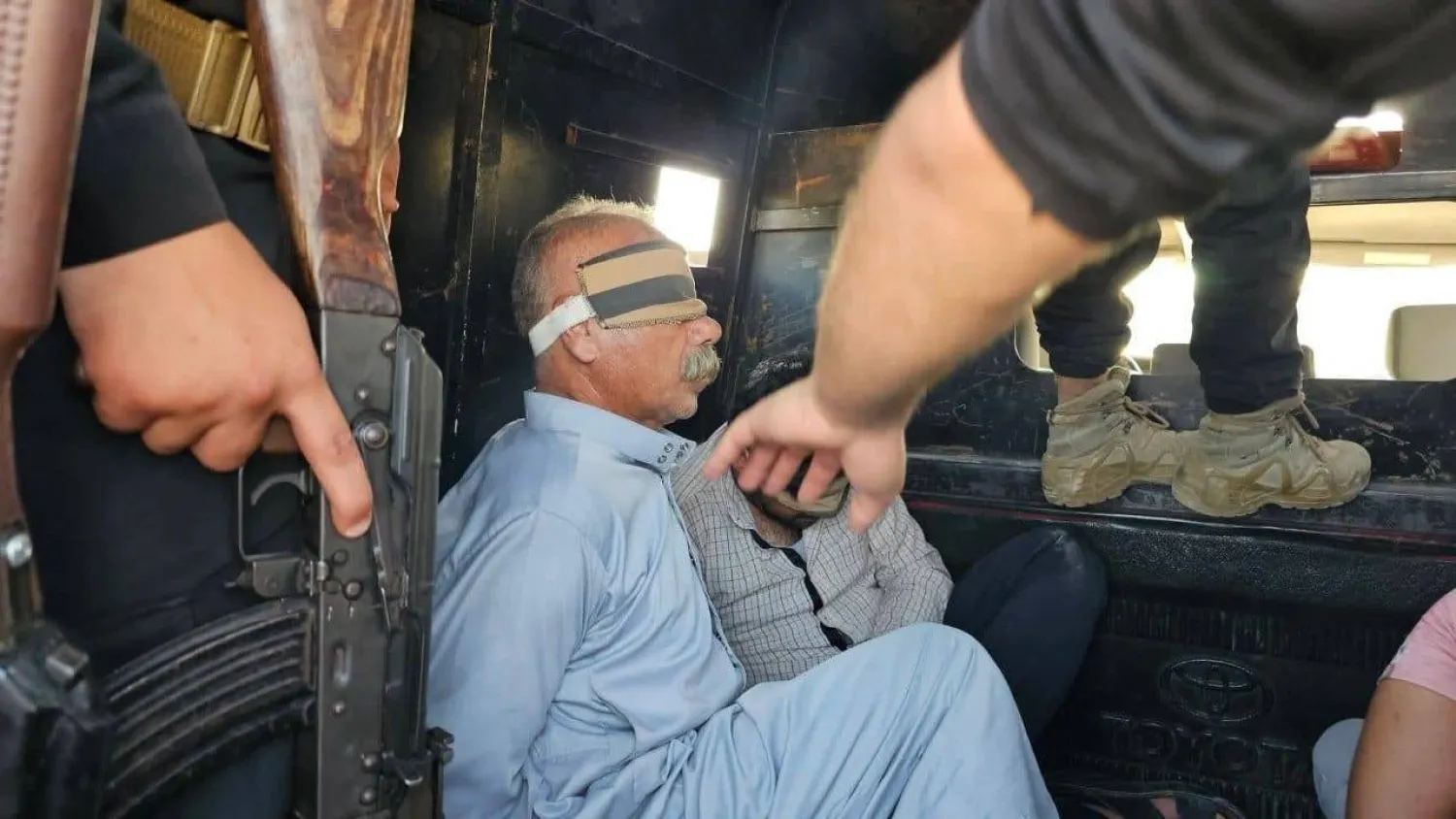
 A number of wanted people arrested during the security campaign in Aleppo (security sources) 
 A number of wanted people arrested during the security campaign in Aleppo (security sources) 
TT

Asharq Al-Awsat Follows Sweeping Security Campaign Against Former Regime Remnants in Aleppo

 A number of wanted people arrested during the security campaign in Aleppo (security sources) 
 A number of wanted people arrested during the security campaign in Aleppo (security sources) 

For a third consecutive day, Syrian security forces continued a sweeping campaign in Aleppo in the north, led by Internal Security forces and the Counterterrorism Department, targeting former leaders and members of the ousted regime of Bashar Assad accused of war crimes.

The operation is the second of its kind in Aleppo this year and has led to the arrest of several former regime officers, most notably Brig. Gen. Hamada Ali Murad, a military pilot, in the town of Nubl. It also targeted a network of former regime members and allied militia personnel.

Sources at Aleppo’s Internal Security Directorate told Asharq Al-Awsat that more than 50 people have been detained so far, including former officers, personnel and informants, in operations across the city and surrounding countryside conducted with the Counterterrorism Service.

Murad was arrested in Nubl over accusations that he was responsible for numerous violations against civilians and facilitated alleged illicit activities by members of his family, including looting homes, seizing properties and selling them.

The sources said the operation followed an extensive assessment of those targeted, surveillance of their activities and the gathering of evidence of their alleged involvement in widespread crimes and abuses against civilians. Accusations and individual complaints against them included war crimes, intimidation, extortion, robbery, and the exploitation and sale of property belonging to civilians and displaced people.

They noted that security operations in Aleppo and its countryside would continue until their objectives were achieved, namely arresting wanted former regime personnel and other suspects found to have been involved with terrorist groups or committed acts of violence against civilians.

A Pilot and Allegations Involving His Family

Murad, from Nubl, graduated with the 30th class of the Air Force Academy as a helicopter pilot. He previously served with the 63rd Helicopter Air Brigade at Taftanaz air base in the Idlib countryside, initially as the brigade’s security officer. He was later transferred to the Air Force Academy as an instructor and subsequently served as an officer at the Air Force Institute.

At the beginning of the Syrian uprising against the former regime, Murad was transferred to the Air Force Intelligence branch in Aleppo as a liaison officer. According to the sources, he coordinated between the branch and pilots, relaying and directing information concerning air sorties and identifying areas targeted for bombardment in Aleppo and its countryside.

After fighting in Aleppo subsided, Murad was appointed director of the Air Force Training Institute. Information cited by the sources also points to the alleged involvement of several members of his family in theft and the seizure of homes during the uprising, exploiting Murad’s position.

In a statement on its official channels, the Internal Security Directorate said a pilot — whom it did not name — had been detained in an operation conducted with the Counterterrorism Department targeting people it described as “wanted individuals involved in committing crimes against civilians.”

It said investigations were continuing “to uncover the full circumstances of his activities during the era of the ousted regime.”

Group Leaders and Members Detained

Sources at Aleppo’s Internal Security Directorate said the latest operation did not target “mere names,” but groups that had been affiliated with and fought alongside the former regime, with both group leaders and members detained.

According to the sources, security forces dismantled a group led by Khaled Hazari that had previously operated in Aleppo’s Old City, arresting Hazari, Firas Kako, Zakaria al-Ahmad and others. Another group led by Hamdi Mardali was also dismantled. Mardali was detained in the Bab al-Hadid neighborhood of the Old City, while Nour al-Din Alwan was also arrested.

Director of Public Relations at the Aleppo Media Directorate, Moataz Khattab, wrote on his personal account that several wanted individuals had been detained, including Hassan Raghed al-Ibrahim and his son, Raghed Hussein al-Ibrahim. The two had served with the Fourth Division’s 555th Regiment before moving to the former Republican Guard’s 155th Battalion.

The father is accused of informing on his brother, who later died in Saydnaya prison, as well as three of his cousins, and of seizing their property. He is also accused of illegally selling more than 40 properties belonging to people displaced from Aleppo during the uprising.

Khattab also named Nour Alwan, whom he described as involved in crimes against Syrians; Hossam al-Saad, a former fighter with Liwa al-Quds; and Khaled al-Shahoud, known as Abu Watan, whom he described as accused of working with Air Force Intelligence under the former regime.

Internal Security Responds to Appeal

The father of one detainee, Khaled Mohammed Abed, submitted an appeal to Internal Security authorities requesting his son’s release and a broader review of his security file and the accusations against him.

He maintained that his son had not been in areas controlled by the former regime throughout the years of the uprising and requested an urgent review because his son suffers from a heart condition.

The father asked security authorities to take whatever action they deemed appropriate after examining his son’s case and what he described as malicious accusations against him. He also requested that his son’s reputation be restored legally and in the media following what he described as defamation and abuse on social media.

Aleppo’s Internal Security Directorate confirmed to Asharq Al-Awsat that Khaled al-Abed had been released because of insufficient evidence and the weakness of the accusations against him. It said his health condition had also been taken into account, prompting authorities to expedite the investigation and his release.


Jordan Sentences Man to Death Over Attack That Killed Officer

The State Security Court convicted the man of carrying out ⁠terrorist acts resulting in death. (Petra news agency)
TT

Jordan Sentences Man to Death Over Attack That Killed Officer

The State Security Court convicted the man of carrying out ⁠terrorist acts resulting in death. (Petra news agency)

Jordan's State ‌Security Court on Wednesday sentenced a man to death over an attack that killed a security officer in the capital Amman earlier this month, the armed forces said in a statement.

The officer was stabbed near the Sri Lankan embassy ‌on November 5, ‌less than two weeks ‌after ⁠gunmen opened fire ⁠at a church in the southern Karak governorate, both rare assaults in the country.

The court convicted the man of carrying out ⁠terrorist acts resulting in death, ‌and of ‌possession of a weapon for ‌terrorist purposes, the statement read.

The ruling ‌is subject to an appeal and an automatic review by the Court of Cassation, the statement said.

Jordan ‌sentenced three men to death earlier this month ⁠for the ⁠church attack. Gunmen opened fire during a funeral at a Greek Orthodox church in the village of Hamoud on October 23, killing nine people and wounding 34.

Jordan's King Abdullah ordered security forces to respond with an "iron fist" after that attack.


Israeli Strike Kills Hamas Security Official and Family

 A Palestinian man inspects an apartment destroyed in an Israeli strike in Gaza City, Wednesday, Nov. 25, 2026. (AP)
A Palestinian man inspects an apartment destroyed in an Israeli strike in Gaza City, Wednesday, Nov. 25, 2026. (AP)
TT

Israeli Strike Kills Hamas Security Official and Family

 A Palestinian man inspects an apartment destroyed in an Israeli strike in Gaza City, Wednesday, Nov. 25, 2026. (AP)
A Palestinian man inspects an apartment destroyed in an Israeli strike in Gaza City, Wednesday, Nov. 25, 2026. (AP)

An Israeli strike killed a Gaza security official, his wife and their two daughters on Wednesday, first responders and officials said, while the Israeli military told AFP it "targeted a Hamas terrorist".

Civil defense spokesman Mahmoud Bassal told AFP that an Israeli strike on a residential building in the Al-Shati refugee camp west of Gaza City killed four people including "a man, his wife and his two daughters" and wounded 12 others.

The civil defense, a rescue force which operates under Hamas authority, said the girls were aged 13 and 15 years old.

It reported "extensive destruction to the targeted apartment and several neighboring homes" in the camp located on the Mediterranean coast.

Gaza's interior ministry, which also operates under Hamas authority, identified the man as Colonel Mohammed Abu al-Ouf, the director of the internal security service for northern Gaza. It confirmed his death and that of his wife and two daughters.

Israel's military told AFP it "targeted a Hamas terrorist" without immediately providing more details.

Gaza City's Al-Shifa Hospital confirmed to AFP the arrival of the four bodies.

The strike comes a day after Israel killed Hamas's director of internal security, Naim Abu Nahal, who had been appointed two months ago.

Israel and Hamas regularly accuse each other of violating the ceasefire that came into effect in October 2025, after two years of war triggered by Hamas's October 2023 attack on Israel.

More than 1,650 Palestinians have been killed since the start of the truce, according to an AFP tally based on data from the Gaza health ministry, which also operates under Hamas authority and whose figures are considered reliable by the United Nations.

In the same period, the Israeli military says seven of its soldiers have been killed, as well as one civilian contractor.


Al-Zaidi’s Sweeping Measures Spark Anger in Iraqi Kurdistan

The Iraqi government is moving to assert control over oilfields currently under the security authority of the Kurdistan region. (X)
TT

Al-Zaidi’s Sweeping Measures Spark Anger in Iraqi Kurdistan

The Iraqi government is moving to assert control over oilfields currently under the security authority of the Kurdistan region. (X)

Sweeping decisions by Iraqi Prime Minister Ali al-Zaidi have sparked anger in Erbil, with Kurdistan Regional Government (KRG) Prime Minister Masrour Barzani rejecting the measures and Kurdish politicians warning against treating the autonomous region like Jurf al-Sakhar, a town south of Baghdad targeted by a security campaign against oil smuggling.

Kurdistan Democratic Party (KDP) leader Masoud Barzani on Tuesday urged Baghdad to uphold constitutional principles and exercise wisdom in resolving disputes, rejecting decisions driven by “personal whims.”

“For some time, Iraq’s decision-making centers have witnessed unusual moves targeting the Kurdistan region, with ill-conceived decisions and proposals reflecting a tendency towards escalation and adventurism,” he said.

Al-Zaidi announced on Tuesday what observers described as an “administrative storm,” ordering the closure of all unofficial border crossings with neighboring countries, including those in Kurdistan, and placing oil fields in the region under federal control as part of efforts to combat the smuggling of oil and petroleum products.

Estimates of the number of unofficial crossings range from six to 46, most of them in Sulaymaniyah.

Kurdistan Interior Minister Rebar Ahmed rejected Baghdad’s decisions on border crossings, stressing that the region had its own laws and that its Peshmerga and interior ministry forces had their own responsibilities.

Speaking on the sidelines of the World Youth Summit in Erbil, Masrour Barzani described Baghdad’s decisions as “unacceptable in any form,” saying they contradicted messages conveyed during earlier talks.

He stressed that the door remained open to dialogue, provided any agreement was based entirely on the constitution rather than unilateral decisions that violated the region’s constitutional rights.

The measures came just three days after Popular Mobilization Forces (PMF) chief Faleh al-Fayyad held talks with Masoud Barzani, Kurdistan President Nechirvan Barzani and Masrour Barzani on outstanding disputes over the budget, oil and border crossings.

The KRG denied reports that Fayyad’s visit was intended to warn the region that it would face measures similar to those implemented in Jurf al-Sakhar.

Mounting pressure

KDP member and KRG adviser Dijwar Faiq told Asharq Al-Awsat that al-Zaidi’s decisions stemmed from pressure over the security campaign in Jurf al-Sakhar, with voices in Baghdad questioning why Kurdistan was not being treated similarly.

“They have forgotten that the region is protected by the constitution and the law and is not an area where illegal activities take place,” he said.

He stressed that the constitution provided for joint management of border crossings and oil, rather than exclusive federal control.

Faiq said there was no evidence that Kurdistan had violated the law or smuggled “a single drop of oil,” citing ongoing joint inspections by federal and regional authorities.

He attributed the oil dispute to Baghdad’s insistence on receiving 400,000 barrels per day as a condition for releasing salaries, a demand exceeding the region’s capacity.

Kurdish activists believe political disputes have largely obstructed the adoption of a new oil law for nearly two decades, while disagreements persist over constitutional powers, contracts with foreign companies, independent oil projects and contractual arrangements.

Security concerns

Beyond the oil and border measures, concerns are mounting in Erbil over possible changes in security arrangements and federal troop deployments, although there has been no official confirmation.

KDP member and former federal lawmaker Mayada al-Najjar stressed that Kurdistan was a federal region recognized under Article 117 of the constitution, unlike Jurf al-Sakhar, which falls under the Babil province.

Disputes over powers, security or resources must be resolved through constitutional and legal mechanisms and institutional coordination, rather than escalation or threats of force, she told Asharq Al-Awsat.

Historic rivals unite

Al-Zaidi’s divisive decisions have united Kurdistan’s historic rivals, the KDP and the Patriotic Union of Kurdistan (PUK), despite nearly two years of tensions over government formation.

In a joint statement late Tuesday, the parties rejected what they described as repeated violations of the region’s rights, insisting that the constitution was the sole arbiter of disputes and that undermining Kurdistan’s gains was a red line.

They urged dialogue and transparency and called for avoiding unilateral decisions to preserve Iraq’s stability.

The statement followed an appeal for unity by Masrour Barzani, who stressed that safeguarding the Kurdistan region took precedence over personal or partisan gains.
