Data Centers Open New Avenue for Localizing Saudi Cooling Industry

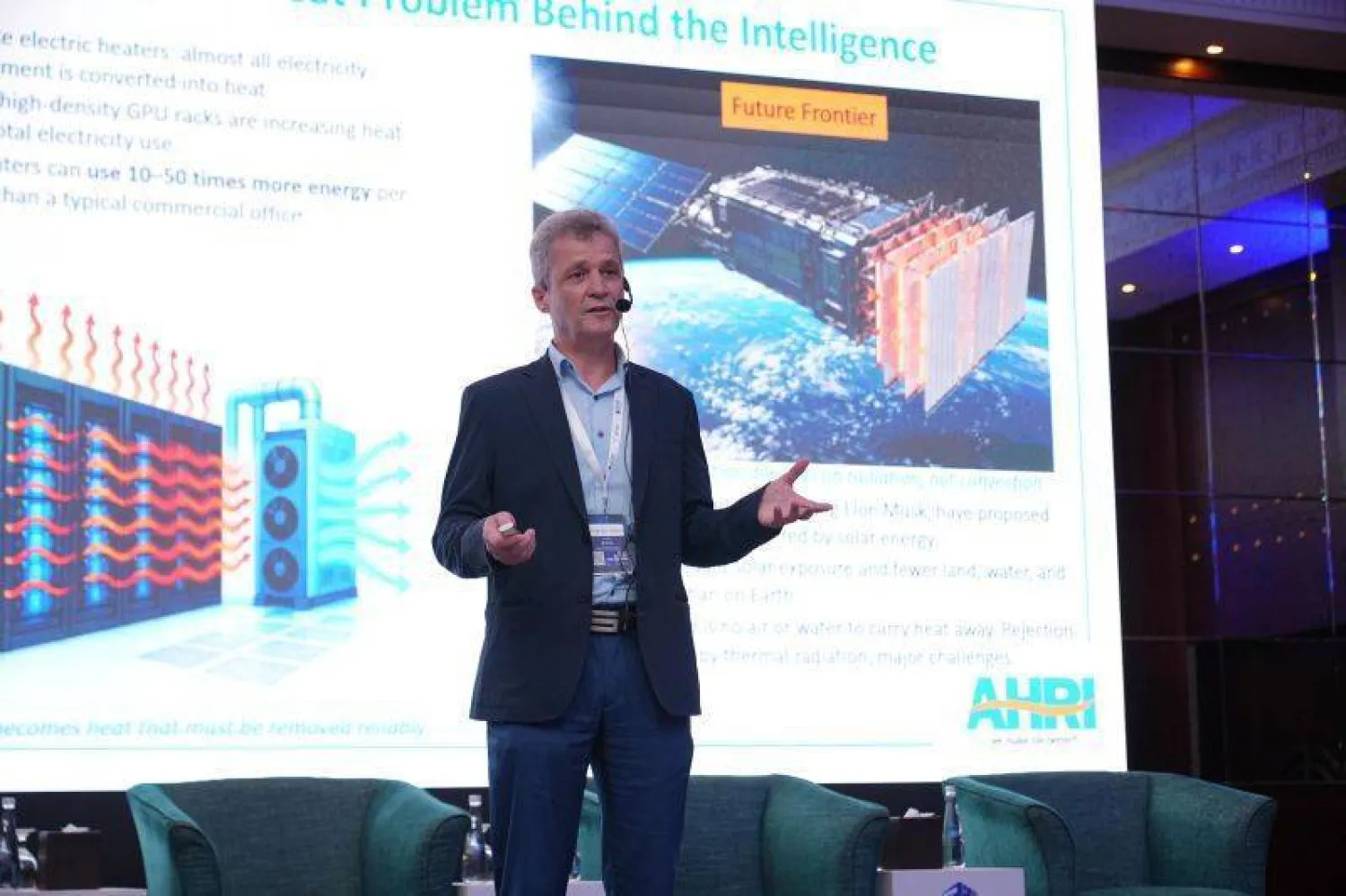
Nabil Shahin discusses standards developed by the US-based Air-Conditioning, Heating, and Refrigeration Institute (AHRI). (LinkedIn) 
TT

Data Centers Open New Avenue for Localizing Saudi Cooling Industry

Nabil Shahin discusses standards developed by the US-based Air-Conditioning, Heating, and Refrigeration Institute (AHRI). (LinkedIn) 

From buildings and megaprojects to data centers, demand for air-conditioning and cooling solutions is expanding across Saudi Arabia, driven by rapid construction and accelerating investment in digital infrastructure.

As artificial intelligence and cloud computing enter a period of rapid expansion, data centers are emerging as a new growth driver for the cooling industry, requiring advanced levels of efficiency and reliability and equipment capable of operating under harsh climatic conditions.

The boom extends beyond Saudi Arabia. Globally, the cooling industry is expanding as temperatures rise and demand for data centers grows. The International Energy Agency estimates that global electricity demand for building cooling has risen by about 50% since 2015 to around 2,900 terawatt-hours, while worldwide air-conditioner shipments reached about 200 million units in 2024.

Cooling buildings is placing increasing pressure on power grids, particularly during heat waves, while data centers and AI are adding another layer of demand for advanced cooling technologies.

Global data-center electricity consumption stood at around 415 TWh in 2024 and is projected to reach about 945 TWh by 2030, with cooling and environmental-control systems accounting for a significant share of energy use at these facilities.

The growth comes amid mounting pressure to improve air-conditioning efficiency and reduce its environmental impact. According to the UN Environment Program, global cooling demand could more than triple from current levels by 2050 under existing policies, making equipment efficiency and less energy-intensive technologies increasingly important.

These shifts offer Saudi Arabia an opportunity to expand its domestic air-conditioning and cooling manufacturing base as the Kingdom seeks to increase local content and meet more of its market needs through domestic production.

Nabil Shahin, managing director of the Middle East and North Africa office of the US-based Air-Conditioning, Heating, and Refrigeration Institute (AHRI), told Asharq Al-Awsat that Saudi Arabia accounts for more than half of the Gulf air-conditioning market. He attributed the market’s growth to expanding commercial and construction projects, alongside the boom in data centers.

Data Centers Reshape Cooling Market

The Kingdom is experiencing a “growth boom” in data centers, according to the AHRI executive, fueled by the rapid spread of AI and rising demand for cloud-computing services. He noted that several US and European companies are developing data-center projects in Saudi Arabia.

As their cooling requirements increase, AHRI is working with the Saudi Standards, Metrology and Quality Organization (SASO) to develop and modify standards for data-center equipment to reflect the Kingdom’s temperatures, climatic conditions and local requirements.

Saudi Standard for Evaporative Coolers

Shahin noted that SASO had asked AHRI to develop a new standard for evaporative cooling systems, locally known as “desert coolers,” which use water in the cooling process rather than the refrigerants used in conventional air-conditioning systems.

There is currently no unified global standard for such systems, he explained. AHRI is developing the standard for submission to SASO, with the aim of providing a reference for manufacturers in the Saudi market.

The new standard will include energy-efficiency measurement criteria to assess equipment performance and suitability for local conditions.

Improving air-conditioning efficiency is particularly important in Saudi Arabia because of the sector’s high electricity consumption. More efficient systems could reduce power demand and emissions associated with electricity generation.

Saudi Arabia Leads Gulf Market

The AHRI executive estimated Saudi Arabia’s share of the Gulf air-conditioning market at more than 50%, with demand continuing to rise alongside commercial and construction projects, particularly in Riyadh, coastal areas and Makkah.

Some estimates put the Kingdom’s share at about 60%, he noted, but he prefers the more conservative figure of over 50% because no verified official data precisely establish its market share.

The scale of demand has made Saudi Arabia attractive to international companies, several of which have expanded their presence over the past two years by establishing new factories or enlarging existing facilities.

Local manufacturing can give companies an additional advantage by reducing some import costs, which can range from 5% to 12%, according to Shahin. He pointed to three large domestic factories that are expanding their operations.

From Assembly to Component Manufacturing

Localization, however, still faces the challenge of dependence on imported components. Most key air-conditioning components — including electric motors, compressors, copper and refrigerants — continue to come from abroad.

Much of Saudi Arabia’s current manufacturing activity remains focused on assembly, although some components, including heat exchangers, are produced domestically.

The next step, the AHRI official argued, is to move gradually from assembly toward manufacturing a greater proportion of air-conditioning components in the Kingdom, including electronics, circuit boards and electric motors.

He called for additional government incentives and support, including land, industrial space, free zones and investment facilities, to help Saudi factories expand and increase the share of locally manufactured components.


Barclays Bank to Cut about 5,000 Jobs amid AI Drive

Barclays says the job cuts are due to AI efficiencies. Paul ELLIS / AFP/File
TT

Barclays Bank to Cut about 5,000 Jobs amid AI Drive

Barclays says the job cuts are due to AI efficiencies. Paul ELLIS / AFP/File

British bank Barclays announced Thursday plans to cut around 5,000 jobs, or roughly five percent of its global workforce, by the end of 2026 in an AI efficiency drive.

The announcement came alongside an earnings update that showed Barclays' net profit grew 13 percent in the third quarter, fueled by surging income across its equities division, said AFP.

Barclays said in an earnings presentation that it was implementing "organizational simplification and technology change efficiency driven by AI".

"About 60 percent of the job losses relate to support functions, including fewer developers as AI makes our people more productive," it added.

The bank's profit after tax grew to £1.65 billion ($2.2 billion) in the third quarter from £1.46 billion in the July-September period a year earlier.

Barclays chief executive C. S. Venkatakrishnan noted "ongoing momentum of... operational and financial performance" and said the investment bank division "delivered strong equities performance".

Revenue from equities jumped 47 percent year-on-year, while total group income for the quarter climbed three percent to £7.37 billion.

Barclays' share price was up slightly following the news updates.

The AI "announcement comes as the company failed to match expectations with its third-quarter performance -- with the unveiling of a healthy share buyback failing to entirely ease investors' disappointment", noted AJ Bell investment director Russ Mould.

"Across the wider group, costs went up and Barclays shareholders are also having to contend with two major clouds over the business.

"The first being a widely expected increase in tax on the sector in next week's (UK) budget and the other being a reported probe into possible misrepresentation of risks in its private credit portfolio."


Norway Sovereign Wealth Fund Loses Over $30 Bn in 3rd Quarter

A view shows the building of Norway’s central bank (Norges Bank) in Oslo, Norway, June 23, 2022. REUTERS/Victoria Klesty/ File Photo
TT

Norway Sovereign Wealth Fund Loses Over $30 Bn in 3rd Quarter

A view shows the building of Norway’s central bank (Norges Bank) in Oslo, Norway, June 23, 2022. REUTERS/Victoria Klesty/ File Photo

Norway's sovereign wealth fund, the world's largest with assets of more than $2 trillion, on Thursday reported a negative return of 278 billion kroner ($31 billion) in the third quarter as it was weighed down by higher interest rates.

It posted a negative return of 0.5 percent in the quarter, dragged down by a negative return of 3.5 percent in its fixed-income investments, while its equity and property portfolios increased by 0.5 percent and 0.4 percent respectively.

"The fund's return was close to flat, ending slightly negative as rising interest rates led to weaker results on our fixed-income investments," the fund's deputy CEO Trond Grande said in a statement.

Invested primarily in equities, bonds and real estate across the globe, the fund reported a value of 22,014 billion kroner at the end of September.

Inflation around the world, fuelled in particular by soaring energy prices linked to the conflict in the Middle East, has led several central banks, including the US Federal Reserve and the European Central Bank, to raise interest rates in the third quarter.

"Equity returns were also close to zero, but there were large differences between sectors.

Energy companies rose the most, while interest-rate-sensitive sectors such as utilities and real estate fell," Grande said, according to Reuters.

Fueled by the Nordic country's oil revenues, the fund is invested in more than 7,100 companies spanning the globe, and holds around 1.5 percent of all listed companies worldwide, making it the world's largest single investor.


IMF: Non-Oil Activities Bolster Saudi Economy’s Resilience to Disruptions

King Fahd Highway in Riyadh (SPA)
TT

IMF: Non-Oil Activities Bolster Saudi Economy’s Resilience to Disruptions

King Fahd Highway in Riyadh (SPA)

The International Monetary Fund’s outlook for the Saudi economy points to promising prospects for recovery and growth, despite pressures from regional disruptions affecting energy production, trade flows and supply chains.

While the Kingdom’s GDP is expected to be affected in 2026 by a decline in oil and gas activity, non-oil activities are proving more resilient. The economy is projected to rebound strongly in 2027 as energy production gradually returns to normal and security and trade conditions improve.

The IMF’s Regional Economic Outlook, issued in October 2026, places Saudi Arabia among the major economies of the Middle East, North Africa, Afghanistan and Pakistan region, at a time when the region is grappling with the repercussions of conflicts and disruptions to energy supplies and global trade.

Temporary Growth Contraction, Non-Oil Activities Remain Resilient

The report forecasts that Saudi Arabia’s real GDP will contract by 3.3 percent in 2026, reflecting a decline in hydrocarbon-sector activity during the first half of the year amid disruptions affecting energy production, shipping and regional supply chains, particularly those linked to the Strait of Hormuz and Bab al-Mandab.

By contrast, the Kingdom’s non-oil activities have demonstrated resilience and performed relatively better than the energy sector, supported by sustained investment momentum and economic diversification programs associated with Vision 2030.

In the tourism sector, the Kingdom recorded the smallest decline in hotel occupancy rates compared with other countries directly affected by regional tensions, reflecting its relative ability to sustain tourism and services activity under the current circumstances.

Strong Rebound Expected in 2027

Despite the contraction expected in 2026, the IMF projects a strong rebound in the Saudi economy the following year, with real GDP forecast to grow by 7.9 percent in 2027.

The recovery is linked to the gradual return of energy production to normal levels, greater stability in security and trade conditions, and an improvement in global supply chains.

Over the medium term, the report projects Saudi real GDP growth to stabilize at around 3.6 percent by 2031, reflecting a return to a more stable growth trajectory following the volatility expected during the current period.

Inflation and Monetary Policy

On prices, average inflation in Saudi Arabia is estimated at around 2.7 percent in 2026 before stabilizing at approximately 2 percent in subsequent years, according to the projections cited in the report.

Factors including subsidies, price controls and fiscal discipline have helped contain inflationary pressures and maintain relative price stability compared with several other economies in the region.

On monetary policy, Gulf central banks, including Saudi monetary authorities, have taken steps in line with moves by the US Federal Reserve, with the aim of supporting financial market stability and limiting potential inflationary pressures.

Fiscal Resilience and Capacity to Absorb Shocks

Saudi fiscal policy in 2026 is characterized by discipline and prudence, while retaining room to direct spending toward strategic priorities, including infrastructure development, improving spending efficiency and supporting long-term structural reforms.

According to the report, the Kingdom also entered the period of regional disruption with comfortable reserves and fiscal buffers, helping it absorb temporary shocks that could affect the current account and official reserves.

These fiscal buffers are particularly important amid heightened regional and global uncertainty, providing greater capacity to withstand volatility while continuing to invest in economic priorities.

Artificial Intelligence

Investment in technology and artificial intelligence is one of the areas in which Saudi Arabia, alongside other Gulf countries, is seeking to expand its presence. The report examines announced investments in AI infrastructure and data centers, which, according to figures cited in the report, exceed 5 percent of GDP. These investments are expected to contribute to stronger productivity and growth over the medium term.

At the same time, structural reforms remain an important factor in strengthening the economy’s ability to withstand external shocks by increasing labor-market flexibility, investing in human capital and diversifying non-oil exports.

The report also points to the progress made by Gulf Cooperation Council countries in diversifying their merchandise exports over the past two decades, underscoring the importance of continuing efforts to broaden the production and trade base and reduce dependence on traditional sources of income.

Taken together, these trends underscore the importance of economic diversification and investment in new sectors in strengthening Saudi Arabia’s ability to weather the repercussions of current disruptions while preserving its medium-term growth prospects.