Saudi Arabia and Serbia Expand Partnership in Energy, Technology and Trade

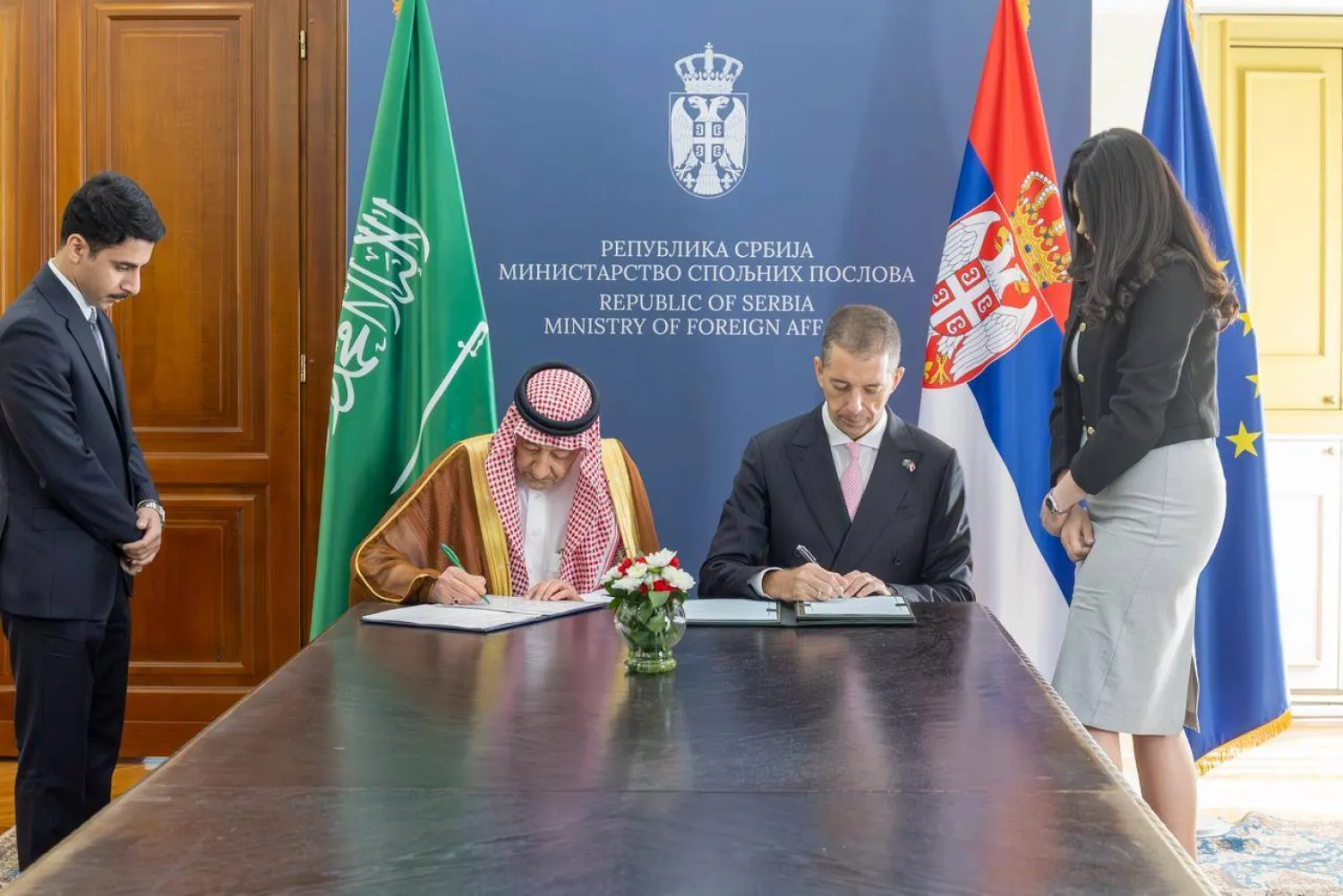
Serbian Foreign Minister and Saudi Deputy Foreign Minister sign an agreement waiving visa requirements for holders of diplomatic and official passports. (X)
TT

Saudi Arabia and Serbia Expand Partnership in Energy, Technology and Trade

Serbian Foreign Minister and Saudi Deputy Foreign Minister sign an agreement waiving visa requirements for holders of diplomatic and official passports. (X)

Saudi-Serbian relations are moving toward a new phase of economic and diplomatic cooperation, as Riyadh and Belgrade work to expand their partnership in the energy, technology, agriculture and food industries sectors, alongside rapid growth in trade between the two countries. This comes as the hosting of EXPO 2027 in Belgrade and EXPO 2030 in Riyadh by Serbia and Saudi Arabia, respectively, opens additional avenues for exchanging expertise and building new partnerships and projects.

A meeting held last week in Belgrade between Saudi Deputy Minister of Foreign Affairs Waleed A. M. Elkhereiji and Serbian Minister of Foreign Affairs Marko Đurić saw the signing of an agreement to cancel visa requirements for holders of diplomatic and official passports, in a step expected to support official contacts and strengthen cooperation between the two countries.

The two sides discussed ways to develop cooperation in the energy sector through joint projects, as well as in information and communications technology, advanced technologies, agriculture and the food industry. They also discussed strengthening the presence of Serbian companies in the Saudi market and increasing investment by Saudi partners in Serbia. Serbia is scheduled to participate in the Saudi Food exhibition in Jeddah later this month with more than 50 companies.

Three new initiatives for cooperation between the two countries were also launched during the meeting: "Digital Non-Aligned," the Film Festival of the Non-Aligned Movement, and an international seminar for young diplomats from member states of the movement. The initiatives are part of commemorations marking the 65th anniversary of the First Conference of the Non-Aligned Movement, which was hosted by Belgrade in 1961.

The meeting was held on the sidelines of a gathering marking the anniversary. Saudi Arabia was among the countries that participated in the founding conference and was represented at the time by Minister of Foreign Affairs Ibrahim bin Abdullah Al Suwaiyel, who planted the first "tree of peace."

Bizenic: Riyadh Is an Important Economic Partner

Serbian Ambassador to Saudi Arabia Dragan Bizenic told Asharq Al-Awsat that last Wednesday's meeting gave the Serbian foreign minister an opportunity to once again thank the relevant Saudi institutions for their "exceptional cooperation and support" during the evacuation of Serbian citizens from Riyadh following the recent events in the Middle East.

Bizenic affirmed his country's commitment to deepening comprehensive cooperation with Saudi Arabia, with a particular focus on the economic side. He said he was impressed by the results achieved by the Kingdom under Vision 2030, which he saw during his visit to Riyadh to participate in the Future Investment Initiative conference last year.

According to the Serbian foreign minister, Belgrade is interested in strengthening trade cooperation with Saudi Arabia, increasing exports of Serbian products, and benefiting from the expertise and knowledge of Saudi experts in the fields of science and technology. The two sides also discussed expanding partnership and cooperation through EXPO, in addition to increasing the volume of trade and mutual investments.

EXPO: A New Bridge for Partnership

Bizenic considers Saudi-Serbian cooperation through EXPO 2027 and EXPO 2030 to be a highly important area for deepening relations between the two countries, pointing to the meeting between Saudi Deputy Minister of Foreign Affairs Waleed Elkhereiji and Minister of Foreign Trade, Mrs. Jagodom Lazarevic, who is also the commissioner of the EXPO 2027 exhibition in Belgrade.

He explained that Belgrade and Riyadh hosting two world expos in the coming years, EXPO 2027 Belgrade and EXPO 2030 Riyadh, represents a unique opportunity to turn the experience, knowledge and networks the two countries will gain through these events into new forms of cooperation and concrete projects.

He revealed that Saudi Arabia has already signed a contract to participate in EXPO 2027 Belgrade and will have one of the largest national pavilions at the exhibition, in a prominent location at the entrance to the EXPO area. He said the pavilion will provide the Kingdom with an opportunity to showcase its development potential, innovations, culture and business opportunities, as well as promote EXPO 2030 Riyadh.
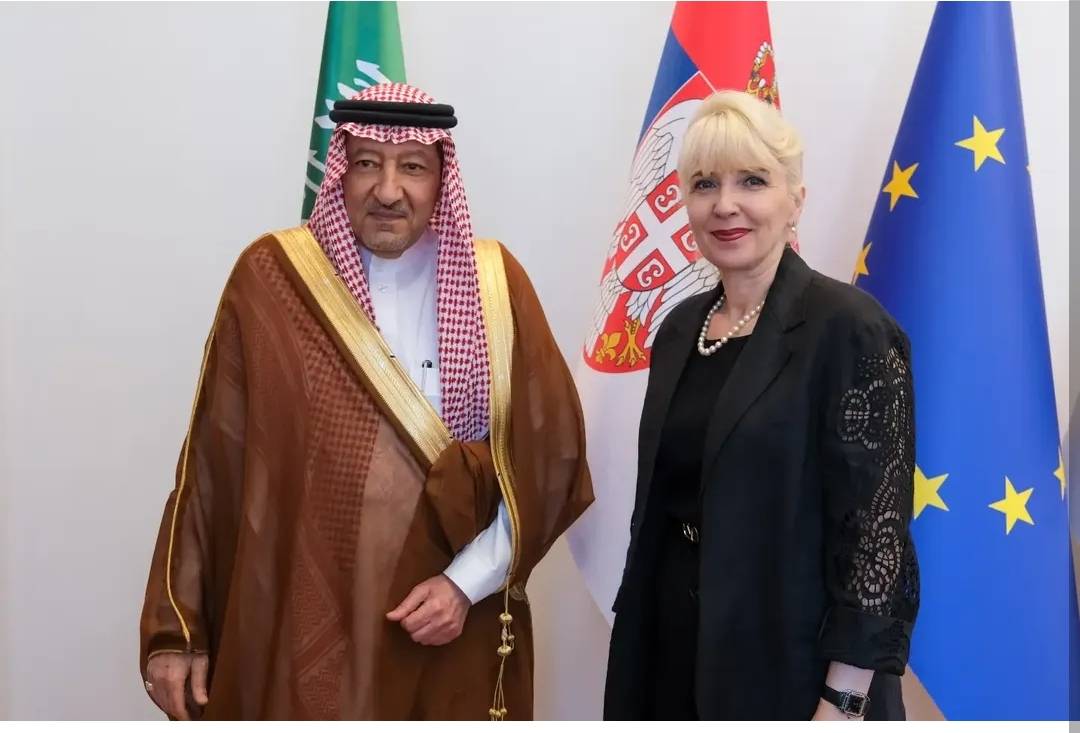
Saudi Deputy Foreign Minister during his meeting with Serbian Minister of Internal and External Trade Jagoda Lazarević (X)

Trade Surges 152%

Bizenic noted that the Serbian foreign minister affirmed during his Wednesday meeting in Belgrade with Elkhereiji that Saudi Arabia could be "one of Serbia's key economic and political partners in the Arab world," given its membership in the Group of Twenty and OPEC+, as well as its weight in global energy markets. Saudi Arabia holds about 16 percent of the world's oil reserves.

The ambassador believes that strengthening Saudi-Serbian relations, opening the way for more investments and business projects, and expanding contacts between the business communities of the two countries would bring significant benefits to Serbia and support its economic presence in the region.

As an indicator of the growing economic ties, Bizenic said trade between Serbia and Saudi Arabia has recorded significant growth in recent years, reaching $121 million at the end of 2025, nine times its 2012 level. Trade continued to grow this year, reaching $130.4 million in the first half of 2026, an increase of 152 percent compared with the same period last year.


Saudi Arabia, US Sign MoU on Strengthening Trade, Investment Cooperation

The agreement was signed during a session on Saudi-US innovation and economic cooperation on the sidelines of the B20 Summit in Washington, DC. (SPA)
TT

Saudi Arabia, US Sign MoU on Strengthening Trade, Investment Cooperation

The agreement was signed during a session on Saudi-US innovation and economic cooperation on the sidelines of the B20 Summit in Washington, DC. (SPA)

The Federation of Saudi Chambers of Commerce and the US Chamber of Commerce signed on Tuesday a memorandum of understanding aimed at strengthening trade and investment cooperation and expanding opportunities for collaboration between the business sectors between their countries.

The signing took place on the sidelines of the B20 Summit in Washington, DC.

The agreement was signed during a session on Saudi-US innovation and economic cooperation, organized by the US Chamber of Commerce, with the participation of Deputy Chief of Mission at the Saudi Embassy in the United States Nawaf Alissa, Secretary-General of the Federation of Saudi Chambers of Commerce Sultan Al-Musallam, and several US Chamber of Commerce officials and representatives of companies and the business sector.

Alissa highlighted the depth of economic relations between Saudi Arabia and the US.

The partnership has continued to evolve, expanding from traditional sectors into new fields, including artificial intelligence, digital technologies, advanced manufacturing, and infrastructure, amid the economic transformation underway in the Kingdom under Saudi Vision 2030, he remarked.

He noted that the total value of investment activities by the Public Investment Fund in the United States has reached approximately $170 billion since 2017, stressing the importance of sustaining the investment partnership between the two countries and strengthening cooperation in future economic sectors.

The event coincides with the B20 Summit, being held in Washington from November 9 to 11, with the participation of business leaders and international economic institutions to discuss priorities related to economic growth, trade, investment, and innovation.


China’s Trade Surplus Soars Past $1 Trillion as AI Boom Powers Exports

 In this aerial photo, new Tesla electric vehicles wait for shipment to overseas markets in a port in Shanghai on Tuesday, Nov. 10, 2026. (Chinatopix via AP)
In this aerial photo, new Tesla electric vehicles wait for shipment to overseas markets in a port in Shanghai on Tuesday, Nov. 10, 2026. (Chinatopix via AP)
TT

China’s Trade Surplus Soars Past $1 Trillion as AI Boom Powers Exports

 In this aerial photo, new Tesla electric vehicles wait for shipment to overseas markets in a port in Shanghai on Tuesday, Nov. 10, 2026. (Chinatopix via AP)
In this aerial photo, new Tesla electric vehicles wait for shipment to overseas markets in a port in Shanghai on Tuesday, Nov. 10, 2026. (Chinatopix via AP)

China's trade surplus surged past $1 trillion in the first 10 months as a global race to build AI infrastructure buoyed sales of high-tech products and helped offset weak domestic demand, a dynamic likely to sharpen tensions with major trading partners.

The data comes ahead of next week's Asia-Pacific Economic Cooperation summit in Shenzhen, where Chinese President Xi Jinping and US President Donald Trump are expected to meet for the third time this year, putting broader economic ties and tariff policy squarely in focus.

The figures highlight Beijing's growing reliance on overseas demand to support an economy hobbled by subdued consumption and a protracted property slump. But while the global AI investment boom is expected to keep demand for Chinese technology products strong into 2027, analysts warn that deeper dependence on external markets could leave China more vulnerable to protectionist measures abroad while masking persistent weakness at home.

Exports rose sharply by 35.2% in October from the ‌same month last year ‌in US dollar terms, customs data showed on Tuesday, only a touch slower than the ‌36.3% ⁠surge in September ⁠and comfortably ahead of economists' forecast for an increase of 33.5%.

That helped lift China's trade surplus to $1.04 trillion in the first 10 months, topping $1 trillion for a second consecutive year and reaching the milestone a month earlier than in 2025.

The swelling surplus could fuel further tensions with the European Union, where leaders have called for more trade curbs with China after reaching an agreement with Beijing to limit Chinese exports of hybrid vehicles to the bloc over the next few years. Because the measures have yet to take effect, factories are expected to bring forward shipments, bolstering exports in the near term.

"The risk of additional tariffs and other trade barriers will remain elevated ⁠in 2027, particularly as Chinese manufacturers continue expanding their presence in overseas markets," said Joe ‌Peissel, lead macroeconomist at Trivium China.

China's trade surplus with the US narrowed slightly ‌to $32.71 billion in October from $34.01 billion the previous month, though the broader imbalance remains a source of friction between the world's two largest ‌economies.

Beijing and Washington on Monday formally extended by two months a trade truce that had been due to expire ‌on Tuesday. China said last week that any expansion of purchases of US farm goods would hinge on the implementation of agreed reciprocal tariff reductions.

Imports rose 41.6% in October from a year earlier, beating the 32% increase forecast in the Reuters poll and accelerating from the 31% growth in September. Customs data also showed rare-earth exports edged higher from the previous month, while crude oil imports climbed to their highest level ‌since March as buyers adjusted to supply disruptions in the Middle East.

"The contraction in rare-earth export volumes eased last month, suggesting that China may have begun to relax enforcement of ⁠some export controls," said ⁠Nguyen Hoang Nam, China economist at Capital Economics. "This may reflect continued pressure from the US on Beijing to improve rare-earth supplies."

The data elicited little market response, with China's blue-chip CSI300 Index and the Shanghai Composite Index both edging up 0.1% by the lunch break.

HEADWINDS

One big worry for Beijing is that consumers remain reluctant to spend, constrained by a property market downturn that has battered household wealth and dented confidence in the economic outlook.

Sluggish demand at home has pushed Chinese automakers to seek sales in overseas markets. China's car exports maintained a solid pace of growth in October, while domestic vehicle sales recorded a 12th straight month of declines, separate data released by an industry association showed.

Greater reliance on exports, however, leaves China's economy increasingly exposed to any slowdown in global demand, with some analysts cautioning that shipment growth could cool once the AI investment cycle matures.

For now, most industry observers expect AI-related demand to remain robust. China's exports of semiconductors surged 111.1% year-on-year in the first 10 months in US dollar value terms, while overall shipments of high-tech products jumped 47.9%.

"We may see trade growth moderate next year, given the base effect," said Lynn Song, chief economist for Greater China at ING.

"But AI-related trade is expected to remain strong in the months ahead despite recent equity market volatility."


Tech Leads Stock Rally as Traders Track Wall St Rebound

Chip titans SK hynix and Samsung rallied as Seoul led gains across Asian stock markets. GREG BAKER / AFP
TT

Tech Leads Stock Rally as Traders Track Wall St Rebound

Chip titans SK hynix and Samsung rallied as Seoul led gains across Asian stock markets. GREG BAKER / AFP

Stocks rallied Tuesday to extend a Wall Street surge led by technology firms as investors took advantage of lower prices following last week's rout, while another plunge in oil prices added to the upbeat mood.

AI-linked firms led gains across the region, in stark contrast to the battering in reaction to last Tuesday's Democratic sweep of Congress that stoked regulatory concerns.

However, traders remain on edge about profitability in light of the vast sums pumped into the sector, while they were also keeping tabs on Nvidia after boss Jensen Huang's admission of an affair amid speculation of a Chinese espionage plot.

Titans including Amazon, Microsoft and Apple were among the big gainers Monday in New York as tech bounced back with help from bargain-hunting, with observers pointing out that confidence in the AI outlook remained solid.

The Nasdaq's 2.7 percent spike led a strong day on Wall Street, and Asian investors took up the baton.

Seoul surged 4.5 percent thanks to strong advances in chipmakers SK hynix and Samsung, while Tokyo jumped almost three percent on the back of rallies in Kioxia, SoftBank and Tokyo Electron.

Taiwan's TSMC and MediaTek climbed more than two percent to drag the Taiex 2.5 percent higher.

Hong Kong, Shanghai, Sydney, Singapore, Bangkok, Jakarta and Wellington were also higher.

London, Paris and Frankfurt opened with big gains to extend Monday's jump.

However, SPI Asset Management's Stephen Innes said the gains did not suggest markets were back in rude health.

"The market rallied because the sellers stepped away, not because the entire buy-side suddenly rediscovered its courage," he wrote in a commentary.

"For the second consecutive session, the companies receiving the enormous capital expenditure cheques dramatically outperformed the businesses writing them. That is a potentially important development after last week's indiscriminate liquidation," he said.

- 'Positive momentum' -

"The hyperscalers remain central to the AI investment cycle, but the market is increasingly questioning the returns on the extraordinary sums being committed to new infrastructure.

"Equipment providers, optical networking companies and selected data-center suppliers can still benefit from existing spending programs, even as investors become more selective about the ultimate economics for the companies funding those projects."

Oil prices continued their retreat on hopes the United States and Iran will eventually bring an end to the Middle East crisis.

Both main contracts fell around one percent Tuesday, extending the previous day's drop that saw Brent give up almost six percent.

They have lost around 20 percent this month as traders bet on a resolution to the seven-month-old conflict, which has sent inflation soaring and forced central banks to hike interest rates.

US President Donald Trump said Monday there was "positive momentum" towards ending the war after meeting Qatar's prime minister at the White House.

"I had an excellent conversation with Sheikh Mohammed bin Abdulrahman bin Jassim Al Thani," Trump said on Truth Social, adding that "much was discussed with respect to the Islamic Republic of Iran".

While expectations had grown ahead of last week's midterms that he would resume strikes on Iran this month, Trump has talked down such a move while leaving the door open to them.

In his post on Monday, Trump reiterated that the United States was "locked and loaded", but that he believed further strikes were "quite unlikely" given that key US allies in the Gulf "would prefer the status quo".

His comments echoed early statements to CNN over the weekend when he said it was "highly unlikely" fighting would resume.