
Political and economic experts linked security, stable energy supplies and independent decision-making as key pillars of Saudi stability, stressing that alliances can deter wars, while domestic security protects the energy industry and balanced partnerships allow the Kingdom to maintain international ties without compromising its sovereignty.
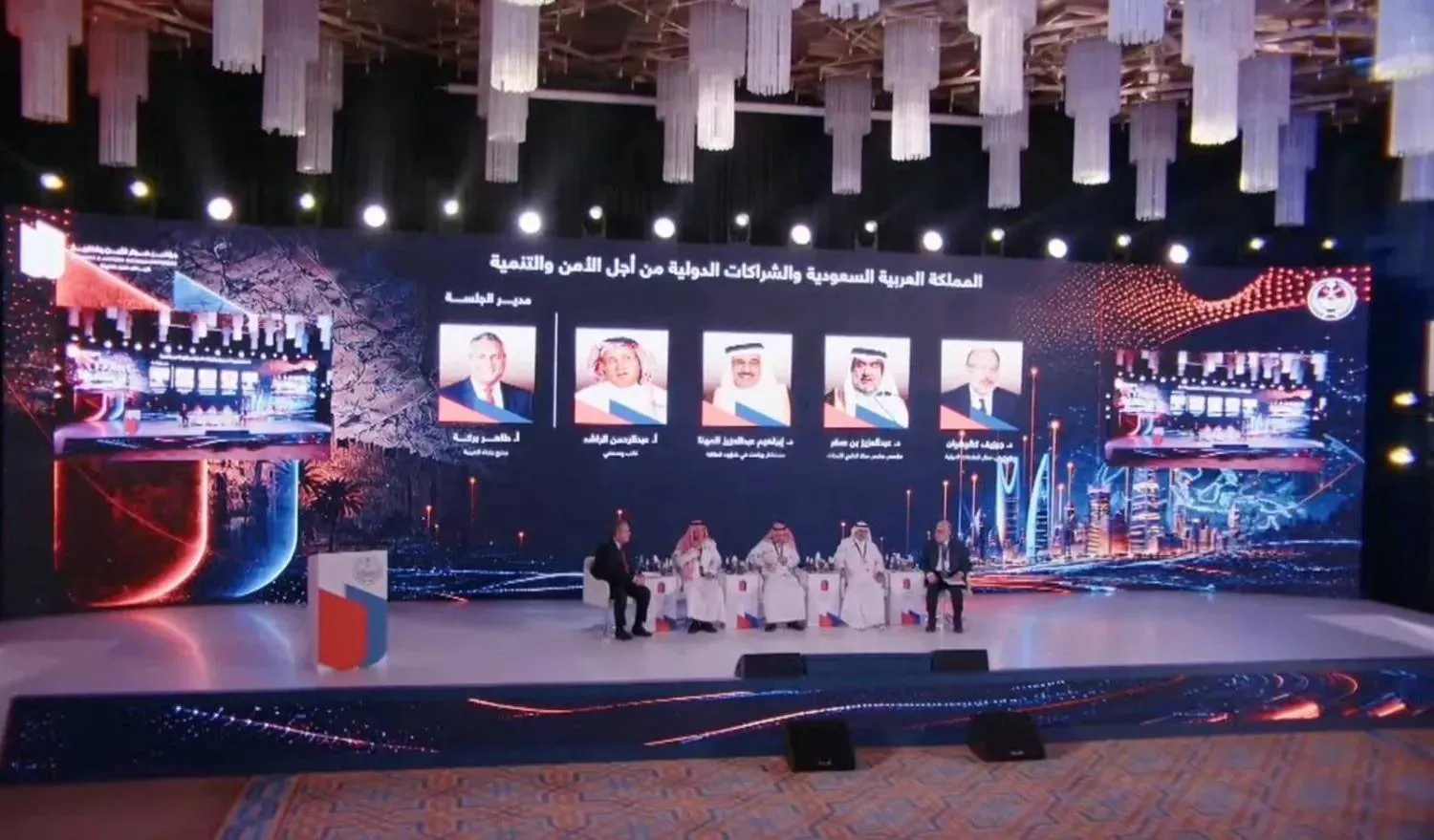
The remarks were made during a panel Monday at the Security and History Dialogue 2026 Conference in Riyadh.
Alliances to prevent wars
Saudi journalist and Asharq Al-Awsat columnist Abdulrahman Al-Rashed noted that Iran had attacked nine countries in the region and that major alliances were needed to prevent war.
He pointed to the establishment of the Gulf Cooperation Council as a bloc formed to confront Iranian threats, while other coalitions followed, including the alliance that liberated Kuwait, in which the GCC played a role.
Saudi Arabia has faced attacks from three fronts — directly from Iran, as well as from Iraq and Yemen — prompting countries to seek common ground, Al-Rashed added.
He described the Saudi-Pakistani-Turkish alliance as bringing together regional countries bordering Iran, but stressed that its purpose goes beyond Tehran and is aimed more broadly at protecting states from attacks.
Al-Rashed highlighted longstanding military ties between Saudi Arabia and Pakistan, dating to the 1970s and 1990s, as well as growing military cooperation between Saudi Arabia and Türkiye over the past three or four years.
He also cited the strength of Türkiye’s defense industry, saying that such cooperation sends a clear message that attacking any of the three countries would carry a high cost.
Security and energy supplies
Energy adviser Ibrahim Al-Muhanna described domestic and international energy security and stability as essential to economic growth, internal stability and citizens’ well-being, alongside the availability of petroleum products and other energy sources worldwide.
Saudi Arabia is the world’s second-largest oil producer, and has at times been first, as well as its second-largest exporter, he noted. The Kingdom is also virtually alone in maintaining spare production capacity that enables it to compensate for supply shortages elsewhere.
Al-Muhanna stressed that domestic security and stability underpin the Kingdom’s continued role in the oil industry and its ability to supply global markets. Protecting oil facilities has been a priority since the reign of King Abdulaziz, beginning around the time the Kingdom signed an agreement with an American company, he added.
Recalling the 1980s tanker war during the Iran-Iraq War, Al-Muhanna explained that Saudi Arabia began considering ways to export oil from the Gulf to the Red Sea and planning the East-West pipeline. The pipeline now carries about 7 million barrels and supplies refineries on the Red Sea, while providing an alternative route when Gulf exports face disruptions.
Balancing partnerships and independence
Abdulaziz Sager, chairman of the Gulf Research Center, highlighted Saudi Arabia’s ability to maintain its international relationships while balancing ties with competing global powers.
He pointed to Riyadh’s position on the Russia-Ukraine war as an example of that balance: the Kingdom voted against Russia and provided humanitarian aid to Ukraine while maintaining relations with Moscow.
Saudi Arabia also supported the establishment of the GCC, was a founding member of the Arab League, hosts the Organization of Islamic Cooperation and belongs to international organizations and the G20.
For the Kingdom, partnership does not mean relinquishing independence or sovereignty but instead reinforces the principles of neutrality and balance, Sager added.
Forward-looking policy
International relations researcher Joseph Kechichian described Saudi foreign policy as consistent over time and, in most cases, forward-looking.
While Saudi society is traditional, past and present developments have allowed it to evolve, contrary to some outside perceptions of authority in the Kingdom, he observed.
That consistency has evolved from reliance on basic security guarantees into a pragmatic strategy. Saudi Arabia’s strategic alignment at times extends beyond longstanding security partnerships with the US, UK and others to include relations with China, Russia and countries of the Global South, he said.
He stressed that the approach is aimed at promoting regional stability and supporting economic transformation.