

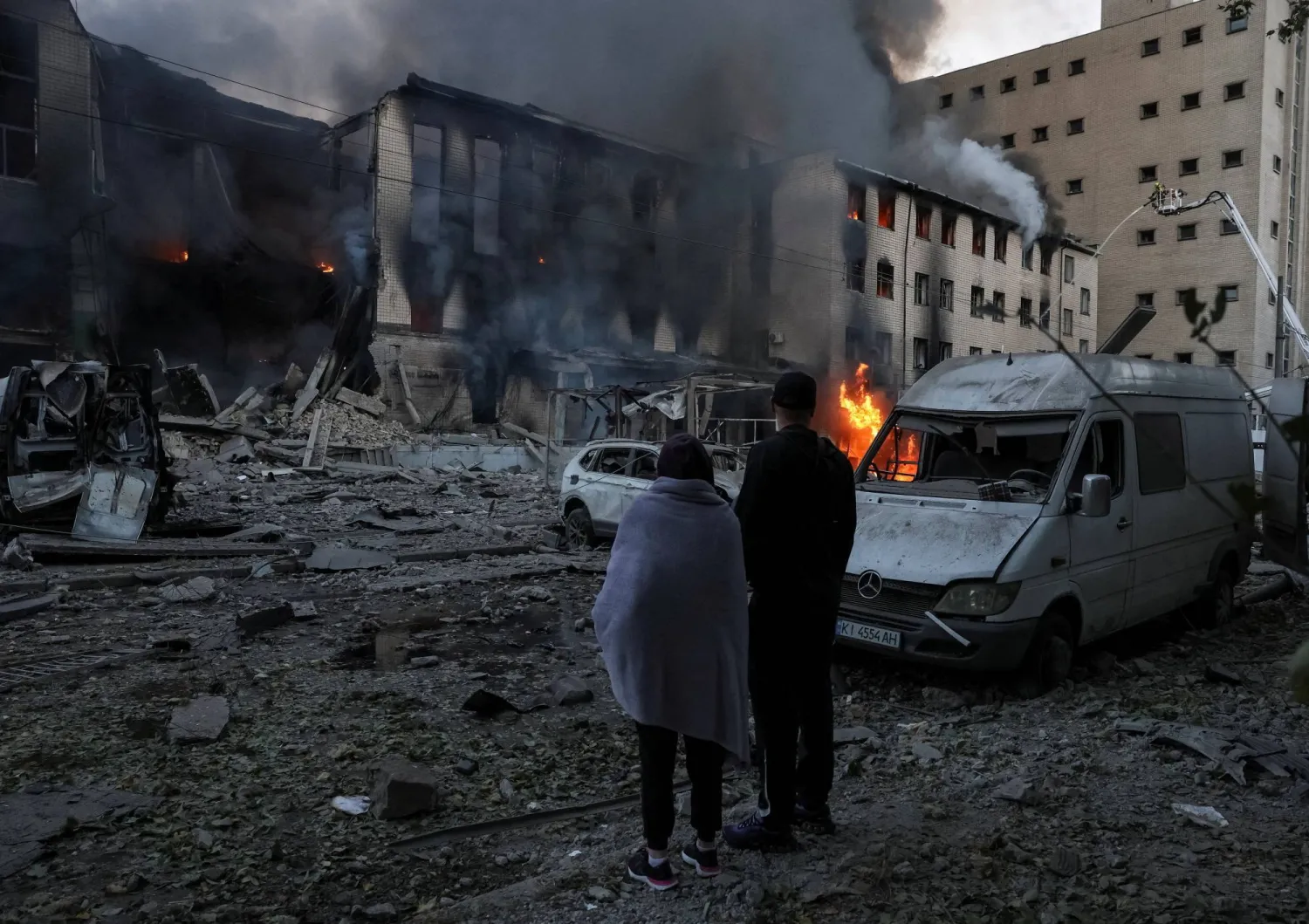

Russia Pounds Kyiv, Ending Three-Day Halt for US Talks

Residents stand at a site of a Russian missile attack, amid Russia's attack on Ukraine, in Kyiv, Ukraine September 8, 2026. (Reuters)
TT

Russia Pounds Kyiv, Ending Three-Day Halt for US Talks

Residents stand at a site of a Russian missile attack, amid Russia's attack on Ukraine, in Kyiv, Ukraine September 8, 2026. (Reuters)

Russian missiles and drones pounded Kyiv overnight, killing two people and sending smoke billowing above the Ukrainian capital, ending Moscow's temporary halt to strikes on the city.

Russian President Vladimir Putin had ordered the pause in attacks as US President Donald Trump's envoys Steve Witkoff and Jared Kushner visited the Russian and Ukrainian capitals at the weekend.

AFP reporters in the city heard fresh explosions ringing out in the early hours of Tuesday, triggering fires and sending locals down into basements and metro stations for shelter.

"The moment the US president's peace envoys left, Putin launched another massive, horrific attack against Kyiv, damaging residential areas and killing at least two people," Ukrainian Foreign Minister Andriy Sybiga said on social media.

"His ballistic missiles speak louder than his words on diplomacy."

Witkoff and Kushner's trips provided no immediate breakthrough in ending the four-and-a-half-year war, but represented Washington's reengagement with trying to broker a deal between the two sides, which had been on hold for months.

Kyiv Mayor Vitali Klitschko said people were trapped in a residential building after the strikes.

Russia's army said it had a carried out a "massive strike" on military-industrial sites, logistics hubs and storage centers in Kyiv and its suburbs.

Civilian deaths in Ukraine are running at their highest rate since the first months of Russia's invasion, according to statistics verified by the United Nations.

In the Moscow-annexed Crimean peninsula, Russian-installed officials said a Ukrainian attack killed two people.

- US proposals -

The strikes came hours after Witkoff touted "substantive progress" in the discussions with Ukraine and Russia, raising the prospect of reviving three-way peace talks to end Europe's deadliest conflict since World War II.

"President Trump is working hard to stop the killing and work towards a lasting and durable peace," he said on X.

Witkoff and Kushner met Putin in Moscow on Saturday, before holding separate talks with Ukrainian President Volodymyr Zelensky in their first official trip to Kyiv.

The Kremlin announced Monday that it did not rule out three-way talks, with spokesman Dmitry Peskov telling reporters "it is too early to say anything about the venue or the exact dates at this stage".

Zelensky told US news outlet Axios that the United States was pushing to de-escalate the conflict ahead of the long winter.

Russia has struck Ukraine's energy grid each winter since invading in February 2022, cutting power and heating to millions in temperatures as low as -20C.

Zelensky has said the weekend talks included US proposals around energy facilities, grain shipments and oil and gas exports, but declined to give further details.

Russian Foreign Minister Sergei Lavrov on Tuesday appeared to rule out a Turkish proposal for a truce on strikes in the Black Sea, saying it was "unrealistic" and "impossible to monitor".

The two sides appear no close to agreeing on how the war should end.

Moscow is demanding Ukraine cede territory in its eastern Donetsk region that it still controls and renounce Western military support.

Kyiv has said such terms amount to capitulation and would only allow Russia to prepare a fresh attack in its bid to install a Moscow-friendly puppet government.



Iran’s President Says Tehran to Resist Until ‘Aggressors Are Regretful’

People walk near an anti-US mural in Tehran, Iran, September 2, 2026. Majid Asgaripour/WANA (West Asia News Agency) via Reuters
TT

Iran’s President Says Tehran to Resist Until ‘Aggressors Are Regretful’

People walk near an anti-US mural in Tehran, Iran, September 2, 2026. Majid Asgaripour/WANA (West Asia News Agency) via Reuters

Iran will continue its resistance with strength until "aggressors" become regretful and its rights are defended, President Masoud Pezeshkian said on Tuesday, pointing ‌to a ‌less conciliatory ‌tone ⁠from Tehran.

"Iran has always been against war and has considered the ⁠preservation of people's ‌interests ‌and regional security to ‌lie in refraining ‌from conflict. However, just as it has boldly risen to ‌defend against aggression up to this ⁠day, ⁠it will continue this resistance with strength until aggressors become regretful and will remain guardian of people's rights," Pezeshkian posted on X.

Iran threatened the United States with "economic warfare" on Tuesday and said it had fired an advanced missile at US warships, underscoring the risks of further escalation in the war only days after both sides traded blows again.

The six-month-old war has been marked by a cycle of pauses followed by periodic flare-ups, with the US last reporting attacks on Iranian targets on Saturday, when US forces struck three Iranian oil tankers. Iranian state media on Sunday reported that Iran fired the Qassem Basir missile in its attacks on several US vessels.


Nepal Glacier Saw Exceptional Heat Before Collapse Caused Deadly Floods, Says Researcher

A man looks at the remains of sludge-ridden houses in the aftermath of flash floods at Devighat in Nepal's Nuwakot district on September 8, 2026. (AFP)
TT

Nepal Glacier Saw Exceptional Heat Before Collapse Caused Deadly Floods, Says Researcher

A man looks at the remains of sludge-ridden houses in the aftermath of flash floods at Devighat in Nepal's Nuwakot district on September 8, 2026. (AFP)

The mountain section whose collapse triggered fatal floods in Nepal and China on August 26 had experienced unprecedented heat for the time of year, meteorological data analyzed by a researcher shows.

Average temperatures on the mountain glacier at an altitude of 5,200 meters (17,060 feet) were estimated at around five degrees Celsius between August 21 and 26.

This is exceptionally high.

They had not exceeded 4.0C over the same period in more than 55 years of data recording, although no direct link to the collapse has so far been established.

This series of highly localized temperatures was reconstructed by Robert Rohde, chief scientist at the independent Berkeley Earth organization in California.

At the site of the collapse, the average temperature recorded over that six-day period has risen by about 1.8C since the mid-20th century.

Without the additional heat brought by climate change, a comparable temperature pattern "would probably occur only once in a few thousand years", Rohde calculated for AFP.

The collapse came during the Langtang region's fourth-hottest summer on record, according to AFP's analysis of data from Europe's Copernicus observatory dating back to 1970.

- Tipping point -

"These hot conditions can also explain permafrost thaw and combined slope and glacier collapse," said French climatologist Valerie Masson-Delmotte.

Permafrost acts as ice cement, holding rock faces together. Its degradation makes them more unstable.

Satellite images also showed significant snowmelt in the days before the disaster, providing "a substantial source of liquid water that can infiltrate fractures in the mountain and facilitate landslides", said Etienne Berthier, a glaciologist at France's CNRS research agency.

Experts remain cautious, however, about the precise role played by the heatwave.

"It's not as straightforward as 'high temperature equals collapse,'" Kristen Cook, a geomorphologist at the Grenoble Alpes University in France, told AFP.

"If the temperature acted as a trigger, it seems that it needed to wait until the rock was right at the tipping point of collapse," she added.

Researchers are now examining the small movements observed in the mountain in the years before the collapse and their interaction with changes in temperature.

"Proving the rock near the fracture plane was significantly weakened as a result of meltwater and/or permafrost thaw" would be a "smoking gun" of climate change, according to Rhode of Berkeley Earth.

His temperature analysis used data from the Copernicus program's ERA5 climate model and a network of 14 high-altitude weather stations located between nine and 140 kilometers (six and 87 miles) from the collapsed glacier.


North Korea Calls Russia Bridge a Sign of Tighter Ties

A handout photo made available by the Russian Transport Ministry on 08 September 2026 shows a Zaporozhets car on the new Russia-North Korea road bridge over the Tumen River, during the opening ceremony in Khasan statement, Primorsky Krai, Russia. (EPA/Russian Transport Ministry Press Service/Handout)
TT

North Korea Calls Russia Bridge a Sign of Tighter Ties

A handout photo made available by the Russian Transport Ministry on 08 September 2026 shows a Zaporozhets car on the new Russia-North Korea road bridge over the Tumen River, during the opening ceremony in Khasan statement, Primorsky Krai, Russia. (EPA/Russian Transport Ministry Press Service/Handout)

North Korea called the first road bridge across its narrow border with Russia a concrete sign of tightening bonds, state media reported Tuesday, as Pyongyang gains advantages from its powerful neighbors Moscow and Beijing.

The bridge over the Tumen River into Russia and an under-construction span to China are part of a shift that offers Western-sanctioned Pyongyang economic and strategic options it has long sought, experts said.

North Korea "will simultaneously secure two major overland routes linking it with Russia and China, allowing it to encourage competition between the two countries and maximize its gains," said Lim Eul-chul, a professor at Kyungnam University.

He noted the bridges also "can be a message to the United States that North Korea has no reason to beg Washington for sanctions relief or make concessions on denuclearization in order to negotiate".

Russia noted the bridge is designed to accommodate expanded growth in freight with the capacity for up to 300 vehicles daily, which adds to the rail and air links already between the neighbors.

Ukrainian rights group Truth Hounds, however, previously warned that the new bridge could become "a direct artery for moving North Korean troops, construction brigades and military officials into Russia, with Russian technology and resources flowing in the opposite direction".

The ceremony on Monday marking the new bridge's opening came as Russia and North Korea have heavily boosted military and economic ties since Moscow launched its Ukraine offensive in 2022.

North Korea dispatched thousands of troops to Russia in 2024 to help ward off a Ukrainian incursion into the Kursk region, while Kyiv has accused Moscow of using North Korean missiles in its regular barrages.

South Korea's central bank estimated in July that North Korea's economy grew more than three percent for a third straight year in 2025, citing it's expansion of economic cooperation with Russia as a "major drive."

The bank's official said North Korea's gross national income also "received a boost from a sharp rise in foreign currency earnings" linked to the deployment of its troops to Russia.

- Beijing-Moscow-Pyongyang bloc -

North Korean official Pak Thae Song, according the official KCNA news agency, said: "The completion of the bridge is a significant event adding a new dynamic movement to the overall bilateral cooperation."

North Korea and China are already connected by the Sino-Korean Friendship Bridge, which is regularly used by passenger trains, but its capacity is limited.

After a long halt, the bridge partly reopened and restored daily passenger train services with China early this year, but has not yet resumed issuing tourism visas to Chinese citizens, who once made up the bulk of its overseas visitors.

North Korea has long kept tight control over foreign visitors, and effectively sealed its borders at the start of the pandemic six years ago.

The New Yalu River Bridge, intended as an alternative and eventual replacement of the Sino-Korean Friendship Bridge, is expected by experts to be completed this year.

The completion of the bridge "sends a political and geopolitical message demonstrating the formation of a "North Korea-China-Russia continental triangular bloc", said Lim.