Macron Urges EU Ban on Social Media for Under-15s in Letter to Von der Leyen

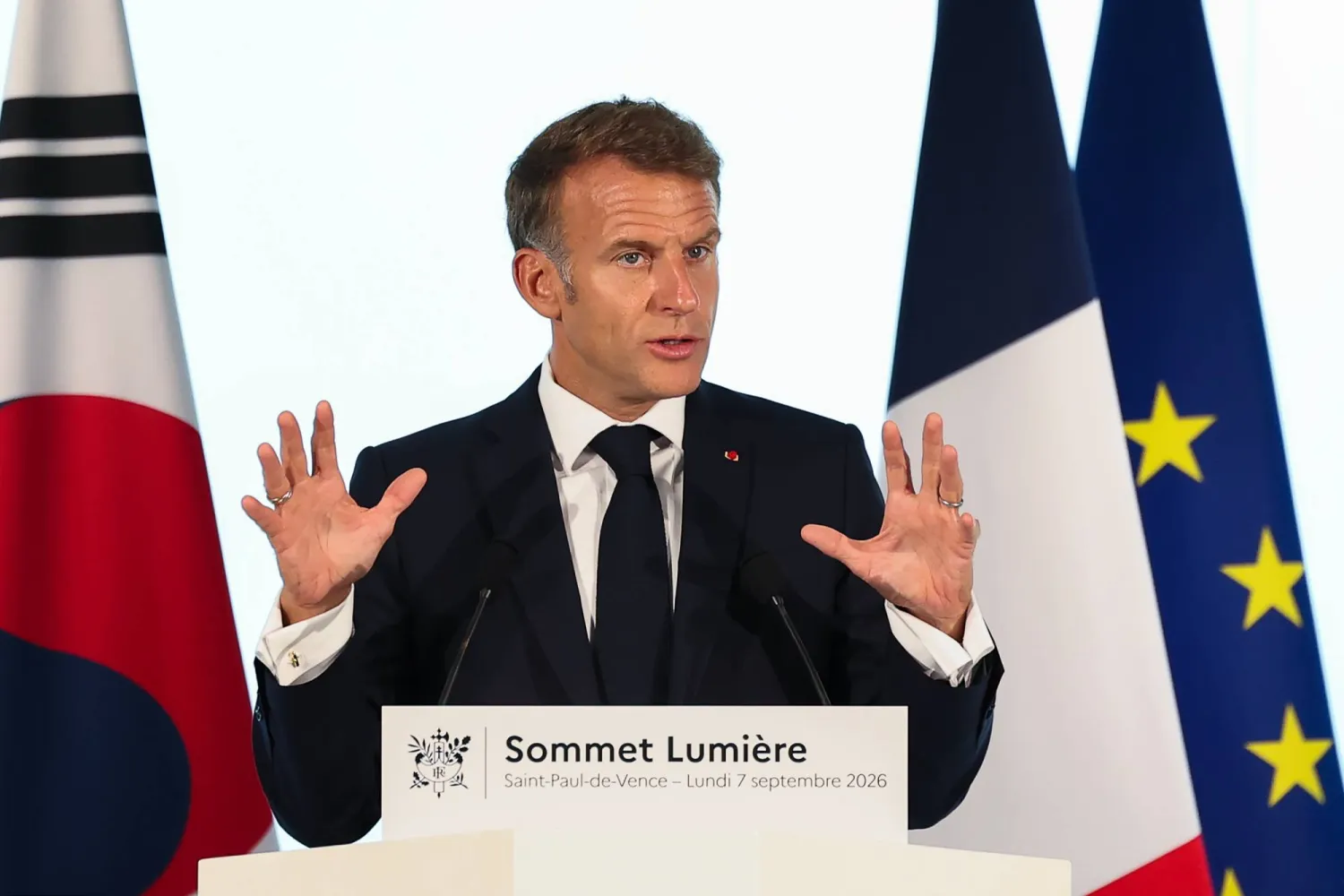
France's President Emmanuel Macron addresses the audience during the opening plenary session of the "Lumière Summit" meeting on the future of cinema and the moving-image industry at the Maeght Foundation in Saint-Paul-de-Vence, southeastern France, Monday, Sept. 7, 2026. (Valery Hache/Pool Photo via AP)
TT

Macron Urges EU Ban on Social Media for Under-15s in Letter to Von der Leyen

France's President Emmanuel Macron addresses the audience during the opening plenary session of the "Lumière Summit" meeting on the future of cinema and the moving-image industry at the Maeght Foundation in Saint-Paul-de-Vence, southeastern France, Monday, Sept. 7, 2026. (Valery Hache/Pool Photo via AP)

French President Emmanuel Macron has urged the European Commission to back a European Union-wide ban on social media for children under 15 after France failed to enact its own legislation, his office said on Tuesday.

In a letter to European Commission President Ursula von der Leyen dated Aug. 29 and seen by Reuters and other media, Macron said it had become urgent to introduce a bloc-wide ban through new EU legislation after France's Constitutional Council struck down a national bill this summer before it was due to take effect in September.

"I believe it has now become ⁠essential to go ⁠further and, through a new European legislative text, harmonize a ban on access to social media platforms for children under the age of 15, in order to protect all children across the Union," Macron wrote.

Following Australia's landmark social media ban for children adopted last year, several European countries are considering their own ⁠curbs amid growing concern over the impact of social media on young people's mental health and safety. But some countries, especially in Scandinavia, believe it is best left for parents to decide.

Macron, now in his final year as French president, has taken up the cause as a priority before the next French presidential election in 2027, and has been lobbying other EU governments to back restrictions. He said France would separately rework the legislation struck down by the Constitutional Council, though political fragmentation in ⁠parliament and ⁠difficult budget negotiations could complicate efforts to pass a new law.

Von der Leyen said in July that the European Union would move to limit young children's access to social media across the 27-member bloc, citing proposals from two experts recommending a tiered system. Under that approach, children under 13 would only be allowed limited, supervised access, with restrictions eased gradually as they get older.

Macron is seeking a tougher approach, pushing for a blanket ban on social media access until the age of 15, ahead of Von der Leyen's flagship State of the Union speech to the EU parliament later this month.


Dutch Peanut Butter Artwork Proves a Sticky Attraction

The peanut butter had to be spread as smoothly as possible, without lumps. AFP
TT

Dutch Peanut Butter Artwork Proves a Sticky Attraction

The peanut butter had to be spread as smoothly as possible, without lumps. AFP

An artwork consisting of 390 kilograms of peanut butter spread on the floor of a Dutch museum attracted 48,000 visitors, 48 accidental footprints, five phones and one "licking incident" during its run, the institution said Tuesday.

The unusual work, a tribute to artist Wim T Schippers who died this year, was on display for two months at the Boijmans van Beuningen museum in Rotterdam.

Peanut butter was spread on a hexagonal floor measuring 25 square meters "as smoothly as possible, without any lumps", according to the artist's instructions.

"Forty-eight visitors made a fatal misstep into the floor," said the museum in a statement summing up the exhibition. "Five phones were fished out."

"There was one licking incident," the statement added, with a spokesperson telling AFP that a young child was thought to be the culprit.

The museum also received 80 complaints in writing or by telephone.

The big question now the exhibition is over: what to do with the hundreds of kilograms of used peanut butter?

"We looked into whether the peanut butter could be reused, for example by zoos, animal shelters or sustainable initiatives," museum spokesman Rene Timmermans told AFP.

"However, after being part of the tribute... for eight weeks, we could no longer guarantee its quality, hygiene or food safety."

The peanut butter is therefore destined for the compost heap, he said.

The Dutch are a huge fan of peanut butter, often combining it with "Hagelslag" chocolate sprinkles for a calorie-rich breakfast.

The museum said more than 400 peanut butter sandwiches were served in its cafe.

"The combination with Hagelslag was the most popular."


Eiffel Tower Reopens after Row over Removing Women Staff

Pedestrians walk past the Eiffel Tower in Paris on September 8, 2026. (Photo by Lou BENOIST / AFP)
TT

Eiffel Tower Reopens after Row over Removing Women Staff

Pedestrians walk past the Eiffel Tower in Paris on September 8, 2026. (Photo by Lou BENOIST / AFP)

The Eiffel Tower reopened on Tuesday after staff walked out over the removal of women colleagues during a visit by a Hindu religious group which later apologized.

The operating company that runs the Paris landmark, SETE, acknowledged that the Hindu delegation had requested the visit on Saturday be organized so as to limit "interactions with women" and said that "these conditions should not have been accepted.”

The Eiffel Tower, which says it receives nearly seven million people a year, reopened on Tuesday morning, with visitors making their way through security checkpoints at the base.

The monument was closed on Monday, when SETE said it held a meeting between staff and management, AFP reported.

The Bochasanwasi Akshar Purushottam Swaminarayan Sanstha (BAPS) spiritual movement apologized for "any pain or inconvenience caused" by the incident.

"To the best of our knowledge, at no point was anyone prevented access to the Eiffel Tower," the organization wrote on X.

"Due to the size of our delegation, the visit was arranged in conjunction with the Eiffel Tower team at the start of normal operating hours to avoid disrupting or inconveniencing others."

Eiffel Tower staff condemned "professional instructions that led to female employees being sidelined, replaced and made invisible because of their sex" during the visit by the delegation.

"Instructions were given to female employees of the Eiffel Tower and to female employees of contractors to make themselves invisible in order to welcome this delegation," the staff said in a statement, adding they were shocked to have been put in such a situation.

"Some were asked to leave their posts and withdraw to other areas. In some posts they were replaced by men. And all female employees were instructed not to go through or cross certain areas while the delegation was present."

BAPS, which is close to Indian Prime Minister Narendra Modi's ruling conservative Hindu nationalist party, opened its first major temple in France on Sunday, near Paris.

BAPS spiritual leader Mahant Swami Maharaj, 93, consecrated it himself.

The BAPS organization claims a worldwide network of more than 1,300 temples, some of which have been inaugurated by Modi himself.

France's gender equality minister Aurore Berge voiced indignation after the Eiffel Tower incident.

"In France, we do not ask women to erase themselves," she said.

Candidates in next year's presidential election also weighed in.

Far-right presidential candidate Marine Le Pen also criticized the incident, saying France would "never accept that women's presence be 'limited'".

Gabriel Attal, a centrist rival to become head of state, said: "In France, no culture, no belief, no religion, nothing and no one can come and dictate to women what their place should be."


Australia Targets Social Media Algorithms with New User-Choice Rules

The Instagram app icon is seen on a smartphone in this illustration taken October 27, 2025. (Reuters)
TT

Australia Targets Social Media Algorithms with New User-Choice Rules

The Instagram app icon is seen on a smartphone in this illustration taken October 27, 2025. (Reuters)

Australia on Tuesday ‌proposed giving social media users the option to select the content they see on their feeds, marking the next step in the government's push to improve online safety, following its world-first social media ban for children.

Under draft laws proposed by the center-left Labor government, social media platforms will be required to notify users and offer them a choice over their default feed.

Users can choose to opt in to having their default feed include personalized content recommended by an algorithm. Alternatively, they can opt out of algorithmically recommended content and instead ‌see posts ‌only from the friends and creators they choose ‌to ⁠follow.

"This is sensible, ⁠pragmatic, practical reform," Prime Minister Anthony Albanese told reporters. "It gives users choice and it will hold the big tech companies responsible for inaction if they don't follow our laws."

Meta Platforms, which owns Facebook, Instagram and WhatsApp, and Alphabet's Google did not immediately respond to a request seeking comment.

Australia follows in the footsteps of the European Union's Digital ⁠Services Act, which has since 2024 required platforms ‌to offer users the option of ‌switching off profiling. However, the rollout had a bumpy start, with regulators complaining ‌that platforms did not make it simple enough for users ‌to opt out.

Social media companies face growing scrutiny around the world over concerns that algorithms have been designed to encourage addictive behavior, with users drawn into prolonged viewing through recommendations that push them toward similar content.

Albanese said ‌the "My Feed, My Way" initiative would also require digital platforms to document the measures taken to address identified ⁠risks of ⁠harm to Australian users and ensure those measures remain effective over time.

Failure to comply could attract penalties of up to A$109.2 million ($79 million), with Australia's internet regulator, eSafety, responsible for compliance and enforcement.

eSafety will also be granted the power to issue notices requiring Big Tech companies to swiftly remove harmful, nudity-related and illegal content. However, free speech advocates warned the proposed legislation could result in censorship.

"It's not about giving government control. It's about giving people control," Albanese said.

The government will seek feedback from digital platforms, industry bodies, civil society organizations and advocates on the draft legislation, with the bill expected to be introduced to Parliament this year.