Nepal Glacier Saw Exceptional Heat Before Collapse Caused Deadly Floods, Says Researcher

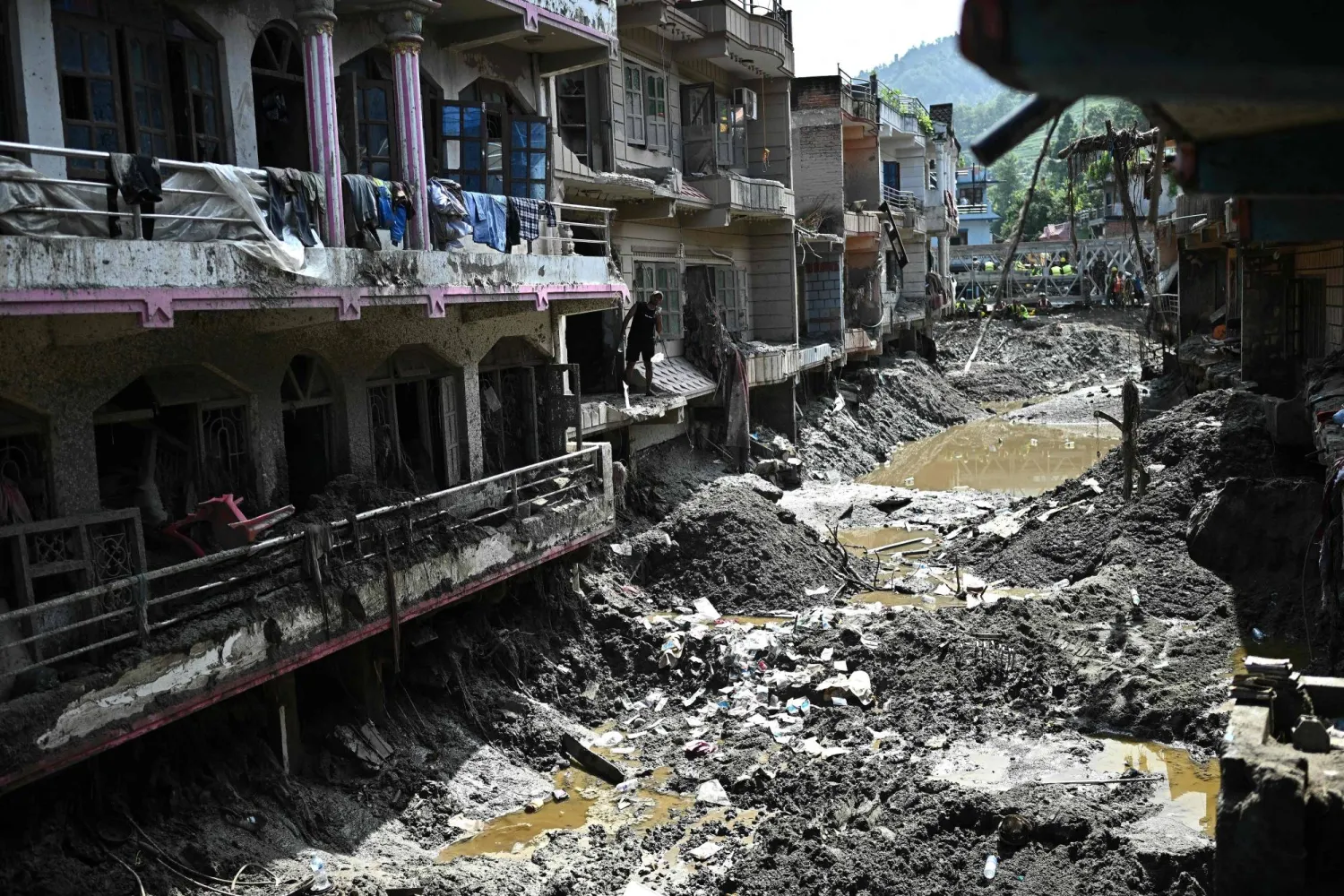
A man looks at the remains of sludge-ridden houses in the aftermath of flash floods at Devighat in Nepal's Nuwakot district on September 8, 2026. (AFP)
TT

Nepal Glacier Saw Exceptional Heat Before Collapse Caused Deadly Floods, Says Researcher

A man looks at the remains of sludge-ridden houses in the aftermath of flash floods at Devighat in Nepal's Nuwakot district on September 8, 2026. (AFP)

The mountain section whose collapse triggered fatal floods in Nepal and China on August 26 had experienced unprecedented heat for the time of year, meteorological data analyzed by a researcher shows.

Average temperatures on the mountain glacier at an altitude of 5,200 meters (17,060 feet) were estimated at around five degrees Celsius between August 21 and 26.

This is exceptionally high.

They had not exceeded 4.0C over the same period in more than 55 years of data recording, although no direct link to the collapse has so far been established.

This series of highly localized temperatures was reconstructed by Robert Rohde, chief scientist at the independent Berkeley Earth organization in California.

At the site of the collapse, the average temperature recorded over that six-day period has risen by about 1.8C since the mid-20th century.

Without the additional heat brought by climate change, a comparable temperature pattern "would probably occur only once in a few thousand years", Rohde calculated for AFP.

The collapse came during the Langtang region's fourth-hottest summer on record, according to AFP's analysis of data from Europe's Copernicus observatory dating back to 1970.

- Tipping point -

"These hot conditions can also explain permafrost thaw and combined slope and glacier collapse," said French climatologist Valerie Masson-Delmotte.

Permafrost acts as ice cement, holding rock faces together. Its degradation makes them more unstable.

Satellite images also showed significant snowmelt in the days before the disaster, providing "a substantial source of liquid water that can infiltrate fractures in the mountain and facilitate landslides", said Etienne Berthier, a glaciologist at France's CNRS research agency.

Experts remain cautious, however, about the precise role played by the heatwave.

"It's not as straightforward as 'high temperature equals collapse,'" Kristen Cook, a geomorphologist at the Grenoble Alpes University in France, told AFP.

"If the temperature acted as a trigger, it seems that it needed to wait until the rock was right at the tipping point of collapse," she added.

Researchers are now examining the small movements observed in the mountain in the years before the collapse and their interaction with changes in temperature.

"Proving the rock near the fracture plane was significantly weakened as a result of meltwater and/or permafrost thaw" would be a "smoking gun" of climate change, according to Rhode of Berkeley Earth.

His temperature analysis used data from the Copernicus program's ERA5 climate model and a network of 14 high-altitude weather stations located between nine and 140 kilometers (six and 87 miles) from the collapsed glacier.


First Ebola Patients in Nigeria and Kenya Might Have Crossed Paths at Uganda Airport

Kenya Red Cross personnel doff their Personal Protective Equipment (PPE) during a simulation of the evacuation of remains of an Ebola victim in the Kenyan capital Nairobi on October 22, 2026. (AFP)
TT

First Ebola Patients in Nigeria and Kenya Might Have Crossed Paths at Uganda Airport

Kenya Red Cross personnel doff their Personal Protective Equipment (PPE) during a simulation of the evacuation of remains of an Ebola victim in the Kenyan capital Nairobi on October 22, 2026. (AFP)

The first Ebola patients confirmed in Kenya and Nigeria might have crossed paths at an airport in Uganda earlier this month, African health officials said Thursday as they race to trace and slow an outbreak that has spread to several African countries.

Both patients are known to have traveled through Uganda's Entebbe International Airport on Oct. 3, said Dr. Wessam Mankoula, head of emergency preparedness and response at the Africa Centers for Disease Control and Prevention.

“One of the issues we are currently investigating has been some sort of interaction between the two cases at the airport,” Mankoula said.

Nigerian Health Minister Muhammed Pate said Nigeria's case remains contained and that contact-tracing is in progress. “We are trying to contain it so it doesn’t go out to the communities. Hopefully, it won’t get to that and we are working hard to ensure that,” Pate said.

The current Ebola outbreak emerged in Congo in May and the disease has since been detected in three other African countries, becoming the continent’s most geographically widespread Ebola outbreak in history.

Nigeria announced its first case on Tuesday, saying the patient had travelled from Uganda. Ugandan authorities denied the claim that the patient was exposed in their country and said the patient had travelled to Congo — something now disputed by health officials.

The Nigerian patient, who is a Uganda-born wife of a diplomat in Abuja, had vacationed in Uganda for two weeks in September and had arrived in Nigeria in early October, officials said. Nigeria said it is currently tracing 44 contacts.

Mankoula said additional contacts have been identified, but declined to give the new figure.

Uganda recorded 20 cases before declaring itself free of the disease in June. However, the country is now believed to be linked to the new imported cases in Nigeria and Kenya. Kenya has recorded nine cases so far, linked to a traveler who had returned from Congo to Kenya through Uganda.

So far there is no indication that the Nigerian patient traveled to Congo, Mankoula said. Officials from the World Health Organization said the same thing at a separate briefing on Thursday.

“The information supplied to WHO did not include travel to another country during that period, and other accounts about prior travels were not communicated to us,” said Dr. Pavel Ursu, the WHO country representative in Nigeria.

Congo has been struggling to contain the virus, which has infected more than 9,500 people, killing nearly half of them. The virus has spread to eight provinces and 66 health zones across the country’s eastern region.

According to data from the Africa CDC, only 20% of confirmed cases are among known contacts and about 60% of deaths are within the community, outside of treatment centers. Analysts say the disease in some of the hotspots in Congo is out of control.


Storm Causes Power Outages and Train Disruption across Northwest France

File photo: A huge wave crashes on the jetty of the harbor of Le Conquet in western France, on January 8, 2026.  Fred Tanneau, AFP
File photo: A huge wave crashes on the jetty of the harbor of Le Conquet in western France, on January 8, 2026. Fred Tanneau, AFP
TT

Storm Causes Power Outages and Train Disruption across Northwest France

File photo: A huge wave crashes on the jetty of the harbor of Le Conquet in western France, on January 8, 2026.  Fred Tanneau, AFP
File photo: A huge wave crashes on the jetty of the harbor of Le Conquet in western France, on January 8, 2026. Fred Tanneau, AFP

Hundreds of thousands of people were hit by power outages and train services were disrupted by heavy winds and ‌rain sweeping ‌across France ‌on Friday, said Reuters.

-Utility Enedis said ⁠in a situation update on Friday morning that 161,000 clients had ⁠no electricity from ‌the ‌storm.

-National rail ‌network manager ‌SNCF said it would suspend train service or limit train ‌speeds.

-Meteo France, France's weather ⁠agency, ⁠has issued orange alerts for much of the country's northwest, saying that heavy wind and thunderstorms would continue into late Friday.


Taiwan Shuts Schools and Grounds Flights as Typhoon Champi Brushes by

A woman struggles with winds generated by Typhoon Champi in Taipei, Taiwan, Friday, Oct. 23, 2026. (AP)
TT

Taiwan Shuts Schools and Grounds Flights as Typhoon Champi Brushes by

A woman struggles with winds generated by Typhoon Champi in Taipei, Taiwan, Friday, Oct. 23, 2026. (AP)

Taiwan shut down schools and offices and grounded hundreds of flights as Typhoon Champi brushed by the island Friday, packing strong winds and torrential rains.

Champi peaked at 298 kph (185 mph) maximum sustained winds earlier this week but has weakened to 155 kph (96 mph) winds as it approached Taiwan from the southwest. Its center is forecast to remain offshore as it sweeps by the island's northeastern tip before turning north toward Japan's southwestern islands.

Taiwan’s Central Weather Administration urged residents in coastal areas to avoid outdoor activities and driving and be cautious of falling objects.

One person was killed Thursday after being swept by waves in Liuqiu, a small island off the southeastern coast of Taiwan’s main island, according to the fire department. Ninety-four others were injured in the storm.

Almost 1,300 people have been evacuated from vulnerable, mountainous areas, the government said.

All of Taiwan’s 262 domestic flights were cancelled along with 669 international flights, according to the transport ministry. High-speed rail services on the western coast were operating normally.

In southwestern Japan, the typhoon has injured one person, grounded flights and knocked out power.

On Miyako island, a woman in her 70s suffered a broken leg in the blowing wind, according to the Okinawa prefecture government.

On Ishigaki island, nearly 2,000 homes were without electricity.

Dozens of flights in and out of the southwestern islands, including Miyako, Ishigaki and Okinawa, have been canceled.

In the Philippines, the coast guard prohibited ships and ferries from venturing into the increasingly choppy waters off several northern towns and cities Friday.

The main domestic airport in Batanes provincial capital of Basco was shut down Friday and two local flights were canceled, Philippine aviation officials said. The airport’s windows were boarded up as a safety precaution.

In Cagayan province, nearly 200 people evacuated to safer grounds as a precaution, including nearly 100 who moved to government-run emergency shelters. Classes were suspended in all levels in the island town of Calayan off Cagayan due to the typhoon, provincial officials said.

Champi earlier this month blew past several Pacific islands, including Guam, where a federal disaster area was declared.