Renoir Paintings Are Worth a Fortune, but Not When They’re Stolen

Painting of "Coco Reading" by French painter Pierre-Auguste Renoir, which was stolen from Renoir Museum in Cagnes-sur-Mer, France, but was later retrieved, September 8, 2026, in this screen grab obtained from a page on the Renoir Museum's website. (Musée Renoir/Handout via Reuters)
TT

Renoir Paintings Are Worth a Fortune, but Not When They’re Stolen

Painting of "Coco Reading" by French painter Pierre-Auguste Renoir, which was stolen from Renoir Museum in Cagnes-sur-Mer, France, but was later retrieved, September 8, 2026, in this screen grab obtained from a page on the Renoir Museum's website. (Musée Renoir/Handout via Reuters)

Two Renoir paintings stolen from a small French museum have yet to be recovered but if the thieves are hoping to cash in on the artwork, they would be hard-pressed to find a buyer.

Selling well-known, stolen art is impossible to do at an auction house or through other public channels without raising eyebrows. Even under the table, the value plummets. And unlike other eye-catching artifacts such as jewels, paintings can't be chopped up and sold for parts without losing their entire worth.

Art crime experts stress that most buyers simply don't want the liability. In short, the reality looks nothing like the movies.

“People always think that there is this kind of ‘Dr. No’ type from the James Bond movie," said Arthur Brand, a private art detective based in the Netherlands. "But that’s Hollywood. In the real world, there are no collectors like that.”

Brand, who has investigated art crime for about 20 years, explains that often “nobody will touch” stolen art, particularly high-profile work. Sometimes that means paintings valued at millions of dollars are effectively “worth zero” once they're outside of the museum, he added, if not a small fraction of the price.

Tuesday's theft at the Renoir Museum — the last home of painter Pierre-Auguste Renoir in the French Riviera — marks the latest high-profile art crime targeting collections around the world, and experts warn there could be more.

Here's what we know.

Where the Renoirs could wind up

Cagnes-sur-Mer's mayor, Bryan Masson, said a group of “well-equipped” burglars stole a total of four Renoir paintings from the museum in his town on Tuesday. But they dropped two of them — Renoir’s “Portrait of Madame Pichon″ and “Coco Reading" — in the museum garden before they fled, the prosecutor’s office said in a statement.

Police are still searching for the perpetrators. In the meantime, Renoir's “Portrait of Madame Colonna Romano” and “Young Woman at the Well" remain missing.

Masson estimated the value of the combined Renoir works stolen Tuesday at 9 million euros ($10.5 million).

But the probability of profiting off such a heist is “extremely low,” said Erin Thompson, an art crime professor at the John Jay College of Criminal Justice in New York. In cases that end in arrests, the common takeaway is that “thieves are people who are good at stealing things and bad at thinking through the consequences,” she added.

Some may try to make money from heists in other ways, such as through demanding a ransom or looking for an insurance payout. But Thompson explains many museums don't have insurance because it's too costly. That's why the practice is so rare in the US, for example, and it would be difficult to negotiate with insurance companies elsewhere without the thieves incriminating themselves.
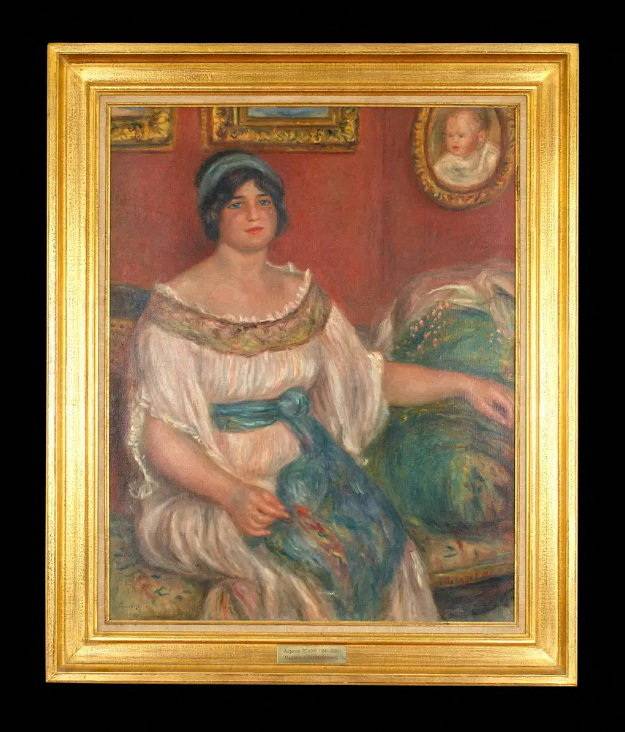
Painting of "Madame Colonna Romano" by French painter Pierre-Auguste Renoir, which was stolen from Renoir Museum in Cagnes-sur-Mer, France, September 8, 2026, in this screen grab obtained from a page on the Renoir Museum's website. (Musée Renoir/Handout via Reuters)

As a result, if not surrendered or otherwise recovered, stolen paintings may remain hidden or in some cases eventually destroyed to get rid of evidence, Thompson says.

Brand, who collaborates regularly with law enforcement in his art crime investigations, says that he's still seen limited cases of stolen paintings “floating around in the underworld” — perhaps as partial payments for products like drugs. And depending on country-by-country laws, he noted that the promise of returning the art has led to reduced sentences of other charges.

“Some more savvy criminal will acquire it as a get out of jail free card, sort of a bargaining chip,” added Christopher Marinello, a lawyer and founder of Art Recovery International. “So, if some drug dealer ever is arrested, he can bargain with the prosecutor and say, ‘Listen, give me a lesser sentence and I’ll show you where these Renoirs are.’ And that has always worked and it will work again.”

Paintings are harder to hide and sell than jewels

Stolen paintings are much more difficult to profit from than museums' other crown jewels — literally.

Jeweled and metal goods have increasingly become a target of theft because they can be melted down or broken down into parts. Last year, a handful of experts warned that could be the fate of the stunning heist of crown jewels at the Louvre Museum in Paris, for example, noting that, if done successfully, smaller pieces could later go up for sale as part of a new necklace, earrings or other jewelry without turning too many heads.

But of course, such pieces would lose their historical worth and, if actually sold, likely only go for a fraction of their original value. Experts also warn that it's far from a simple process overall and gems may still be identifiable by characteristics like clarity, for example.

Apart from an emerald-set imperial crown found outside the museum the day of the October 2025 heist, the stolen jewels remain unrecovered.

Paintings, in contrast, don't have the same commodity value that can potentially be parceled off. “It’s a canvas with some old oil paint on it,” said art theft expert James Ratcliffe, of the Art Loss Register. “You can’t touch it up. You can’t resell it other than for what it is.”

Uptick in art crime overall

Ratcliffe and others note that hasn't stopped thefts of famous paintings and other artwork from museums. Just earlier this year, three pieces by Renoir, Cézanne and Matisse worth millions of euros were stolen in Italy, for example, before being recovered last month.

Ratcliffe notes that smaller museums, in particular, are harder to secure because they might not have the funding necessary to invest in the latest technology or are located in historic buildings that may take more time and effort to install new guardrails.

Still, pressures are piling up, with some warning that future cases of art theft could be likely as vulnerabilities persist.

“We need to change the way we treat small and country house museums before we lose to our cultural heritage permanently,” said Marinello, who stresses that stronger security and enforcement is overdue. “We’re supposed to be preserving our cultural heritage, not allowing criminals to take what they want and using them as shopping malls.”


Paris’ Louvre and Other Top Museums to Close on Saturday Over Concern about Protest Violence

Visitors wait outside as protesters block the entrance to the Louvre Museum to express their support for the high school students' movement in Paris, France, 19 October 2026, two days after demonstrations and riots took place alongside nationwide cost-of-living protests. (EPA)
TT

Paris’ Louvre and Other Top Museums to Close on Saturday Over Concern about Protest Violence

Visitors wait outside as protesters block the entrance to the Louvre Museum to express their support for the high school students' movement in Paris, France, 19 October 2026, two days after demonstrations and riots took place alongside nationwide cost-of-living protests. (EPA)

The Louvre and several other major Paris museums will be closed on Saturday over concerns about potential violence during planned protests, France’s culture ministry said.

In a statement to The Associated Press, the ministry said the Orsay and Picasso museums were also among those that will close.

Protests last Saturday devolved into mayhem, with rioters setting fires, smashing shop windows, looting and clashing with police. The ministry called on all institutions under its authority to adopt any necessary measures to ensure “visitor safety, staff protection and the preservation of artworks,” according to the statement.

Others are taking the same tack. After two days when admission was invite-only, Art Basel Paris opened to the public on Friday — but only for the day, with the threat of unrest prompting organizers on Thursday to cancel the weekend program.

Paris’ Grand Palais is hosting 211 international galleries and their exhibitions for Art Basel, considered one of the world’s most prestigious contemporary art fairs.

“It’s kind of like the art Olympics,” New York-based artist Drake Carr, who is showing his work with Mariposa Gallery, said in an interview.

However, timing proved unfortunate, with the French capital gripped by social tension. The clashes and widespread looting over the weekend marked France’s most violent unrest in years.

A protest on Thursday afternoon in Paris was peaceful, and Art Basel's organizers announced the decision to close for the weekend around the same time. The protest planned for Saturday is expected to be much larger.

"This decision has not been taken lightly, and the safety of everyone involved in the fair remains our utmost priority," organizers said in a statement. Its website posted a similar announcement and said weekend ticketholders would be contacted.

Saloni Doshi, an art collector who travelled to Paris from India for the fair, grew worried last Saturday as she saw the fires and panicked people, and she received phone calls from friends asking whether Paris was safe. She agreed with the organizers' rationale to close.

“It's hard that something like this has to happen, but state activities and people's freedom have to continue,” she told the AP. “I cannot imagine that a bunch of elite, privileged people getting inconvenienced because of this should have a voice.”

Antoine Donzeaud and Elisa Rigoulet, the owners of the gallery exo exo, felt the same.

“We understand this decision, which we consider reasonable and consistent with the urgency of the social demands currently unfolding in France,” they said in a text message.


Twice a Year, a Golden Sunbeam Illuminates a 3,000-Year-Old Pharaonic Temple

 Tourists crowd to film the sun as it sends a beam of light into the Great Temple of Ramses II's dark inner chamber in Abu Simbel, 870 kilometers (540 miles) south of Cairo, Egypt, Thursday, Oct. 22, 2026, a rare 3,200-year-old astronomical ceremony that happens twice a year. (AP)
Tourists crowd to film the sun as it sends a beam of light into the Great Temple of Ramses II's dark inner chamber in Abu Simbel, 870 kilometers (540 miles) south of Cairo, Egypt, Thursday, Oct. 22, 2026, a rare 3,200-year-old astronomical ceremony that happens twice a year. (AP)
TT

Twice a Year, a Golden Sunbeam Illuminates a 3,000-Year-Old Pharaonic Temple

 Tourists crowd to film the sun as it sends a beam of light into the Great Temple of Ramses II's dark inner chamber in Abu Simbel, 870 kilometers (540 miles) south of Cairo, Egypt, Thursday, Oct. 22, 2026, a rare 3,200-year-old astronomical ceremony that happens twice a year. (AP)
Tourists crowd to film the sun as it sends a beam of light into the Great Temple of Ramses II's dark inner chamber in Abu Simbel, 870 kilometers (540 miles) south of Cairo, Egypt, Thursday, Oct. 22, 2026, a rare 3,200-year-old astronomical ceremony that happens twice a year. (AP)

Hundreds of tourists from around the world and locals gathered at dawn Thursday at a temple in southern Egypt, with some sleeping outside it overnight to witness a solar phenomenon that has taken place here for millennia.

Twice a year, on Oct. 22 and Feb. 22 — dates believed to mark the ascension of Ramesses II to the throne and his birthday — the sun sends a beam of light into the Great Temple of Ramses II’s dark inner chamber to illuminate the statues of the pharaoh and two gods beside him.

The illumination, a result of the temple's alignment with the sun, lasts about 20 minutes.

“Today is a very special day, as you can see. It’s a celebration and a historic holiday," Hisham Khela, a local tour guide for Italian tourists, told The Associated Press.

Egyptology enthusiasts and other visitors stood in a messy single-file line with phone cameras in hand, some with selfie sticks and most with bags under their eyes from waking up so early. Although huge crowds turned up, they looked tiny beside the giant statues lining the temple, which overlooks the Nile.

To mark the phenomenon, colorfully dressed performers scattered in front of the temple smiled and danced in unison to meditative chimes, the percussion of the tabla and the distinct sound of mizmars, an ancient Egyptian trumpet.

Inside the temple, visitors huddled tightly in near-total darkness in front of the statues of Ramesses II and the gods Amun-Ra and Ra-Horakhty, lit by a beam of sunlight that traveled about 60 meters (200 feet) into the temple, according to the National Research Institute of Astronomy and Geophysics.

For first-timers, ancient history created modern memories.

Janice Souudi, who traveled from Atlanta, Georgia, said it was her first time in Egypt, and she said it won’t be her last.

“I came here today for the huge temple statues and how well preserved they are. But I was most impressed with the colors of the carvings and hieroglyphics and imagery," she said. "Beautiful, stunning, worth it!”

In the 1960s, archaeologists carried out a massive project to dismantle and relocate the temple, moving it out of the path of rising waters created by the Aswan High Dam.

Engineers took care to preserve the temple’s alignment with the sun, so that more than 3,000 years after it was built, the light still finds its way inside.


AlUla's Dadan Excavations Explore Ancient Civilizations in 2026–2027 Archaeology Season

The work aims to study historical sites and uncover evidence that sheds light on the development of ancient civilizations in northwestern Arabia. (SPA)
TT

AlUla's Dadan Excavations Explore Ancient Civilizations in 2026–2027 Archaeology Season

The work aims to study historical sites and uncover evidence that sheds light on the development of ancient civilizations in northwestern Arabia. (SPA)

Archaeological excavations and research are continuing at Dadan in AlUla as part of the 2026–2027 archaeology season, launched by the Royal Commission for AlUla in AlUla and Khaybar.

The work aims to study historical sites and uncover evidence that sheds light on the development of ancient civilizations in northwestern Arabia.

Photographs taken by the Saudi Press Agency (SPA) have documented ongoing excavations at Dadan, focusing on funerary and residential areas as part of the second phase of the archaeological project. Building on five years of research, the work aims to trace the development of the ancient city and provide further insights into patterns of human settlement and daily life.

This season's work includes specialized archaeological studies and digital documentation of historical sites and findings.

Saudi specialists and university students are also participating in fieldwork and research, gaining practical experience and developing their skills in excavation, documentation, and archaeological analysis.

In Khaybar, research projects are exploring the relationship between people and the ancient oasis across different historical periods.

The projects involve studying ancient environments, sediment records, and natural resources, while other studies trace human activity in Khaybar from the Neolithic period through the Islamic eras.

The work is part of the Royal Commission for AlUla's efforts to support scientific research, preserve cultural heritage, and develop national expertise in archaeology and documentation. Together, these efforts aim to expand knowledge of the region's history and successive civilizations.