‘Wallace & Gromit’ Creators Turn 50 with Spook-Tacular Shaun Yarn

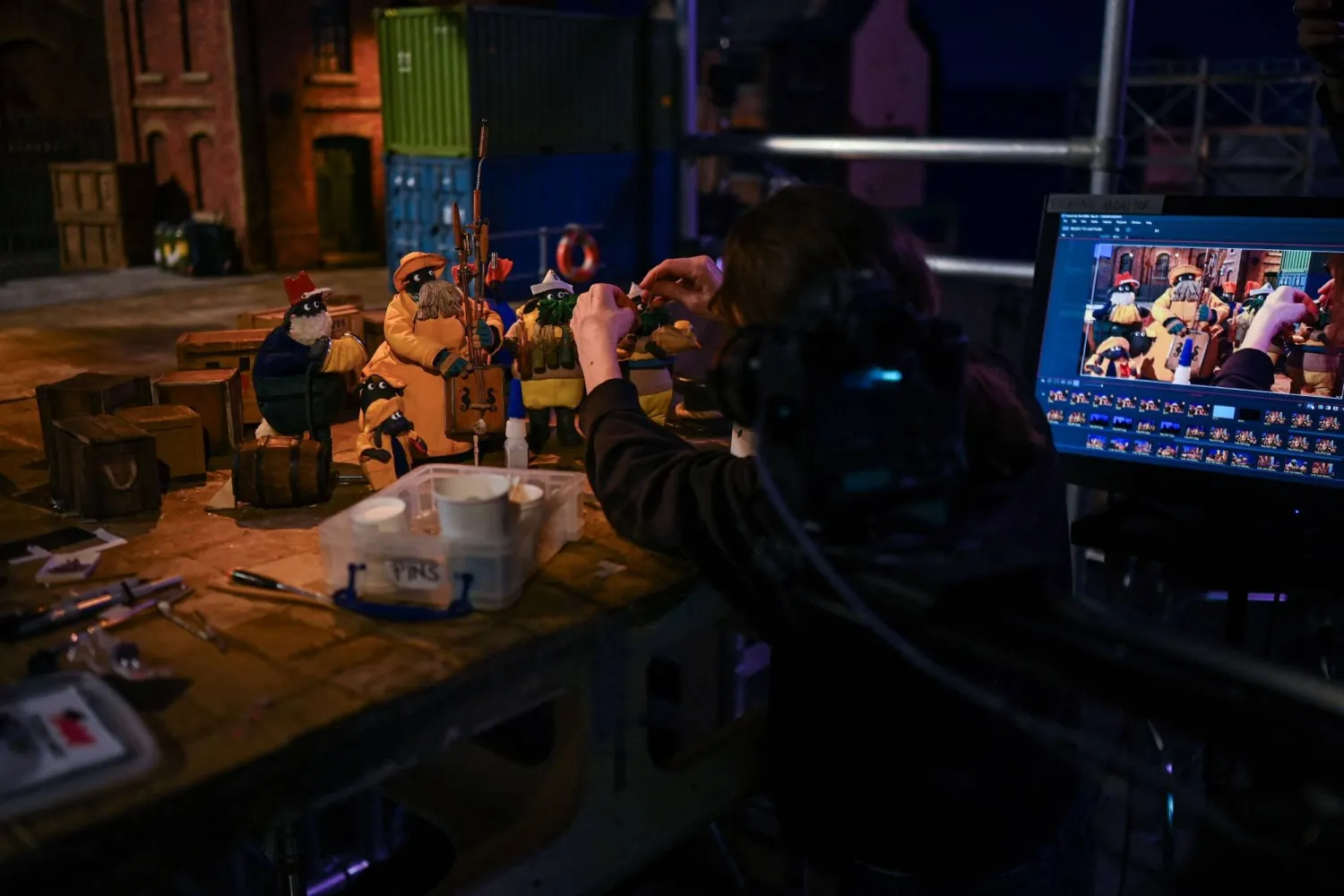
This photo taken on March 4, 2026 shows an employee working on models for "Shaun the Sheep: The Beast of Mossy Bottom" at Aardman Animations studios in Bristol, western England. (AFP)
TT

‘Wallace & Gromit’ Creators Turn 50 with Spook-Tacular Shaun Yarn

This photo taken on March 4, 2026 shows an employee working on models for "Shaun the Sheep: The Beast of Mossy Bottom" at Aardman Animations studios in Bristol, western England. (AFP)

Crochet hook in hand, the animator slightly raises the eyelid of a clay model sheep in a filmmaking technique as old as cinema, perfected over five decades by Aardman Animations.

In the basement of the Bristol-based company -- whose beloved characters such as Wallace and Gromit have won them four Oscars -- designers have been working for the past three-and-a-half years on the latest adventure in their "Shaun the Sheep" series.

"Shaun the Sheep: The Beast of Mossy Bottom" is the third full-length film starring the mischievous, savvy sheep, due to be released on September 18 in UK cinemas.

This time Shaun and his flock have to work together to save Halloween from a fur-raising creature terrorizing their farm's pumpkin patch.

The film marks the 50th anniversary of Aardman, founded in Bristol in 1976 by Peter Lord and David Sproxton who went to school together and used to make models on a kitchen table.

In the dim light of Aardman's basement, about 40 small rooms with a blue background have been set up, with curtains concealing puppet-sized scenes from the film.

One curtain opens to reveal Mossy Bottom farm and its autumnal colors, another a mad science lab, while behind yet another is a black and red fishing boat.

In the world of sophisticated digitalized animations and computer graphics, Aardman stands out for its painstaking handcrafted "stop-motion" technique, which dates back to the late 19th century.

"Our aim as animators is to make people think these puppets are alive," said animation director Claire Rolls.

"Nowadays, there's not a lot of places in the world doing stop-motion animation."

- 'Spare arms and ears' -

In a docklands scene, Rolls, who joined the company in 1998, was working with team member Ed Jackson setting up camera shots.

The sheep, wearing yellow rain jackets, are trying to attract the attention of a crew of sailors, Rolls explained.

The animator gets down to work, eyes fixed on a screen that alternates between the shot he's preparing and the previous frame.

To create the illusion of movement, he raises one sheep's head, lowers another's legs, and clicks the camera once the shot is ready.

After two days of this patient, exacting work, he will have filmed about two seconds of footage, each second made up of 24 frames.

The complete film is made up of more than 100,000 of these painstakingly created stop-motion frames.

The creatures that populate the studio's productions are created upstairs, in the puppet department.

After first appearing in 1995 in "Wallace & Gromit: A Close Shave", Shaun has become one of the studio's icons.

He is now the hero of a television series, shown in 170 countries, and two previous films, and has attracted a huge social media following.

Amid a jumble of drawings and materials, Kate Anderson, the head of the puppet department, pulls out a box filled with interchangeable parts -- a mouth closed, a jaw dropped, or rounded in an "O" of surprise.

Such parts help animators to illustrate different "sounds and expressions" for Bitzer, the long-suffering sheepdog.

The puppet makers "stick with clay for really expressive areas of the puppet, like the face," said Anderson, even if sometimes silicon is used to make the characters' bodies.

That material is more resistant when applied to a metal frame, she said, with the figures nailed in place to avoid any continuity errors.

"Because animators are touching puppets all day long, they do break quite easily," she said.

"We always know that we need to have a big stock of spare sheep arms and ears."

- 'Quirky, fun' -

"The animation is like a live performance," said co-director Steve Cox.

It is different to computer-generated images and two dimensional or 2D ones as "you can't really go back and change things once you've done it".

Filming is done in silence and sound added later, but that doesn't stop its "very British" humor, kind of "quirky and fun", from shining through.

"We do use digital effects in our films, but they're an embellishment to... the hand-crafted work," said producer Richard Beek.

Artificial intelligence has not been used for this latest Shaun movie, he said.

Aardman's playful, imaginative clay figures are instantly recognizable, from the pumpkins to Shaun's mad-scientist glasses.

The release of Disney's "Toy Story" in 1995 caused concern, as with AI, that "we're going to make films now on computers" and there would no longer be any place for stop-motion.

"But what's happened is we've continued to make films," Beek said.

"The whole world changes around us, but there's lots of things that stay the same at Aardman, and maybe that's partly what people like... there's a familiarity to it."


China's First AI Film Hits Cinemas, But Ticket Sales Lag

Nearly 100 people took more than two years to make the film. Hector RETAMAL / AFP
TT

China's First AI Film Hits Cinemas, But Ticket Sales Lag

Nearly 100 people took more than two years to make the film. Hector RETAMAL / AFP

China's first fully AI-generated feature film opens in cinemas on Friday in what promises to be a tough box-office test for the country's booming tech industry as advance ticket sales lag.

More than 10,000 screenings of the sci-fi thriller "Sanxingdui: Future Past" are scheduled for Friday, according to ticketing platform Maoyan.

Public reception, however, has been less than enthusiastic, said AFP.

Presale revenue as of Friday morning stood at 80,000 yuan ($11,980), while total box-office takings were forecast to remain below 150,000 yuan, only a fraction of the reported production cost, according to Maoyan.

Ticket prices range from 20 to 90 yuan, bringing the number sold to a few thousand at most.

Jiang Defu, CEO of the production company Bona Film Group, acknowledged the lukewarm reception in a recent interview but said the film was pushing boundaries.

"We are the first to try it, the first to get a theatrical release permit, and the first to be tested by the audience," he told Chinese film industry outlet Yuli.

"I think that is not easy at all."

Nearly 100 people took more than two years to make the film, which cost more than 10 million yuan ($1.5 million), Bona said, although all the actors, their voices and the backdrops are AI-generated.

The film touches on the theme of humanity in a future shaped by AI.

But that was not enough to convince Iris Yang, who attended a free preview screening of the film on Thursday for acquaintances of the production team and industry workers.

Yang said she would not have paid for a ticket, given the movie's quality.

"If AI generation can match the theatrical experience of 'Avatar', I think I would be willing to pay for it," she said, referring to the US franchise known for the quality of its animation.

AI-generated video has gained popularity in the world's second-largest economy. On Douyin, the Chinese equivalent of TikTok, AI-generated short dramas garnered more than 200 billion views in September alone.

But "the audience won't automatically pay for the tickets just because it's an AI-generated film", independent AI director Zhang Jun told AFP.

Online, Chinese social media users also seemed unconvinced by the launch of AI movies in cinemas.

"If it's free to watch on streaming platforms, it could become legendary. But paying to watch? People are not going to accept it at this stage," one user on Weibo commented.

In Hollywood, the rise of AI has sparked concern among film workers about the prospect of job losses.

An AI-generated sci-fi feature called "Gods Don't Give Gifts" is scheduled for US release on December 4.

And a virtual Hollywood actor called Tilly Norwood, whose interviews have gone viral while fueling job fears, is also set to star in an upcoming movie called "Misaligned".


Spotify Adds 11 Mn Active Users in 3rd Quarter to Reach 788 Mn

FILE PHOTO: Small figurines are seen in front of displayed Spotify logo in this illustration taken February 11, 2022. REUTERS/Dado Ruvic/Ilustration/File Photo
TT

Spotify Adds 11 Mn Active Users in 3rd Quarter to Reach 788 Mn

FILE PHOTO: Small figurines are seen in front of displayed Spotify logo in this illustration taken February 11, 2022. REUTERS/Dado Ruvic/Ilustration/File Photo

Music streaming giant Spotify on Thursday said it had added 11 million monthly active users in the third quarter and had reached 788 million active users by the end of September, in line with the company's forecast.

The uptick represented an 11-percent growth in users compared to a year earlier, Spotify said in a statement, adding that paying subscribers had grown by nine percent compared to a year earlier, reaching 306 million, just above the company's forecasted 305 million.

"This was a quarter where we did what we said. We've built a strong business that keeps compounding," AFP quoted co-chief executive Alex Norstrom as saying in a statement.

Revenue for the third quarter came in at 4.97 billion euros ($5.6 billion), up 16 percent from a year earlier.

Operating income meanwhile rose 15 percent to 672 million euros.

Looking forward, the company said it expected to add 30 million additional active users to the platform by the end of the year to reach 818 million.

Spotify also said it expects to reach 316 paying subscribers.

In recent years, the company has started expanding from music, first investing heavily into podcasts and now offering audiobooks.

In early October, the streaming giant announced that it was expanding access to its audiobook service to more than 180 markets, up from the previous 22.

Amid growing concern across the music industry over AI-generated content overwhelming streaming catalogues, the company has recently taken steps to identify and label AI content.

Earlier this week it reported that it had taken "more than 50 million slop and spam tracks" out of recommendations -- meaning the songs would not be suggested to listeners -- this year.

In August it announced that it was launching a new "AI Persona" badge to identify content producers that are AI-generated and not real people.

In April, the company launched its "Verified by Spotify" badge, signaling that a profile has been reviewed and meets its authenticity standard.


UK Actor Noel Clarke Pleads Not Guilty to Six Offence Charges

Actor Noel Clarke poses for photographers at the British Academy Film Awards Nominees Party at Kensington Palace in London, Britain February 11, 2017. REUTERS/Neil Hall
TT

UK Actor Noel Clarke Pleads Not Guilty to Six Offence Charges

Actor Noel Clarke poses for photographers at the British Academy Film Awards Nominees Party at Kensington Palace in London, Britain February 11, 2017. REUTERS/Neil Hall

British actor and filmmaker Noel Clarke appeared in a London court on Wednesday and pleaded not guilty to six charges, including two counts of sexual assault.

Clarke also denied three ‌counts of ‌voyeurism and ‌one ⁠count of exposing himself, ⁠with the allegations spanning 2007 to 2016, Reuters said.

The 50-year-old stood in the dock at Westminster Magistrates' Court ⁠and spoke only to ‌confirm ‌his name, date of birth ‌and address and ‌enter his not guilty pleas.

He was granted bail ahead of his next ‌appearance at Southwark Crown Court on November ⁠18.

Clarke ⁠is best known for writing and starring in "Kidulthood" (2006), which explored bullying, drug abuse and extreme violence among young people in London, and for a recurring role in sci-fi show "Doctor Who".