

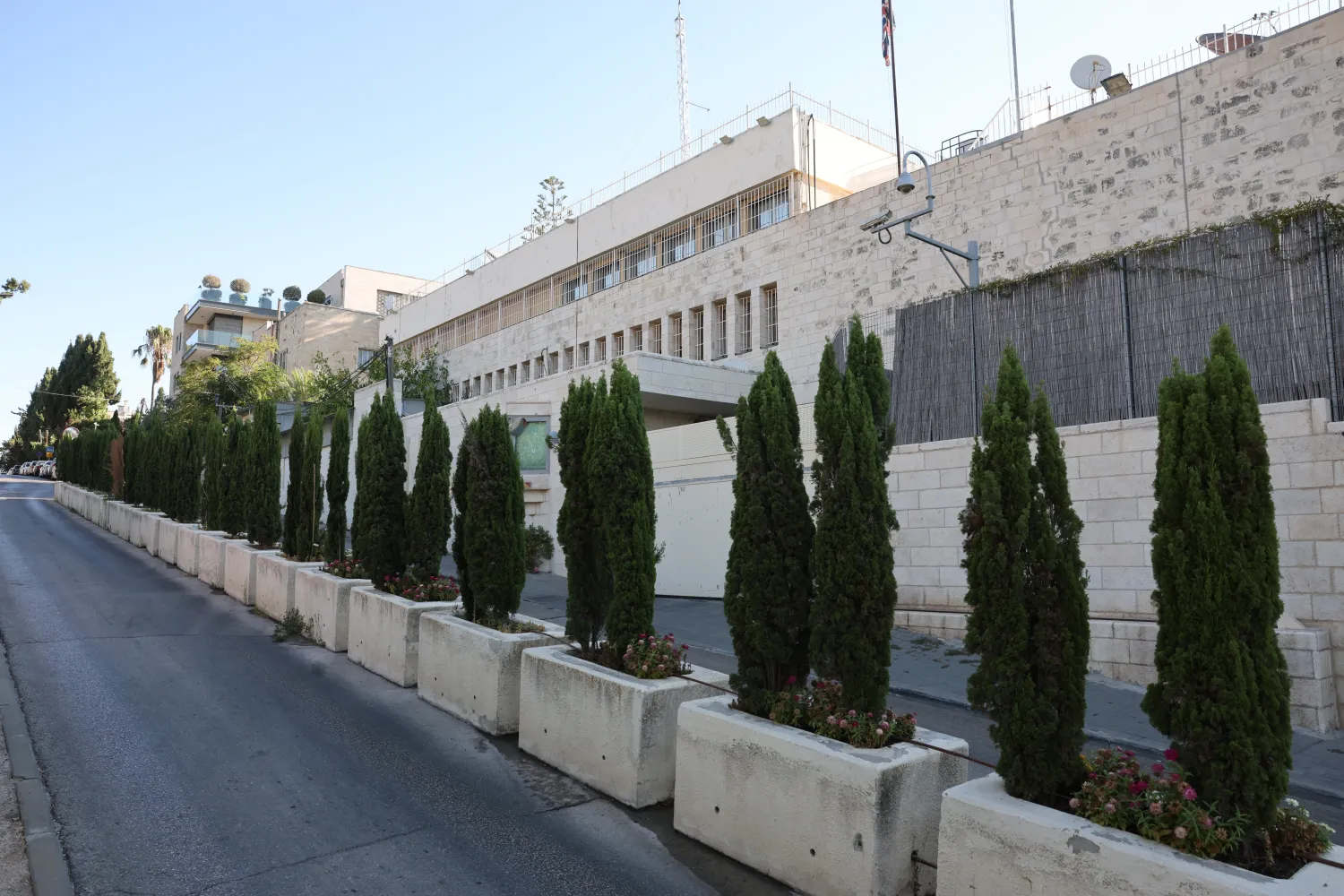

UK Govt Defends Decision to Ban Trade with Israeli Settlements

A view shows the British Consulate General in East Jerusalem, 09 September 2026. (EPA)
TT

UK Govt Defends Decision to Ban Trade with Israeli Settlements

A view shows the British Consulate General in East Jerusalem, 09 September 2026. (EPA)

British Prime Minister Andy Burnham defended his government's decision to ban trade with Israeli settlements in the occupied West Bank on Wednesday, saying that Britain was being true to its roots by taking a stand for justice. 

“Britain has to stand for fairness against injustice where people are being bullied out of their homes,” Burnham told Parliament. “We will always stand with the underdog and take what action we can to support them.” 

The UK announced the ban on Tuesday, and Israel responded by closing the British consulate in east Jerusalem and banning 11 lawmakers from the country. 

The UK’s tougher stance was followed by France and Canada’s leaders saying they would take similar action to prevent expanding settlements and growing violence from making it impossible to establish a future Palestinian state. 

Foreign Secretary Ed Miliband said “settler terrorists” were carrying out “ethnic cleansing” of Palestinians in the UK government’s biggest pushback to Israel since it recognized Palestinian statehood a year ago. He said there had been “houses bulldozed, roads and public infrastructure destroyed, families displaced from their homes.” 

Israeli Foreign Minister Gideon Saar condemned the “despicable” move and said Israel would expel UK representatives from a joint military center monitoring the Gaza ceasefire and end UK training of the Palestinian Authority’s security forces in the West Bank.  

In addition, Israel barred entry to a dozen British lawmakers and other UK citizens whom Saar said were “involved in antisemitic and anti-Israel activity.” 

Miliband, who is Jewish, said he was disappointed with Israel’s response and rejected criticism from the UK’s chief rabbi, saying it would not lead to more anti-semitism in the UK 

Ephraim Mirvis, the chief rabbi in the UK, accused the government of “gesture politics” that would bolster “the very extremism they seek to target.” 

“We all need to do more to tackle antisemitism, but I believe we can do that and stand up for British values,” Milband said. 

The ban covers imports of all goods from the settlements and bars companies from providing services for the settlements, including financing, construction, infrastructure, real estate and advertising. It will take effect in up to nine months. 

Denmark, Finland, Iceland, Poland, Portugal and Sweden have pledged to “support further action,” Miliband said. The Netherlands, Ireland, Belgium, Spain and Norway have either banned goods from settlements or are in the process of doing so, he said. 

Miliband also tightened Britain’s embargo on weapons sales to Israel for use in Gaza to include arms “that materially contribute to the occupation” of Palestinian territories. 

Conservative lawmaker Bernard Jenkin said he was concerned that the government's decision could affect counter-terror cooperation with Israel to keep Britons safe. 

“We are now embarked, it seems, on a full diplomatic dispute with Israel and tit-for-tat expulsions of diplomats,” Jenkin said. 

The economic impact of the ban is likely to be limited, since the settlements produce only a small amount of largely agricultural exports. But the move is a symbolic expression of displeasure with Israel by some of its closest allies, and it offers a new sign of the Israeli government’s growing isolation as a result of the Gaza war. 

Under Israeli Prime Minister Benjamin Netanyahu 's ultranationalist government, settlement construction in the West Bank — seized by Israel in the 1967 Mideast war — has surged. Netanyahu’s government views the West Bank as the biblical and historical homeland of the Jewish people and is opposed to the creation of a Palestinian state. 

The international community overwhelmingly considers such construction to be illegal. Britain and other countries have voiced particular concern about the E1 settlement project approved by Israel, which would effectively cut the territory in two. 

There have been marked increases in attacks by settlers on Palestinians, evictions from Palestinian towns, Israeli military operations and checkpoints that choke freedom of movement, as well as several Palestinian attacks on Israelis. 

Britain's action was applauded by former Ireland President Mary Robinson and ex-New Zealand Prime Minister Helen Clark, both former UN officials. The two said the EU should follow suit. 

“A coordinated international defense of the two-state solution is needed now more than ever,” they said. “Palestine must not be erased.” 


Iran’s Currency Hits a New Record Low as War Erodes the Country’s Economic Stability

A display shows currency exchange information, in Tehran, Iran, September 27, 2026. Majid Asgaripour/WANA (West Asia News Agency) via Reuters
TT

Iran’s Currency Hits a New Record Low as War Erodes the Country’s Economic Stability

A display shows currency exchange information, in Tehran, Iran, September 27, 2026. Majid Asgaripour/WANA (West Asia News Agency) via Reuters

Iran’s currency fell to a new record low on Tuesday, with traders in Tehran exchanging more than 2.5 million rials to the US dollar in a stark reflection of how the war in the Middle East has steadily eroded the Iranian economy.

The latest decline came just 27 days after the rial hit its previous record low of 2.2 million to the dollar on Sept. 2. The currency has repeatedly reached new lows since the war began in February.

The Iranian economy has been under duress for years in the face of international sanctions. But a US naval blockade on Iranian oil and new sanctions imposed since the start of the war have sent it into free fall.

Meanwhile, Iran’s top diplomat said indirect negotiations with the United States aimed at reopening the critical Strait of Hormuz have become “more serious,” while the Iranian Revolutionary Guard Corps’ chief spokesman Gen. Hossein Mohebbi on Tuesday called on Americans to take to the streets and protest the conflict.

Iran's top diplomat raises the prospect of new talks

Foreign Minister Abbas Araghchi told Iranian media late on Monday that the “current focus is solely on the Strait of Hormuz,” the chokepoint of the war.

Araghchi made the comments shortly before departing New York, where he attended last week’s gathering of world leaders at the UN General Assembly, and after meeting with Pakistani and Qatari mediators.

Araghchi said the Qatari intermediaries were expected to soon engage with the US side.

“They are set to raise the matter with the American side once more, after which the final US response will be conveyed to us,” Araghchi said. “If there is a response, the Qataris will convey it to us and a decision will be made in Tehran on that basis.”

Officials, including from the US, have confirmed to The Associated Press that mediators are working with Iran and the US on trying to broker a deal to end the fighting and open the strait.

The mediation efforts continue even after US President Donald Trump earlier this week spurned an Iranian proposal to reopen the strait in seven days if the US agreed to lift its blockade of Iranian ports, release frozen Iranian assets and waive sanctions on Iranian oil sales, among other conditions.

Tensions in the Strait of Hormuz were underscored by a report Tuesday that a cargo vessel was struck by an “unknown projectile” while moving through the strait on Monday. The United Kingdom Maritime Trade Operations said it had received a delayed report from a third party.

The strike caused a fire on board that was extinguished, UKMTO said, and all crew members were reported safe, UKMTO said. The vessel, which wasn't identified, continued on its way, the report said. There was no immediate claim of responsibility for the attack.

US targets Iran’s military supply chain with new sanctions

The Trump administration said Tuesday that 10 individuals and entities based in Iran, Hong Kong and Pakistan now face sanctions over accusations of procuring weapons and weapon components for Iran’s defense ministry as it fights its now seven-month war against the US

The United States is targeting people and companies around the globe that it accuses of being financial facilitators or enablers of Iran’s military supply chain, pushing ahead with economic warfare against Tehran at a time when renewed diplomacy between the two countries remains uncertain.

The latest action by the Treasury Department is part of the administration’s “Operation Economic Outcast” campaign, aimed at severing “critical financial lifelines” for the already heavily sanctioned Iranian government.

“Treasury will not tolerate any support to the regime and will continue to identify, expose, and isolate Iran’s enablers,” Treasury Secretary Scott Bessent said in a statement.

Iran sends a provocative message to the US public

The Iranian Revolutionary Guard Corps on Tuesday made an appeal to everyday Americans to push their government to end the US war against Iran, a provocative message that comes just weeks before critical midterm elections in the United States.

Mohebbi, the Guard spokesman, read a letter during a news conference in Iran's capital, Tehran, appealing to Americans to pressure their government and claiming that the only way for the war to end is for Washington to admit defeat and leave the Middle East.

Mohebbi’s remarks come as Trump’s Republican Party faces fierce headwinds as it looks to maintain control of Congress. But polling shows the war has darkened the American electorate’s mood ahead of the Nov. 3 election in which elevated gasoline prices, a byproduct of the conflict, loom large.

Trump and his top aides are insistent that Iran’s economy cannot sustain a conflict much longer and have expressed confidence that Tehran will be forced to capitulate.

The US president predicted soon after launching the war that the conflict would last a matter of weeks. More recently, he’s said that the war will likely end after the November elections in the US

US Secretary of State Marco Rubio in a Monday appearance on Fox News said Iran was heading toward an economic “cataclysm.”

Administration officials say that a combination of new sanctions and a US naval blockade aimed at preventing Iranian oil from going to market are having the intended effect.

“And so when you’re denying them money through oil sales and sanctions, you’re not just punishing them,” Rubio said. “You are preventing them from getting access to money that they will use to try and kill Americans and others around the world and their own people and build weapons and threaten the world and ultimately break out to a nuclear weapon program."


Rival Says Netanyahu ‘Fear-Mongering’ Over Warning of Pre-Vote Attack

A giant electoral poster for Israeli Prime Minister Benjamin Netanyahu's Likud party with the slogan "no surrender" is displayed on the facade of a building in Tel Aviv on September 29, 2026 during campaigns ahead of the October 2026 legislative elections. (AFP)
TT

Rival Says Netanyahu ‘Fear-Mongering’ Over Warning of Pre-Vote Attack

A giant electoral poster for Israeli Prime Minister Benjamin Netanyahu's Likud party with the slogan "no surrender" is displayed on the facade of a building in Tel Aviv on September 29, 2026 during campaigns ahead of the October 2026 legislative elections. (AFP)

Israel's opposition chief early Wednesday accused Prime Minister Benjamin Netanyahu of fear-mongering after he alleged that enemies may attack before October 27 elections.

Netanyahu, who polls show is in a close race to hold on to power, has issued warnings in recent weeks to Iran, the armed groups Hamas and Hezbollah and even the West Bank-based Palestinian Authority, vowing retaliation in case of an attack.

Israel has kept striking Gaza and Lebanon, and Netanyahu has also stepped up his tone against the leaders of Türkiye, Syria and Qatar.

Parliamentary opposition leader Yair Lapid requested an urgent security briefing after Netanyahu alleged a potential attack, in a video the right-wing prime minister made Tuesday in front of a fighter-jet at a base.

Lapid, speaking after the late-night meeting with Netanyahu, said he was certain elections will take place on time and that "there is no reason to panic the public".

He again accused Netanyahu of failing to heed warnings of the Hamas attack on October 7, 2023 -- the deadliest ever against Israel, which has responded with a massive military campaign in Gaza.

"Netanyahu ignored every warning before October 7 and now, 28 days before the election, he's suddenly busy fear-mongering," Lapid said.

"I of course will not violate the confidentiality of the security briefing but it must be said -- security threats must be handled professionally and responsibly," Lapid said.

Israeli military bases "are not the setting for election videos", Lapid said.

Lapid, a centrist former prime minister, is one of a number of opposition players in the election, with former military chief Gadi Eisenkot emerging as Netanyahu's most formidable rival.

Netanyahu's office said he provided the briefing alongside military leaders to Lapid soon after the opposition leader has requested it in response to Netanyahu's remarks.

"During the intelligence update, alerts of possible attacks on the various fronts ahead of the elections were presented in detail," Netanyahu's office said in a statement.

In his video earlier Tuesday, Netanyahu said: "We have indications that ahead of the elections our enemies will try to attack us."

"I am sending you a message: Don't mess with us, not now and not ever. Our long arm will reach you anywhere, anytime," Netanyahu said.

Netanyahu and US President Donald Trump in late February launched a war on Iran, which retaliated with weeks of missile and drone attacks against Israel.

Iran and Israel have not struck each other since April even as a ceasefire that Tehran's clerical government reached with Washington crumbles elsewhere in the region.

- Warning to Hamas abroad -

Separately, Defense Minister Israel Katz issued a video statement threatening leaders of Hamas based outside Gaza, after the military said it had killed a commander in the north of the territory overnight.

"Hamas leaders abroad are also in the crosshairs. None of these despicable murderers, who played a central role in the October 7 massacre, should die peacefully in their beds," Katz said.

"Once, they were spared because of a mishap -- but the next time will come, and they too will be sent to the depths of hell," he added, in an apparent reference to an Israeli airstrike against a gathering of top Hamas leaders in Qatar in September 2025.

The strike in Doha killed a Qatari security officer and five Hamas members, but none of the group's top officials.


US Imposes Sanctions on 13 Tied to Iran Weapons Procurement

The seal of the Treasury Department is seen before a news conference, Aug. 24, 2026, at the Treasury Department in Washington. (AP)
TT

US Imposes Sanctions on 13 Tied to Iran Weapons Procurement

The seal of the Treasury Department is seen before a news conference, Aug. 24, 2026, at the Treasury Department in Washington. (AP)

The US government announced fresh sanctions on Tuesday against 13 individuals and entities, including some based in Russia, China, Hong Kong and Pakistan, saying they helped Iran procure weapons and components.

The sanctions announced by the Treasury and State departments are part of the Trump administration's effort to isolate Iran economically and force it to negotiate an end to the war that began with a US-Israeli strike on Iran on February 28.

Treasury Secretary Scott Bessent said: “Treasury will not tolerate any support to the ‌regime and ‌will continue to identify, expose, and isolate Iran’s ‌enablers.”

Treasury ⁠said the sanctions ⁠were aimed at degrading Tehran's ability to reconstitute its weapons programs, while increasing the costs for those who supported its procurement efforts.

Those targeted in Tuesday's sanctions announcements include:

* Seyyed Asghar Alizadeh Tabatabai, a Beijing-based representative of Iran's Ministry of Defense and Armed Forces Logistics agency, who Treasury said had coordinated ⁠the procurement of finished weapons systems and dual-use ‌components in China on Iran’s behalf.

* ‌Iran-based Kavoshcom Asia R and D Group, which Treasury said had ‌procured electronics including connectors for Iran Aircraft Manufacturing Industrial Company.

* ‌Hong Kong-based EC Mojo Technology Co Limited, which Treasury said had provided electronic components in support of Kavoshcom’s procurement efforts, and EC Mojo's China-based representative Li Fen.

* Pakistan-based Waseem Pasha Tajammal, who serves ‌as chairman of Cavalier Group, a privately owned defense company with locations in Pakistan and internationally.

* ⁠Joint Stock ⁠Company Experimental Design Bureau Named After A.S. Yakovlev, a Russia-based aircraft manufacturer.

* MG-Flot LLC, a Russia-based shipping company whose vessels transport weapons for the Russian government.

* Saha Airlines, an Iran-based airline affiliated with the country's air force.

Brett Erickson, managing principal with Obsidian Risk Advisors, said the latest sanctions action would do little to impede Iran's ability to launch missiles and drones in the Strait of Hormuz.

"This is optics management for the Trump administration to claim 'We're hammering them,' when the reality is we're poking them with a toothpick," he said.
