


As Oceans Warm, Florida Scientists Hunt for Heat-resistant Coral

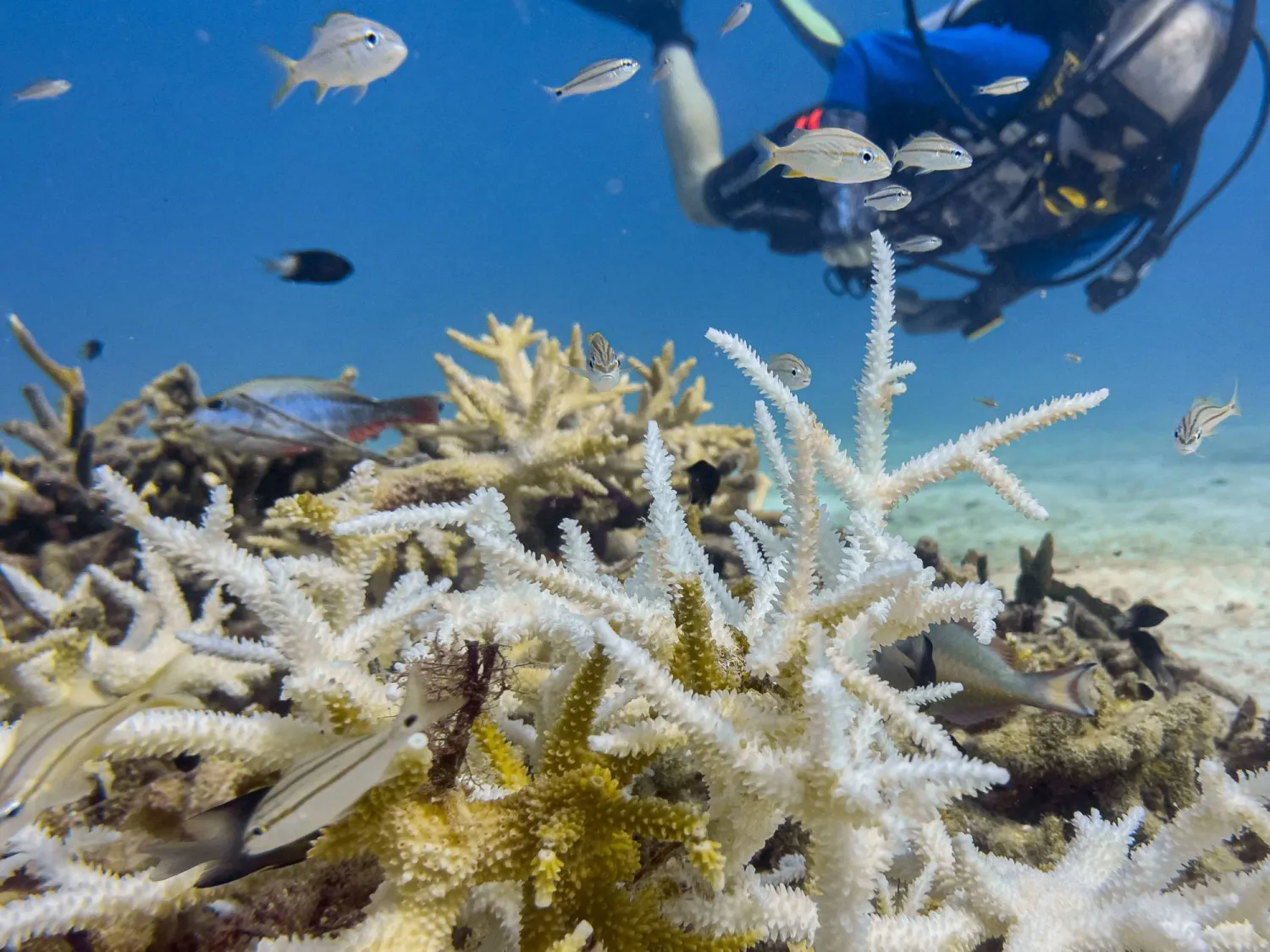
A mass of bleached staghorn coral, its pale and white branches a sign of stress after prolonged exposure to abnormally warm ocean waters, is seen off the coast of Florida on August 28, 2026. (Photo by Jesus Olarte / AFP)
TT

As Oceans Warm, Florida Scientists Hunt for Heat-resistant Coral

A mass of bleached staghorn coral, its pale and white branches a sign of stress after prolonged exposure to abnormally warm ocean waters, is seen off the coast of Florida on August 28, 2026. (Photo by Jesus Olarte / AFP)

Off Florida's coast, a team of scientists and trained volunteers in scuba gear descends to the ocean floor and begins planting young coral onto a reef and examining how others are faring in the increasingly warm waters.

It is part of a long-running "Rescue a Reef" program run by the University of Miami that aims to advance conservation efforts and raise public awareness.

Part of that work involves researching which coral species are able to better withstand rapidly warming oceans as a result of human-caused climate change.

"Certain species may be more resilient, where they're able to better survive and recover from thermal stress events," program manager Devon Ledbetter explained to AFP during a recent dive to Rainbow Reef about three miles offshore from Key Biscayne.

Coral reefs support vibrant marine ecosystems, but also act as breakwaters, protecting coastlines from storm-driven erosion and flooding.

The situation, however, is increasingly dire.

A record-breaking marine heat wave that began in 2023 left two ecologically vital coral species, elkhorn and staghorn, "functionally extinct" in Florida's Coral Reef, highlighting the growing dangers a warming climate poses for the world's oceans.

The National Oceanic and Atmospheric Administration believes that this fourth global coral bleaching event likely concluded in mid-2025. But the arrival of a very strong El Nino could bring a return to more widespread bleaching -- including in Florida's waters.

During the expedition, the participants go about their tasks diligently. Some coral species with fast-growing branches are planted onto "coral trees" that look like old television antennas and are suspended in the water column, with floats to keep them upright.

Others are placed onto table frames fixed to the ocean floor, and yet others are mounted onto plugs, screwed into a three-hole "cookie" and planted onto the reef.

These are given predation umbrellas to protect them from the hungry fish having a nibble.

Researchers place color reference charts around newly planted coral to record the pigmentation, a method used to monitor its health and detect early signs of heat stress.

Coral is made up of tiny individual animals called polyps, which maintain a symbiotic relationship with microscopic algae that live within their tissues.

When the algae are stressed by heat or pollution, however, they leave, causing the coral to "bleach" and become vulnerable to disease and death.

"Anecdotally, we've seen that Mountainous Star Coral tends to be the most resilient to bleaching and thermal stress," Ledbetter explained. So far, this summer the program has planted 615 coral, with 228 of those part of the thermal bleaching study. Their results are then given to state environmental and wildlife authorities.

The program began in 2015 and Ledbetter explained it exists both to serve science and educate the public -- but also to rebuild the ecosystem "one coral at a time."

The risks have never been higher. Even with the end of the fourth global bleaching event, sea surface temperatures are still higher than 25 to 30 years ago, when the first global coral bleaching event occurred, according to recent research published by NOAA in the journal Coral Reefs.



Belgium’s Francis Halzen Wins Nobel Prize in Physics

Eva Olsson, Ellen Moons, and Mark Pearce sit in front of a screen displaying Francis Halzen as the recipient of the 2026 Nobel Prize in Physics during a press conference at the Royal Swedish Academy of Sciences in Stockholm, Sweden, on October 6, 2026. (Photo by Christine OLSSON / TT NEWS AGENCY / AFP)
TT

Belgium’s Francis Halzen Wins Nobel Prize in Physics

Eva Olsson, Ellen Moons, and Mark Pearce sit in front of a screen displaying Francis Halzen as the recipient of the 2026 Nobel Prize in Physics during a press conference at the Royal Swedish Academy of Sciences in Stockholm, Sweden, on October 6, 2026. (Photo by Christine OLSSON / TT NEWS AGENCY / AFP)

Belgian Francis Halzen won the Nobel Prize in physics on Tuesday for his contributions to the IceCube Neutrino Observatory and his discovery of high-energy neutrinos of astrophysical origin.

The Royal Swedish Academy of Sciences announced the award in Stockholm.

The prize money this year is 12 million Swedish kronor (about $1.2 million), whether for an individual, a small group of laureates or an organization.

Last year, three scientists won the Nobel Prize in physics for research on the strange behavior of subatomic particles called quantum tunneling that enabled the ultra-sensitive

measurements achieved by MRI machines and laid the groundwork for better cellphones and faster computers.

The announcements of this year's prizes began Monday with the Nobel Prize in medicine being awarded to three scientists whose work led to a tool that uses light to help unravel how the brain works.

This week's awards continue Wednesday with the chemistry prize and literature on Thursday. After Friday’s peace prize is awarded, the Nobel Memorial Prize in Economic Sciences will be announced on Monday.

The prize money this year is 12 million Swedish kronor (about $1.2 million), whether for an individual, a small group of laureates or an organization.


Indonesia Says Will Halt Forest Destruction for Rice Paddies

A man attempts to extinguish flames with a bucket amid thick smoke and fires burning through peatland in Palangkaraya, Central Kalimantan, on October 3, 2026. (Photo by REINA / AFP)
TT

Indonesia Says Will Halt Forest Destruction for Rice Paddies

A man attempts to extinguish flames with a bucket amid thick smoke and fires burning through peatland in Palangkaraya, Central Kalimantan, on October 3, 2026. (Photo by REINA / AFP)

Indonesia said on Tuesday it will halt a project to raze several million hectares of forest to clear land for rice production, saying it had reached self-sufficiency levels of the staple grain.

The government launched a program in 2024 to stop relying on rice imports within five years by clearing three million hectares of land for paddies.

Indonesia is one of the world's most forested countries, and as such a major absorber of planet-warming carbon emissions from mankind's burning of fossil fuel.

It aims to become a net carbon sink by 2030, with forests and other land use absorbing more carbon than they emit.

However, observers have said continuing forest destruction for agriculture and logging, as well as rampant wildfires, could put Indonesia's plans at risk.

President Prabowo Subianto hailed an "important victory" this year after data showed countrywide rice demand had been met with domestic production in one of the world's top consumers of the commodity.

Climate envoy Hashim Djojohadikusumo said on Tuesday the government's strategic reserve rice stock had reached about 5.3 million tonnes.

"The government sees no further need for expanding rice cultivation areas in the so-called forest areas," said Hashim, who is Prabowo's brother.

He added that the government will focus instead on "intensification measures" using superior seeds, for example, to increase rice yields.

It was not known how much forest had already been replaced by rice paddies before the project was halted.

According to the National Food Agency, a government body that seeks to advance food security, Indonesia produced 34.71 million tons of rice in 2025 -- exceeding annual demand of 31.19 million tons.

Haze from wildfires consuming forests and peatlands in Indonesia has blanketed neighboring Malaysia and Singapore for weeks.

Hot, dry conditions associated with the El Nino weather phenomenon have fueled the fires, which are also linked to land clearing.

The Mighty Earth advocacy group welcomed Hashim's announcement, AFP reported.

"This decision renews Indonesia's leadership in showing how to expand agriculture while protecting nature," the NGO's founder, Glenn Hurowitz, said in a statement.

"This decision creates an opportunity for large-scale investments in achieving President Prabowo's goal of restoring 12 million hectares of forest, peat, and other ecosystems," he added.


Vietnam Busts Cat-stealing Ring that Took 2,700 Pets for Food

Stray cats. AFP
Stray cats. AFP
TT

Vietnam Busts Cat-stealing Ring that Took 2,700 Pets for Food

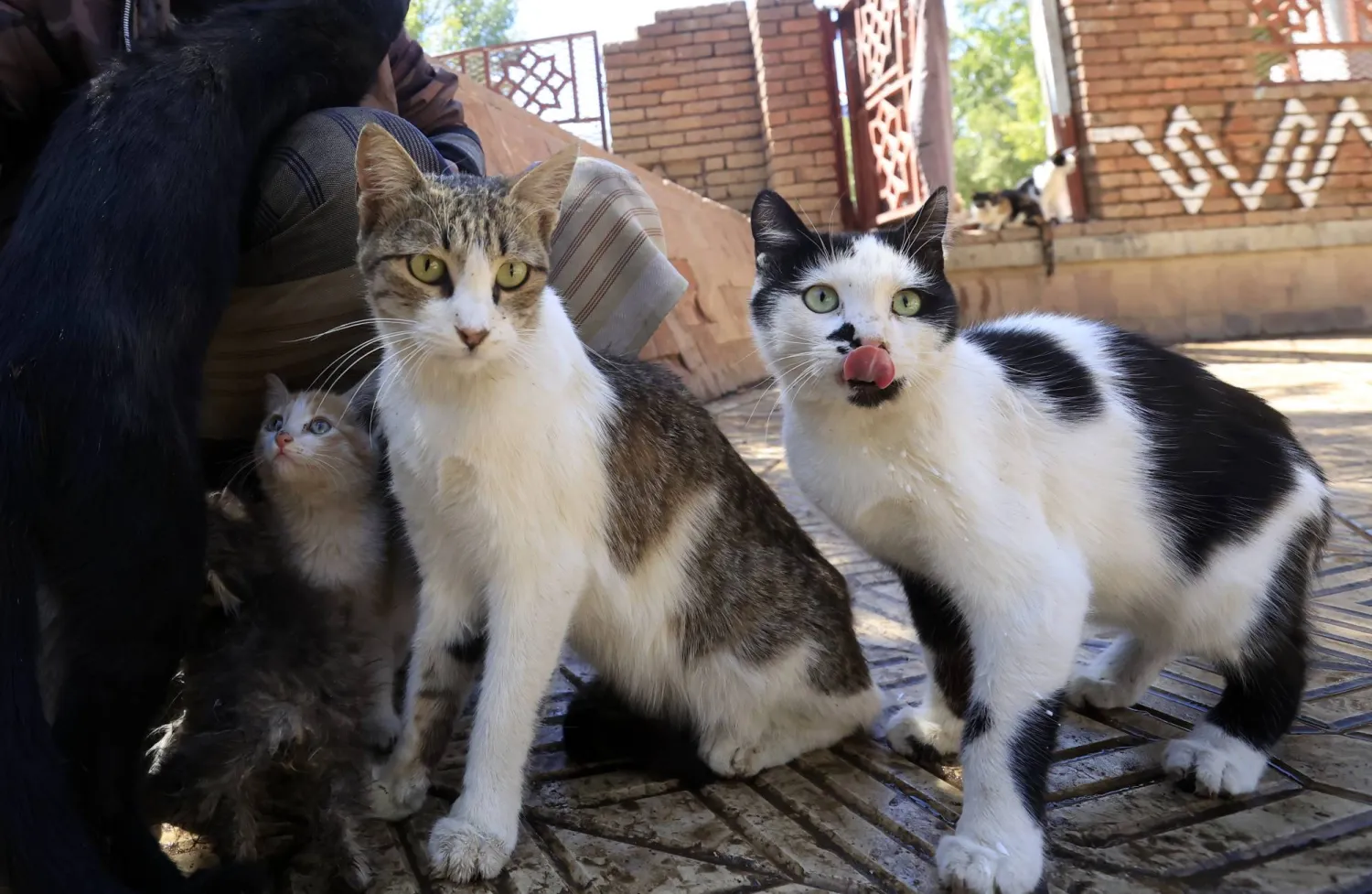
Stray cats. AFP
Stray cats. AFP

Vietnamese police have arrested 12 men accused of stealing nearly 2,700 cats during night raids into residential neighborhoods, taking the pets to be slaughtered for food, police and state media said on Monday.

Fur removal machines, cat traps and measuring scales were among items confiscated during investigations into the alleged cat-stealing ring in Ho Chi Minh City.

Consumption of dogs and cats is legal in Vietnam, where many restaurants openly advertise the meat, but vendors are required to obtain certificates showing the origin of the animals.

Media reports have said that stolen cats can be sold at restaurants for at least 70,000 dong ($2.70) per kilogram.

The 12 men were arrested on allegations of property theft and admitted "to stealing and trafficking approximately 2,700 cats of various types", police said in a statement.

Criminal proceedings began on Sunday, but it was not clear when the men were detained.

The suspects pounced between 11:00 pm and 04:00 am, roaming residential areas on motorbikes in small groups to steal local cats, state media said.

The network was first discovered in July, with police seizing 50 live cats alongside 55 cat traps, two scales and two fur removal machines.

Each team was estimated to have stolen between four and 10 cats per night.

Police in Ho Chi Minh City arrested 18 people earlier this year accused of being part of two separate cat-stealing rings.