


Apple Joins Foldable Phone Race with $1,999 Passport-shaped iPhone Duo

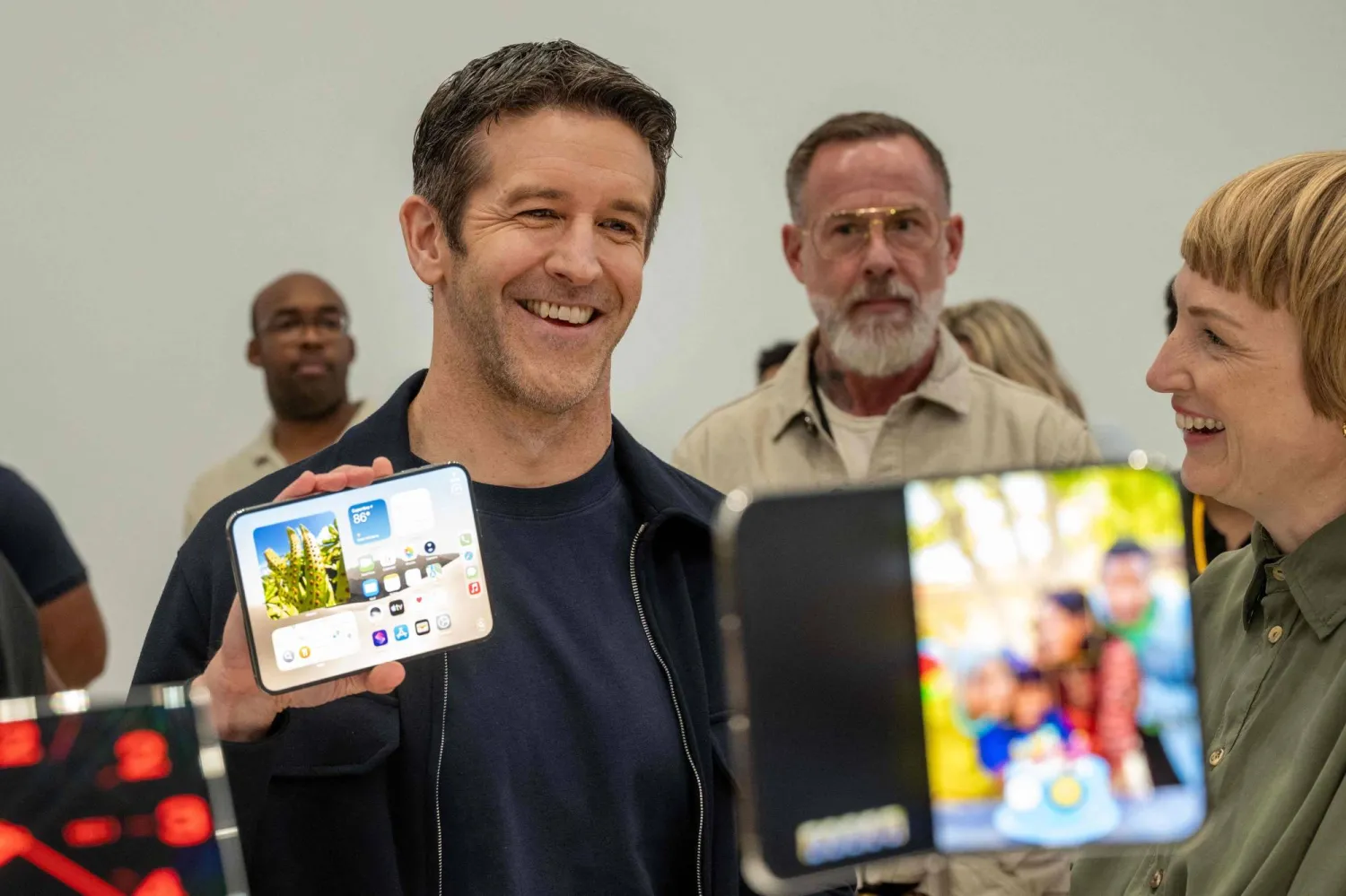
New Apple CEO John Ternus, alongside vice president of industrial Molly Anderson, shows off an iPhone Duo during an Apple event at the Steve Jobs Theater in Apple Park in Cupertino, California, on September 9, 2026. (Photo by Karl Mondon / AFP)
TT

Apple Joins Foldable Phone Race with $1,999 Passport-shaped iPhone Duo

New Apple CEO John Ternus, alongside vice president of industrial Molly Anderson, shows off an iPhone Duo during an Apple event at the Steve Jobs Theater in Apple Park in Cupertino, California, on September 9, 2026. (Photo by Karl Mondon / AFP)

Apple on Wednesday redefined its flagship smartphone with the launch of the Duo, a folding $1,999 iPhone, betting its design and promises of data privacy will let it leap ahead of rivals who have been selling folding phones for years.

The Duo could shake up a category long dominated by Samsung and Chinese companies like Huawei, whose devices have struggled to move beyond a niche audience. Analysts have long said Apple's entry could be the catalyst foldables need, helping bring the form factor into the mainstream much as the company did with smartwatches and wireless earbuds.

The Duo is sized and shaped like a passport, with rounded edges. It opens into a horizontal, 7.6-inch-diagonal (19 cm) screen that also can be viewed vertically. There is a smaller single screen on the front, when the phone is folded. When open, it is Apple's thinnest phone, the company said. However, it is thicker than folding phones offered by Chinese rivals.

New CEO John Ternus led the event, for the most notable overhaul of Apple's flagship product since the iPhone X in 2017. The iPhone brought in $209.6 billion, or just over half of Apple's sales, in its most recent fiscal year.

Ternus criticized existing foldables as awkward and poorly suited for common tasks such as scrolling and video viewing, saying the Duo was designed to deliver an iPad-like experience in a pocket-sized device through a custom hinge, dual displays with a consistent aspect ratio, and a new titanium body.

"It's entirely new and at the same time remarkably familiar. A similar size to your passport, it feels familiar to hold ⁠and comfortable to use ⁠with one hand," Reuters quoted Ternus as saying.

Other tech companies made light of the launch. Duolingo, the foreign-language learning app with a green owl mascot named Duo, messaged on X, "We infringed upon," with laughing-crying emojis. That drew a message of "solidarity" from foldable phone company Samsung Mobile US, which added, "They copied us, too."

It will fall to Ternus, the previously low-profile hardware chief, to persuade Apple's customers that they need a foldable device costing about $2,000, a new high for a global brand that has defined mass luxury. Analyst firms such as International Data Corporation expect Apple will sell every foldable iPhone it can produce and secure a 40% share of the lucrative niche by the end of next year.

Apple positioned the iPhone Duo as a business productivity device, showing how it would manage Zoom calls with multiple participants and a broader view of the Slack messaging app.

The Duo's larger screen will support multiple app windows at once, a move aimed at productivity that Apple has made with some of its iPads.

Apple said the iPhone Duo, ⁠available from October 23, will feature the A20 Pro chip to drive its displays and also a new C2 modem chip designed by Apple, part of its move away from Qualcomm's wireless data chips. Its battery supports 24 hours of mixed dual-screen use and can charge to 50% in about 20 minutes.

"Apple showed up years after everyone else, yet it walks in and sets the rules. Apple entered the foldable market and, in one keynote, set the price and the standard every rival will now be measured against," said Francisco Jeronimo, vice president for Data and Analytics, Devices, at IDC EMEA.

"The real fight is China, where Huawei owns nearly 80% of foldables. Apple has just given Chinese buyers a reason to look up. Huawei owns China's foldable market today. Apple has just handed Chinese buyers their first genuinely compelling reason to reconsider."

Samsung has launched a publicity campaign for its foldable phones, as it seeks to defend its leadership in the segment, which it pioneered in 2019.

“Apple’s entry is a serious threat to Samsung, particularly in North America," said Paolo Pescatore, founder of research firm PP Foresight, adding Samsung for the first time faced a competitor capable of taking the category mainstream.

Apple shares closed down 0.3% at $315.34 on Wednesday, following the presentation.

Former CEO Tim Cook handed off to Ternus at the start of the presentation with a video of a joking debate about how to begin the event. The video closed with a closeup of Cook, who said, "Not me. That's your guy," pointing back toward the new ⁠CEO.

Ternus described the iPhone platform as a ⁠personal AI hub that focused on privacy, saying that others wanted to collect and store personal data.

"Honestly, trust only goes so far when your data is no longer yours to control," he said. "That's why Apple Intelligence runs on device whenever it can."

Apple's Lilian Rincon, who oversees AI products for the iPhone maker and was recruited from Google earlier this year, described an updated Siri assistant.

Executives also showed off the iPhone 18 Pro and the 18 Pro Max handsets that are the latest versions of Apple's well-known line, which do not fold.

Pricing for the iPhone 18 Pro and Pro Max starts at $1,199 and $1,299, up $100 from the starting prices of the iPhone 17 Pro and Pro Max.

Apple also unveiled a feature aimed at addressing growing concerns over AI-generated and manipulated images. It introduced a new standard it calls "Apple Reference Image" to prove the authenticity of the images taken with the new iPhone 18 Pro cameras and said it will also support the emerging SynthID standard for identifying images that have been created or edited with AI. The Apple Reference Image feature will not be available in the EU or China.

The iPhone 18 Pro also will include the new A20 Pro chip, which brings improvements to help advanced AI models run directly on iPhones.

The company also said a new version of AirPods would start at $129 with noise cancellation, a first for its budget line of earbuds. Apple also unveiled the Apple Watch Series 12 and Apple Watch Ultra 4, positioned as major health-focused upgrades with new features that gauge recovery and fitness, as well as improved heart-rate tracking.

Micron CEO Sanjay Mehrotra attended the launch, notable because Apple rarely gives suppliers a prominent role at such events. As Apple adds more AI features to iPhones and other products, demand for high-performance memory has increased, elevating the strategic role of suppliers such as Micron, especially amid a global shortage of memory chips.



China's DeepSeek launches V4.1-Flash model

A DeepSeek AI sign is seen at a building where the Chinese start-up's office is located in Beijing, China, February 19, 2025. REUTERS/Florence Lo
TT

China's DeepSeek launches V4.1-Flash model

A DeepSeek AI sign is seen at a building where the Chinese start-up's office is located in Beijing, China, February 19, 2025. REUTERS/Florence Lo

Chinese artificial intelligence startup DeepSeek on Thursday launched DeepSeek-V4.1-Flash, which the company said is the smallest model in its new architecture ⁠family, according to ⁠a statement.

The release came as the company ⁠is starting to prepare for an initial public offering on Shanghai's tech-focused STAR Market, Reuters has reported.

DeepSeek said the new model ⁠is designed ⁠for greater capability, faster inference, higher throughput and scaling to larger models.


China Says US Accusations of AI Theft Are ‘Groundless’

A DeepSeek AI sign is seen at a building where the Chinese start-up's office is located in Beijing, China, February 19, 2025. (Reuters)
TT

China Says US Accusations of AI Theft Are ‘Groundless’

A DeepSeek AI sign is seen at a building where the Chinese start-up's office is located in Beijing, China, February 19, 2025. (Reuters)

China said on Wednesday that US accusations of Chinese labs stealing the capabilities of American models were "groundless", as the two countries race for tech supremacy. 

The US cyber defense agency released an advisory on Tuesday accusing top Chinese AI labs including DeepSeek and Moonshot AI of systematically stealing the capabilities "through industrial-scale knowledge distillation campaigns". 

It came ahead of an expected meeting this month between President Donald Trump and his Chinese counterpart Xi Jinping at the White House, where AI could be an important discussion topic. 

China hit back on Wednesday, calling the accusations "groundless". 

"The US approach is a typical case of using the crackdown on distillation as a pretext to achieve industrial monopoly," the Ministry of Commerce said in a statement. 

The US accusations are a "case of double standards", it added. 

Distillation is where an AI model is trained to mimic the output of a larger, more capable one. 

The method is widely used across the industry, but Washington says Chinese firms have deployed it at scale to illicitly copy American systems. 

The US advisory also detailed how DeepSeek, Moonshot AI, Alibaba, MiniMax, StepFun and Z.AI allegedly used millions of exchanges and requests to steal the capabilities of US models from the likes of OpenAI, Anthropic, Google and xAI. 

Chinese companies that adopt this strategy "see significantly shorter AI development timelines and reduced financial expenditures in training a frontier model", the advisory said. 

These actions, taken "likely with Chinese government awareness", have occurred since at least late 2024, it said. 

AFP contacted the Chinese companies apart from StepFun, which was not immediately reachable. Moonshot AI declined to comment. 

Trump is under pressure to respond to the increasing success of Chinese AI models that many companies prefer to the more powerful, but pricier, US versions from Anthropic or OpenAI. 

In July, dozens of startups wrote a letter to the Trump administration urging it to think twice against any outright ban or strict curbs on foreign-made AI models, saying this should only be considered for government use of the technology. 

That month, Beijing also turned the tables by accusing US AI of using Chinese examples to train their models. 

Asked about the accusations at a regular briefing on Wednesday, Chinese foreign ministry spokeswoman Mao Ning said the United States should "refrain from making unfounded accusations against and smearing China". 

"The development of artificial intelligence in China is the result of achieving high-level self-reliance and strength in science and technology," she said. 

"Both China and the United States are major countries in the field of AI. We should strengthen cooperation." 


OpenAI Says Working with Samsung on Next-Generation Chips, Deepening Cooperation

The logo of Samsung is seen on a building during the Mobile World Congress in Barcelona, Spain February 25, 2018. (Reuters)
TT

OpenAI Says Working with Samsung on Next-Generation Chips, Deepening Cooperation

The logo of Samsung is seen on a building during the Mobile World Congress in Barcelona, Spain February 25, 2018. (Reuters)

OpenAI is deepening cooperation with Samsung Electronics as the ChatGPT maker develops its own chips, expanding ties with the South Korean technology giant across semiconductors and enterprise AI services.

"One of the areas where we have made the most progress and gained the most recognition with Samsung Electronics is our joint production and research on the next-generation chips we are developing," Harrison Kim, General Manager of OpenAI Korea, said at a press ‌conference in Seoul ‌on Wednesday, without elaborating.

Kim also said Samsung Electronics was "one ‌of ⁠the largest-scale deployments of ⁠ChatGPT globally," saying the company's employees in Korea and overseas use ChatGPT for work across research and development, marketing and sales.

Samsung Electronics said in a statement that it could not confirm information related to customers.

In June, OpenAI unveiled its first custom artificial intelligence chip designed with Broadcom. OpenAI's engineers designed the chip, called Jalapeno, together with Broadcom for a task known as AI inference, the ⁠process of crunching data to answer queries in applications ‌such as ChatGPT.

OpenAI at that time said that ‌Taiwan's TSMC would manufacture the chips.

Last year, Samsung Electronics and SK Hynix signed letters ‌of intent to supply memory chips for OpenAI's Stargate data center project.

Kim ‌said demand for memory chips would continue to grow as more advanced chips were needed to enable faster and more complex computing, making cooperation with South Korean semiconductor suppliers a priority for OpenAI's local office.

The cooperation comes as Samsung broadens its ‌use of generative AI. The company said in June that workers in its Device eXperience division, which oversees mobile ⁠phones, televisions and home ⁠appliances, would be allowed to use ChatGPT, Google's Gemini and Anthropic's Claude internally.

OpenAI said the number of ChatGPT Enterprise users at South Korean companies and institutions had surged about 28-fold as of the end of August from a year earlier, as businesses broadened their use of artificial intelligence from individual tasks to company-wide operations.

Companies were increasingly using AI across functions including legal, sales, finance, marketing and operations, OpenAI said. The company declined to provide absolute user numbers.

South Korea had the largest number of paying ChatGPT subscribers outside the United States as of late last year, according to OpenAI.

OpenAI expects adoption to accelerate following the September 4 launch of GPT-6 Astra, its latest model, which it said offered improved performance in computer use, professional work, science, coding and cybersecurity.