


Yemeni Forces Reposition Themselves in Southern Mokha

Yemeni government forces fire a tank during clashes with Yemen's Iran-aligned Houthis in a location given as near al-Hazm, Yemen, in this screengrab obtained from a handout video released September 9, 2026. (Media Center of the Yemeni Armed Forces/Handout via Reuters)
TT

Yemeni Forces Reposition Themselves in Southern Mokha

Yemeni government forces fire a tank during clashes with Yemen's Iran-aligned Houthis in a location given as near al-Hazm, Yemen, in this screengrab obtained from a handout video released September 9, 2026. (Media Center of the Yemeni Armed Forces/Handout via Reuters)

Battles on the Yemeni western coast and west of Taiz entered a new phase on Thursday as government forces reorganized their deployment south of the city of Mokha, and formed an alternative command center in the Dhubab district toward Bab al-Mandeb, following breakthroughs achieved by the Iran-backed Houthi group on a number of fronts during the past hours.

The development came following days of violent battles on the west coast, during which the Houthi forces managed to advance in al-Waziyah and Mawza and seize control of important positions as government forces withdrew from positions in Hays and al-Khawkha. The Houthis continued to push large human reinforcements to the confrontation lines, using missiles, drones, and heavy weapons.

Member of the Presidential Leadership Council and commander of the National Resistance Tareq Saleh said the armed forces on the west coast were regrouping in preparation for the next phase in the fighting.

According to local media, Saleh said the armed forces on the west coast “have paid a heavy cost, including martyrs and wounded, in the days they have been fighting the Houthi assault.”

The armed forces include the National Resistance, Giants Brigades and National Shield forces.

He said the forces confronted an attack “planned and supported by Iran.” He also accused Iran of being involved in the fight “though its various tools.”

The military media of the National Resistance announced the formation of the new command center in the Dhubab region, south of Mokha, in the direction of Bab al-Mandeb to positions closer to the city of Mokha.

Houthi militants had seized control Wednesday of al-Waziyah, southwest of Taiz, and Mawza, east of Mokha, in addition to the Khalid bin Al-Walid camp in the Mawza district, following violent battles with government forces.

National Resistance and other forces withdrew from areas in the Hays district north of Mokha and Khawkha south of Hays. The Houthis continued their advance on the northern and eastern axes leading to Mokha.

Military media sources reported that the Houthis stormed several areas in the Mokha district, seizing control of the Jabal al-Nar camp, which housed the headquarters of the military forces command on the western coast. Zuqar Island was struck by two ballistic missiles amid escalation that included wide areas of the coast and the Red Sea.

Air strikes meanwhile hit Houthi positions in al-Tahita, al-Salif, and Kamran island in Hodeidah. More air raids sough to weaken the group’s fire power and cut its supply routes.

These developments come a week after a broad Houthi attack began in western Taiz and southern Hodeidah, during which the group managed to mobilize large numbers of fighters and open more than one front at the same time, with heavy use of missiles, drones, and artillery shelling to cover its ground movements.

Despite the Houthis’ heavy losses, they continued to bring more reinforcements to the fronts amid apparent disarray in government forces and a depletion of their reserves.
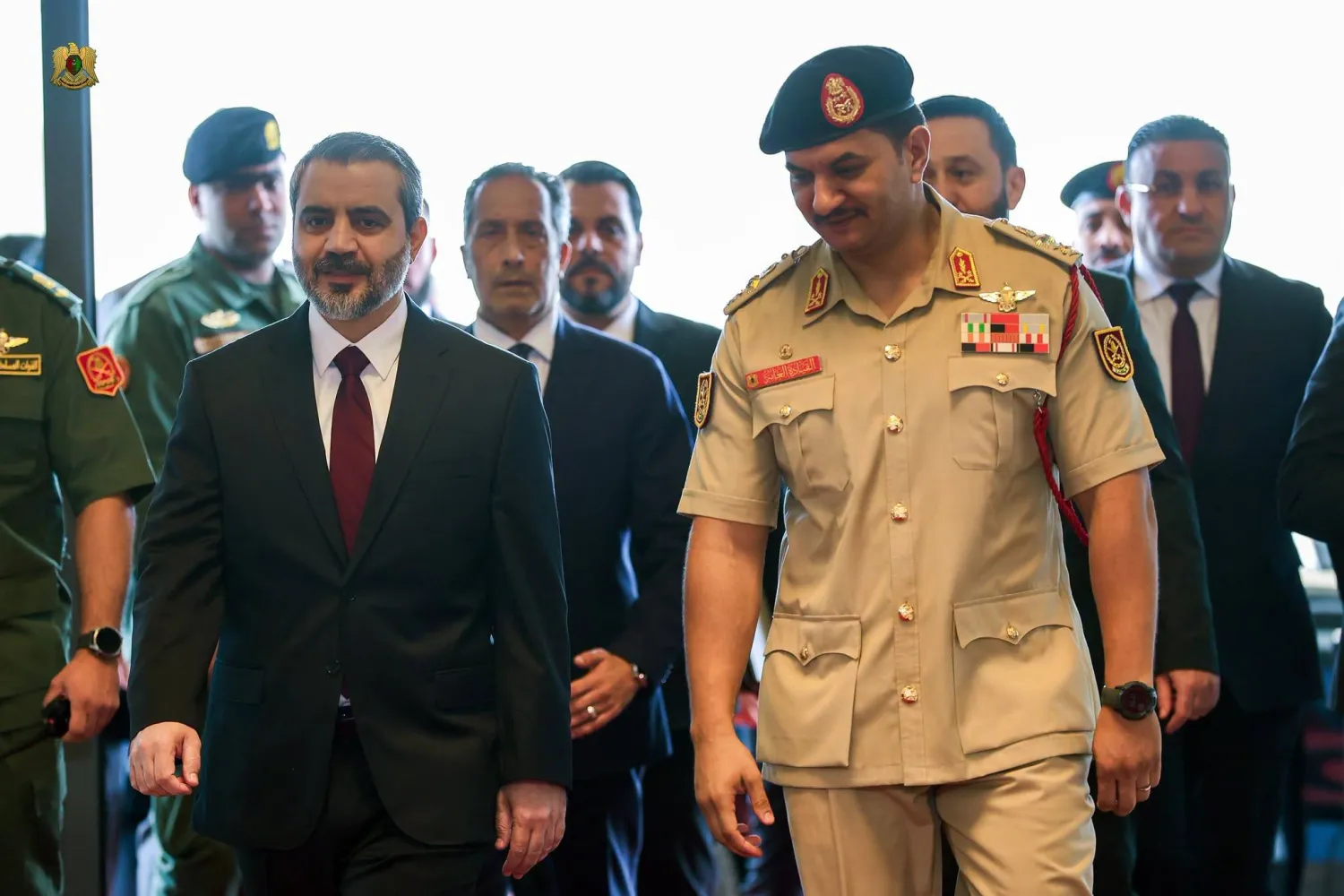



Saddam Haftar Assures Shaibani of General Command’s Readiness to Support Syrian People

General Saddam Haftar, deputy commander-in-chief of the Libyan National Army, and Syrian Foreign Minister Asaad al-Shaibani in Benghazi. (LNA General Command)
TT

Saddam Haftar Assures Shaibani of General Command’s Readiness to Support Syrian People

General Saddam Haftar, deputy commander-in-chief of the Libyan National Army, and Syrian Foreign Minister Asaad al-Shaibani in Benghazi. (LNA General Command)

General Saddam Haftar, deputy commander-in-chief of the Libyan National Army, discussed with Syrian Foreign Minister Asaad al-Shaibani several issues of common interest during the minister’s first visit to Benghazi.

They also underlined the depth of the fraternal and historical relations uniting the Libyan and Syrian people.

Libya and Syria restored diplomatic ties after nearly 14 years after Shaibani visited Tripoli in August. Talks discussions aimed to strengthen bilateral relations and expand joint cooperation between the two countries, culminating in the reopening of the Syrian embassy in Libya.

The LNA General Command said on Sunday that Saddam praised the role of the Syrian leadership "in achieving security and stability in Syria, overcoming the challenges faced during the transition phase, and working to restore normalcy and open up to the international community."

He underscored the General Command's support for the Syrian leadership, and “its readiness to provide everything within its power to support the brotherly Syrian people to help Syria regain its position in the Arab and international arenas.”

For his part, Shaibani expressed the Syrian leadership's keenness to support everything that would achieve permanent stability in Libya.


Washington Targets Hezbollah’s Alternative Funding Networks

Hezbollah supporters hold up a portrait of the group’s former secretaries-general, Hassan Nasrallah and Hashem Safieddine, during the second anniversary of their assassinations in Beirut’s southern suburbs (AP). 
TT

Washington Targets Hezbollah’s Alternative Funding Networks

Hezbollah supporters hold up a portrait of the group’s former secretaries-general, Hassan Nasrallah and Hashem Safieddine, during the second anniversary of their assassinations in Beirut’s southern suburbs (AP). 

The United States is stepping up efforts to track alternative financing channels used by Hezbollah as tighter sanctions threaten its traditional sources of funding, particularly Iranian money that has long underpinned the group’s military and security capabilities and political influence in Lebanon.

Washington’s campaign extends beyond restricting Iranian transfers to tracing foreign funding networks and cross-border commercial activities that Hezbollah could use to compensate for any decline in Tehran’s support.

A Reuters report last week that Hezbollah had received $200 million in cash from Iran the previous month to assist tens of thousands of families displaced by the war prompted a response from the US State Department.

The department expressed doubt that the money had reached Hezbollah but reaffirmed its commitment to maintaining pressure on the group’s funding sources through sanctions, while supporting the legitimate Lebanese government’s efforts to rebuild southern Lebanon.

New round of sanctions

Sami Nader, director of the Middle East Institute for Strategic Affairs, described the measures as part of a new round of US sanctions aimed at tightening financial pressure on Iran and its regional affiliates.

“The issue is not specifically Hezbollah, but primarily Iran,” Nader told Asharq Al-Awsat, pointing to a recent US announcement describing Hezbollah as an integral part of Iran’s Revolutionary Guard Corps.

Nader said Tehran had developed alternative channels to circumvent financial restrictions, particularly through gold and cryptocurrencies.

He described an expanding network of such activities across the region, with links to Iran and Hezbollah.

The latest sanctions are designed to target these alternative mechanisms, he explained.

Nader added that if cryptocurrency offices linked to these networks are found to exist, Lebanese authorities would likely be asked to shut them down and take action against them, while also tightening oversight of gold transactions.

Four sources of financing

Hezbollah has long relied on multiple funding sources, particularly under previous Lebanese administrations that turned a blind eye to billions of dollars reaching the group, including through official border crossings.

Economist Antoine Farah identified four principal sources of financing: The first was direct Iranian support, provided through regular transfers from Tehran. The second involved illicit activities, particularly drug smuggling and the Captagon trade, which Farah said Hezbollah had engaged in both inside Lebanon and abroad, notably in several Latin American countries. The third consisted of substantial donations from Shiite financiers and supporters around the world. The fourth was a network of front businesses established to generate additional revenue, launder money and conceal the origins and destinations of funds.

Farah told Asharq Al-Awsat that Hezbollah’s ability to draw on most of these sources had declined considerably, while the group faced mounting pressure from legislative and regulatory measures being strengthened in Lebanon.

Stricter financial oversight

Farah highlighted amendments being introduced to Law No. 44 on combating money laundering and terrorist financing, particularly provisions requiring the identification of the ultimate beneficial owners of companies and commercial enterprises.

Identifying who ultimately benefits from commercial activities, while tracing the origins and destinations of funds, would help restrict the operations of front businesses established by Hezbollah, he explained.

Farah also pointed to measures being taken by Banque du Liban, Lebanon’s central bank, to regulate currency exchange dealers and money transfer companies.

He said the measures were making it increasingly difficult to exploit these sectors to transfer money and channel financing to Hezbollah.


Syrian Security Forces Step Up anti-ISIS Operations, Pursue Former Regime Loyalists

A scene from the arrests carried out in Masyaf (Hama Security Correspondent).
TT

Syrian Security Forces Step Up anti-ISIS Operations, Pursue Former Regime Loyalists

A scene from the arrests carried out in Masyaf (Hama Security Correspondent).

Syrian security forces have intensified operations against ISIS cells following a deadly September bus attack near Masyaf in central Syria, while separately pursuing former regime operatives accused of crimes against civilians.

Within a week, authorities announced the dismantling of an ISIS cell in Homs province, following the arrest of the group’s alleged military commander there. Seven former regime suspects were also detained as part of transitional justice efforts.

The Internal Security Forces announced that raids in the Houla area of northern Homs, conducted with the General Intelligence Directorate, had dismantled an ISIS-linked cell and foiled planned attacks on places of worship and security patrols.

Two suspects were arrested and two explosive devices were seized. Preliminary investigations indicated that the detainees had received and transported explosives and monitored potential targets as part of plans to incite unrest and undermine security.

One suspect was caught attempting to plant an explosive device on a railway track, authorities reported. Investigations are continuing to identify other cell members and their connections.

The operation followed the arrest about three days earlier of Khaled Raed Bayrouni, known as Abu Hassan Doshka, in Hujayra, near Damascus. The Interior Ministry described him as ISIS’s operational arm in Homs and the group’s overall military commander in its so-called Homs province.

Bayrouni is accused of planning and overseeing bombings and sectarian attacks, including an explosion at an Alawite mosque in Homs that killed eight people in late 2025.

Authorities also launched raids and arrests following a Sept. 27 attack on a bus transporting workers near the Masyaf bypass bridge, on the road linking Masyaf and Homs, that killed seven civilians.

Despite ISIS’s territorial defeat in Syria and Iraq, its small cells remain a security threat, exploiting instability and security gaps, particularly in remote areas.

In early October, the international coalition against ISIS pledged more than $75 million to support Syria’s counterterrorism efforts, including measures to address security vulnerabilities and dismantle dormant cells.

Separately, the Defense Ministry reported Saturday that a Syrian army soldier had died of wounds sustained in a shooting by unidentified gunmen Tuesday evening in Buqrus, eastern Deir Ezzor province.

Two customs patrol members were also wounded when unidentified attackers opened fire near Izraa bridge in Daraa province as officers escorted a transit convoy, the General Authority for Ports and Customs announced Saturday.

Former regime suspects arrested

In a parallel operation, security forces detained seven former regime suspects in Masyaf, Hama province, accusing them of serious abuses against civilians.

Nabil Adnan Ismail and Ghazi Mohammed Ismail allegedly commanded groups within militias affiliated with the former Air Force Intelligence Directorate and participated in kidnappings, looting and massacres, including violence in Aqrab village. They also face extortion allegations.

Brothers Taher Youssef al-Mohammed and Talal Youssef al-Mohammed, who served in Air Force Intelligence and the Scientific Studies and Research Center, are accused of repression, arrests and exploiting access to detainees’ files to extort their families.

Faisal Badour, nicknamed “Tiger Cub” for his alleged brutality toward civilians, joined armed militias in 2012 and participated in former regime military operations in Hama and Aleppo provinces.

Another detainee, Assef Salameh, served as a noncommissioned officer at defense factories until 2018.

Authorities had earlier arrested Shaheen Hamdan al-Shaheen, a founder of the Air Force Intelligence-linked Shaheen Regiment militia.

He is accused of involvement in massacres in eastern Hama and along the Athriya–Raqqa road in 2017. His militia allegedly committed killings, arrests, torture and destruction in Palmyra and Deir Ezzor province through 2019.