Gold, Gems and Renoirs: France’s Museums Grapple with a Wave of Smash-and-Grab Thefts

 The entrance of the Renoir Museum is pictured after thieves stole four valuable Renoir paintings, in Cagnes-sur-Mer, Tuesday, Sept. 8, 2026. (AP)
The entrance of the Renoir Museum is pictured after thieves stole four valuable Renoir paintings, in Cagnes-sur-Mer, Tuesday, Sept. 8, 2026. (AP)
TT

Gold, Gems and Renoirs: France’s Museums Grapple with a Wave of Smash-and-Grab Thefts

 The entrance of the Renoir Museum is pictured after thieves stole four valuable Renoir paintings, in Cagnes-sur-Mer, Tuesday, Sept. 8, 2026. (AP)
The entrance of the Renoir Museum is pictured after thieves stole four valuable Renoir paintings, in Cagnes-sur-Mer, Tuesday, Sept. 8, 2026. (AP)

At a museum in eastern France, two men disguised with wigs used a sledgehammer and a hammer to smash a display case and make off with a 2,500-year-old gold necklace. The heist took under four minutes.

In a smash-and-grab at another French museum, three masked robbers stole 27 pieces of jewelry valued at more than 4.5 million euros (US$5.2 million), busting through two doors to break in.

Those thefts took place in July. This week, thieves sliced through a fence and climbed through the window of a museum on the French Riviera and fled with two paintings by Pierre-Auguste Renoir. They abandoned two other artworks by the Impressionist master as they made their escape.

The rash of the robberies, coming on the heels of last year's stunning jewel heist in France's most famous and most visited museum, the Louvre, show how the country is both blessed and cursed by its troves of treasure accumulated over centuries of conquest, creativity and having money to spend on art.

France's passion for paintings, sculptures, ancient artifacts and other valuables and curios is a source of national pride and identity. Thousands of museums that house collections big and small help transmit France's love of culture and history from one generation to the next. The biggest also draw millions of tourists who pump money into the French economy.

But keeping all that wealth safe is costly and difficult. Criminals see museums as soft targets. The brazen and agonizing theft of 88 million euros ($102 million) worth of crown jewels from display cases in the Louvre's Apollo gallery served as a wake-up call. But it was only the most shocking example of broader threats to museums, and not just in France.

“When the jewels of a French king disappear, to be melted down because of the price of gold, it is tragic. It breaks everyone’s heart,” said Guillaume Poitrinal, president of a foundation that funds the renovation and protection of French cultural sites, the Fondation du patrimoine.

“We need to make it more difficult to steal works of art and objects that are part of France’s cultural heritage and belong to all French people. That is absolutely essential. And to achieve that, we need to invest,” he said in an interview with The Associated Press.

The Renoir heist took just minutes

Before dawn Tuesday, two robbers made off with “Portrait of Madame Colonna Romano” and “Young Woman at the Well.” They dropped “Portrait of Madame Pichon” and “Coco Reading” as they fled through the garden of the Renoir Museum in Cagnes-sur-Mer.

They cut through a fence with an electric knife or saw and entered the museum through the ground floor, said Bryan Masson, mayor of the town between Cannes and Nice on the Mediterranean coast.

The heist took under three minutes. Masson estimated the artworks' value at 9 million euros ($10.5 million). Offloading well-known, stolen art is impossible through legitimate channels, so the paintings could prove to be worth little or nothing for the thieves.

European police agency Europol says museum heists are becoming more violent, with sledgehammers, axes, crowbars and even explosives used for break-ins and to smash display cases.

Thieves also are increasingly targeting museum items with gold and other precious metals that can be melted down and with gemstones that can be removed and sold, the agency said in a report in August. Criminals believe “museum security measures are less robust than those in jewelry stores,” it said.

The ancient necklace stolen July 24 from the museum in Châtillon-sur-Seine, eastern France, was crafted from nearly half a kilo (a pound) of gold.

A record 10 burglaries targeted French and other European museums this summer, according to Jean-Christophe Castelain, director of Le Journal des Arts, a bimonthly revue of the art world.

“Eight of those 10 involved jewelry, coins or antique objects that can easily be melted down,” he said.

A distraught museum director shares her pain

The Lalique Museum in Wingen-sur-Moder, further east near France's border with Germany, has not reopened since the July 5 theft of jewelry there from six display cases busted open with sledgehammers and hammers. The public museum celebrates 19th-century jeweler and glassmaker René Lalique and his successors.

The pain is still raw for its director, Véronique Brumm Schaich. Her voice cracked with emotion during an interview. The museum is seeking 200,000 euros ($233,000) for security upgrades.

“Robbers’ tactics are evolving,” she said. “The recent examples show that we are not the only ones who need to go further in our efforts.”

Because of government budget squeezes, it's not yet clear how much funding will come from public coffers, she said. The museum is also collecting private donations, because “these are things that are extremely expensive,” she said.

“These are difficult times,” she said. “A burglary never comes at a good time, but this one came at an especially bad time.”

Some of the funding that the Fondation du patrimoine provides, including for museums, comes from a national lottery. To help boost museum revenues, the foundation is also launching a pass that will grant subscribers access to 500 museums, monuments and châteaux.

“France is a country where we love passing the buck,” said Poitrinal, the foundation president. “People say it is the state’s responsibility or the city’s responsibility. I say it's quite simple: it is everyone’s responsibility.”


Landmark Bus Tours, Folk Arts, and Stargazing Draw Crowds to 'Wasm Hail' Cultural Festival

The program features traditional camel processions, folk arts, stage and musical performances, handicraft stalls, exhibition pavilions, and classic car displays - SPA
TT

Landmark Bus Tours, Folk Arts, and Stargazing Draw Crowds to 'Wasm Hail' Cultural Festival

The program features traditional camel processions, folk arts, stage and musical performances, handicraft stalls, exhibition pavilions, and classic car displays - SPA

The Wasm Hail events at Al-Qishlah Palace in Hail have welcomed thousands of residents and tourists from within the region and beyond to enjoy a diverse array of experiences blending heritage, culture, and entertainment.

The program features traditional camel processions, folk arts, stage and musical performances, handicraft stalls, exhibition pavilions, and classic car displays. A dedicated tourist bus service also offers guided tours of landmarks, SPA reported.

Adding an educational dimension, the festival includes an astronomical experience enabling visitors to observe the moon and planets through optical telescopes and safely view the sun via specialized solar telescopes, highlighting Hail's diverse cultural and tourism assets.


A Long-Buried Ancient Library in Rome Opens to the Public After Restoration

 Marble archaeological remains from the western library of Trajan's Forum, which archaeologists believe may have housed the ancient Bibliotheca Ulpia, one of ancient Rome's most important libraries, are displayed during a press preview of the restored site in Rome, Thursday, Nov. 19, 2026. (AP)
Marble archaeological remains from the western library of Trajan's Forum, which archaeologists believe may have housed the ancient Bibliotheca Ulpia, one of ancient Rome's most important libraries, are displayed during a press preview of the restored site in Rome, Thursday, Nov. 19, 2026. (AP)
TT

A Long-Buried Ancient Library in Rome Opens to the Public After Restoration

 Marble archaeological remains from the western library of Trajan's Forum, which archaeologists believe may have housed the ancient Bibliotheca Ulpia, one of ancient Rome's most important libraries, are displayed during a press preview of the restored site in Rome, Thursday, Nov. 19, 2026. (AP)
Marble archaeological remains from the western library of Trajan's Forum, which archaeologists believe may have housed the ancient Bibliotheca Ulpia, one of ancient Rome's most important libraries, are displayed during a press preview of the restored site in Rome, Thursday, Nov. 19, 2026. (AP)

The famed Alexandria Library in Egypt may have been lost, but another of the ancient world's repositories for texts has been restored in Rome and is reopening to the public this week.

The ruins of the Ulpia library are located in Emperor Trajan’s Forum, just next to the iconic column that celebrates his victorious campaigns against the Dacians and the Roman conquest of what is modern-day Romania. It remained inaccessible for almost a century.

“After the Alexandria Library of Egypt, after the Library of Pergamon in Asia Minor, this one in the Trajan’s Forum was certainly one of the most important, given both the number of ‘volumina,’ as books were called in ancient times, and the quantity of documents," Claudio Parisi Presicce, an archaeologist and Rome's superintendent for cultural heritage, said in an interview with The Associated Press.

The place was in a state of ruin when discovered in 1932 during clearing works by Benito Mussolini's government for the road that became the famous Via dei Fori Imperiali. Later, it was covered in concrete and used as a storage room for some of the countless pieces from Trajan's Forum, the last and greatest of the imperial fora, built in 112 AD.

But the niches in its walls were evidently spots to set cabinets for scrolls, signaling that this was one of the two, two-story buildings comprising the Ulpia library referenced in ancient texts, Presicce said.

Archaeologists from Rome's superintendency for cultural heritage identify it as the Ulpia library's western building, which ancient texts indicate stored Greek-language scrolls.

The new permanent exhibition offers visitors an idea of the space as it used to be, featuring the remains of some of the library’s rich marble decorations — white for the walls, and different colors for its floor and columns. Immersive videomapping is also projected on its walls, showing the history of the library and its discovery. Instead of scroll-filled cabinets, spread throughout the space today are broken Corinthian columns and pieces of sculptures.

The library was a fundamental part of the Forum, and a place that for centuries attracted citizens from all over Rome with its vast collection of edicts and documents.

“The libraries were used by both common citizens, those who could afford a certain cultural level and a better education than those from the lower classes, but also by magistrates who needed access to older documents, or needed to check the norms that regulated the life of the community,” he said.

Restoration started in 2025, and lasted about a year. The 1.75-million-euro cost ($1.92 million) came from the European Union’s pandemic recovery funds — just one of many restoration projects Rome is carrying out across the city with EU money.

It will initially be opened to visitors only on Fridays, Saturdays and Sundays. Visits are scheduled every 40 minutes, 20 people at a time.

The library's eastern building remains buried beneath an 18th-century church, on the other side of Trajan's Forum, and stored Latin-language scrolls. There are no plans for its excavation.


Afghan Tradition Keeps Grapes Fresh for Winter Treat

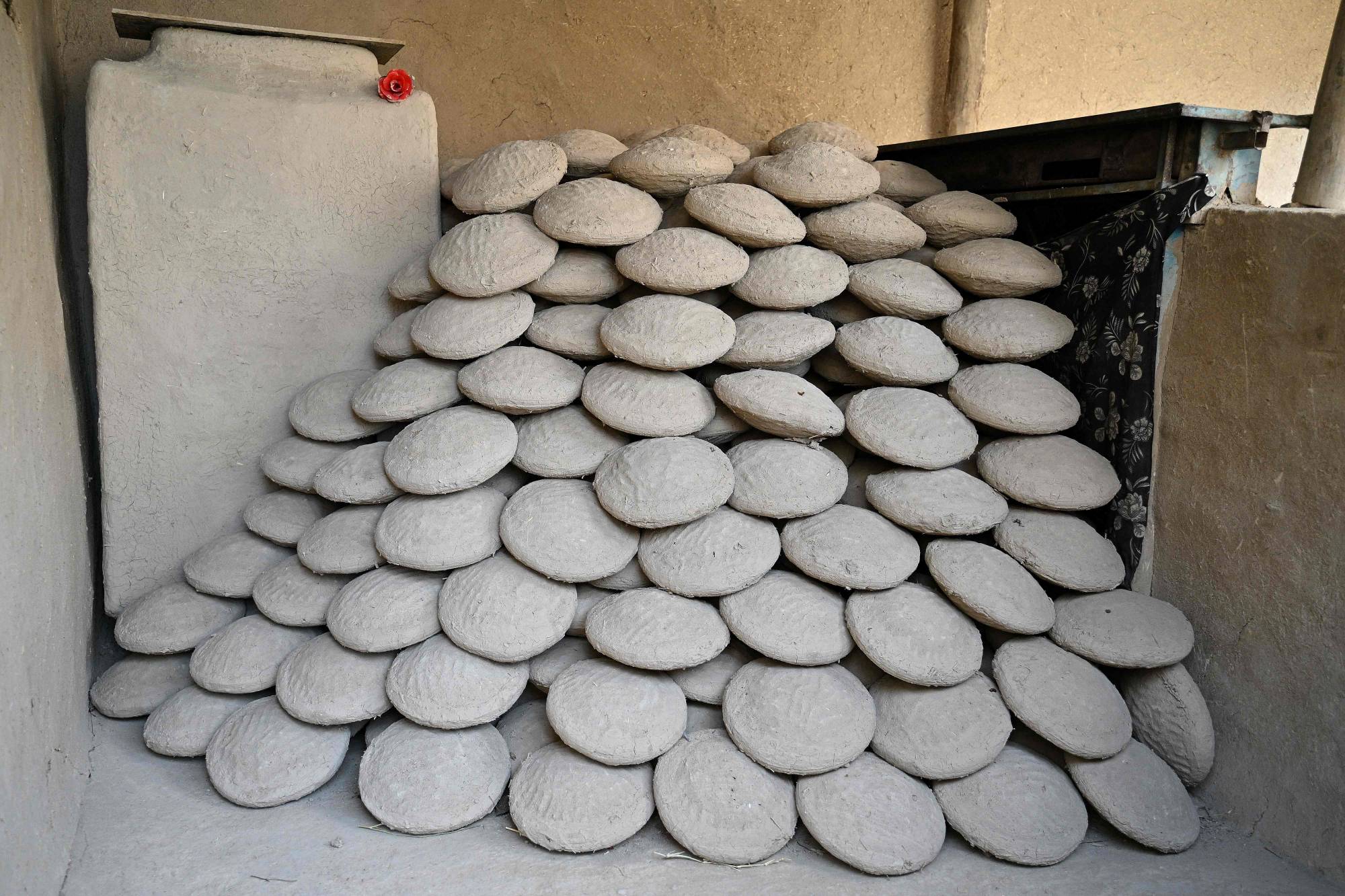
This photograph taken on November 10, 2026 shows Afghan farmer Muhammad Saber Shojaei seal packing grapes in mud-and-straw discs known as Kanginas before storing them in a dark room in the Kalakan district of Kabul province. (AFP)
TT

Afghan Tradition Keeps Grapes Fresh for Winter Treat

This photograph taken on November 10, 2026 shows Afghan farmer Muhammad Saber Shojaei seal packing grapes in mud-and-straw discs known as Kanginas before storing them in a dark room in the Kalakan district of Kabul province. (AFP)

On the outskirts of Afghanistan's frenetic capital Kabul, Muhammad Saber Shojaei is carrying out a centuries-old task of preserving fistfuls of grapes to be eaten when winter bites.

Crouched in front of dozens of "kanginas", clay-and-straw discs containing grapes, Shojaei recalls his father, who taught him the technique.

"I remember the old days, when we sat together around the sandali (stove), eating kangina grapes and enjoying those happy moments," said the 47-year-old from Kalakan district.

Carefully putting a bunch of grapes in one of the discs, Shojaei added a second disc on top and sealed the kangina with mud before placing it in a dark storage room.

"In this way, kanginas can keep grapes fresh from now until the spring," said the farmer, who makes about 700 each year to sell by the roadside.

No one knows quite how long kanginas have been used in Afghanistan, with estimates starting at "centuries" and the knowledge passed down through the generations.

This photograph taken on November 10, 2026 shows Kanginas, a traditional preserving method made from clay mud and straw used to keep grapes fresh for up to six months, in a storage inside of a house in the Kalakan district of Kabul province. (AFP)

During harvest season, grapes for sale can be seen bundled in big plastic bags, or piled high onto trucks as they're taken to markets further afield.

But such abundance comes with problems in Afghanistan, where cold storage to keep produce fresh is severely limited and the export route to Pakistan has been cut off by cross-border conflict.

Farhad Ezati, a 21-year-old trader, said "farmers can't even cover their costs" this year as grape prices have plummeted by 70 percent due to the border closure causing a supply glut.

Standing in a bright green field while laborers packed grapes into cardboard boxes, Ezati said competition among sellers is incredibly tough.

"Afghan grapes are the best," he said, his face brightening. "They're really high in quality... and have a really good taste."

- 'Keep our culture alive' -

Labor-intensive and fragile, kanginas cannot overcome large-scale storage or trade problems.

But in the depths of winter, Afghans living near the vineyards can buy them along the roadside or in nearby markets, and farming families can crack them open and enjoy fresh grapes.

Gulagha Frotan, a community leader in Kalakan, said people wait until snow or rain to enjoy them.

"We don't wash the grapes because they might lose their natural quality. We only blow away the dust, or shake them gently, and then they're ready to eat," the 61-year-old told AFP.

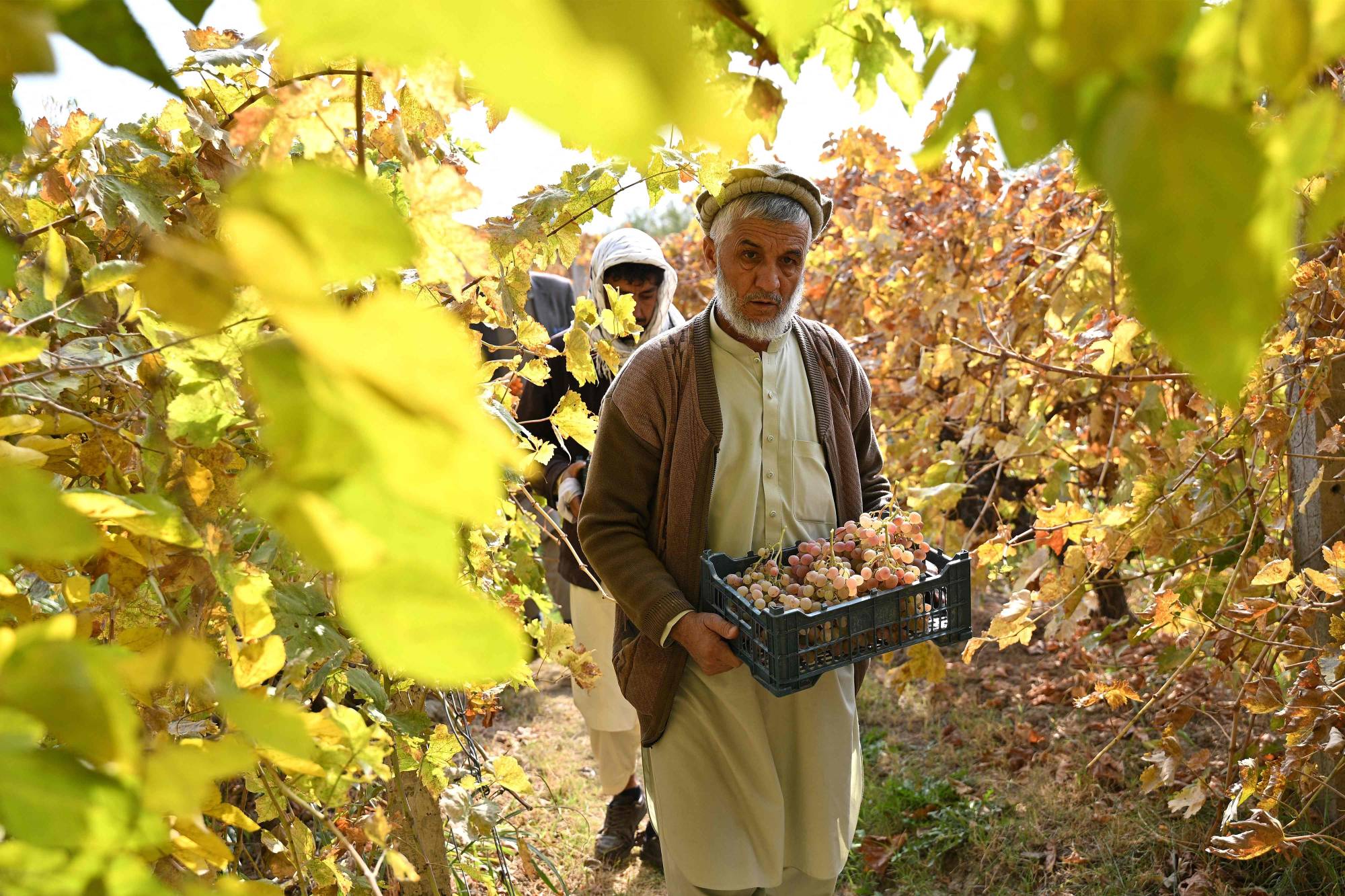
This photograph taken on November 10, 2026 shows an Afghan farmer carrying harvested fresh Taifi grapes in a vineyard in the Kalakan district of Kabul province. (AFP)

Despite its long history in the Kabul area, the practice is currently only being used in one other province, neighboring Parwan, according to the UN's Food and Agriculture Organization (FAO).

The agency's Ezatullah Noori said that, along with the cool weather, the large population in the area means that farmers don't have to travel far to sell the kanginas.

"There's potential for farmers to sell some of their grapes, rather than to lose them during the peak production season," said Noori, FAO's emergency and resilience team leader in Afghanistan.

He called for scientific research to better understand such unique heritage, as well as an organized effort to help farmers cooperate to sell their kanginas on a larger scale.

"I am afraid that one day this will disappear from our country and nobody will know how to make it," Noori told AFP.

"We should keep our culture alive."