Ali al-Taher Demolition Leaves Nabatieh Residents Wondering What Comes Next

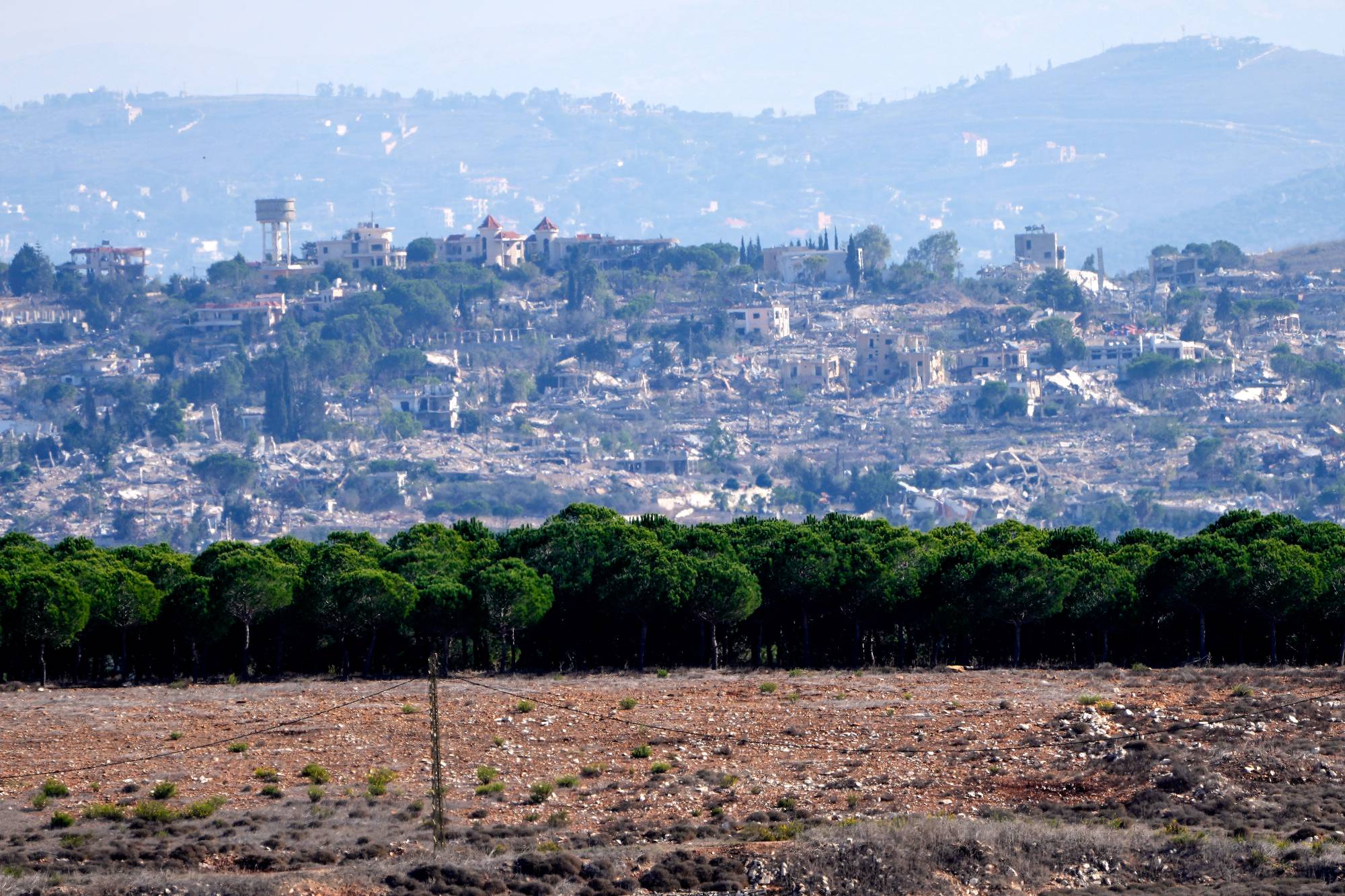
Destroyed stones on the top of Ali al-Taher ridge, which Israeli forces captured after fighting with Hezbollah and where the Israeli military said it blew up a network of Hezbollah tunnels Thursday night near Nabatieh town, southern Lebanon, Friday, Sept. 11, 2026. (AP)
TT

Ali al-Taher Demolition Leaves Nabatieh Residents Wondering What Comes Next

Destroyed stones on the top of Ali al-Taher ridge, which Israeli forces captured after fighting with Hezbollah and where the Israeli military said it blew up a network of Hezbollah tunnels Thursday night near Nabatieh town, southern Lebanon, Friday, Sept. 11, 2026. (AP)

Israel’s demolition of two tunnels extending two kilometers through Ali al-Taher ridge brought movement in south Lebanon’s Nabatieh city to a standstill and deepened fears over what comes next.

Israeli Defense Minister Israel Katz said Israel was ready to press ahead with its campaign and continue striking Hezbollah and other sites.

The Israeli military carried out a powerful explosion on Ali al-Taher ridge, on the outskirts of Nabatieh al-Fawqa, causing tremors and a loud blast that echoed strongly across Nabatieh and the surrounding area, according to Lebanon’s state-run National News Agency.

The US Geological Survey recorded a magnitude 4.1 seismic event in southern Lebanon. Lebanon’s National Center for Geophysics, which is affiliated with the National Council for Scientific Research, said ground waves were detected at 9:08 p.m. on Thursday by all its monitoring stations.

The center said the waves “resulted from the explosion carried out by the Israeli enemy in the Ali al-Taher area and could be compared to a magnitude 4.2 earthquake on the Richter scale.”

A difficult night

Residents of southern Lebanon endured “a difficult night.”

“The ground shook beneath us for about five seconds,” said one resident living 20 kilometers from Ali al-Taher.

“The sound of the explosions was faint, but the doors shook around us,” the resident told Asharq Al-Awsat. “It felt like an earthquake that ended after five seconds.”

A resident of the town of Marjeyoun said the ground “shook beneath us, and we saw the houses shaking,” underscoring the force of the blast, “before columns of flames rose into the air.”

“I began seeing the explosions. There were between seven and eight, with columns of flames rising to varying heights,” the resident told Asharq Al-Awsat.

“The sky glowed red. The scene was terrifying and frightening. The children panicked, and within minutes, dust began reaching us, covering the trees, cars and rooftops.”

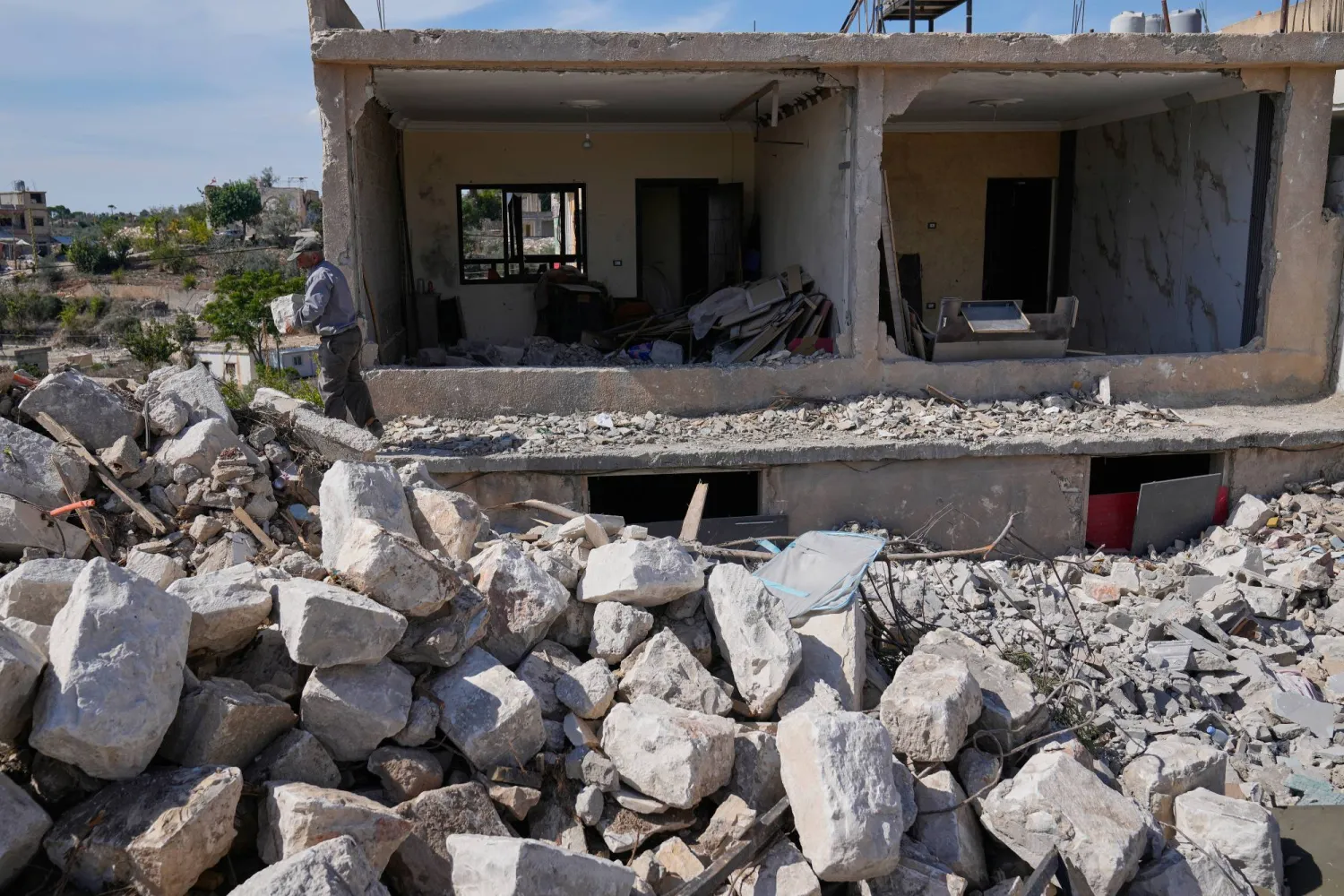
A picture shows destroyed houses in the southern Lebanese village of Kfar Tebnit on September 11, 2026, following an Israeli demolition on the Ali al-Taher ridge. (AFP)

“The smell of gunpowder choked us, forcing us to close the windows again,” the resident said, adding that sunrise revealed a thick layer of dust covering the town.

Residents of Qlayaa and Marjeyoun said windows and doors were shattered by the blast in homes on the western edges of the two towns overlooking Ali al-Taher.

The tremors and sounds of the explosions carried over long distances. Residents living 20 kilometers from Ali al-Taher said they saw flashes and flames and felt the ground shake, although the sound was not loud. Residents of Marjeyoun, by contrast, reported hearing powerful explosions.

NNA said the Khardali road was completely blocked after the overnight blast caused rocks and stones to tumble onto the roadway.

Residents’ fears

Daylight revealed a changed landscape. The explosion and Israel’s threats to continue its bombardment and demolitions deepened residents’ fears as they wondered what would come next.

Local sources in Nabatieh said many residents who had returned to the city “left again for fear that the war would resume or the fighting would expand.”

People are asking about “the next phase,” which remains unclear even to the Lebanese state. Beirut is continuing contacts with the United States aimed at de-escalation and resuming negotiations through an eighth session with Israel expected to be held this month. The Lebanese presidency has not yet been informed of the date.

Residents fear the fighting could spread toward Nabatieh following the demolition of Ali al-Taher.

“No one can guarantee what will happen,” one resident said. “The Israeli statements are alarming.”

The Ali al-Taher hill is seen in the background overlooking destroyed houses in the southern village of Kfar Rumman, Lebanon, Friday, Sept. 4, 2026. (APi)

Fighters’ fate unknown

Hezbollah issued no official statement on the Ali al-Taher demolition, while the fate of its fighters suspected of having been inside the tunnels remained unknown.

An Israeli military official told AFP that some fighters who had been operating in the highlands had left the area, while others were eliminated by airstrikes and artillery fire.

The Israeli military said last week that it had taken control of the highlands, located north of the Litani River on the edge of the Israeli-occupied area in southern Lebanon.

Supporting returning residents

Meanwhile, the Lebanese government is seeking to help returning residents remain in areas where the fighting has subsided.

Prime Minister Nawaf Salam received a delegation from the municipality of Kfar Rumman, which borders Ali al-Taher and was subjected to continuous bombardment for three months. The delegation presented a series of demands related to residents’ return and the area’s recovery.

Salam said the Council for Development and Reconstruction would soon begin implementing projects in the area after completing the necessary preparatory procedures.

He said he was also following up with the Council of the South on projects concerning the town.

Salam asked the municipality to prepare a list of its most urgent priorities and needs and to survey families in need of help with shelter or prefabricated homes. Priority would be given to the neediest families with no alternative housing, given the limited resources and capabilities available.

Salam said the Israeli attacks on Kfar Rumman, which killed and wounded civilians, including children, were being documented by the National Committee for International Humanitarian Law, chaired by Deputy Prime Minister Tarek Mitri.

The delegation called for a stronger deployment of the Lebanese army, particularly along roads leading to Khardali and Dawhet Kfar Rumman, as well as a greater security presence in the town, especially by the Internal Security Forces.

Salam said efforts were continuing to reinforce the presence of the army and security forces to reassure residents and strengthen stability.


Iran Asks Iraq to Return Flights Between the Two Countries to Normal Conditions

Two Iranian airlines planes at Imam Khomeini International Airport south of Tehran (Archive - Mizan)
TT

Iran Asks Iraq to Return Flights Between the Two Countries to Normal Conditions

Two Iranian airlines planes at Imam Khomeini International Airport south of Tehran (Archive - Mizan)

Iran asked Iraq to take steps to lift flight ‌restrictions ‌caused by ‌US ⁠sanctions and return flights ⁠to normal conditions, the country's ⁠foreign ‌ministry said in ‌a statement ‌on ‌Thursday.

Flights between the two countries were suspended amid ⁠US sanctions restricting services to Iranian airlines, Reuters said.


Egypt Accuses 6 Arrested Journalists of Being Members of the Muslim Brotherhood

Headquarters of the Egyptian Ministry of Interior (Ministry's Facebook page)
TT

Egypt Accuses 6 Arrested Journalists of Being Members of the Muslim Brotherhood

Headquarters of the Egyptian Ministry of Interior (Ministry's Facebook page)

Egyptian authorities have accused six journalists arrested this week of being members of the outlawed Muslim Brotherhood, saying they produced fabricated news for an online outlet in exchange for foreign funding.

Egypt’s Interior Ministry on Thursday described "Matsadaash" as an unlicensed page managed from abroad by a “fugitive Brotherhood member” it identified as Abdelrahman Mansour.

It said the six people detained were part of a Brotherhood “media committee” that prepared false and fabricated news for Mansour to publish.

Only one of the six is a member of the Journalists’ Syndicate - the national press union - the statement said. It said legal measures have been taken.

On Wednesday, the Journalists' Syndicate demanded the Interior Ministry and the General Prosecutor to release the six journalists and disclose the circumstances and reasons for their arrest, as well as their places of detention.

In the report submitted by the Head of the Journalists' Syndicate, Khaled El-Balshy, the Syndicate stated that it had received complaints from lawyers and colleagues regarding the arrest of six journalists from the platform, one of whom holds syndicate membership.

It confirmed that "the six colleagues Abdullah Qadri, Mohamed Sharaf, Mohamed Adel, Islam Barakat, Mohamed Mahmoud, and Omar Hidayah were arrested from their homes over the past two days."

The Syndicate affirmed that it is making "diligent efforts around the clock to secure the release of the six colleagues ... with a full commitment to their appearance for any investigations should any charges be brought against them."


Lebanon Army Says Seized 245 Kg of TNT at Syria Border

An army unit seized approximately 245 kg of TNT. (Lebanese Army on X)
TT

Lebanon Army Says Seized 245 Kg of TNT at Syria Border

An army unit seized approximately 245 kg of TNT. (Lebanese Army on X)

The Lebanese army announced on Thursday that it had seized nearly 250 kilograms (around 550 pounds) of explosives being transported from neighboring Syria into Lebanon, though it was unable to apprehend the smugglers.

"An army unit seized approximately 245 kg of TNT, four explosive devices, eight detonators and electrical wiring for the detonators", which were being "smuggled from Syrian territory into Lebanese territory", the army said in a statement.

"The smugglers fled back toward Syria as soon as an army patrol arrived at the scene," it added.

Lebanon and Syria share a 330-kilometer (205-mile) border known for being porous.

Since the fall of longtime Syrian ruler Bashar al-Assad in late 2024, both Lebanon and Syria have been working to stamp out overland smuggling along their shared border -- including the trafficking of weapons and captagon.

Damascus regularly announces the interception of arms shipments destined for Lebanon on behalf of Hezbollah, an organization that denies any presence or activity in Syrian territory.