

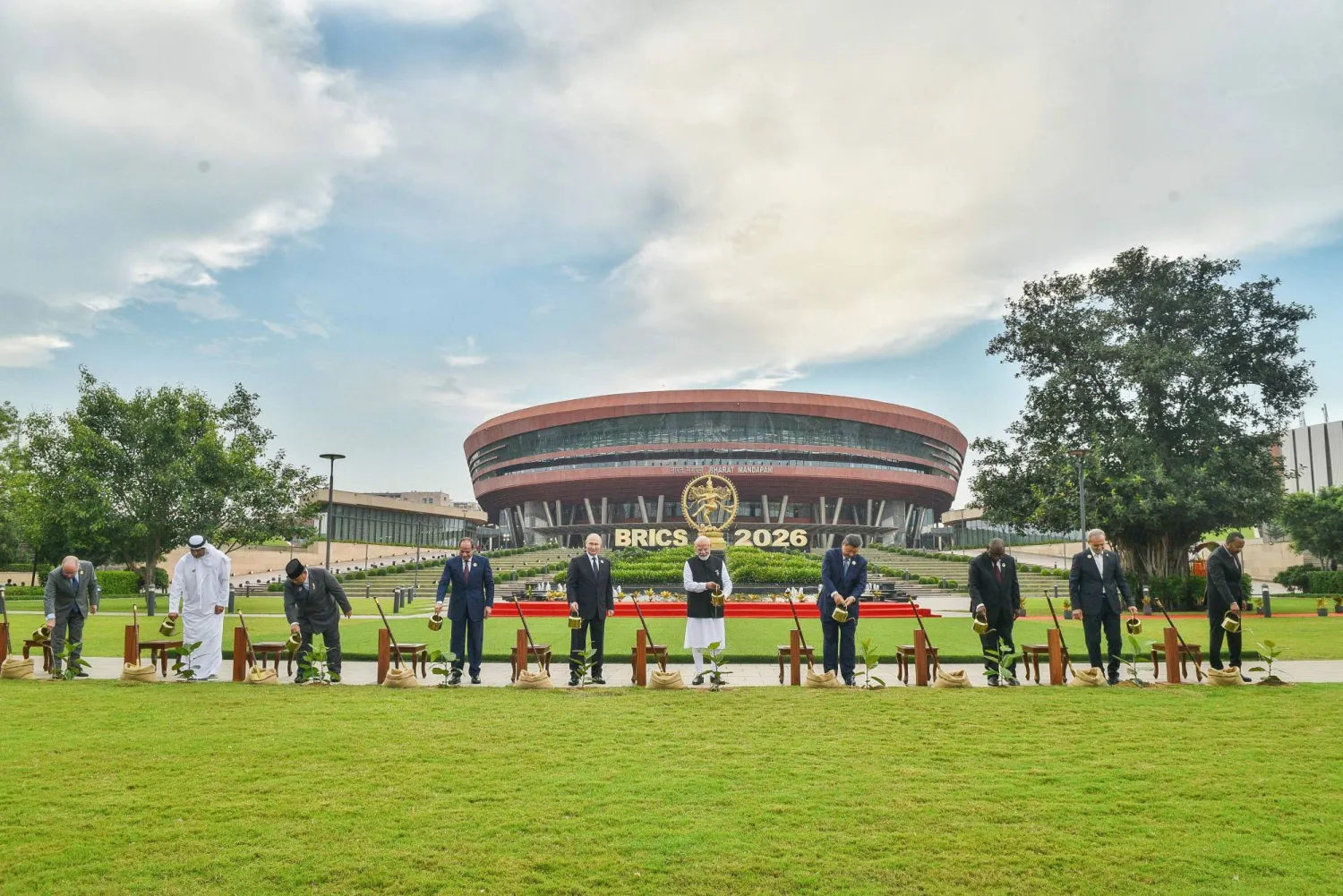

BRICS Nations Call for 'Maximum Restraint' in Middle East War

A handout photo made available by India’s Ministry of External Foreign Affairs shows BRICS leaders planting trees during the 18th BRICS Leaders' Summit in New Delhi, India, 12 September 2026. EPA/INDIAN MINISTRY OF EXTERNAL FOREIGN AFFAIRS/HANDOUT
TT

BRICS Nations Call for 'Maximum Restraint' in Middle East War

A handout photo made available by India’s Ministry of External Foreign Affairs shows BRICS leaders planting trees during the 18th BRICS Leaders' Summit in New Delhi, India, 12 September 2026. EPA/INDIAN MINISTRY OF EXTERNAL FOREIGN AFFAIRS/HANDOUT

Members of the 11-nation BRICS group including China, Russia, Iran and India called for calm in the Middle East at a summit in New Delhi on Saturday.

Chinese President Xi Jinping, who joined Russian, Iranian, Indian and other leaders in India's capital, told the summit that the Middle East war "does not serve the common interests of the international community.”

Leaders issued a statement on Saturday after intense diplomatic efforts by host India, as the bloc seeks to bolster its global influence and address conflict, trade turbulence and energy security.

"We express deep concern over the continued escalation of tensions in Middle East/West Asia," the joint statement said, according to AFP, adding the countries "call for exercising maximum restraint, as well as avoiding actions that could further aggravate the situation.”

BRICS was created in 2009 as a forum for major emerging economies seeking greater influence in institutions dominated by Western powers.

"We have to transform this pyramid of privilege into a platform of partnership," Indian Prime Minister Narendra Modi told Xi, Russian President Vladimir Putin, Iranian President Masoud Pezeshkian and other leaders as he opened the two-day summit.

Modi said BRICS nations "represent 50 percent of the world's population, 40 percent of global GDP and more than 25 percent of global trade.”

But finding balance in the bloc is a tough diplomatic task.

India maintains cordial relations with both Iran and US ally Israel, but is also careful to strike a delicate balance in its ties with Washington.

Iran's Pezeshkian attended the summit shortly after warning that the Middle East does not need the United States to be a "regional policeman,” with the two countries at war and tensions threatening the vital Strait of Hormuz.

India has navigated the energy crisis caused by the US-Iran war in part by turning to Russia, despite Moscow's war in Ukraine and pressure from Washington and other Western capitals.

Modi embraced Putin before talks on Friday. The Russian president, who last visited India in December 2025, is one of New Delhi's most important strategic partners.

Xi's participation is also being closely watched because it is his first visit to neighboring India since 2019, and the biggest step yet in a cautious thaw between the nuclear-armed rivals.

Xi was given a red-carpet welcome, with an honor guard of soldiers and traditional dancers in colorful dresses.

"Although our two countries are different in many respects, they are fully capable of complementing each other's strengths, supporting one another, achieving mutual success and advancing together," Xi said as he met Modi, in a video released from New Delhi.

His visit comes six years after a deadly military clash along the disputed Tibetan border between China and India, with ties gradually improving through restored flights, visas and high-level contacts.

The underlying territorial dispute remains unresolved, and both sides retain heavy military deployments along their roughly 3,500-kilometer high-altitude border.

India's foreign ministry said in a statement after the meeting that "the two leaders expressed commitment to a fair, reasonable, and mutually acceptable resolution of the boundary question.”

Modi "underlined the need for both sides to observe existing agreements and understandings on border related issues," the foreign ministry added.

Deep mistrust remains, with their contested Himalayan frontier, a widening trade deficit and strategic rivalry continuing to complicate ties.

"Both sides should... work hand-in-hand to promote high-quality major financial cooperation, advocate an equal and sustainable global order, and foster an economic globalization that is open and inclusive," Xi said.



UN Says 5.8 mn Refugee Children Out of School

Syrian refugee children attend a class at a school in Mount Lebanon, October 7, 2016. REUTERS/Mohamed Azaki
TT

UN Says 5.8 mn Refugee Children Out of School

Syrian refugee children attend a class at a school in Mount Lebanon, October 7, 2016. REUTERS/Mohamed Azaki

Some 5.8 million refugee children were out of school in 2025, the United Nations said Friday, warning that funding cuts threatened to make the situation worse.

UNHCR, the UN refugee agency, said 44 percent of the world's 13.1 million school-age refugee children were out of school last year.

"Education is protection. But it is also a pathway to opportunity and self-reliance," said Barham Salih, the UN high commissioner for refugees, AFP reported.

"At a time of severe pressure on humanitarian and development financing, cuts to education risk reversing decades of collective investment and closing opportunities for a generation of young people."

The former Iraqi president, who was a refugee, said that looking back on his own life, "education gave me opportunities that displacement might otherwise have denied me".

"Displacement should not determine the limits of a child's life."

UNHCR said that while 65 percent of refugee children of primary school age were enrolled in education in 2025, only 32 percent were enrolled in secondary.

Refugee tertiary education enrolment reached a record 11 percent in 2025.

Earlier this week, UNHCR said its available funding had fallen from $5.2 billion in 2024 to $3.9 billion in 2025, while the number of people it is mandated to protect is hovering around historically high levels.

UNHCR said it needed $8.5 billion this year to protect refugees, but by the end of July had received only 32 percent of that amount ($2.7 billion).

UNHCR said nearly 8.3 million refugees and other forcibly displaced people faced losing vital assistance from the agency as protection services crumble due to the "severe" funding cuts.


Iran: Strait of Hormuz Will Not Reopen Until Conditions Are Met

Iran: Strait of Hormuz Will Not Reopen Until Conditions Are Met
TT

Iran: Strait of Hormuz Will Not Reopen Until Conditions Are Met

Iran: Strait of Hormuz Will Not Reopen Until Conditions Are Met

The Strait of Hormuz will not reopen until seven Iranian conditions set out in a June interim agreement with the US are met, Nournews reported Iran's parliament speaker Mohammad Baqer Qalibaf as saying on Sunday, a few days after Tehran received Washington's reply to its diplomatic proposal.

“The Americans, who say something different in the media, have recently put forward proposals through a mediator. ⁠But they must understand that ⁠the period of dragging out the process and dictating one-sided demands is over," Qalibaf was quoted as saying.

"The position of the Islamic Republic of Iran is completely clear and firm, and the Strait of Hormuz ⁠will not be opened until our seven conditions, based on the Islamabad Memorandum of Understanding, are met."

Meanwhile, army spokesperson Mohammad Akraminia told Fars news on Sunday that Iran will upgrade the range of its missiles following the war with the US as American forces are now ⁠positioned as much ⁠as 1,000 km (621 miles) away from the Iranian ⁠coast.

"During this war, we concluded that we absolutely must increase the ⁠range of ⁠our missiles, and we have now moved in that direction," he said.


Iran Tells US There is No Military Solution to Mideast War

(FILES) Vehicles drive past a giant billboard reading 'The Strait of Hormuz remains closed' at the Revolution Square in Tehran on April 28, 2026. (Photo by ATTA KENARE / AFP)
TT

Iran Tells US There is No Military Solution to Mideast War

(FILES) Vehicles drive past a giant billboard reading 'The Strait of Hormuz remains closed' at the Revolution Square in Tehran on April 28, 2026. (Photo by ATTA KENARE / AFP)

Iran's top diplomat insisted on Sunday that there would be no military solution to the United States' war against Iran, with talks on ending the conflict apparently at an impasse.

A campaign of heavy bombardment failed to bring a decisive close to the war launched by the US and Israel in late February, and Washington in recent weeks has dialed back military operations in favor of economic pressure.

The main point of contention remains Iran's attempt to blockade the Strait of Hormuz where a UK maritime agency reported on Sunday another tanker struck by an unknown projectile.

"If our enemies again choose the path of military confrontation, our response will be stronger than before, and we will defend ourselves with even more force," Iranian Foreign Minister Abbas Araghchi said at a gathering of foreign ambassadors.

"There is no military solution, nor any solution based on new sanctions," he continued, adding "only negotiations based on justice and fairness" could end the conflict.

The two sides agreed a memorandum of understanding in June that spelled out a framework for a permanent resolution, but Iranian attacks on vessels in the Hormuz prompted a return to US military operations.

On Sunday, the British maritime security agency UKMTO said a tanker in the Hormuz "reported being struck by an unknown projectile, causing damage to the engine room", though the crew were reported safe and no environmental impact was recorded.

The agency did not specify the date of the incident, the vessel's origin or destination, or whether it was an oil tanker or LNG carrier.

Iranian and US officials last week held indirect talks on the sidelines of the UN General Assembly, with Tehran saying it presented seven conditions for reopening the strait.

Iran has demanded, among other things, a ceasefire across the Middle East, the unfreezing of its assets abroad, the lifting of sanctions on its oil sector and an end to the US naval blockade.

Trump, however, rejected the proposal, while leaving the door open both to further talks or renewed military operations.

Iranian foreign ministry spokesman Esmaeil Baqaei on Sunday characterized the latest US counterproposal as being "in line with their previous proposals concerning nuclear issues".

"We have clearly indicated that we are focusing on the issue of the Strait of Hormuz," he said, adding that reopening the waterway required "an end to the disruptions to Iranian commercial maritime traffic and the lifting of sanctions".