


South Korea's Expanded Espionage Law Takes Effect amid Push to Protect Chip Technology

Semiconductor chips are seen on a printed circuit board in this illustration picture taken February 17, 2023. REUTERS/Florence Lo/Illustration
TT

South Korea's Expanded Espionage Law Takes Effect amid Push to Protect Chip Technology

Semiconductor chips are seen on a printed circuit board in this illustration picture taken February 17, 2023. REUTERS/Florence Lo/Illustration

South Korea's expanded espionage law ‌takes effect on Sunday, broadening espionage offences beyond acts involving North Korea to include all foreign countries as Seoul seeks to protect key technologies amid intensifying competition in semiconductors and other strategic industries.

Here are more details:

* The National Assembly passed the revised Criminal Act on February 26 after years of criticism that existing laws were ill-suited to punish technology and industrial espionage involving non-North Korean actors.

* The amendment creates a new offence covering espionage for a foreign country or equivalent organization, carrying a ‌minimum sentence of three ‌years in prison. Existing provisions for espionage ‌benefiting ⁠an "enemy state" remain ⁠in place.

* Under the previous law, espionage charges generally applied only to acts benefiting North Korea, forcing prosecutors in many cases involving foreign governments or companies to rely on other industrial technology or trade-secret laws.

* The National Intelligence Service welcomed the amendment when it was passed, saying it would strengthen South ⁠Korea's ability to prevent leaks of strategic technologies ‌such as semiconductors, displays, batteries and ‌AI.

* Legal and security experts cited the change as closing a longstanding ‌loophole that often left advanced industrial technology leak cases subject ‌to lighter penalties, with supporters arguing it will strengthen deterrence against industrial espionage.

* The amendment was promulgated on March 12 and takes effect after a six-month grace period on September 13.

* The change follows ‌high-profile technology leak cases, including the indictment last year of five former Samsung Electronics employees accused ⁠of transferring ⁠key dynamic random-access memory (DRAM) chip technology to Chinese memory maker CXMT. Samsung and CXMT did not comment at the time.

* Asked whether the law, which does not specify any country, could be seen as targeting Beijing, Chinese foreign ministry spokesperson Mao Ning said China requires its enterprises to conduct international cooperation in accordance with international rules and laws. "At the same time, to this end, we believe that all countries should safeguard the normal investment and business activities of enterprises and provide a fair, just, and non-discriminatory business environment," Mao told a regular news briefing on Friday.



India’s Modi and China’s Xi Seek to Reset Ties on BRICS Sidelines

This handout photograph taken on September 12, 2026 and released by the Indian Press Information Bureau (PIB) shows India's Prime Minister Narendra Modi (R) and China's President Xi Jinping shaking hands during a bilateral meeting on the sidelines of the 18th BRICS Summit at the Bharat Mandapam in New Delhi on September 12, 2026. (Handout / Indian Press Information Bureau (PIB) / AFP)
TT

India’s Modi and China’s Xi Seek to Reset Ties on BRICS Sidelines

This handout photograph taken on September 12, 2026 and released by the Indian Press Information Bureau (PIB) shows India's Prime Minister Narendra Modi (R) and China's President Xi Jinping shaking hands during a bilateral meeting on the sidelines of the 18th BRICS Summit at the Bharat Mandapam in New Delhi on September 12, 2026. (Handout / Indian Press Information Bureau (PIB) / AFP)

Indian Prime Minister Narendra Modi and Chinese President Xi Jinping met Saturday on the sidelines of the BRICS summit in New Delhi, the latest effort by the rival neighbors to repair ties strained by a deadly border clash six years ago.

Xi said China has approached relations with India from a “strategic and long-term perspective” and called for the two countries to draw on each other’s strengths, support one another and pursue common development.

He also urged “high-quality cooperation” between the two countries, saying China and India, as major members of the Global South, should promote a more multipolar world and contribute to global peace and stability.

Xi said institutional exchanges between the two countries have gradually resumed and bilateral trade has expanded, according to China’s official Xinhua News Agency. China and India are partners, not rivals, Xi said, and the two countries present opportunities for each other’s development rather than threats, according to Xinhua.

Modi thanked Xi for China’s cooperation in hosting the summit. China will host the summit next year. BRICS stands for Brazil, Russia, India, China, the group's founding countries, plus South Africa.

Modi said peace along the disputed border was essential for broader ties and urged both sides to honor existing agreements, a statement by India’s foreign ministry later Saturday said. Both leaders reaffirmed their commitment to a fair and mutually acceptable settlement of the boundary dispute, it said.

“Differences should not become disputes,” Modi said, adding: “Both sides must be guided by three mutuals: mutual respect, mutual sensitivity and mutual interest.”

The leaders discussed expanding people-to-people and business ties while addressing trade imbalances, supply chain issues and market access concerns, the statement said.

The two leaders held talks in China last year during Modi's visit to attend the Shanghai Cooperation Organization, a regional political, economic and security group founded by China.

The summit marks Xi’s first visit to India since 2019 and yet another effort toward a cautious thaw between the rival neighbors, six years after a deadly border clash badly damaged ties.

A military clash in 2020 killed at least 20 Indian soldiers and four Chinese service members along a grueling frontier in the cold desert region of Ladakh. It turned into a long-running standoff in the rugged mountainous area, where each side has stationed tens of thousands of military personnel backed by artillery, tanks and fighter jets.

India and China have since taken steps to ease tensions, but deep mistrust remains.

The two nuclear-armed powers still dispute some parts of their border, while India’s large trade deficit with China, restrictions on Chinese investment and technology and their competing strategic interests in Asia continue to weigh on relations. India has also significantly expanded military infrastructure along its disputed frontier with China, while Beijing has built roads and defensive positions on its side of the contested border.

Xi’s visit is expected to test whether the recent thaw can translate into a broader stabilization of ties.

Since their 1962 war, the economies of both countries have grown substantially, but China has far outpaced India and runs a large trade surplus with its neighbor. Their growing economic rivalry has added to longstanding territorial and strategic differences.

India has sought to capitalize on China’s rising labor costs and strained ties with the United States and Europe to position itself as an alternative base for foreign manufacturers. New Delhi has also viewed China’s multibillion-dollar Belt and Road Initiative with concern and has strongly opposed it.

At the same time, India’s growing strategic partnership with the US has raised concerns in Beijing, which views the relationship as part of efforts to counter China’s rise.


One Dead, 102 Rescued from Stricken Ferry Off Indonesia's Java

A police boat is seen as a team member uses binoculars during search operations for a speedboat carrying eight people including five journalists, which went missing September 7 in waters of the Sunda Strait, on September 12, 2026.  (Photo by PERDIANSYAH / AFP)
A police boat is seen as a team member uses binoculars during search operations for a speedboat carrying eight people including five journalists, which went missing September 7 in waters of the Sunda Strait, on September 12, 2026. (Photo by PERDIANSYAH / AFP)
TT

One Dead, 102 Rescued from Stricken Ferry Off Indonesia's Java

A police boat is seen as a team member uses binoculars during search operations for a speedboat carrying eight people including five journalists, which went missing September 7 in waters of the Sunda Strait, on September 12, 2026.  (Photo by PERDIANSYAH / AFP)
A police boat is seen as a team member uses binoculars during search operations for a speedboat carrying eight people including five journalists, which went missing September 7 in waters of the Sunda Strait, on September 12, 2026. (Photo by PERDIANSYAH / AFP)

One person was killed and more than 100 were rescued on Sunday after a ferry sailing between the Indonesian islands of Java and Borneo was hit by bad weather, rescue officials said.

The Virgo Transport 8, carrying 243 passengers and crew, had lost contact with its shipping company early on Sunday after departing from Surabaya in East Java.

"We can inform you that the total number of evacuated passengers is 103 people," local search and rescue chief I Putu Sudayana said.

One of the passengers had died, he told reporters in the port city of Banjarmasin, where the vessel was headed.

Rescuers battled waves of up to 2.5 meters (8.2 feet) to reach the ferry, he added.

"It is extremely risky for vessels. Even our Basarnas vessel, which is 40 meters long, is at great risk," he said, referring to Indonesia's Search and Rescue Agency.

Sudayana earlier told AFP that the ship's captain had reported that the vessel was "tilting" before losing contact.

The vessel's last position had been detected in the Java Sea, around 150 kilometers (90 miles) from its destination.

Marine accidents are a regular occurrence in Indonesia -- an archipelago of more than 17,000 islands that relies heavily on boat connections for daily transport and tourism.

Lax safety standards and unpredictable weather are the main reasons for the disasters.

On Monday, a speedboat carrying eight people, including five journalists working for local and international news agencies went missing near a volcano, Mount Anak Krakatau, in Banten province and a search is ongoing.

The journalists were sent to cover the volcano's eruption that paralyzed Jakarta's main airport and several others.

Last month, a fire on board a ferry killed one person and left five others missing while 211 were rescued in the Lombok Strait off Indonesia's Bali island.

The ferry had been heading from Bali to Lombok when it ran into trouble in the early hours of August 12.

In July, a ferry transporting more than 70 people sank while sailing near Selayar, a small island south of Sulawesi.


Iran Authorities Say One Dead after Ship Struck in Hormuz

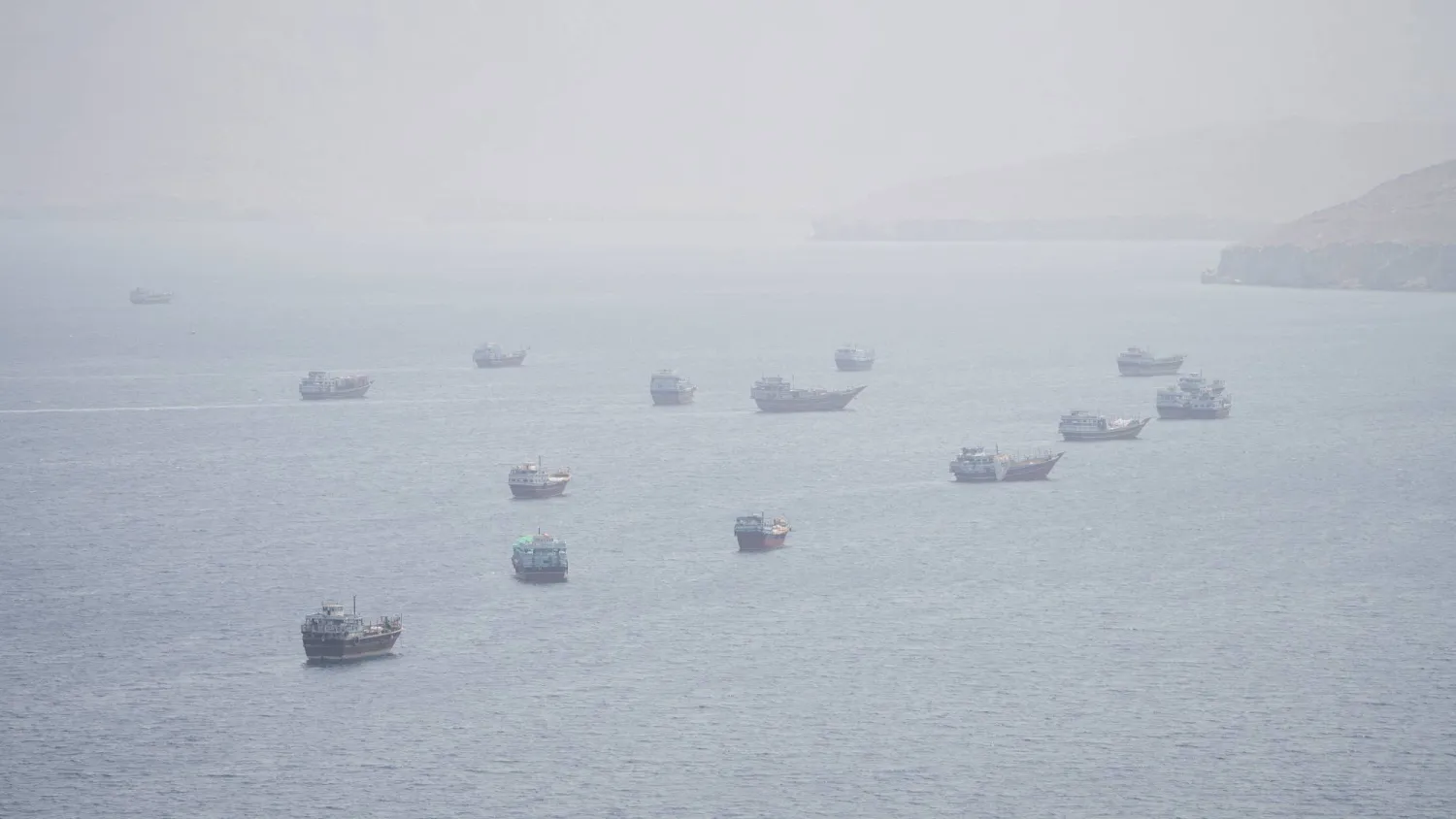
FILE PHOTO: Vessels near the Strait of Hormuz, as seen from Musandam, Oman, September 2, 2026. REUTERS/Stringer/File Photo
TT

Iran Authorities Say One Dead after Ship Struck in Hormuz

FILE PHOTO: Vessels near the Strait of Hormuz, as seen from Musandam, Oman, September 2, 2026. REUTERS/Stringer/File Photo

A ship was struck in the Strait of Hormuz on Sunday, killing one person and injuring three, local Iranian authorities said, as Tehran and Washington clash over the strategic waterway. 

"A merchant vessel was struck around 5:00 am (0130 GMT) this morning off the coasts of Hengam and Qeshm islands. One person was killed and three others were injured," Qeshm city governor Amir Teymouri said, according to state TV, without specifying the origin of the strike. 

Several explosions were reported overnight around Qeshm, the largest island in the Hormuz strait. 

The deadly incident comes a day before a meeting between Iran and Gulf states in Oman, which also borders the strait, over the blockaded route crucial for global oil and gas trade. 

Control over the strait has become a major flashpoint in the conflict between Iran and the United States in their six-month war. 

In retaliation for attacks by the United States and Israel that started the war on February 28, Iran has blocked the waterway, a passage that was previously free and unobstructed before the conflict began. 

Iran now requires vessels to obtain authorization to pass through the strait, citing security and sovereignty concerns, and is considering a mechanism to impose service fees. 

Vessels that fail to comply are frequently targeted by Iranian strikes, while the United States sporadically bombs the Iranian coast in a bid to challenge Tehran's control of the strait.