China Urges US to ‘Stop Preparing for War in Outer Space’

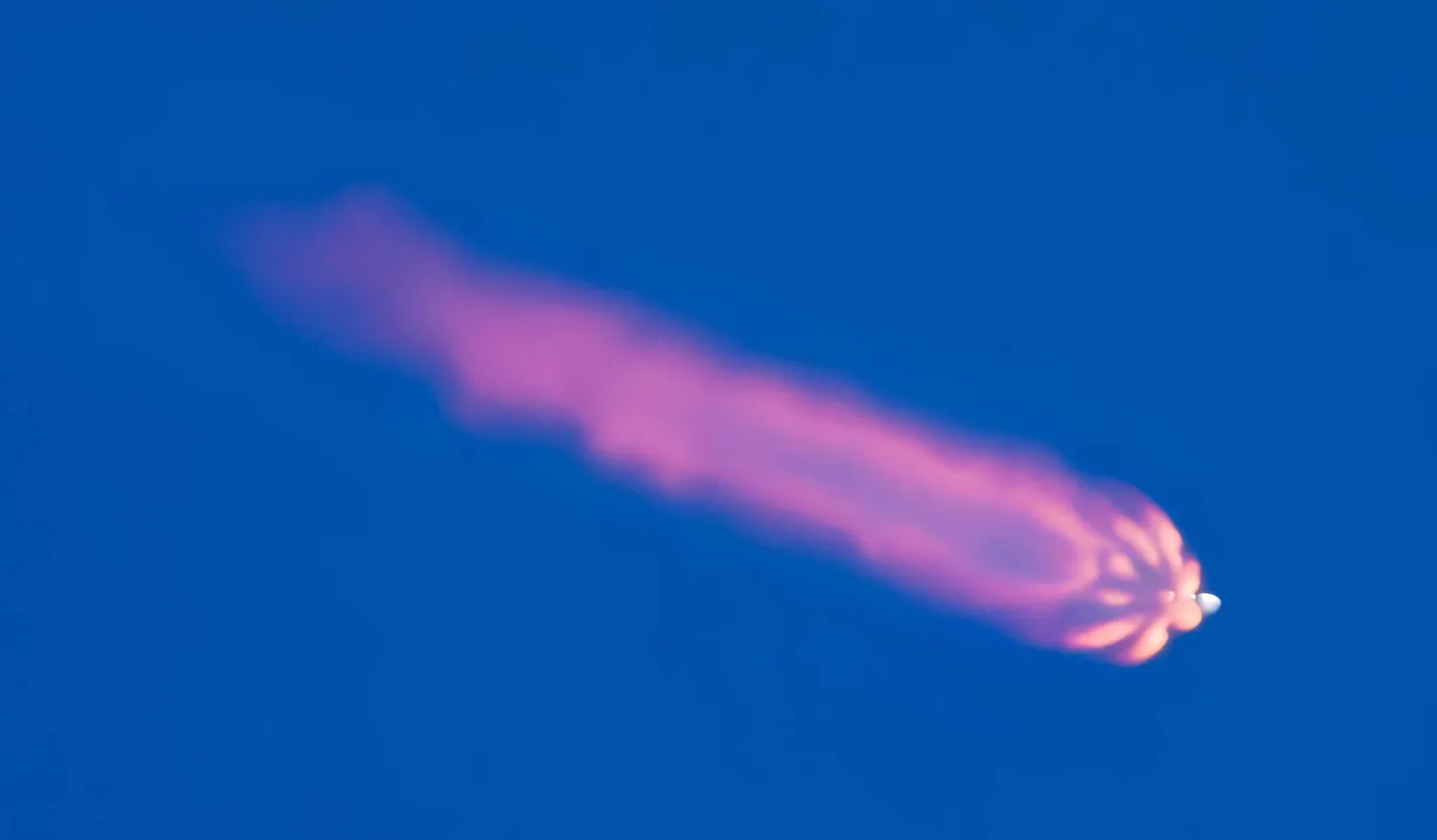
13 September 2026, US, Merritt Island: A SpaceX Falcon 9 rocket launches from Space Launch Complex-40 at Cape Canaveral Space Force Station, carrying a Boeing-built O3b mPOWER satellites owned and operated by a Luxembourg-based satellite telecommunications network provider, SES. (dpa)
TT

China Urges US to ‘Stop Preparing for War in Outer Space’

13 September 2026, US, Merritt Island: A SpaceX Falcon 9 rocket launches from Space Launch Complex-40 at Cape Canaveral Space Force Station, carrying a Boeing-built O3b mPOWER satellites owned and operated by a Luxembourg-based satellite telecommunications network provider, SES. (dpa)

China urged the United States on Tuesday to "stop preparing for war" in space, after the US Space Force confirmed it had deployed weapons into orbit for the first time.

Beijing and Washington are key geopolitical rivals and have long sought to expand their interests -- and strategic footprints -- in space.

The US Space Force said on Monday that it had deployed "on-orbit space control weapons capable of defending... against hostile adversary action", without providing specifics.

China's foreign ministry opposed the move, warning against the "weaponization of outer space, turning it into a battlefield, as well as an arms race there".

"We urge the US side to stop expanding its military capabilities and preparing for war in outer space," ministry spokesman Guo Jiakun told a news briefing.

The US Space Force singled out China as a threat in its announcement, saying Beijing "develops and operates space and counterspace capabilities as part of a military modernization strategy".

It also named Russia, another geopolitical rival, which it said "believes space supremacy will be a decisive factor in future conflicts".

The militarization of space is as old as the space race itself -- as soon as the Soviet Union launched the world's first artificial satellite, Sputnik, into orbit in 1957, Washington and Moscow began exploring ways to both arm and destroy such spacecraft.

The biggest worry was once about nuclear weapons in space, but the superpowers and other countries signed the Outer Space Treaty in 1967, banning weapons of mass destruction in orbit.

Since then, the United States, China, Russia and India have explored ways to fight in space outside of that treaty, including by targeting rivals' satellites, which are key for military communications, surveillance and navigation.


Bangladesh Measles Crisis 'Warning Sign' of Other Outbreaks

A child receives treatment for measles at the Bangladesh Shishu Hospital & Institute in Dhaka on September 3. Salahuddin Ahmed / AFP
TT

Bangladesh Measles Crisis 'Warning Sign' of Other Outbreaks

A child receives treatment for measles at the Bangladesh Shishu Hospital & Institute in Dhaka on September 3. Salahuddin Ahmed / AFP

Experts have warned Bangladesh that deadly outbreaks of diphtheria, whooping cough and polio could follow an ongoing measles epidemic that has already killed over 1,200 children, according to a report seen by AFP on Monday.

"The measles outbreak is a litmus test and a warning sign of a deteriorating immunization system," said the report by an independent committee of national and international experts, which carried out its research earlier in October.

Bangladesh has struggled since March to contain the outbreak, which has killed more than 1,200 children and infected 220,000 people, making it the country's deadliest in decades, according to the Directorate General of Health Services (DGHS).

"If no urgent mitigation measures are taken, it is only a matter of time before there are large outbreaks of pertussis (whooping cough), diphtheria and even vaccine-derived poliovirus," added the report, which has been submitted to the government.

The health ministry pledged action on Monday.

"We are going to recruit vaccinators as quickly as possible as the first step towards implementing the recommendations," spokesman Zahid Raihan told AFP.

The government, supported by the World Health Organization (WHO), UNICEF, the Gavi vaccine alliance and other partners, deployed a 70-member team earlier this month to assess the country's immunization program.

The review found that just 82 percent of children were fully immunized, well below the national target of 95 percent. Around 40 percent of vaccinator posts remain vacant.

Bangladesh was long considered an immunization success story. Since its program began in 1979, the country has eliminated polio and neonatal tetanus and controlled rubella and hepatitis B.

A measles vaccination campaign planned for 2024 was delayed by the revolution that toppled former prime minister Sheikh Hasina, while strikes and political instability further disrupted a campaign in 2025.

Authorities have since launched a mass vaccination drive, but cases continue to climb.

Measles spreads easily through coughs and sneezes and has no specific treatment. Complications include brain swelling and severe breathing problems, with young children particularly vulnerable.

Whooping cough can cause severe illness and death in infants. Diphtheria can obstruct breathing and damage the heart and nerves, while vaccine-derived poliovirus can cause paralysis in under-immunized populations.


Israeli President Says He Won’t Bow to US Pressure on the Next Govt

Israeli President Isaac Herzog addresses a press conference with his Hungarian counterpart Andras Baka (not pictured) at the presidential Sandor Palace in Budapest on October 20, 2026. (AFP)
TT

Israeli President Says He Won’t Bow to US Pressure on the Next Govt

Israeli President Isaac Herzog addresses a press conference with his Hungarian counterpart Andras Baka (not pictured) at the presidential Sandor Palace in Budapest on October 20, 2026. (AFP)

Israel’s President Isaac Herzog said on Monday he won’t bend to pressure from US President Donald Trump on which party he will select first to form a government after Tuesday's national elections.

Herzog’s role is largely ceremonial. No single party is expected to outright win control of the country’s parliament, or Knesset.

The president is expected to tap the leader of the party with the most support to try to build a governing coalition, a process that could drag out for days or weeks, or fail entirely and force Israelis to return to the polls to vote again.

Herzog's remarks came after Trump reiterated his endorsement for Netanyahu, who is in a tight race to remain in power.

Herzog told the MS NOW cable news network that neither Trump nor anyone else “can intervene" and that it was up to him to see “what the facts are.”


Nigeria Evacuates Ebola Patient to Switzerland

An ambulance is stationed outside the Nigeria Centre for Disease Control and Prevention (NCDC) headquarters in Abuja, Nigeria, October 25, 2026. (Reuters)
TT

Nigeria Evacuates Ebola Patient to Switzerland

An ambulance is stationed outside the Nigeria Centre for Disease Control and Prevention (NCDC) headquarters in Abuja, Nigeria, October 25, 2026. (Reuters)

The only confirmed case in Nigeria of Africa's latest deadly Ebola outbreak was evacuated Monday by air from Abuja, the capital, to Switzerland, where she has citizenship.

The patient, the 42-year-old wife of a Swiss embassy staff worker based in Abuja, had been traveling in Uganda with her husband before returning to Nigeria.

Her condition was "much improved, stable, conscious, communicating, and her clinical laboratory test results closing towards baseline", said Nigerian health minister Muhammad Ali Pate in a statement.

"This does not mean she is not still infectious," he added.

Fifty-three of the patient's contacts have been identified by the Nigerian health authorities.

The World Health Organization has warned that Africa is facing a "complex" Ebola outbreak, with the virus now present in the west, east and center of the continent.

The outbreak of the Bundibugyo strain of the virus, for which there is no vaccine or specific treatment, has been ravaging the Democratic Republic of the Congo, which has recorded more than 4,600 deaths since May.

Health authorities in Nigeria, Africa's most populous country, successfully stemmed a previous Ebola outbreak a dozen years ago.

But some experts are worried about how much the illness could have spread in the time between the woman's arrival on October 3 and her diagnosis, announced October 20.