


House Votes for a Third Time to End the Iran War as Conflict Drags on

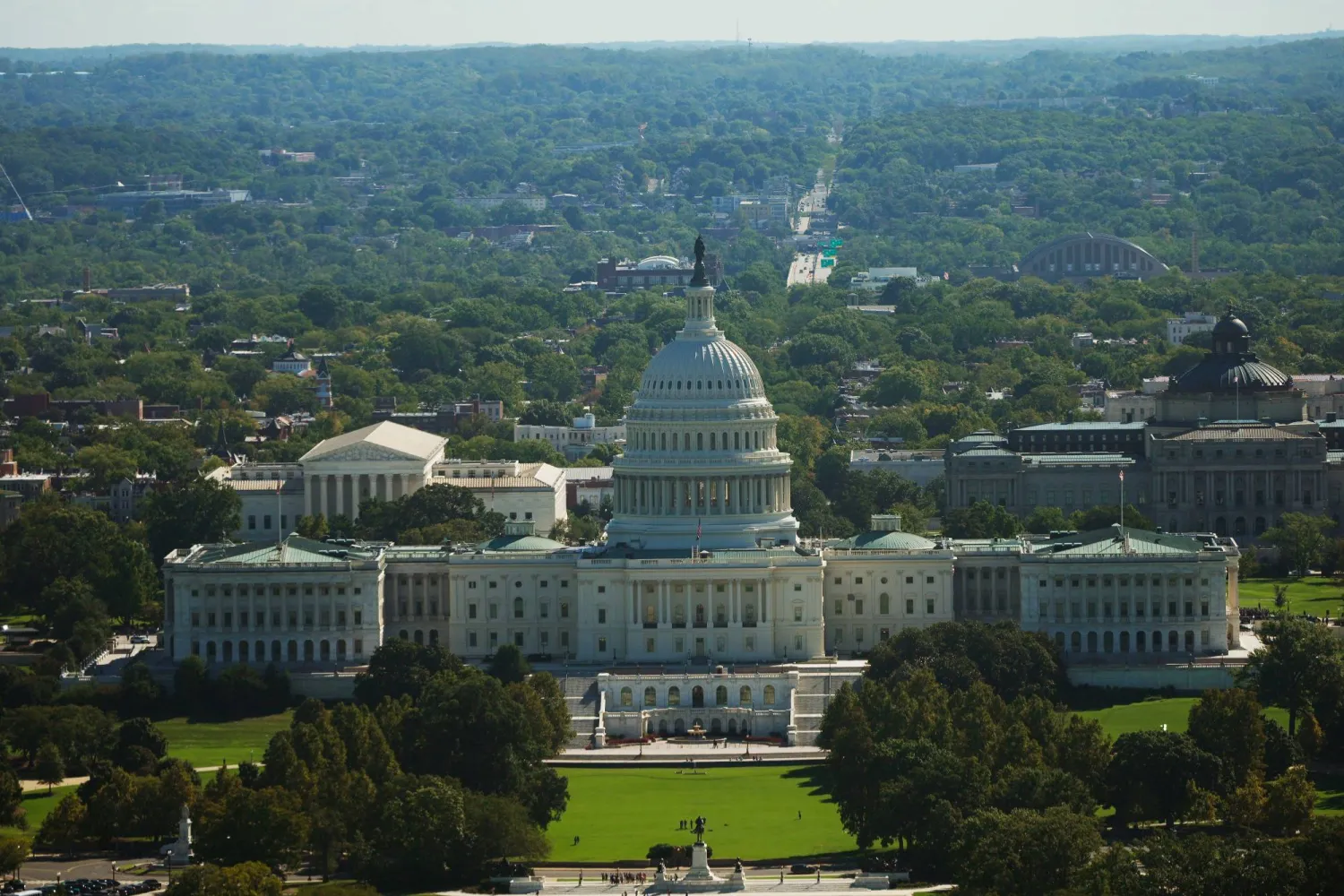
 The US Capitol is seen from the Washington Monument, Tuesday, Sept. 15, 2026, in Washington. (AP)
The US Capitol is seen from the Washington Monument, Tuesday, Sept. 15, 2026, in Washington. (AP)
TT

House Votes for a Third Time to End the Iran War as Conflict Drags on

 The US Capitol is seen from the Washington Monument, Tuesday, Sept. 15, 2026, in Washington. (AP)
The US Capitol is seen from the Washington Monument, Tuesday, Sept. 15, 2026, in Washington. (AP)

For a third time, the US House has voted to end the war in Iran, approving a war powers resolution that would halt President Donald Trump's ability to continue military action without congressional approval.

The roll call late Tuesday, 220-204, was similar to earlier efforts this summer, with a few more Republicans joining all Democrats voting to bring an end to the conflict. None of the resolutions have made it to the president's desk, where Trump would almost certainly veto the measure.

“Remember when Donald Trump said that this war would last just a few weeks?” said Rep. Seth Moulton, D-Mass., who served as a Marine during the Iraq War and pushed the resolution forward.

He said it's time for Congress to “actually ask tough questions, as the Constitution directs us to do, rather than be subservient to another warmongering administration.”

Republican Rep. Brian Mast of Florida, the chairman of the House Foreign Affairs Committee, questioned which military resources Democrats would want to remove from the region where he said Iran remains a threat.

Mast said Trump is against “forever wars, and that is what he is ending” — the decades of hostilities from Iran.

“They are a continuous ongoing threat to the United States," Mast said. “Enough is enough.”

Last war powers vote before the midterms

The action is likely the last House vote on the Iran war ahead of the midterm elections, where the conflict overseas is playing a substantial role in the political campaigns. The war that Trump launched Feb. 28 has dragged, with on-again, off-again deadly missile strikes being exchanged and causing havoc in the region for nearly seven months.

Lawmakers are heading home at the end of the week to campaign nearly full-time, with less than 50 days to go before the elections that will determine control of Congress as Democrats try to wrest power from Republicans.

Voters are confronting high prices, particularly for gas at the pumps, as the conflict disrupts the flow of oil resources through the vital Strait of Hormuz.

The Congressional Budget Office said Tuesday that the war has cost more than $38 billion, as of Aug. 1, and is projected to be costing between $2 billion and $3 billion monthly, depending on the intensity of the fighting. The budget office projected inflation will be 0.5 percentage points higher than expected heading into 2027 due to the war.

Trump himself had promised not to involve the US in foreign wars when he won a second term in the White House, and his actions against Iran are weighing on the Republican Party that controls the House and Senate. Most Americans say the war in Iran has not been worth fighting, according to an AP-NORC poll in July.

In the previous House actions, four Republicans voted to halt the war in Iran, but that number rose to seven in Tuesday’s war powers vote, including GOP lawmakers from battleground Iowa, Rep. Zachary Nunn and Rep. Mariannette Miller-Meeks, and retiring Rep. Nancy Mace of South Carolina.

They joined GOP Reps. Tom Barrett of Michigan, Warren Davidson of Ohio, Brian Fitzpatrick of Pennsylvania and Rep. Thomas Massie of Kentucky voting in favor of the war powers resolution, with all Democrats.

War powers being put to the test

Congress has tried repeatedly to alter the trajectory of the war against Iran, but efforts to limit the Trump administration's military action remain a longshot so long as the president is able to fend off or veto the measures.

The House first approved a war powers resolution in June, and followed up with another one in July, all seeking to halt US action in Iran. The Senate on its 10th try also approved a war powers resolution to end the conflict, but GOP senators quickly reversed course the next day after Trump berated them during a closed-door lunch.

While the Constitution gives Congress the authority to declare war, it also gives the president authority as the commander in chief to engage in some military actions. The War Powers Act, created in the aftermath of the Vietnam conflict, sought to put a more specific time limit on the president's power, requiring congressional approval for sustained military actions after 60 or 90 days.

House Speaker Mike Johnson acknowledged at a press conference Tuesday the need to bring gas prices down.

But the Republican speaker said he believes the Iran conflict is entering a “new phase” as allies step up to help stabilize the region. When that happens, he said, “you’re going to see, as the president said, anytime gas prices will go down again, the cost of groceries will as well.”

Johnson said Trump expects the shift after the election, and the speaker added, “I'd love it to happen today.”

Amnesty Says Iran Committed ‘Crimes Against Humanity’ in Crackdown on 2022 Protests

Iranian women walk in a street on the fourth anniversary of protests following Mahsa Amini's death in downtown Tehran, Iran, 16 September 2026. (EPA)
TT

Amnesty Says Iran Committed ‘Crimes Against Humanity’ in Crackdown on 2022 Protests

Iranian women walk in a street on the fourth anniversary of protests following Mahsa Amini's death in downtown Tehran, Iran, 16 September 2026. (EPA)

Iranian authorities committed crimes against humanity in the crackdown on 2022 protests that left hundreds dead, Amnesty International said Wednesday, adding Tehran's suppression of new demonstrations this year bore the "same hallmarks" but on an even wider scale.

The crackdown in 2022 amounted to "crimes against humanity" including murder, torture, rape and enforced disappearance, Amnesty said in a report marking four years since those protests, warning that the authorities' actions earlier this year were "on an even deadlier and more staggering scale".

The London-based rights group named 87 national and regional officials, six of whom were subsequently killed in US-Israeli air strikes, who it believed were responsible in the chain of command and should face international justice.

Several months of protests against the country's theocratic authorities known as the "Woman. Life. Freedom." movement erupted in September 2022 following the custody death of Iranian Kurdish woman Mahsa Amini who had been arrested for allegedly violating the strict dress rules for women.

These were the biggest protests in Iran in recent years until demonstrations earlier this year sparked by anger over the cost of living that peaked on the nights of January 8 and 9.

On both occasions authorities responded with a deadly crackdown that caused international outrage. Amnesty's 1,000 page report focused on the 2022 protests while making clear that the crackdown in 2026 followed the same pattern while being even more severe.

"The extensive evidence gathered and analyzed in our report leaves no doubt: Iranian authorities committed crimes against humanity to crush the 2022 Woman Life Freedom uprising," said Agnes Callamard, Amnesty International's Secretary General.

Amnesty urged the UN General Assembly to "create an international criminal justice mechanism aimed at prosecuting those most implicated".

- 'Unlawfully killed' -

The 87 officials it named included former supreme leader Ali Khamenei and top figures in the Revolutionary Guards who were killed in the US-Israeli war this year.

But some others, including Ahmad Vahidi, who was then the interior minister and now chief of the Revolutionary Guards, are still alive.

"The security forces deployed by the authorities unlawfully killed hundreds of protesters and bystanders, including dozens of children" in the crackdown from September to December 2022, Amnesty said.

"They subjected thousands more to arbitrary arrests, incommunicado detention, enforced disappearance and torture or other ill-treatment. They raped and committed other sexual violence against some of those arrested in connection with the protests," it added.

Amnesty said it had identified 377 protesters and bystanders, including 56 children, who lost their lives during the 2022 protests, of whom at least 326 were killed by security forces, including with metal pellets fired at close range.

- 'Unprecedented massacres' -

One of those killed identified by Amnesty in the report was 62-year-old Minoo Majidi who was hit by metal pellets while protesting in the western city of Kermanshah in September 2022.

"She was killed on the street. She had gone to the street for change, to shout 'freedom'," her daughter Mahsa Piraei, who lives outside Iran, told AFP.

"The world thinks the protests were about freedom for women. They were, but they were also about freedom for people and the right to life," she added.

Amnesty described the crackdown this year as the "unprecedented massacres of thousands of protesters and bystanders" which "bear the same hallmarks as the crimes against humanity documented in this report, yet on an even deadlier and more staggering scale".

"Seeking justice is partly for my mum but to help the still many lives who are in danger," Piraei added, referring to the dozens of people arrested during the January protests who rights groups say are at risk of execution.

They include Ali Zarei, who was blinded in one eye during 2022 protests and then took refuge in Germany, but returned to Iran this year and was arrested and sentenced to death.

"We need to shout out their names," Piraei added.


Russian Drones Hit Ukrainian Bus and Train, Killing Five, Officials Say

 A woman crosses a road as smoke rises in the background from the site of a Russian drone strike, amid Russia’s attack on Ukraine, in Kyiv, Ukraine, September 16, 2026. (Reuters)
A woman crosses a road as smoke rises in the background from the site of a Russian drone strike, amid Russia’s attack on Ukraine, in Kyiv, Ukraine, September 16, 2026. (Reuters)
TT

Russian Drones Hit Ukrainian Bus and Train, Killing Five, Officials Say

 A woman crosses a road as smoke rises in the background from the site of a Russian drone strike, amid Russia’s attack on Ukraine, in Kyiv, Ukraine, September 16, 2026. (Reuters)
A woman crosses a road as smoke rises in the background from the site of a Russian drone strike, amid Russia’s attack on Ukraine, in Kyiv, Ukraine, September 16, 2026. (Reuters)

Russian drones struck a passenger bus and a train in southern Ukraine on Wednesday, killing five people, Ukrainian officials said, as Moscow pressed on with strikes on transport links and infrastructure.

A photo posted on Telegram by a regional governor showed a white vehicle with blown-out windows and a line of what appeared to be blood streaming down its side. Reuters has not verified the image.

"There is no military logic to this, just another act of brutality," Ukraine's President Volodymyr Zelenskiy said on social media, urging the US and ‌Europe to press ‌ahead with toughening sanctions against Russia.

ESCALATING STRIKES ON ECONOMIC TARGETS

Moscow ‌and ⁠Ukraine have traded ⁠escalating strikes in recent months on logistics and other economic targets, aimed at hampering each other's war effort and damaging morale.

With Ukraine's airspace closed since Russia's full-scale invasion in 2022, buses and trains have become a vital transport link for ordinary Ukrainians and businesses.

The drone attack on the passenger bus near the frontline city of Nikopol killed four men and a woman early on Wednesday, police said.

A further seven people were ⁠injured in the attack, said the governor of the surrounding Dnipropetrovsk ‌region, Oleksandr Hanzha, who posted the photo.

There was ‌no immediate comment from Russia on the attack. Both Ukraine and Russia deny deliberately targeting ‌civilians in the war, triggered by Moscow's full-scale invasion of its neighbor.

ATTACK ON PASSENGER ‌TRAIN

A Russian drone also attacked a passenger train in Ukraine's southern Mykolaiv region, the acting regional governor said.

All 168 passengers and crew were evacuated and no one was injured, Heorhii Reshetilov said on Telegram. The train was attacked twice more after the first strike, he ‌said.

Zelenskiy said that, in addition to the Mykolaiv train attack, a locomotive in Kovel — near the border with Poland — was also ⁠struck.

The incidents follow ⁠similar attacks recently, including on a train near Ukraine's border with NATO-member Poland on Sunday, shortly after European diplomats and political figures had used the same line.

Russia has intensified its attacks on Ukrainian railways, hitting 120 passenger wagons, 304 locomotives and 43 railway stations so far this year, the state rail operator told Reuters.

The company said that Russia has attacked 1,700 railway facilities in total since the start of the year, up from 1,206 facilities in 2025 and 842 in 2024.

"Russian forces strike passenger trains, locomotives, stations, and railway routes knowing exactly how essential they are for civilians, evacuations, and Ukraine's economy," Ukraine's Foreign Minister Andrii Sybiha said on X.

"This is not collateral damage. It is a systematic hunt for people and an attempt to paralyze civilian life," he said.


India Summons Pakistan’s Top Diplomat After a Naval Collision in International Waters

Indian Border Security Force personnel and Pakistani Rangers take part in a ceremony on the occasion of Pakistan's Independence Day and eve of India's Independence Day at the India-Pakistan Wagah border post on August 14, 2024. (AFP via Getty Images)
TT

India Summons Pakistan’s Top Diplomat After a Naval Collision in International Waters

Indian Border Security Force personnel and Pakistani Rangers take part in a ceremony on the occasion of Pakistan's Independence Day and eve of India's Independence Day at the India-Pakistan Wagah border post on August 14, 2024. (AFP via Getty Images)

India summoned Pakistan’s top diplomat on Wednesday over a collision involving Pakistani naval units and an Indian naval vessel in international waters, India’s foreign ministry said.

The collision occurred Tuesday in the northern Arabian Sea. No major damage was reported, the ministry said.

India described the incident as “unacceptable and unprofessional” and asked Pakistan to ensure its military units exercise caution and follow bilateral agreements to prevent similar incidents. India also asked its top diplomat in Islamabad to raise the issue with Pakistan’s Foreign Ministry.

There was no immediate comment from Pakistan’s government.

India and Pakistan have fought three wars since gaining independence from British rule in 1947, two over disputed Kashmir. Each country administers part of the region, but both claim it in full.

Tensions escalated sharply last year after suspected militants killed 26 people, mostly Hindu tourists, in Indian-controlled Kashmir. India blamed Pakistan, which denied involvement.

The attack was followed by tit-for-tat military strikes that brought the nuclear-armed rivals close to a wider war over the disputed region.
