


Riyadh Opens the Way for Driverless Parcel Delivery

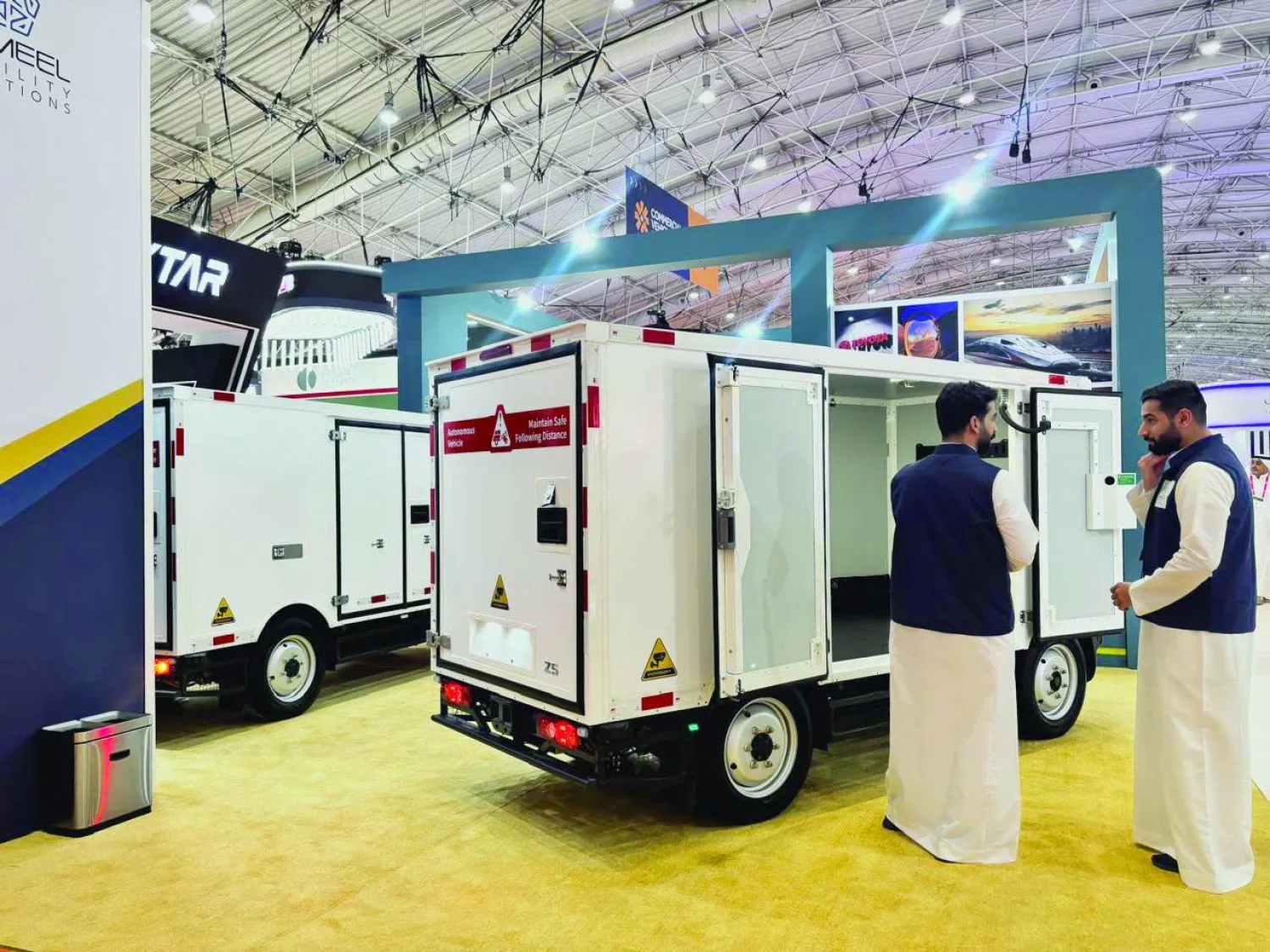
One of the autonomous trucks (Asharq Al-Awsat)
TT

Riyadh Opens the Way for Driverless Parcel Delivery

One of the autonomous trucks (Asharq Al-Awsat)

As the mobility landscape within Saudi cities continues to evolve, Riyadh is preparing to embark on a new experience in which no driver sits behind the wheel and the success of a journey does not depend on a driver's ability to navigate the road. By mid-November, 24 autonomous trucks are expected to begin trial operations on the capital's roads, opening the door for the technology to move from passenger transport into parcel and freight delivery.

The move follows the General Transport Authority's sponsorship in May of a memorandum of understanding between Abdul Latif Jameel Motors and China's Zeelos Technology, a company specializing in autonomous driving technologies, with the aim of adopting and enabling autonomous mobility solutions in the Kingdom.

The trucks expected to operate in Riyadh represent one of the practical applications of this cooperation. The first phase will focus on testing the ability of autonomous vehicles to transport parcels within the capital, paving the way for an assessment of their performance and efficiency before moving to broader stages of operation.

Ammar Baterdok, General Manager of Mobility Solutions Projects at Abdul Latif Jameel Motors, told Asharq Al-Awsat that the pilot operation will begin after the completion of geospatial mapping and the training of autonomous driving systems on local roads.

He explained that the fleet allocated to the first phase comprises 24 trucks of different sizes and models. Four have already arrived in the Kingdom, while another 20 are currently in transit, amid logistical challenges affecting shipments from China due to developments in the region.

The trucks have payload capacities of 0.5 tons, 1.5 tons, and 2.5 tons. The fleet includes refrigerated and non-refrigerated models, with the remaining batches expected to arrive successively during October and November.

Free Trials with SPL

Abdul Latif Jameel Motors is carrying out the pilot phase in cooperation with Saudi Post | SPL to transport parcels from the main center to neighborhood centers in Riyadh. The service will be provided free of charge throughout the trial period.

Baterdok said the company is prepared to extend the pilot period for several months if necessary in order to collect sufficient operational and investment data to assess the fleet's performance and economic viability before making a decision on commercial expansion.

The phase will allow the company to test the vehicles under actual driving conditions within the capital, including their ability to navigate local roads and traffic, while also measuring their performance during different operating hours.

Millions Invested to Test Viability

The cost of the pilot phase amounts to millions of riyals, according to Baterdok, covering the purchase of vehicles, customs clearance, fees, and taxes. He explained that the investment is not intended to generate a direct financial return, but rather to test the technology's economic and technical viability and collect the data needed before decisions are made regarding commercial expansion and the size of the future fleet.
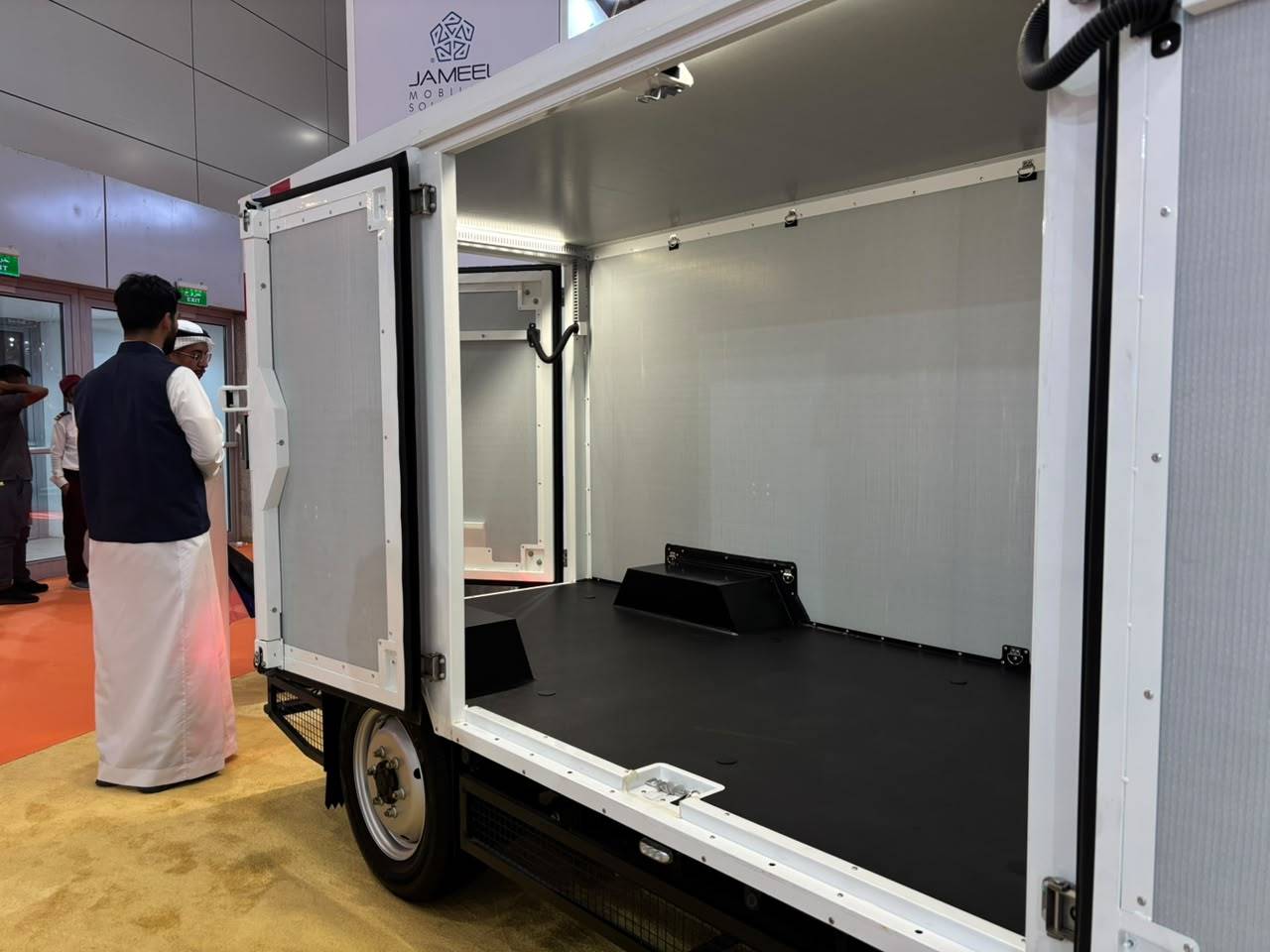
Illustrative photo of the inside of the truck (Asharq Al-Awsat)

Operating Savings Could Exceed Truck Costs

The company is banking on autonomous trucks being able to reduce operating costs compared with conventional vehicles. Baterdok explained that the price of an autonomous truck is approximately half that of a conventional fuel-powered truck, whether gasoline or diesel.

The cost gap becomes wider during operation due to lower labor and maintenance expenses, in addition to the possibility of operating the trucks around the clock, except for the periods required for recharging.

In an analysis, logistics expert Hassan Al Halil told Asharq Al-Awsat that the most significant economic impact would come from reducing operating costs and improving supply-chain efficiency. He noted that autonomous trucks could increase fleet utilization, improve route planning, and allow for longer operating periods, particularly on repetitive and defined routes.

Al Halil added that it is too early to establish a fixed percentage for reductions in logistics costs in Saudi Arabia, given that savings vary depending on the type of shipment, distance, and operating model. He said that "the greatest opportunities for savings lie in operating labor costs, increasing truck utilization, reducing waiting times, improving fuel consumption, and maintenance," adding that "the economic value will come from increasing fleet productivity and completing more trips efficiently."

Baterdok, meanwhile, said the absence of a driver allows supply and delivery operations to be shifted to nighttime hours, increasing the efficiency of fleet utilization in major cities such as Riyadh by taking advantage of periods when road traffic is less dense.

According to company estimates, electricity costs account for only about 20 percent of the cost of conventional fuel, while maintenance expenses decline due to the absence of conventional engines and transmissions. Routine servicing therefore focuses to a greater extent on components such as brakes and tires.

The trucks rely on sensors and radar systems for autonomous driving, enabling them to operate in nighttime driving conditions without relying on human vision.

Road Readiness Determines the Path to Expansion

Despite these advantages, Al Halil believes that large-scale operation of autonomous trucks in Riyadh requires more than well-maintained roads. It requires highly accurate maps that are continuously updated, reliable communications systems, smart infrastructure, and coordination among the relevant authorities.

He pointed out that the main challenges within cities include congestion, sudden changes in routes, roadworks, unexpected behavior by some vehicles, dusty conditions, and the handling of loading and unloading points. He said that "the most realistic starting point will be defined, repetitive roads and logistics routes before moving to more complex urban operations."

From Passenger Transport to Parcel Delivery

The truck trial comes as Saudi Arabia expands its testing of autonomous mobility applications, as the technology moves from passenger transport into freight and delivery.

Last year, Saudi Arabia launched autonomous passenger vehicles and is currently operating more than five routes, including the Roshn area, Princess Nourah bint Abdulrahman University, and the route connecting Riyadh Gallery and Hayat Mall.

The service has transported more than 3,100 passengers across 1,600 trips under the supervision of the General Transport Authority, as part of efforts to test autonomous driving technologies in the Saudi urban environment.

The expansion of these applications into the freight sector opens a new field for testing the impact of autonomous driving on the efficiency of delivery operations within cities, at a time when e-commerce is expanding and supply chains are seeing growing demand for more efficient and flexible solutions.

From Roads to the Sky

Abdul Latif Jameel Motors' plans do not stop at ground transportation. The company has begun studying the market for drone-based goods delivery in preparation for entering the field once the necessary regulatory frameworks are in place.

Baterdok expects the process of developing regulations governing goods delivery by drones to take between one and a half and three years. He noted that the company is in discussions with global suppliers of trucks and drones designed to transport goods and individuals.

In evaluating these solutions, the company is focusing on technical readiness, range, speed, the ability of vehicles and aircraft to operate under different weather conditions, and resistance to wind, with the aim of achieving operational readiness as soon as official licenses are issued.

Accordingly, Abdul Latif Jameel Motors' plan is not limited to testing autonomous trucks in Riyadh. It extends to developing a broader system of autonomous mobility solutions, beginning with ground transportation and eventually reaching air-based goods delivery, while testing the technical and economic viability of each solution before moving from trials to commercial expansion.

Saudi Minister of Energy Signs Energy Cooperation MoUs with Kuwait, Qatar and Egypt

Saudi Minister of Energy and Minister of Industry and Mineral Resources Prince Abdulaziz bin Salman bin Abdulaziz and Kuwait’s Minister of Electricity, Water and Renewable Energy Dr. Subaih Abdulaziz Abdulmohsen Al-Mukhizim. (SPA)
TT

Saudi Minister of Energy Signs Energy Cooperation MoUs with Kuwait, Qatar and Egypt

Saudi Minister of Energy and Minister of Industry and Mineral Resources Prince Abdulaziz bin Salman bin Abdulaziz and Kuwait’s Minister of Electricity, Water and Renewable Energy Dr. Subaih Abdulaziz Abdulmohsen Al-Mukhizim. (SPA)

Saudi Minister of Energy and Minister of Industry and Mineral Resources Prince Abdulaziz bin Salman bin Abdulaziz signed on Sunday three memoranda of understanding with ministers from Kuwait, Qatar and Egypt, expanding cooperation across a broad range of energy fields.

Prince Abdulaziz signed an MoU on electricity and renewable energy cooperation with Kuwait’s Minister of Electricity, Water and Renewable Energy Dr. Subaih Abdulaziz Abdulmohsen Al-Mukhizim.

The MoU establishes a framework for cooperation between Saudi Arabia and Kuwait in electricity, renewable energy, power grid interconnection and electricity exports, as well as energy efficiency, energy storage and smart grids. It also covers related areas including digital transformation, innovation, cybersecurity and artificial intelligence.

The two countries will also work to develop strategic partnerships between their institutions, localize energy-related materials, products and services, and strengthen cooperation between companies operating in these fields.

The MoU further provides for cooperation on technologies and solutions related to climate change mitigation, including Circular Carbon Economy technologies and solutions.

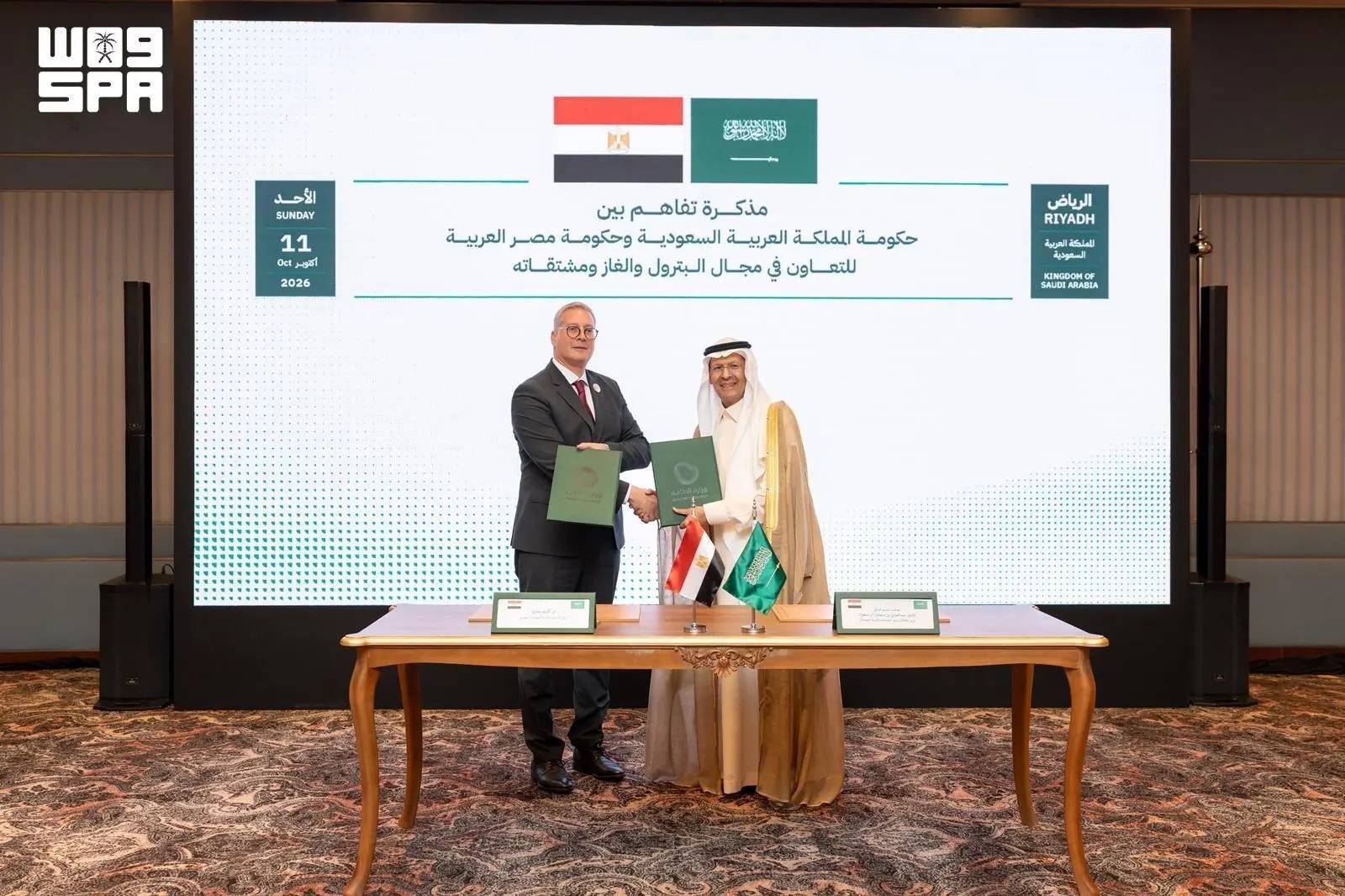
Saudi Minister of Energy and Minister of Industry and Mineral Resources Prince Abdulaziz bin Salman bin Abdulaziz and Egypt’s Minister of Petroleum and Mineral Resources Eng. Karim Badawi. (SPA)

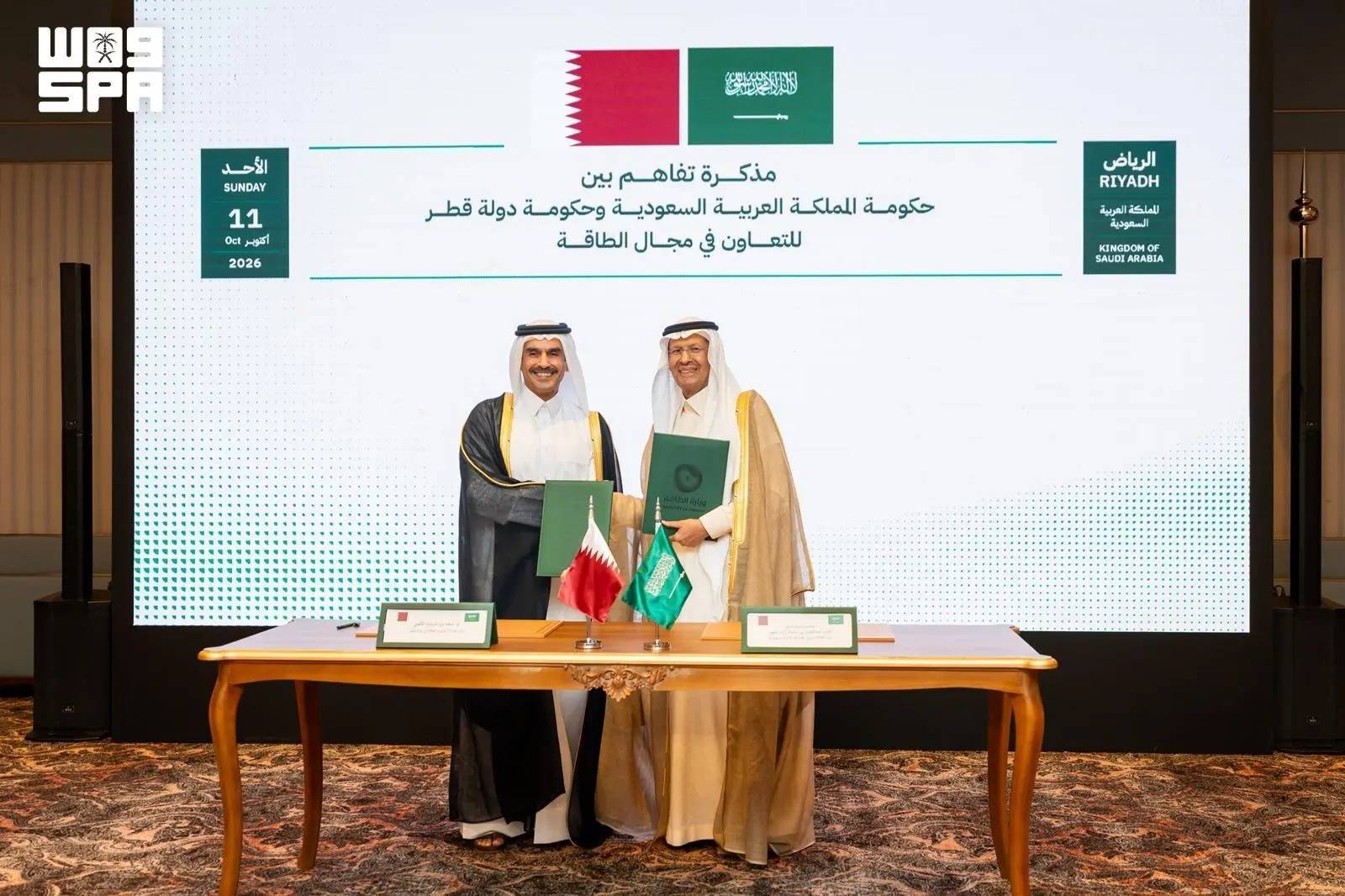
Prince Abdulaziz signed an MoU on energy cooperation with Qatar’s Minister of State for Energy Affairs Eng. Saad bin Sherida Al-Kaabi.

The MoU establishes a framework for cooperation between Saudi Arabia and Qatar across oil and petroleum products, gas and its derivatives, refining, petrochemicals, electricity, clean hydrogen and its derivatives, renewable energy, energy efficiency and energy storage.

It provides for the two countries to explore opportunities for joint projects involving pipelines for the transportation and export of oil and gas; the development and use of sustainable petrochemical materials in construction and other sectors; and cooperation on infrastructure to support access to energy.

The MoU covers cooperation in international negotiations, forums and organizations addressing energy transitions and climate change, including the United Nations Framework Convention on Climate Change, the Paris Agreement and the Intergovernmental Negotiating Committee tasked with developing an international legally binding instrument on plastic pollution, among others.

Prince Abdulaziz also signed an MoU with Egypt’s Minister of Petroleum and Mineral Resources Eng. Karim Badawi on cooperation in oil, gas and their derivatives.

Saudi Minister of Energy and Minister of Industry and Mineral Resources Prince Abdulaziz bin Salman bin Abdulaziz and Qatar’s Minister of State for Energy Affairs Eng. Saad bin Sherida Al-Kaabi. (SPA)

The MoU establishes a framework for Saudi-Egyptian cooperation in crude oil, petroleum products and natural gas, including their trade, handling, transportation, storage and distribution, as well as the development of related infrastructure and logistics.

The cooperation will strengthen energy market integration and supply chain resilience and reliability, enhance energy security, and help meet demand across domestic, regional and international markets. Activities will be carried out in accordance with the laws and regulations of both countries and on commercial terms that advance their mutual interests.

The agreement also covers the exchange of Saudi expertise in fuel station and service center qualification, operation and maintenance, as well as the Kingdom’s experience in opening the liquefied petroleum gas sector to competition. It expands cooperation in petrochemicals and investment in ongoing and planned projects.


Abdulaziz bin Salman: Riyadh is the Capital of Energy Security

Saudi Energy Minister Prince Abdulaziz bin Salman speaks at the opening of the ministerial meeting of the International Energy Forum (IEF) in Riyadh (Turki Al-Agili)
TT

Abdulaziz bin Salman: Riyadh is the Capital of Energy Security

Saudi Energy Minister Prince Abdulaziz bin Salman speaks at the opening of the ministerial meeting of the International Energy Forum (IEF) in Riyadh (Turki Al-Agili)

Saudi Energy Minister Prince Abdulaziz bin Salman stressed on Sunday that Riyadh represents the capital of energy security, noting that this status reflects the Kingdom's efforts, as well as those of the men and women working in the energy sector, to ensure reliable energy supplies and fulfill Saudi Arabia’s commitments to the world.

Achieving energy security requires cooperation among all countries, he said.

Speaking at the opening of the ministerial meeting of the International Energy Forum (IEF) in Riyadh, at the start of Riyadh Energy Week, the minister expressed hope that the gathering would help direct attention toward the most important issues that energy stakeholders should focus on.

He noted that the current period makes dialogue on energy security more important than ever and that in-person meetings enable participants to exchange assessments directly, discuss concerns, and build the understanding necessary for practical cooperation among nations.

He emphasized that Saudi Arabia will continue implementing its plans, meeting its domestic needs, and honoring its commitments to the world regardless of circumstances, stressing the Kingdom’s resilience and ability to continue advancing toward its objectives.

Prince Abdulaziz said that Saudi Arabia’s commitment to energy security is one of its defining characteristics and expressed hope that the event would help more participants understand the depth of that commitment.

“I am proud to say that this country, and the city of Riyadh, is the capital of energy security,” he said, attributing this standing to the efforts of the women and men working in the energy sector and to the work they undertake to ensure the continuity of supplies and the fulfillment of the Kingdom’s obligations.

He pointed to the significant amount of work Saudi Arabia has accomplished over the past eight months, stressing that the Kingdom continues to reassure its partners that it will meet its commitments to the world and will not fail to do so.

Abdulaziz bin Salman also noted that Saudi Arabia has demonstrated its ability to support the reliability of energy supplies under challenging circumstances through investment, preparedness, and decisive action.

He cited the East-West Pipeline as a clear example, explaining that it connects production centers in the Eastern Province with export facilities in Yanbu on the Red Sea, providing an alternative route for oil to reach international markets.

He further spoke about ongoing work on additional pipeline routes, expressing hope that the Kingdom’s commitments in this area would become clearer soon, ensuring the continuation of its efforts and strengthening its role in global energy markets.


International Energy Forum: Security of Supply Requires Ensuring Energy Access for Consumers

International Energy Forum (IEF) Secretary General Jassim Alshirawi speaks with Asharq Al-Awsat on the sidelines of the 17th Ministerial Meeting of the International Energy Forum (IEF) in Riyadh. Asharq Al-Awsat
TT

International Energy Forum: Security of Supply Requires Ensuring Energy Access for Consumers

International Energy Forum (IEF) Secretary General Jassim Alshirawi speaks with Asharq Al-Awsat on the sidelines of the 17th Ministerial Meeting of the International Energy Forum (IEF) in Riyadh. Asharq Al-Awsat

International Energy Forum (IEF) Secretary General Jassim Alshirawi stressed on Sunday that supply security remains a top priority amid growing global energy demand, driven by population growth, industrial expansion, and the increasing needs of data centers and artificial intelligence applications.

He emphasized that the challenge goes beyond producing energy and includes ensuring that it is delivered reliably to consumers.

In remarks to Asharq Al-Awsat on the sidelines of the 17th Ministerial Meeting of the International Energy Forum in Riyadh, Alshirawi praised Saudi Arabia for hosting Riyadh Energy Week, which opened with the forum's ministerial meeting.

He noted that these gatherings provide an opportunity to strengthen dialogue between energy-producing and energy-consuming nations and to explore ways of safeguarding energy security amid the ongoing transformations in the energy sector.

He explained that the forum comprises around 70 countries representing the majority of the world's energy producers and consumers. It also includes an industry advisory board that enables companies to participate in the dialogue between governments, helping to bridge perspectives among stakeholders and address challenges related to energy availability.

Alshirawi added that population growth, industrial needs, and the new demand generated by the expanding use of artificial intelligence are increasing the importance of ensuring adequate energy supplies and the infrastructure needed to transport them to consumers.

He stressed that energy security is not only about a country's ability to produce energy, but also about ensuring that supplies reach their destinations in order to meet the needs of economies and industries.
