Syria Parliament Votes to Abolish Assad-Era Terrorism Court, Nullify Rulings

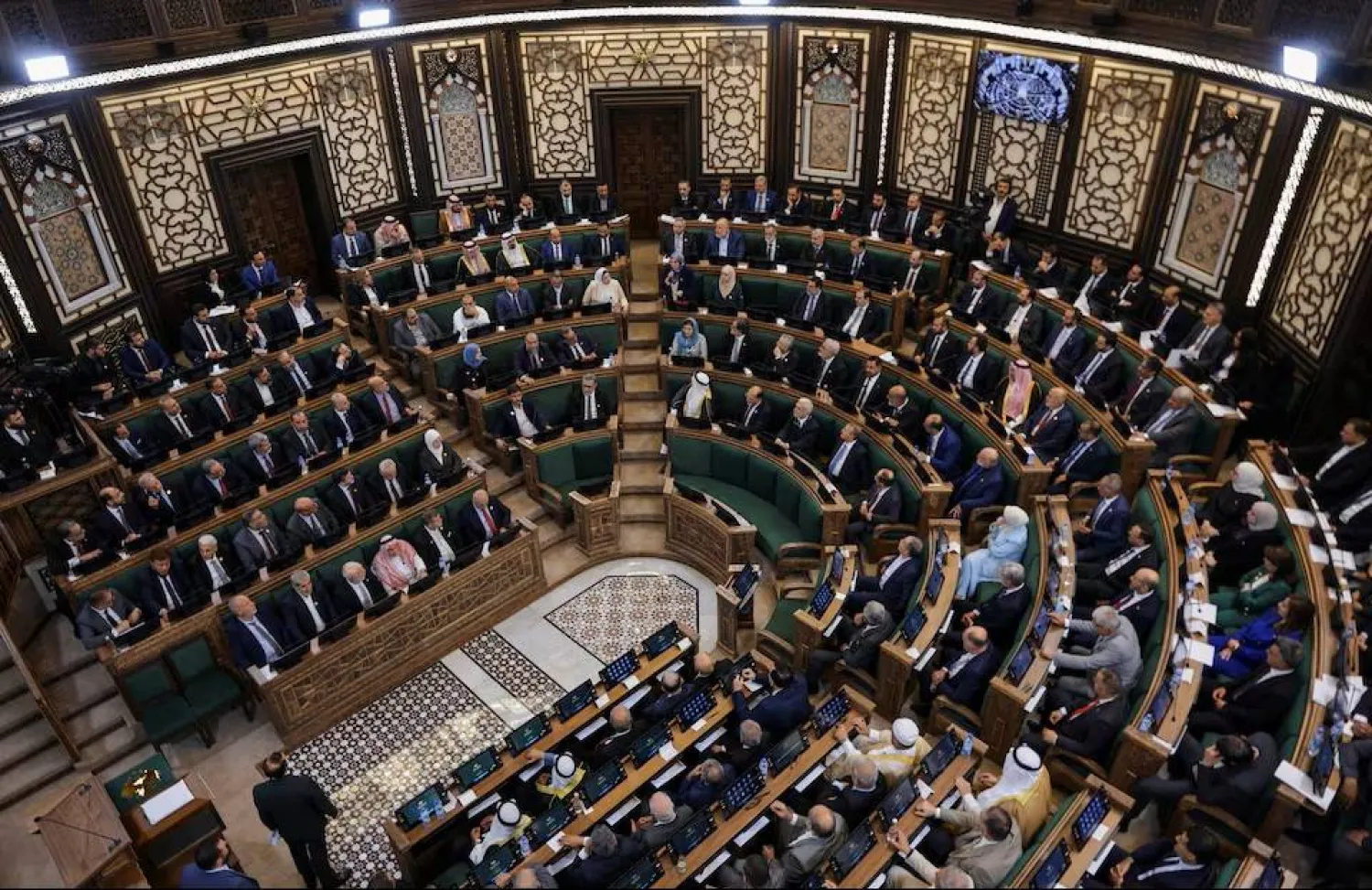
Members of Syria's newly formed People's Assembly attend the body's inaugural session, the first parliament session since the end of the rule of ousted Syrian President Bashar al-Assad, in Damascus, Syria, July 12, 2026. (Reuters)
TT

Syria Parliament Votes to Abolish Assad-Era Terrorism Court, Nullify Rulings

Members of Syria's newly formed People's Assembly attend the body's inaugural session, the first parliament session since the end of the rule of ousted Syrian President Bashar al-Assad, in Damascus, Syria, July 12, 2026. (Reuters)

Syria's parliament voted on Wednesday ‌to abolish an Assad-era terrorism court and nullify the legal effects of its rulings, state-run Al-Ikhbariya TV reported, in one of the first significant legislative moves by the country's new assembly.

The Counter-Terrorism Court was established in 2012 as then-President Bashar al-Assad sought to suppress an uprising against his rule, and it was used to prosecute thousands of Syrians for terrorism-related offences.

The move formalizes the court's abolition after Syria's new authorities had already treated it as defunct. ‌In June 2025, President ‌Ahmad al-Sharaa issued a decree dismissing ‌67 ⁠judges who had served ⁠in what he described at the time as the "abolished Counter-Terrorism Court".

Syria's March 2025 constitutional declaration had also called for abolishing the effects of what it described as unjust rulings issued by the court, including returning confiscated property.

The United Nations Human Rights Committee said in 2024 that the ⁠2012 law establishing the court failed to ‌adequately provide key judicial guarantees ‌and raised concerns over arbitrary detention, torture or ill-treatment, and the ‌court's independence. It also noted that the court was ‌permitted to depart from ordinary procedures during prosecution and trial.

The UN's International, Impartial and Independent Mechanism said in a 2024 report that the Counter-Terrorism Court formed part of the judicial system through ‌which detainees held by Assad-era security agencies could be prosecuted. The report documented widespread and ⁠systematic torture ⁠and ill-treatment across the government's detention system.

Wednesday's vote came during the opening weeks of the first parliament formed since Assad was toppled in December 2024. The chamber convened for the first time in July.

The vote is among the assembly's first major legislative decisions after it spent its initial sessions establishing its internal rules and committees. It held a hearing this week with Education Minister Mohammad Abdul Rahman Tarkou over the state of the country's schools and is due to question the energy minister on Thursday over a sharp rise in fuel prices.


France Coordinates with US on UN Resolution to Fill Post-UNIFIL Vacuum

Indian UN peacekeepers patrol in the village of Mary, in southern Lebanon's Hasbaya district, Monday, Nov. 16, 2026. (AP Photo/Bilal Hussein)
TT

France Coordinates with US on UN Resolution to Fill Post-UNIFIL Vacuum

Indian UN peacekeepers patrol in the village of Mary, in southern Lebanon's Hasbaya district, Monday, Nov. 16, 2026. (AP Photo/Bilal Hussein)

French diplomats have begun drafting a resolution for the period following the expiration of the current mandate of the United Nations Interim Force in Lebanon (UNIFIL) on December 31, following a Security Council meeting at which members reaffirmed their steadfast commitment to Lebanon's sovereignty and territorial integrity.

Southern Lebanon is entering the final weeks of UNIFIL's mission with no clear indication of who will fill the vacuum left by the departure of the peacekeeping force, first deployed in 1978. Meanwhile, diplomatic efforts are underway in several capitals to develop an alternative acceptable to the United States, Israel and Lebanon.

The 15 Security Council members exchanged views Thursday on the situation in Lebanon, the implementation of Resolution 1701 (2006) and the next steps in light of Resolution 2790 (2025).

They reaffirmed their support for UNIFIL and called on all parties to take all necessary measures to respect the safety and security of UN personnel and premises, as well as the mission's freedom of movement, in accordance with international law. They also urged all sides to refrain from any actions that could endanger peacekeepers.

Council members reiterated that peacekeepers must never be the target of attacks under any circumstances and called on all parties to fully comply with their obligations under international humanitarian law.

They also demanded the full implementation of Resolution 1701, reaffirming their steadfast commitment to Lebanon's sovereignty, independence, territorial integrity and unity.

Incorporating the Trilateral Framework

Asharq Al-Awsat has learned that Council members agreed France, which serves as the penholder on Lebanon-related matters at the Security Council, should begin preparing a draft resolution in coordination with the United States.

Washington's position was conveyed by US Ambassador to the United Nations Mike Waltz during his November 15-17 visit to Lebanon, when he met senior Lebanese officials, including President Joseph Aoun, Prime Minister Nawaf Salam and Parliament Speaker Nabih Berri.

During the visit, Waltz stressed the need to restore state sovereignty through the Lebanese Armed Forces and called on Hezbollah to disarm voluntarily, arguing that no country can have two armies.

He also discussed proposed updates to a new Security Council resolution that would revise elements of Resolution 1701 (2006), including the possibility of incorporating the Trilateral Framework reached by Lebanon and Israel under US mediation last June.

Waltz insisted that placing all weapons under state control was not optional and described Hezbollah as a cancer that must be eliminated.

French diplomacy is proceeding with considerable caution to avoid a public confrontation, particularly given Israel's opposition to Paris playing its traditional role in helping Lebanese authorities reestablish control over the country's entire territory.

France's approach begins with seeking agreement with Washington on Hezbollah's disarmament and securing a complete Israeli withdrawal from occupied Lebanese territory.

Given the limited time available, the simplest solution would be a short extension of UNIFIL's mandate, an option supported by most Council members.

However, Washington remains firmly opposed to any further extension, raising concerns among other members that a renewal proposal could face a US veto.

President Donald Trump's administration favors a direct security arrangement between Lebanon and Israel that would reduce outside involvement.

Following weeks of fighting that began when Hezbollah launched its offensive on March 2, Washington sponsored the first direct talks between Lebanon and Israel in more than four decades.

Those negotiations produced a framework agreement announced on June 26, establishing a sequence of pilot zones in which the Lebanese Army would deploy to oversee Hezbollah's disarmament and the dismantling of its infrastructure, in exchange for a gradual Israeli redeployment.

The agreement also established a Military Coordination Group comprising Israeli, Lebanese and American officers.

That arrangement differs from the mechanism established under the November 2024 ceasefire, which also included France and UNIFIL.

Stalled Process

The process has since stalled.

Israel accuses the Lebanese Army of failing to remove Hezbollah from the pilot zones, while Lebanon complains that Israeli military operations continue in both occupied and unoccupied areas. Hezbollah, meanwhile, rejects the agreement outright.

Among Washington's most notable proposals is one put forward by Secretary of State Marco Rubio on November 9, suggesting that the new mission could be civilian rather than military.

Observers acknowledge that civilian personnel could perform some of the mission's functions. However, essential responsibilities, including deconfliction and the protection of military observers, would require at least a limited armed presence.

Last June, UN Secretary-General António Guterres presented several options for an international mission to succeed UNIFIL.

The proposals varied in the size and cost of the force but shared several urgent priorities: deploying and protecting military observers, providing deconfliction services, clearing landmines and delivering engineering support.

That same month, France and Italy announced their willingness to participate in a new international coalition to support Lebanon after UNIFIL's withdrawal.

However, neither Paris nor Rome has yet presented a proposal acceptable to the United States, Israel and Lebanon alike, while Washington remains unwilling to deploy American troops to southern Lebanon.

According to an assessment by the International Crisis Group, the Security Council should put forward a credible proposal for a successor force in the form of a conventional UN peacekeeping mission, a model that has enjoyed broad acceptance in southern Lebanon for decades.

The group recommends establishing the mission under terms that make clear it would not simply replicate UNIFIL, but would instead constitute a new force designed to address American concerns.

Efforts to reassure Washington include proposals for a narrowly defined mandate, robust accountability measures, clear performance benchmarks and an approximate timetable for ending the mission.

Its priorities would be limited to military observation, mine clearance, escorting humanitarian aid convoys and facilitating access to isolated areas.

The cost of leaving a vacuum would extend beyond military considerations.

UNIFIL accompanies humanitarian convoys to predominantly Christian towns such as Ain Ebel, Rmeish and Debel, which are separated from the rest of Lebanon by Israeli-occupied territory.

It also helps farmers, residents and journalists gain access to sensitive areas.

Although the United Nations Truce Supervision Organization (UNTSO), which has operated under a separate mandate since 1948, can continue deploying its observers, it relies in practice on UNIFIL for security and logistical support.

Humanitarian organizations likewise depend on the peacekeeping mission's real-time information to carry out their work in southern Lebanon.

Under the current timetable, UNIFIL will begin drawing down its positions and withdrawing equipment on January 1, 2027, with no designated successor to assume its responsibilities.


Israel Accuses Hamas of Tightening its Grip on Gaza

Palestinians inspect the damage after an Israeli military operation in the Maghazi refugee camp in central Gaza on Thursday (dpa)
TT

Israel Accuses Hamas of Tightening its Grip on Gaza

Palestinians inspect the damage after an Israeli military operation in the Maghazi refugee camp in central Gaza on Thursday (dpa)

Israel pressed ahead with attacks across the Gaza Strip, killing and wounding more Palestinians as Israeli media reports accused Hamas of rebuilding its military strength, restoring its governing authority and planning fresh attacks.

Israeli troops unexpectedly moved to surround the densely populated Qasatna neighborhood in central Gaza's Maghazi refugee camp on Friday afternoon, bringing the area under fire after advancing into the nearby village of al-Masdar and southern parts of the camp.

The incursion was accompanied by heavy gunfire and extensive bulldozing.

At least seven Palestinians were wounded by artillery shelling, sniper fire and indiscriminate fire from Israeli military vehicles and drones. Some were critically injured, including a woman and her son after a shell struck their family's apartment.

Mass funeral for 70 people whose bodies were recovered by civil defense teams from beneath rubble across northern Gaza, November 14.

Israeli ground forces moved into the same areas that armed gangs had repeatedly infiltrated in recent days. Troops swept through neighborhoods, raided homes to check for possible Hamas ambushes and questioned residents before releasing them.

The ground operation coincided with a series of airstrikes.

Three Palestinians were wounded around midday when an Israeli strike hit a tent sheltering displaced people on Al-Ishrin Street in central Gaza's Nuseirat refugee camp.

Earlier, an airstrike targeted a field operative from the Al-Qassam Brigades, Hamas' armed wing, in the Sabra neighborhood of southern Gaza City. He was critically wounded, along with others walking along the street at the time.

Shortly after midnight on Thursday into Friday, an elderly Palestinian man was killed in a strike that directly targeted him in Nuseirat.

A field source told Asharq Al-Awsat that the victim, Diab Radi, owned a currency exchange business that had previously been bombed. His son was also killed in an airstrike more than a year ago.

Sources could not establish whether Radi had links to Hamas. Israel has recently pursued money changers and traders it accuses of working for the group and transferring millions of dollars to it from abroad.

Around the same time, another airstrike targeted two Palestinians walking through the Daraj neighborhood in eastern Gaza City, wounding them and several others, one seriously.

A second field source said the strike targeted an Al-Qassam Brigades field operative.

Israeli forces also carried out large-scale demolitions overnight and throughout Friday, while drones dropped booby-trapped boxes across several parts of the enclave.

On Thursday evening, an Al-Qassam Brigades operative was killed in a strike on a tent near the Saraya area in central Gaza City.

Two other Palestinians were killed by gunfire and artillery shelling in the Zeitoun neighborhood in southeastern Gaza City.

Israeli Media Spotlight Hamas' Resurgence

The intensifying attacks have been accompanied by a sharp escalation in Israeli media coverage, with reports alleging that Hamas is rebuilding its strength and tightening its grip on areas beyond Israeli military control.

Israeli forces currently control more than 65% of the Gaza Strip.

Israel's Yedioth Ahronoth newspaper reported on Friday that Hamas was systematically working to restore its rule and expand its influence across the enclave.

The newspaper said the developments challenged the Israeli security establishment's portrayal of a movement crippled by military blows, suggesting that Hamas remained far from collapse despite suffering heavy losses.

Figures cited by the newspaper showed Hamas had restored operations at 22 of Gaza's 25 municipalities, while all 17 government ministries had resumed work.

The group retains 50,000 government employees and 30,000 members serving in the Al-Qassam Brigades, the newspaper said, adding that Hamas was recruiting new members.

The report also described efforts by Hamas to regain control of Gaza's economy.

It said the group had established a special financial committee to collect taxes retroactively from merchants and business owners, including for the war years.

Hamas-affiliated security agencies were summoning traders and companies involved in bringing goods into Gaza and demanding hefty payments for their activities, the newspaper alleged.

It also said Hamas was pushing businesses to use cash payments as part of a broader effort to reclaim control over private economic activity and secure revenue to sustain its operations.

The newspaper published several other allegations against Hamas, including claims involving hospitals. The group has repeatedly denied such accusations, including those concerning tax collection.

Yedioth Ahronoth described the overall picture as complex.

On one hand, it said, Hamas had suffered devastating losses during three years of war. Its infrastructure had been destroyed, its pre-October 7, 2023, military structure almost completely dismantled, and Gaza left facing widespread destruction.

Yet Hamas was simultaneously reviving municipalities, government ministries, security agencies and economic institutions, while recruiting new members and seeking to preserve its influence over the population, the newspaper said.

Hamas in 2026 was no longer the organization it had been before October 7, the report added, but the figures showed it remained far from collapse.

Without an effective alternative government in Gaza, Hamas would continue to fill the vacuum, rebuild its control and seek to turn its military and organizational survival into a path back to power, the newspaper said.

Meanwhile, Israel's Channel 12 reported that Hamas was renovating tunnels and installing cameras near the "Yellow Line" to confront Israeli troops operating in the area and launch attacks.

"We are also destroying tunnels, both inside and outside the Yellow Line, and working to eliminate militants at all levels to weaken Hamas," a senior officer in Israel's Southern Command said.

Senior Israeli officers voiced frustration over the current security situation, saying it had failed to produce a decisive outcome against Hamas.

They stressed the need for a decision that would prevent the group from exploiting the period of tension to rebuild its capabilities.

Hamas has repeatedly rejected such Israeli media reports, accusing Prime Minister Benjamin Netanyahu's government of obstructing ceasefire agreements.

The group maintains that it remains committed to all agreed terms, including arrangements concerning weapons, provided Israel fulfills its own obligations.


Arab Lawmakers Receive Death Threats as Racist Incitement Escalates in Israel

Arab citizens demonstrate in Israel against rising crime in Arab towns (File photo: AFP)
TT

Arab Lawmakers Receive Death Threats as Racist Incitement Escalates in Israel

Arab citizens demonstrate in Israel against rising crime in Arab towns (File photo: AFP)

Arab political leaders in Israel have received death threats by text message and on social media amid a campaign led by Prime Minister Benjamin Netanyahu and his allies to discredit Arab parties and brand their lawmakers "supporters of terrorism."

Netanyahu, along with several ministers, lawmakers and pro-government media figures, has spearheaded the campaign, which Arab leaders say is fueling a wave of attacks by racist right-wing militias.

Recent incidents include the torching of a mosque in the village of al-Dahi, near Nazareth, a car-ramming attack in Kafr Qasim, a march to "impose Jewish sovereignty" over the Arab city of Lod, and "Death to Arabs" graffiti scrawled on walls in an Arab neighborhood of Karmiel.

Arab political leaders warned of a dangerous deterioration in the safety and security of Arab citizens in Israel. They accused the government of retaliating against a community whose political influence has weakened its grip on power and could potentially bring it down.

Fearing further escalation and potentially disastrous consequences, the secretariat of the High Follow-Up Committee for Arab Citizens of Israel convened an emergency meeting in Lod on Thursday evening.

"We are going through difficult times. The threats we face are serious and growing by the day," committee chairman Jamal Zahalka told the meeting.

"We hold the Israeli government, particularly its prime minister and chief instigator, Benjamin Netanyahu, fully responsible for the racist incitement that is turning into acts of terrorism, as we have seen in Lod, Kafr Qasim and al-Dahi."

Zahalka also blamed the government for a surge in crime across Arab communities, where he said killings had become a daily occurrence, citing recent cases in Kafr Manda, Arara and elsewhere.

He said the threats went beyond violence and incitement to include the targeting of Arab residents in the Negev, home demolitions and land confiscation plans.

"We are a community facing serious and escalating threats that meet all internationally recognized criteria for a 'community at risk,'" he said, calling for international intervention to confront what he described as the tyranny of Israel's ruling establishment and its "terrorist militias."

The committee agreed to seek talks with foreign embassies to brief diplomats on the plight of what it called a "community at risk" and urge them to pressure the Israeli government to reverse its "disastrous policies."

It also agreed to prepare three briefing papers covering racist incitement and attacks, crime and violence, and the situation in the Negev.

The committee strongly condemned the campaign of incitement as "fascist and racist," saying it had targeted every Arab political party and leader, as well as the wider Arab community.

Early Thursday, unidentified assailants entered al-Dahi, a hilltop village in the Jezreel Valley near Nazareth, set fire to its mosque and scrawled anti-Arab slogans in Hebrew at the site.

In Kafr Qasim, eight people, including three women, suffered injuries of varying severity on Wednesday evening when a Jewish settler drove into pedestrians at three separate locations.

The driver arrived near a wedding hall before striking people along the streets, according to the account.

The municipality and the local popular committee called the incident a "terrorist attack" and warned against what they described as police claims that the driver had been under the influence of drugs.

"Kafr Qasim witnessed a serious incident, a car-ramming attack at three locations that injured four residents," Mayor Haitham Taha said in a video released by the municipality.

"One is in serious condition, two suffered moderate injuries and one sustained minor injuries. This is the result of incitement against the Arab community in this country and against Arab lawmakers."

In Lod, about 20 settlers from outside the city marched down its main street earlier in the week, waving Israeli flags and chanting demands for the imposition of state sovereignty.

Some hurled stones and shouted racist insults at Arab residents, sparking clashes and tensions in several areas and leaving people injured.

Israeli police said they arrested 11 suspects, including minors and a woman, as local officers and Border Police moved to disperse crowds and restore order.

In the Negev, lawmaker Hassan al-Nasasra of the National Democratic Assembly (Balad), part of the Joint List, confronted police officers over their alleged assault and violent, humiliating arrest of a young man.

"These practices are not isolated incidents but part of the broader approach police take toward Arab citizens," al-Nasasra said.

"They reflect a policy of repression and intimidation that has intensified under the fascist minister Itamar Ben-Gvir, who has provided political cover for such conduct."