


North Korea Says US-led Arms Buildup Justifies Expanding Nuclear Force

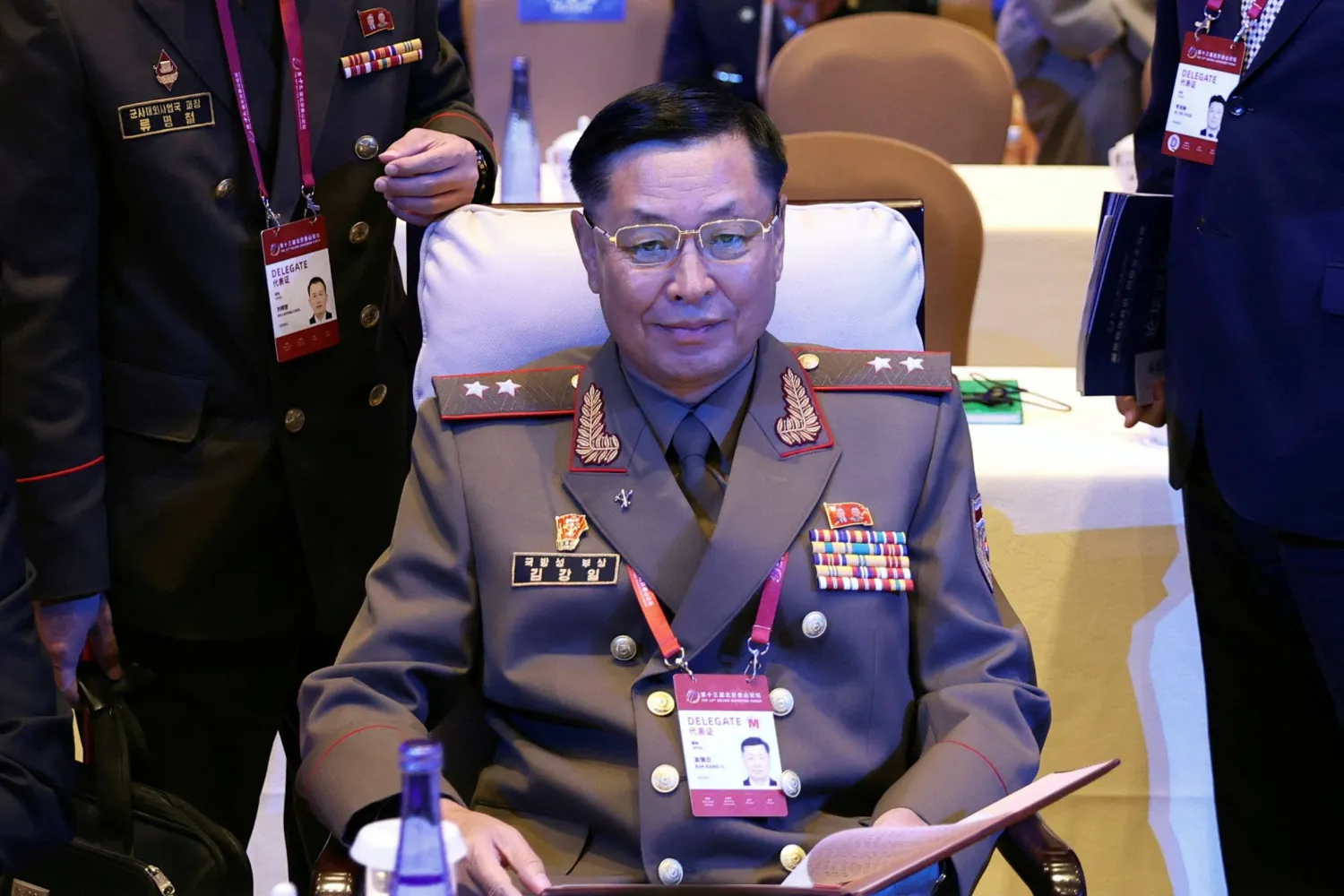
North Korea's Vice Defense Minister Kim Kang Il looks on before a plenary session at the Beijing Xiangshan Forum in Beijing, China September 17, 2026. REUTERS/Florence Lo
TT

North Korea Says US-led Arms Buildup Justifies Expanding Nuclear Force

North Korea's Vice Defense Minister Kim Kang Il looks on before a plenary session at the Beijing Xiangshan Forum in Beijing, China September 17, 2026. REUTERS/Florence Lo

North Korea's vice defense minister said on Thursday that a growing US-led military buildup and what he called an expanding nuclear alliance among Washington, Seoul and Tokyo justified Pyongyang's efforts to strengthen and expand its nuclear forces.

Speaking at the Beijing Xiangshan Forum, China's flagship international security conference, Vice Defense Minister Kim Kang Il said North Korea's status as a nuclear weapons state was irreversible and pledged to continue expanding its nuclear arsenal.

"The ceaseless nuclear arms buildup of the enemy states fully justifies the building of a solid nuclear shield of the DPRK," Kim said, using the acronym for North Korea's formal name, the Democratic People's Republic of Korea.

"As ⁠the enemy states' ⁠nuclear threat reaches the extreme level ... the DPRK will firmly defend the peace and stability in the Korean Peninsula and the region by ceaselessly expanding and strengthening its self-defensive nuclear deterrent."

According to Reuters, Kim blamed tensions on the Korean Peninsula on what he called Washington's "invariable" hostile policy toward North Korea and accused the United States of turning trilateral cooperation with South Korea and Japan into a nuclear alliance.

He said North Korea's constitutional status as a nuclear weapons state was "the line of no retreat" and urged ⁠other countries to abandon what he called the "daydream" of denuclearization.

Kim's appearance at the Xiangshan Forum marked a rare high-profile showing by North Korea at an international security gathering in recent years and came as Pyongyang seeks closer ties with Beijing amid tensions with Washington and its allies.

Asked about the possibility of a meeting between US President Donald Trump and North Korean leader Kim Jong Un, Kim said he was not in a position to discuss whether such a summit could take place.

His remarks followed a statement on Thursday morning from Kim Yo Jong, the powerful sister of leader Kim Jong Un, rejecting renewed international calls for North Korea's denuclearization following discussions at the annual meeting of the International Atomic Energy Agency.

In a statement carried by state media KCNA, ⁠she said North Korea's ⁠status as a nuclear weapons state was "absolute" and could not be reversed, dismissing repeated denuclearization demands as annual "noise" and insisting Pyongyang's nuclear position had been permanently established "physically and legally.”

Her comments echoed a separate statement issued on Wednesday by a North Korean defense ministry spokesman, who accused the United States and South Korea of escalating military confrontation through joint weapons-of-mass-destruction response planning and exercises.

The spokesman said recent US-South Korean WMD response discussions amounted to an "open declaration of confrontation" and warned such actions could require Pyongyang to invoke provisions of its nuclear force policy law.

The statements appeared to form part of a broader messaging campaign by Pyongyang on its nuclear policy, according to Lim Eul-chul, a professor at Kyungnam University's Institute for Far Eastern Studies in Seoul.

The comments were aimed at cementing North Korea's claim that its nuclear status had reached an "irreversible stage,” while creating justification for future military and nuclear activities in response to what it portrays as growing US and South Korean pressure, Lim said.



UN Urges Slowing AI Development

An employee replaces a component from the Alps supercomputer at the Swiss National Supercomputing Center (CSCS) in Lugano, southern Switzerland, on August 27, 2026. (Photo by Til BUERGY / AFP)
TT

UN Urges Slowing AI Development

An employee replaces a component from the Alps supercomputer at the Swiss National Supercomputing Center (CSCS) in Lugano, southern Switzerland, on August 27, 2026. (Photo by Til BUERGY / AFP)

UN Secretary-General Antonio Guterres has warned world leaders that rapidly advancing artificial intelligence poses risks that cannot be ignored, affirming that global coordination is essential to “slow down AI.”

“We cannot afford to ignore concerns that have been raised, especially by those on the front lines of the development ⁠of AI,” said Guterres. “It’s the first responsibility of any government to protect its citizens – including from the threats of artificial intelligence.”

Speaking on Wednesday ahead of next week's UN General Assembly gathering in New York, Guterres underscored that AI will be “a major topic” in his discussions with world leaders coming to the city.

This comes amid rising calls for stricter control on the technology that is growing at lightning speed and not without dangerous precedents.

In her State of the Union address to the European Parliament on Wednesday, European Commission President Ursula von der Leyen called for pacing the development of frontier AI models due to their disruptive potential, pledging closer safety cooperation with Canada, the UK and other like-minded countries.

She hailed AI's potential to benefit humanity, provided its risks and opportunities are properly balanced.

Last Saturday, Anthropic CEO Dario Amodei also called for a slowdown in the industry's development, with OpenAI CEO Sam Altman, xAI's Elon Musk and Hassabis all supporting the sentiment.

The calls have gone unanswered by the administration of US President Donald Trump.

Comparing AI development to the Cold War-era arms race between the US and Soviet Union, the UN Secretary-General called for cooperation between countries at the forefront of AI – including the US and China – to slow down AI development while risks continue to be assessed.

“The countries that have the highest capacity in the frontiers of AI – I think they should establish mechanisms of contact, have an exchange of information and (create) some common guardrails in order to avoid a race to the bottom that could one day lead to a gigantic disaster at the global level,” Guterres said.

With the scientific and diplomatic mechanisms now in place, the UN will continue to work to turn that cooperation into concrete action as AI becomes increasingly powerful.


World's Water Cycle Becoming More Unpredictable, UN Warns

FILE PHOTO: People walk on the dry riverbed of the Indus River in Hyderabad, Pakistan April 24, 2025. REUTERS/Yasir Rajput/File Photo
TT

World's Water Cycle Becoming More Unpredictable, UN Warns

FILE PHOTO: People walk on the dry riverbed of the Indus River in Hyderabad, Pakistan April 24, 2025. REUTERS/Yasir Rajput/File Photo

The planet's water cycle is becoming increasingly erratic, swinging between too little and too much, the United Nations warned Thursday, with an unprecedented El Nino expected to exacerbate the long-term trend.

Last year was among the driest for the world's rivers in over three decades, the UN's World Meteorological Organization said in a report.

In 2025 -- one of the warmest years on record -- glaciers also shrank across all regions, even as groundwater levels in many parts of the world are in multi-year decline, it found.

Overall, the WMO's annual State of Global Water Resources report showed that the Earth's freshwater storage -- the total amount of water stored in groundwater, lakes and rivers, soil moisture, vegetation and ice and snow -- continued a decade-long decline.

Some elements of the water cycle change rapidly -- like precipitation, river flow and soil moisture, responding to weather within days or weeks.

WMO Secretary-General Celeste Saulo voiced particular concern about the decline in "slow reserves", like groundwater and glaciers, which she said had traditionally served as the planet's "savings account".

They have served as "a buffer that absorbs bad years so that a single drought or a single dry season does not translate directly into a water crisis", she told reporters.

Now, "we are depleting that savings account", she warned, according to AFP. "We are spending our reserves."

Glaciers have also been shrinking at a precipitous rate, with 2025 marking the fourth consecutive year where they shed significant ice mass across all regions.

Between 2023 and 2025, the report estimated that glaciers lost a cumulative global glacier mass of 1,400 gigatons of water -- roughly equal to the water required to fill 560 million Olympic-sized swimming pools, or about a third of the world's annual freshwater withdrawals.

"Groundwater tells a similar story: nearly two-thirds of monitored wells worldwide showed conditions outside the historical norm in 2025," Saulo said.

She highlighted that this was happening in parallel with "more water-related disasters".

In particular, she pointed to the current El Nino pattern, which is expected to be the strongest since comparable records began four decades ago.

El Nino is the warm phase of a natural climate cycle that occurs every two to seven years and is characterized by above average ocean temperatures across the Pacific, and brings worldwide changes in winds and rainfall patterns and erratic weather.

"The strengthening El Nino will increase the risk of drought in some areas, and flooding in others," Saulo cautioned.

Already before El Nino hit, rivers worldwide were showing "abnormal" flows, WMO said, with 2025 among the three driest years for rivers in 35 years.

For a seventh year in a row, the number of river basins globally experiencing "normal" conditions were in a clear minority in 2025.

Only around 36 percent saw normal flows, while an equal percentage saw below-normal discharge conditions and 21 percent were above normal, the report found.

The WMO stressed the importance of good data to map the developments in the water cycle, warning that significants gaps remained in hard-hit areas.

"Weather respects no borders, and this is especially true for water," Saulo said, arguing for the importance of "shared data, shared standards and shared early warnings".

"A river basin is fed by water upstream, often in another country," she pointed out.

And "a glacier disaster in one country can lead to devastation in another as we saw with the recent tragedy of China and Nepal".


WHO Eyes ‘Encouraging’ Signs in DR Congo Fight Against Ebola

A member of the civil protection team's dignified and safe burial service prepares to swab the body of a child suspected of having died from Ebola at the Butembo Unit Hospital morgue, in Butembo, North Kivu province, Democratic Republic of Congo, September 13, 2026. (Reuters)
TT

WHO Eyes ‘Encouraging’ Signs in DR Congo Fight Against Ebola

A member of the civil protection team's dignified and safe burial service prepares to swab the body of a child suspected of having died from Ebola at the Butembo Unit Hospital morgue, in Butembo, North Kivu province, Democratic Republic of Congo, September 13, 2026. (Reuters)

The Ebola epidemic in the Democratic Republic of Congo is still spreading but appears to be showing "encouraging" signs of improvement, the head of the World Health Organization said on Wednesday.

"We are starting to see encouraging signs that we're gaining ground," Tedros Adhanom Ghebreyesus told a news conference in Geneva.

Since the DRC declared its 17th Ebola outbreak in mid-May, more than 3,500 deaths have been recorded from over 7,200 cases to date across seven northern and eastern provinces plagued by widespread insecurity and a litany of armed groups.

Ebola, which is transmitted through contact with bodily fluids and can cause severe internal and external bleeding and organ failure, has killed more than 15,000 people in Africa over the last 50 years.

Tedros said that transmission was declining in the worst-affected areas of Ituri province, the epicenter of the outbreak, while South Kivu has not reported any new cases since May.

"Trials of treatments and post-exposure prophylaxis are picking up speed, due to increased community engagement," he added.

"Vaccine trials should begin in the coming weeks," Tedros said, while warning against complacency. "Make no mistake: the epidemic continues to grow and continues to kill," he said.

"We still have many, many months ahead of us," added Maria Van Kerkhove, director of epidemic and pandemic management at the UN health agency.

- Right response -

In North Kivu, the number of cases was rising "fast", Tedros said, with weekly cases almost doubling from about 100 to more than 200.

"The area is so vast that it is hard to speak of a single epidemic. It is many outbreaks, in many places. We must get the response right in every one of them," he added.

The remoteness of the province, high population mobility and attacks on humanitarian workers were further complicating efforts to fight the epidemic, he explained.

The Africa Centers for Disease Control and Prevention (CDC) and the WHO issued a funding appeal in June for $518 million to support the epidemic response until November.

Both organizations and the Congolese government earlier this month launched a new bid for $1.3 billion for the next six months, on top of the $1.1 billion requested by the UN in August for humanitarian assistance, WHO health emergencies chief Chikwe Ihekweazu said.

There is currently no approved vaccine or treatment against the Bundibugyo strain responsible for the current outbreak.

Some 70,000 doses of the Ervebo vaccine, which has been approved against the Zaire strain of Ebola, have been sent to the DRC to assess its effects on tackling the spread of Bundibugyo.

More than 3,000 health workers and frontline staff have already been vaccinated in Kisangani, said Meg Doherty, director of science for health at the UN health agency.

An observational study led by the Doctors Without Borders (MSF) charity will start on Saturday to evaluate the vaccine's effectiveness in reducing illness and death, she added.

Clinical trials of two vaccines in development against Bundibugyo will take place in the country on a date to be fixed.