


Hamas Silent on Killings: Ceasefire Restraint or Inability to Retaliate?

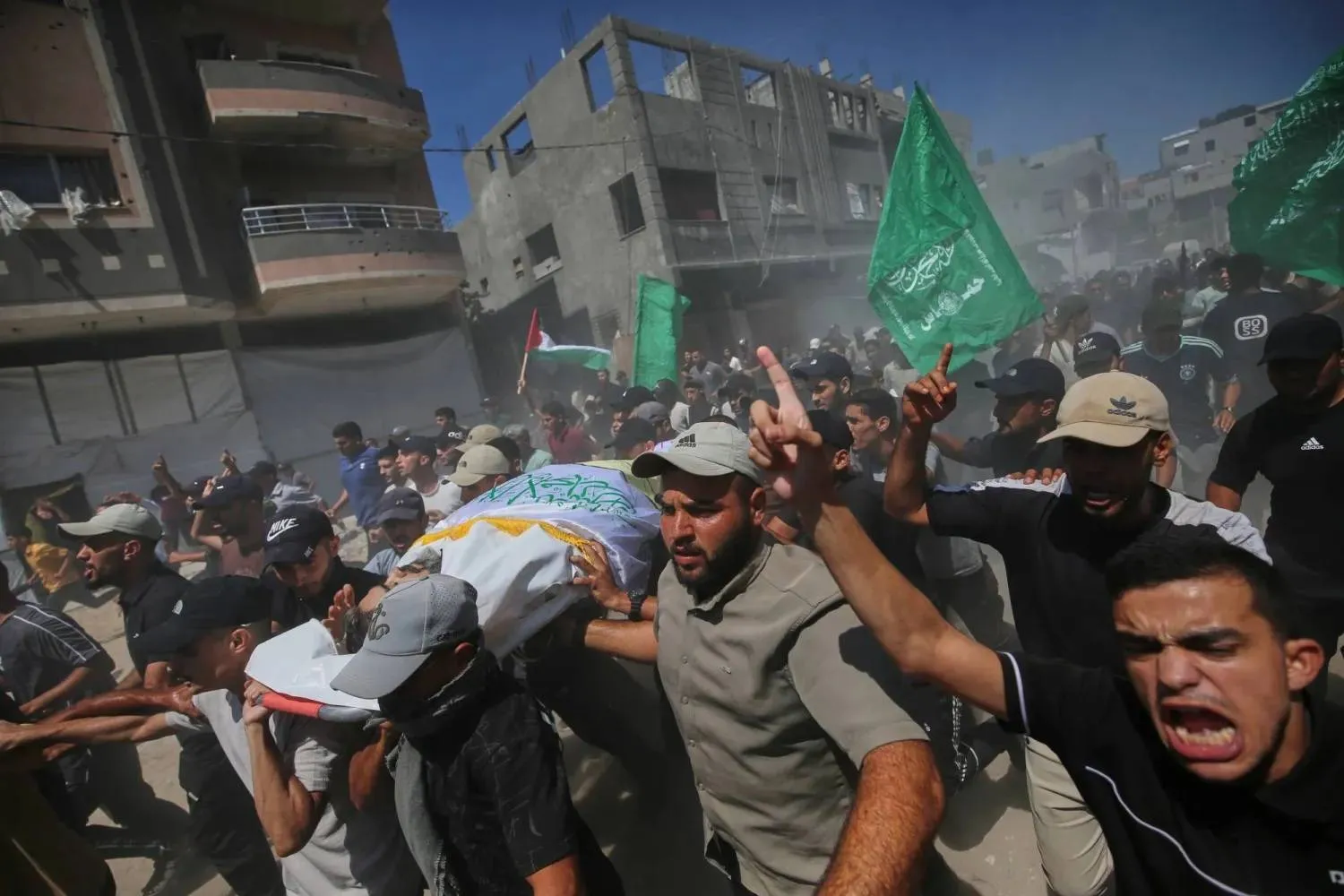
Palestinians carry the body of Nael Abu Obeid, commander of the Rafah Brigade, after he was killed in an Israeli strike in Khan Younis on Wednesday. (AP)
TT

Hamas Silent on Killings: Ceasefire Restraint or Inability to Retaliate?

Palestinians carry the body of Nael Abu Obeid, commander of the Rafah Brigade, after he was killed in an Israeli strike in Khan Younis on Wednesday. (AP)

After killing the most prominent members of the Qassam Brigades’ military council during the Gaza war, Israel has turned its focus to the Hamas armed wing’s second-tier commanders, who now oversee military operations in the enclave.

Over the past week, Israel killed Mohammed al-Yazouri and Nael Abu Obeid, commanders of the Khan Younis and Rafah brigades, in separate strikes on the Mawasi area of Khan Younis in southern Gaza. Both were among the Qassam Brigades’ most prominent commanders in the south.

Al-Yazouri took command of the Khan Younis Brigade shortly after commanders Izz al-Din al-Haddad and Mohammed Ouda were killed in separate strikes less than 10 days apart in May.

Hudhayfa Abu Muammar was killed alongside al-Yazouri. A Qassam Brigades engineer close to its senior commanders, Abu Muammar, was responsible for developing the group’s military capabilities.

Abu Obeid took command of the Rafah Brigade after Mohammed Shabana was killed in May 2025, when Israel struck a tunnel in Khan Younis where he was with Mohammed Sinwar, the Qassam Brigades’ commander-in-chief.

Sinwar had succeeded Mohammed Deif, who was killed in an Israeli strike on July 13, 2024, alongside Rafa Salama, the former commander of the Khan Younis Brigade.

Hamas and its armed wing have notably confined their responses to mourning the commanders, omitting the threats of retaliation common in their statements during and before the war.

Some observers say Hamas has been weakened and can no longer respond militarily. Others say it is merely seeking to avoid provoking a harsher Israeli response or giving Israel a pretext to resume the war.

Israeli media

Israeli media have portrayed Hamas as incapable of responding.

Israel’s Channel 12 said the group feared Israel’s reaction and did not intend to retaliate for the killings, adding that it had “come to realize that the Israeli military has the upper hand on the battlefield.”

Haaretz quoted a former senior Palestinian security official in Gaza as saying Hamas could no longer operate freely in response to the killing of its senior commanders.

Signs of this had emerged even before the October 2025 ceasefire, the official said. Rocket fire from Gaza toward Israel had become “almost nonexistent” during the final months of the war, and there had been no major military operations.

Yedioth Ahronoth quoted Israeli military Chief of Staff Eyal Zamir as telling a closed-door security meeting attended by Prime Minister Benjamin Netanyahu and Defense Minister Israel Katz that Hamas had been defeated and Israel had prevailed in the confrontation.

An official in the military intelligence directorate, however, warned that Hamas still posed a threat and was seeking to rebuild its capabilities and restore its rule.

Katz said Hamas faced a “difficult strategic reality,” adding that Israel would “continue working to achieve its security objectives and ensure that the threat of Oct. 7 is not repeated.”

“We have eliminated Hamas leaders inside and outside Gaza, and even in Iran,” Katz said. “We will not allow Iran or any other party to arm Hamas again.”

Hamas’ Priorities

Four Hamas sources — a political official abroad, another source in Gaza and two field operatives in the enclave — separately told Asharq Al-Awsat that the group and its armed wing had other priorities, chiefly denying Israel any pretext to exploit the situation and resume the war.

The political source abroad said there was “a clear decision not to respond to any assassination, because what Israel wants is a reaction that would lend credibility to its narrative that Gaza contains real weapons capable of affecting it and that these weapons must be removed by force.”

The Gaza-based source said Hamas did not want to drag the enclave’s residents back into war. Palestinian factions had therefore reached broad understandings on the need to avoid any action that could be described as “provocative” and might trigger an unpredictable Israeli response.

Both sources said Hamas remained committed to the ceasefire agreement reached last year and to understandings with the Board of Peace on the second phase.

The problem lay with Israel, they said, accusing it of continuing to violate the agreement and refusing to honor any deal.

They said Hamas, in coordination with the other factions, had decided to move forward with the agreement, including transferring governing authority to the National Committee for the Administration of Gaza and placing all weapons exclusively under its authority, rather than under the control of Israel or the United States.

Israel’s obstruction of the agreement was preventing that process from beginning, they said, adding that Israel was still blocking the committee from entering Gaza and assuming its duties.

The two field sources said Hamas and other factions retained what they described as “limited” capabilities, including small arms, explosive devices and anti-vehicle munitions that could be used to carry out attacks.

The political and military leaderships had decided, however, to preserve calm for as long as possible and prepare only for defensive, not offensive, operations.

One source said the decision reflected a desire to protect civilians, rather than fear of confronting Israel. It was also intended to prevent Israel from exploiting any attack to displace Palestinians, force them to move from one area to another and destroy more of the homes still standing in Gaza.

“The prevailing belief in Israel that Hamas has been defeated is merely a slogan with no value on the ground,” the source said.

“Hamas would rather spare Gaza’s residents the horrors of war than disprove that slogan through an attack whose outcome would have no significance at this time.”

Board of Peace Criticism

Separately, Israel’s i24NEWS quoted a Board of Peace official as criticizing Israel’s current strategy in Gaza: killing commanders while armed operatives remain and Hamas continues to govern.

The Board of Peace seeks to dismantle Hamas and eliminate it completely, while Israel is killing operatives without destroying the movement itself, the official said, according to the channel.

The official said Israel’s policy resembled the approach that prevailed before Oct. 7, 2023.

Dismantling Hamas, the official said, would require 14 days of calm, except for action needed to counter immediate threats; the Israeli government’s full cooperation with all preparations and logistical measures required for voluntary disarmament; and adherence to the Board of Peace’s deadline for halting attacks.

That would allow the parties to agree on a timetable for beginning to bring weapons under a single authority, as agreed in Cairo, the official said.

“If Hamas begins dismantling itself quickly and provides the coordinates of all the tunnels, that would be excellent,” the official added. “If it does not disarm, the Israeli military will receive international support to do so by force.”



Gaza Rescuers Say Israeli Fire Kills Seven

Palestinians walk along a street surrounded by buildings destroyed in Israeli military strikes during the Israel-Hamas war in Gaza City, Tuesday, Oct. 6, 2026. (AP Photo/Jehad Alshrafi)
TT

Gaza Rescuers Say Israeli Fire Kills Seven

Palestinians walk along a street surrounded by buildings destroyed in Israeli military strikes during the Israel-Hamas war in Gaza City, Tuesday, Oct. 6, 2026. (AP Photo/Jehad Alshrafi)

Gaza's civil defense rescue service said Thursday that seven people were killed in separate Israeli strikes through the day, while the Israeli army said three of the victims were "military operatives".

Six of the seven were killed in various parts of Gaza City.

Two people were killed in a drone strike on a car, while one was killed in a drone attack on a tent in an encampment for displaced people, the rescue service and al-Shifa hospital said.

The Israeli army told AFP that the three targeted were "military operatives in terrorist organizations."

"Two people, a woman and a child, were killed and others were wounded when Israeli aircraft bombed a residential building" in Gaza City, the civil defense said.

A woman was also killed by artillery shelling in Gaza City, health officials reported.

The civil defense reported that "one person was killed by Israeli fire southeast of Deir al-Balah in central Gaza."

Contacted by AFP, the Israeli army said it was checking the reports about the other four victims.

The war began after Hamas launched an unprecedented attack against Israel on October 7, 2023.

Hamas on Thursday denied Israeli claims that it uses Gaza hospitals for military activities, after the army said Wednesday that militants "advanced attacks from within (Kamal Adwan) hospital" in northern Gaza.

Hamas in a statement called the accusations "criminal incitement".

Israel's military offensive against the group has displaced nearly all the population of Gaza and killed more than 74,200 people, according to Gaza's health ministry, which is under Hamas authority and whose figures are considered reliable by the United Nations. They do not distinguish between militants and civilians.

Since a ceasefire was declared in October last year, Israeli forces have killed at least 1,450 people in Gaza, according to the ministry.

The Israeli military has declared the deaths of five soldiers and one civilian contractor in the same period.


Israeli Army Says One Soldier Killed, Three Wounded in South Lebanon

An Israeli army vehicle operates in East Zawtar, as seen from West Zawtar, southern Lebanon, October 1, 2026. REUTERS/Mohamed Azakir
TT

Israeli Army Says One Soldier Killed, Three Wounded in South Lebanon

An Israeli army vehicle operates in East Zawtar, as seen from West Zawtar, southern Lebanon, October 1, 2026. REUTERS/Mohamed Azakir

The Israeli army said Thursday that one soldier was killed and three others were slightly wounded in south Lebanon, where the military has occupied a band of territory since invading in March in response to Hezbollah attacks.

"Captain Eliav Haim Tzapalamus, aged 21, from Haifa, a combat officer in the 603rd Battalion, 7th Brigade, fell in combat in southern Lebanon," the army said.

Tzapalamus is the 17th Israeli soldier to be killed since a ceasefire was reached in June between Israel and Hezbollah.

Israel and Lebanon have agreed to a framework deal that involves the disarmament of Hezbollah, a gradual withdrawal of Israeli forces and the deployment of the Lebanese army to the region.

On Thursday, visiting EU foreign policy chief Kaja Kallas told AFP in Beirut that the bloc favored avoiding a security vacuum and extending a UN peacekeeping mandate in south Lebanon.

The EU's top diplomat also said that the bloc would soon be launching a training mission for the under-resourced Lebanese army.

Israeli airstrikes and ground operations in Lebanon have killed more than 4,300 since March, according to Lebanese official figures.


Yemeni Forces Consolidate West Coast Gains, Reinforce Bab al-Mandab Positions

 Yemeni government fighters sit in the back of a vehicle near Dhubab, Taiz Governorate, Yemen, in this still image taken from video released October 5, 2026.    Southern Giants Brigades/Handout via REUTERS
Yemeni government fighters sit in the back of a vehicle near Dhubab, Taiz Governorate, Yemen, in this still image taken from video released October 5, 2026. Southern Giants Brigades/Handout via REUTERS
TT

Yemeni Forces Consolidate West Coast Gains, Reinforce Bab al-Mandab Positions

 Yemeni government fighters sit in the back of a vehicle near Dhubab, Taiz Governorate, Yemen, in this still image taken from video released October 5, 2026.    Southern Giants Brigades/Handout via REUTERS
Yemeni government fighters sit in the back of a vehicle near Dhubab, Taiz Governorate, Yemen, in this still image taken from video released October 5, 2026. Southern Giants Brigades/Handout via REUTERS

Yemeni armed forces consolidated gains along the western coast and reinforced positions overlooking the Bab al-Mandab Strait as they pushed ahead in al-Wazi'iyah district in western Taiz province under Operation “Dawn of Yemen.” Fighting with the Houthis continued in the southern Taiz countryside and on fronts around the city.

The armed forces said they had neutralized more than 1,800 Houthi fighters in recent hours. Army figures put Houthi losses at nearly 10,000 killed or wounded over two weeks of air and ground strikes across multiple fronts.

Nation Shield forces, the Giants Brigades and the Joint Forces took full control of the Kahboub front, according to Yemeni military media. The advance strengthens government forces’ hold on heights overlooking Bab al-Mandab and boosts their ability to secure the strategic corridor as operations continue along the western coast.

Taiz province’s emergency committee suspended classes at public, community and private schools, institutes, colleges and universities in districts that have come under Houthi control. It also placed government employees there on temporary leave, citing exceptional security conditions.

The United Nations warned of a worsening humanitarian situation in Taiz as Houthi attacks spread, displacement rises and aid access faces growing restrictions. Major roads remain closed, adding to pressure on services and limited resources.

The eastern road into Taiz city remains closed, the United Nations said in a recent report. Road closures between Aden and Taiz have disrupted a major supply route from warehouses in Aden, hampering aid agencies’ ability to reach those affected and meet growing needs.