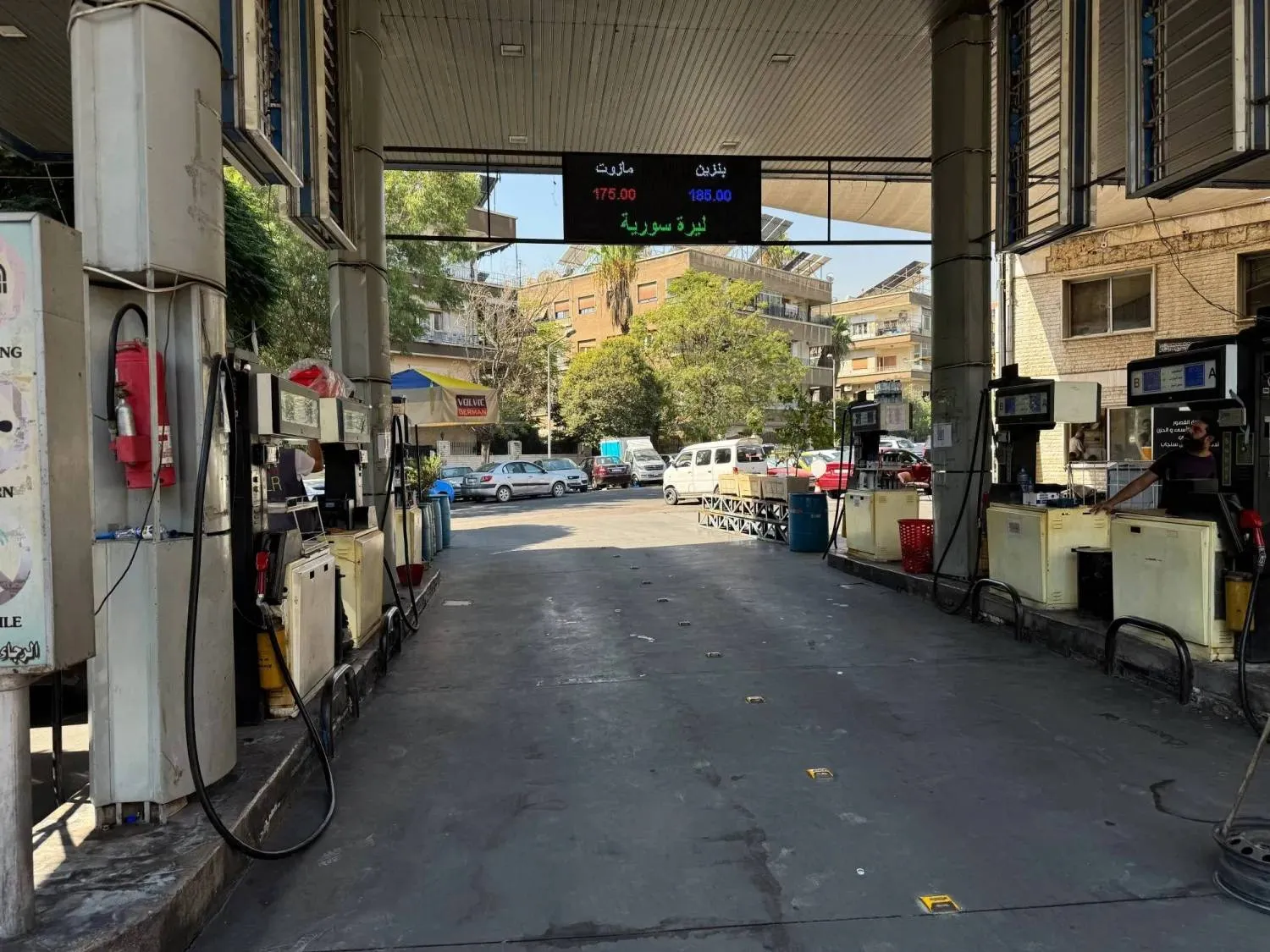
Syrian Energy Minister Revises Fuel Prices, Announces Subsidized Diesel

A fuel station in Damascus displays prices following a recent increase that sparked protests in several Syrian cities. (Reuters)
TT

Syrian Energy Minister Revises Fuel Prices, Announces Subsidized Diesel

A fuel station in Damascus displays prices following a recent increase that sparked protests in several Syrian cities. (Reuters)

Syrian Energy Minister Mohammed al-Bashir announced on Thursday that subsidized diesel would be sold at 115 Syrian pounds per liter, saying the ministry had approved practical measures to ease the burden on citizens while maintaining supplies.

Speaking at a news conference with Syrian Petroleum Company Chief Executive Youssef Qablawi on developments in the oil sector, Bashir said several grades of diesel would be offered at different prices and specifications to reduce living costs.

He also said several small local refineries would be restarted under the management and supervision of the Syrian Petroleum Company, with a combined capacity of up to 35,000 barrels of crude oil per day.

The Permanent Committee for Pricing Petroleum Products and Mineral Resources issued a temporary price list for petroleum products on Sunday. Syrians were caught off guard by the decision, which raised prices by between 25% and 40%, reflecting regional and global developments.

The decision triggered widespread public anger, particularly in eastern and northern Syria, where residents face complex economic, administrative, security and living conditions. Concerns have mounted that higher fuel prices will further increase already steep everyday expenses.

Bashir said at the news conference, carried by the state news agency SANA, that he met President Ahmed al-Sharaa on Wednesday to discuss practical alternatives.

They approved a proposal to offer several grades of diesel at different prices and specifications according to their intended use, rather than limiting the market to a single, high-grade and costly product, he said.

“We recognize that higher energy prices have a direct impact on people’s livelihoods and on the agricultural, production and service sectors,” Bashir said.

“Our responsibility is not limited to securing petroleum products. It also includes seeking solutions that ease the burden while maintaining continuity of supply.”

Bashir said subsidized diesel priced at 115 Syrian pounds per liter would be allocated primarily for heating, agriculture and groups eligible for government support.

Diesel meeting specifications suitable for transportation and for production and service-sector uses would be offered at 150 pounds per liter, he added.

The minister said crude petroleum products cost less than finished products. Syria spends about $140 million a month purchasing gas for power generation to meet the needs of its electricity plants, he said.

Syria imports 5.3 million cubic meters of gas per day from several countries, Bashir said, adding that the state treasury could not bear additional costs.

He said accumulated electricity-sector debt and losses from petroleum products had affected investment projects and capital spending. Unpaid electricity bills and illegal connections to the power grid had also increased losses at the Syrian Electricity Company.

“The state has adopted a policy of moving from a socialist economy to a free-market system, and we recognize the difficulties that this entails,” Bashir said.

“The return of the Baniyas refinery to operation and an increase in domestic production will have a positive effect on petroleum product prices.”

Qablawi said the Syrian Petroleum Company had begun preparing an implementation plan for the measures after discussing the relevant mechanisms with the Energy Ministry.

The company had spent the previous period studying the technical and operational details and working to remove potential obstacles to ensure smooth implementation, he said, according to Syria’s state-run Al-Ikhbariya television.

Qablawi said he hoped implementation would begin in the coming days, depending on technical and administrative readiness, adding that further details would be announced gradually.

Only designated fuel stations in the provinces would sell products processed by the small local refineries, he said.

The pricing committee issued its new temporary price list on Sept. 13.

The Energy Ministry later said the increase in Syrian petroleum product prices resulted from an exceptional rise in global procurement costs coinciding with a comprehensive overhaul of the Baniyas refinery.

It said the adjustment was temporary and intended to maintain supplies and ensure that petroleum products remained available on the domestic market.

Syria has been affected by higher global procurement costs for gasoline, diesel and fuel oil at a time when the Baniyas refinery is undergoing an overhaul expected to last about two months, temporarily increasing the country’s reliance on imported finished products.


Oman Posts Third-Quarter Budget Surplus as Revenue Rises 16%

Visitors and locals gather at the Mutrah Corniche in Muscat, Oman, April 11, 2025. (AP)
TT

Oman Posts Third-Quarter Budget Surplus as Revenue Rises 16%

Visitors and locals gather at the Mutrah Corniche in Muscat, Oman, April 11, 2025. (AP)

Oman's ‌public revenue rose 16% by the end of the third quarter to 9.828 billion Omani rials ($25.53 billion), the Oman News Agency said in a post ‌on X on ‌Wednesday.

Public spending ‌rose ⁠9% to about ⁠9.74 billion rials, and the state budget recorded a surplus of about 90 million rials ⁠at the end of ‌the ‌third quarter.

Public debt ‌fell by more ‌than 600 million rials from a year earlier, to about 14.1 ‌billion rials from 14.7 billion.

Dues paid ⁠to ⁠the private sector and received through the financial system totaled more than 1.43 billion rials by the end of the third quarter.


Subdued Sales for Singles’ Day, China’s Online Shopping Festival, Signal Weak Appetite for Spending

A shopper walks by a display at a mall advertising a Singles' Day (11/11) sale on Singles' Day in Beijing, China, 11 November 2026. (EPA)
TT

Subdued Sales for Singles’ Day, China’s Online Shopping Festival, Signal Weak Appetite for Spending

A shopper walks by a display at a mall advertising a Singles' Day (11/11) sale on Singles' Day in Beijing, China, 11 November 2026. (EPA)

Signs so far show Singles’ Day, China ’s biggest online shopping festival, is failing to entice worried consumers into splashing out more, even when they are offered bargains.

Singles’ Day, a landmark discount campaign similar to Black Friday and Cyber Monday sales in the US, is focused on Nov. 11, or 11-11, which is Wednesday. But it starts weeks earlier and is seen as a barometer for the broader economy.

Retail data platform Syntun said as of Oct. 31, the cumulative sales for this year’s festival were just over 1 trillion yuan ($154 billion), broadly similar to last year’s figure for the same period.

Retailers have managed to increase sales mainly by making the festival longer: total Singles' Day sales in 2025 reached a record of almost 1.7 trillion yuan ($254 billion).

But consumer demand in China has been suppressed as confidence took a hit from a prolonged property sector downturn among other factors. “Optimism over a recovery in domestic demand has faded,” said Max Zenglein, Asia Pacific senior economist at The Conference Board, “Improvements in sentiment have repeatedly proved short-lived.”

E-commerce giants like Alibaba have turned to artificial intelligence to try to get frugal shoppers to spend more. Alibaba's platforms Taobao and Tmall, for example, were integrated with Alibaba's Qwen AI this year even before the campaign started to help with shoppers' orders and product recommendations.

For the first time, Singles' Day AI token plans are on offer and are being promoted prominently. This month, one livestream by Li Jiaqi, dubbed the “Lipstick King” after selling huge amounts of lipsticks, recorded sales roughly equivalent to 2 trillion tokens within half an hour, according to Chinese media.

Consumers feel pinched

While the broader economy is still growing at a relatively robust pace, expanding 4.6% in annual terms in January-September, much of that momentum came from a boom in exports. Retail sales of consumer goods rose just 1.1% from a year earlier during the same period.

China’s huge domestic market has suffered as a yearslong real estate downturn has left families feeling less well off. Home prices are down roughly 20% or more from the market's 2021 peak, with smaller cities and the secondary market suffering more.

While housing prices appear to be stabilizing in larger cities, many homeowners are not convinced they won’t fall further, said Andy Rothman, founder of the advisory firm Sinology.

In the southern furniture manufacturing hub of Foshan, Gabby Liang said she's feeling cautious.

“I’ve been buying much less online, especially when it comes to non-essential items,” the 24-year-old said. “During the Single’s Day festival last year, I bought quite a bit of skincare products. But this year I expect to buy fewer.”

Other shoppers said they are cutting down on big spendings. “I’m perhaps not as keen on pursuing famous or high-end brands as I used to be,” Kong Min, a resident in Beijing, said of this year’s Single’s Day.

Middle-class Chinese consumers have lost a lot of confidence, plus, many of the discounts offered during the festival are not as good as before, said Shaun Rein, managing director of China Market Research Group in Shanghai.

⁠More shoppers are experiencing a “discount fatigue,” said Yaling Jiang, founder of ApertureChina, a market research company. Discounts are being offered year-round, so the boost from Singles Day may be shrinking, she said.

“Looking at what Single’s Day originally was: a shopping festival where people used to expect the largest discounts of the year,” she said. “That is not true anymore after it was extended to multiple platforms, then to a monthlong thing.”

Liang, who works in furniture sales, said extras like cameras and game consoles are off the list this year.

“We’re undergoing a consumption downgrade," she said. “Even the amount that we earn has somehow been downgraded.”

Domestic demand remains weak as exports soar

Business has stalled, Liang said, as Chinese shoppers tighten their belts, despite rising exports to regions such as the Middle East and Africa.

Sales inside China have suffered as an oversupply of many goods, from autos and TVs to shoes and electronics, has pumped up competition in overcrowded industries, prompting manufacturers to step up overseas expansions.

Exports soared 35% year-on-year in October, powered by high-tech items like semiconductors and electric vehicles, and China is on track to surpass last year’s record $1.2 trillion trade surplus.

But at home, demand for big ticket items like some luxury products and cars have been hit especially hard.

Passenger car sales inside China have fallen for most of this year, declining almost 25% in January-September, according to industry data. That's partly due to dialed-back government subsidies this year.

It's a stark contrast to the 71% jump in exports of passenger cars during the same period.

Purchases of luxury goods have also suffered. LVMH, which runs Louis Vuitton, Dior and Fendi, and Kering, whose brands include Gucci, Balenciaga and Saint Laurent, both reported customer demand has dipped in China in recent months.

Chinese leaders have been pledging for years to spur faster growth in domestic demand. But strong export growth has dulled a sense of urgency over launching policies to help stimulate the domestic economy, analysts said.

“As long as China continues to make progress on its industrial and technological ambitions, policymakers have little incentive to fundamentally rebalance the economy toward household demand,” said Zenglein.

There are still some bright spots

When it comes to retailing, not all categories are suffering. The latest consumer status symbols increasingly are related to health, lifestyle, and experiences.

“It’s not a simple case of big-ticket items falling,” said Jacob Cooke, CEO of Beijing-based consultancy WPIC Marketing + Technologies. Sales of health-related items are performing relatively well, he said.

According to WPIC data, for the 12 months ending in September, online sales of imported fish oil grew nearly 43% year-over-year. Other supplements targeting sleep, joint and bone strength grew between 28% and 37%.

Cooke expects some growth in this year Singles' Day sales.

ApertureChina’s Jiang views the defining trend in consumer culture this year as “just living life,” pulling people away from grand gestures and returning the focus to ”the bare necessities and internal fulfilment.”

While many families are holding back, with youth unemployment about 18% and income growth lagging, China's household savings still are huge. With its population of 1.4 billion it has enormous spending potential, though consumer preferences and spending patterns are changing.

China’s consumption story is not one of outright weakness, according to Zenglein, the economist at The Conference Board, but of growing divergence, with pockets of stronger demand despite subdued overall sentiment.

“It’s still enough to make a living, but there’s just not much extra to splurge,” said Liang from Foshan.


Saudi Arabia Approves Unified Consumer Protection Law, with Fines of Up to $2.1 Million

A shopper at a store in Riyadh. (SPA)
TT

Saudi Arabia Approves Unified Consumer Protection Law, with Fines of Up to $2.1 Million

A shopper at a store in Riyadh. (SPA)

Saudi Arabia has approved a unified consumer protection law aimed at strengthening market oversight, curbing unfair commercial practices and consolidating regulations governing relations between consumers and businesses.

Approved by the Cabinet on Tuesday, the legislation introduces broader safeguards covering contracts, warranties and price disclosure. Violators face fines of up to SAR 8 million ($2.1 million) and prison sentences of up to two years.

The Kingdom’s first comprehensive consumer protection law covers products and services and will be implemented in coordination with more than 20 government agencies.

It seeks to protect consumers from harmful, defective or noncompliant products and services, guarantee compensation for damages, simplify dispute resolution and encourage sustainable consumption.

Addressing legislative gaps

The law addresses shortcomings in the existing framework, where consumer protection provisions are scattered across multiple regulations, creating inconsistencies and weakening consumer and investor confidence.

It complements other legislation, including the General Authority for Competition’s efforts to combat collusion and monopolistic practices.

The framework covers consumer safety, contractual terms, product liability, unfair commercial practices, warranties, repairs and maintenance.

It draws on UN consumer protection guidelines, Sustainable Development Goals, OECD documents, G20 principles and the Gulf Cooperation Council’s unified consumer protection law, alongside legislative practices from 11 countries, including the United States, Britain, France and Japan.

Unfair practices

The legislation targets practices that influence consumer decisions unfairly, including burdensome restrictions, pressure and additional fees for certain payment methods.

It prohibits fabricated reviews, manipulated consumer comments and misleading advertisements, including promotions for unavailable products, false scarcity claims and undisclosed advertising.

During crises, pandemics or other exceptional circumstances, authorities may impose price controls, cap profit margins or require prior approval for price increases, subject to Cabinet authorization and applicable procedures.

Transparency and consumer rights

Contracts concluded outside business premises will be subject to safeguards similar to those governing e-commerce.

Businesses must disclose their details, contact information and payment methods, while consumers may cancel such contracts without giving a reason within seven days, subject to applicable conditions.

Service providers must clearly disclose prices and inform customers about maintenance work, its duration and cost.

The law also seeks to invalidate unfair contractual provisions that exempt businesses from liability for negligence or allow them to amend or terminate agreements without consumer consent.

Special protections cover children, older adults and people with disabilities, including restrictions on advertisements that could endanger children’s health or safety.

Minimum statutory warranties are set at two years for new products and one year for services and used products, with longer periods possible depending on their nature.

Dispute resolution

Comparative advertising will be permitted provided it is fair, transparent and free from misleading claims or attempts to damage competitors’ reputations.

Competitions and their advertisements will require prior authorization. Businesses will be prohibited from placing competition coupons inside products, requiring purchases for participation or raising prices during promotional competitions.

The law also introduces simplified procedures for minor claims before competent courts, allows consumer associations to seek compensation for harm to collective interests and provides for alternative dispute resolution.

Enforcement

The legislation establishes graduated enforcement measures, beginning with orders requiring businesses to correct violations and remedy their consequences within specified deadlines.

Serious violations may result in the suspension of products, services or contractual provisions, the blocking of offending websites or the withdrawal of unlawful advertisements.

Cases may be closed under specified conditions when businesses correct violations and settle with affected consumers.

Additional administrative measures include suspending business activities, seizing noncompliant products and issuing consumer warnings.

Government coordination

Article 73 preserves the existing powers of regulatory and supervisory authorities, while maintaining additional consumer rights and guarantees established under other laws or international agreements.

Relevant agencies will oversee compliance, conduct inspections, document violations and enforce the law. A designated committee will examine objections. A dedicated center will handle consumer inquiries and complaints through the unified number 935.

The legislation is expected to strengthen consumer confidence, encourage fair competition, protect vulnerable groups and promote sustainable consumption while reducing waste and harmful products.

It will replace three existing laws 180 days after publication in the Official Gazette: the 2008 Anti-Commercial Fraud Law, the 2019 E-Commerce Law and the 2002 Commercial Data Law.