Israel Links Southern Lebanon Withdrawal to Stronger Lebanese Army

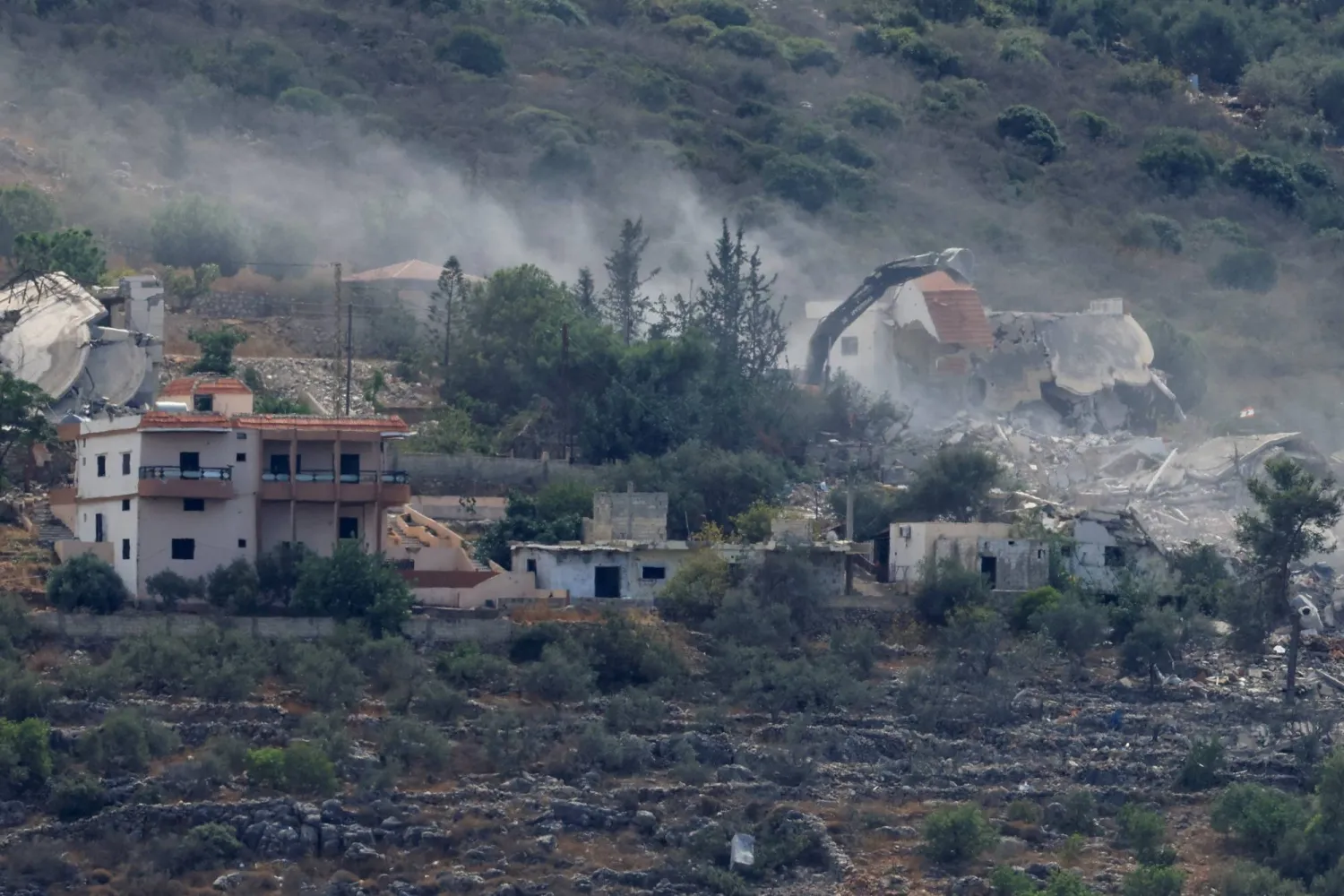
Israeli heavy machinery bulldozes houses in Mansouri, as seen from Hinniyeh, Southern Lebanon, September 19, 2026. REUTERS/Mohamed Azakir
TT

Israel Links Southern Lebanon Withdrawal to Stronger Lebanese Army

Israeli heavy machinery bulldozes houses in Mansouri, as seen from Hinniyeh, Southern Lebanon, September 19, 2026. REUTERS/Mohamed Azakir

From protecting northern Israeli communities to disarming Hezbollah and ensuring that the Lebanese army can assume responsibility for security, Israel has set a series of conditions for the future of its occupation of southern Lebanon.

Although Israel says it has no territorial ambitions in Lebanon, statements by its officials in recent months have offered no clear timetable for withdrawal, instead linking it to a succession of security and political conditions.

From protecting the north to a “security zone”

Amid repeated Israeli statements focusing on maintaining the occupation of southern Lebanon, Israeli Defense Minister Israel Katz said on June 21 that the Israeli military would continue operating there.

He said troops deployed in the “security zone” would not withdraw and would retain freedom of action to eliminate threats.

Israeli Foreign Minister Gideon Saar later said Israel had no territorial ambitions in Lebanon, while stressing that it would not withdraw from the “security zone,” citing the need to protect Israeli citizens from Hezbollah attacks.

Katz was more explicit in rejecting any imminent withdrawal. On June 24, he said the Israeli military will not withdraw from the security zone, even if the US demands it.

The following day, the language shifted from security necessity to an open-ended timeline. Katz said Israeli forces would remain in security zones in Lebanon, Syria and Gaza "without any time limit."

Disarming Hezbollah as a condition

At the end of June, Katz sought to reconcile Israel’s denial of territorial ambitions with its continued military control, insisting that Israel would not withdraw by a single millimeter before Hezbollah was disarmed.

Days later came his most direct statement. After US President Donald Trump raised the possibility of an Israeli withdrawal from Lebanon, Katz responded: “We did not ask permission from any party to enter Lebanon and we do not need permission to stay in Lebanon."

A new condition: Strengthening the Lebanese army

The latest US statement introduced another criterion for the future of Israel’s presence. US Ambassador to Israel Mike Huckabee said on Saturday that the Israeli military will remain in southern Lebanon until the Lebanese army “is strong enough to be the securing force.”

Israeli objectives extend beyond withdrawal

Retired Lebanese Army Maj. Gen. Abdul Rahman Chehaitli said Israel’s objectives went beyond maintaining a military presence in the south.

They included reaching “a military and security agreement between the two countries and abolishing everything that defines Israel as an enemy,” eventually establishing relations “like those between any two states,” in addition, of course, to disarming Hezbollah.

In remarks to Asharq Al-Awsat, Chehaitli said Israel was seeking to establish a joint border committee to monitor violations, followed by economic agreements.

Its most important objective, he said, was a meeting between the Lebanese and Israeli presidents. He viewed Israel’s pressure on the Lebanese state as serving that goal.

Chehaitli rejected linking an Israeli withdrawal to strengthening the Lebanese army, arguing that Israel itself was obstructing efforts to secure the support the army needed. He cited the Paris conference, which ended without final decisions.

The Lebanese army, including its officers and troops, was “fully prepared to carry out its duties,” he said.

The army and Hezbollah’s weapons

Chehaitli said Israel wanted the Lebanese army to act as an “advance detachment,” confronting Hezbollah first before Israeli forces took over — a role he said the army “will not perform.”

The natural sequence, he said, was that “once Israel says it has completed its military operations in Lebanon, the Lebanese army can then carry out its mission.” In other words, an Israeli withdrawal would allow the Lebanese state and its army to assume their responsibilities fully.

Addressing Hezbollah’s refusal to surrender its weapons and Israel’s use of the issue as justification for continuing the occupation, Chehaitli said Israel had previously tied its withdrawal to the Lebanese government adopting decisions establishing the state’s exclusive control over weapons.

“That has happened,” he said. “Parliament granted the government confidence for the third time, including the Shiite component and Hezbollah in particular, which did not withhold confidence from it and therefore did not reject its decisions.”

After an Israeli withdrawal, Chehaitli said, the government could implement its decisions throughout Lebanon “regardless of whether Hezbollah explicitly agrees.”

Israel’s continued presence made the task of the state and army more difficult, he added. “The occupation is the obstacle preventing the state from implementing its decisions and assuming its full responsibilities.”

Two Israeli soldiers were wounded

The statements came as Israeli attacks continued at varying levels of intensity in recent days.

Nabatieh came under a barrage of strikes on Saturday. Israeli warplanes carried out two rounds of strikes on the Old Square neighborhood in Nabatieh al-Fawqa before launching a third strike that targeted emergency teams from the Islamic Risala Scout Association and the Bayt al-Talaba ambulance service as they headed to the site of the earlier attacks.

Members of both teams escaped unharmed, and no casualties were reported.

In Khiam, the Israeli military carried out a large demolition operation in the morning, coinciding with a powerful explosion in the Mansouri area. Israeli warplanes also launched a series of strikes on Mansouri and Kfar Tebnit and bombed Wadi al-Salouqi.

Israeli artillery shelled the outskirts of the towns of Haddatha, Haris and Mayfadoun at dawn as part of a field escalation affecting several areas of southern Lebanon.

Later in the afternoon, the Israeli military said two soldiers were wounded when an explosive device detonated inside what Israel calls its “security zone” in southern Lebanon. It accused Hezbollah of planting the device and announced a series of strikes on sites across several parts of the south.

The Israeli military said its targets included observation posts and facilities it said had been used to prepare operations against its forces. It also confirmed that its troops remained deployed inside what it describes as the “security zone” in southern Lebanon and said it would continue acting against what it considers threats to its forces and Israeli residents.


Rains Mark Return of Winter Misery for Gaza's Palestinians

A displaced Palestinian man attempts to clear a water puddle outside his flooded tent amid heavy rainfall in Gaza City's Al-Remal neighbourhood on November 7, 2026. (Photo by Omar AL-QATTAA / AFP)
TT

Rains Mark Return of Winter Misery for Gaza's Palestinians

A displaced Palestinian man attempts to clear a water puddle outside his flooded tent amid heavy rainfall in Gaza City's Al-Remal neighbourhood on November 7, 2026. (Photo by Omar AL-QATTAA / AFP)

Displaced families spent a sleepless night in the Gaza Strip as heavy rain flooded their fragile tents, soaking mattresses and belongings, and turning camp pathways into pools of muddy water.

The rain marks the start of another difficult winter for the more than 1.6 million Palestinians living in tents or other makeshift shelters in the territory, where nearly the entire population has lost its homes during Israel’s campaign triggered by the Oct. 7, 2023, Hamas-led attacks.

Majed Al-Omari, who lost a limb during the war, struggled to make his way between tents on crutches after the rains tore down the wooden frame and plastic sheeting of his shelter.

“We will have to sleep in the street tonight, or find somewhere else to stay,” he told The Associated Press.

The UN humanitarian office has said 294,250 families need shelter assistance for the rainy season, but available supplies are enough to provide only partial assistance to 18% of those in need.

It said a lack of funds, slow procurement procedures and delayed approvals by the Israeli authorities mean additional supplies may not reach Palestinians until more than halfway through winter.


Yemeni Government Rallies European Support to Confront Houthis, Protect Shipping

Yemen's foreign minister meets with Arab ambassadors in Berlin (SABA)
TT

Yemeni Government Rallies European Support to Confront Houthis, Protect Shipping

Yemen's foreign minister meets with Arab ambassadors in Berlin (SABA)

The Yemeni government has intensified its diplomatic efforts in Berlin to mobilize European political and economic support for confronting Houthi escalation and restoring state institutions.

The diplomatic push comes amid warnings that the threat posed by the Iran-backed group could extend to international maritime security and global trade interests, alongside calls to correct what the government describes as misleading narratives about the Yemeni crisis.

During a series of meetings with German officials and lawmakers, Arab diplomats, experts and representatives of research centers, Foreign Minister and Minister of Expatriates Dr. Afrah Al-Zouba said continued international tolerance of Houthi violations had emboldened the group to expand its destabilizing activities and extend its threats beyond Yemen to vital regional shipping routes.

At a roundtable organized by Germany's Körber Foundation as part of the Berlin Political Breakfast, Al-Zouba outlined the roots of Yemen's crisis, beginning with the Houthi coup against the national consensus and internationally recognized government in September 2014.

She recalled the group's armed takeover of the capital, Sanaa, and its undermining of the outcomes of the National Dialogue Conference, leading to the latest military escalation and attempts to target international shipping in the Bab Al-Mandab Strait.

Al-Zouba said the group's escalating actions posed a direct threat to regional and international peace and security, warning that international silence and tolerance of its violations gave the Houthis greater room to continue threatening global trade.

Expanding Houthi Threat

As part of the same diplomatic efforts, Al-Zouba warned during another roundtable organized by Germany's Konrad Adenauer Foundation that the Houthi threat was expanding to regional security and international shipping.

She pointed to attacks on shipping routes and coordination with terrorist groups in the Horn of Africa, including Somalia's Al-Shabaab.

Al-Zouba linked the Houthis' rejection of peace efforts and attempts to establish control over the Bab Al-Mandab Strait to the launch of Operation Fajr Yemen.

She said the operation aimed to restore state institutions and protect maritime routes against threats to international shipping and trade.

The minister urged participating officials, experts and members of Germany's governing party to convey an accurate picture of developments in Yemen to their institutions and policymakers and to correct misleading narratives about the crisis.

She stressed the need to ensure that Yemenis' voices were heard and that the military escalation's humanitarian consequences received appropriate attention.

Al-Zouba emphasized that political, economic and humanitarian support for the Yemeni government was essential to strengthening its ability to fulfill its responsibilities, consolidate stability and restore state institutions.

Siege of Taiz and Collective Punishment

The humanitarian situation in the city of Taiz featured prominently in the minister's discussions.

She highlighted the continuing Houthi siege and its consequences, including restrictions on the entry of food, medicine and essential supplies, the closure of healthcare facilities and obstruction of efforts to evacuate patients and wounded civilians through safe corridors.

Al-Zouba described these practices as collective punishment against civilians, saying they had intensified the suffering of the most vulnerable groups, particularly women and children.

She added that the siege had caused civilian deaths because people were unable to obtain necessary medical care and supplies.

During a meeting with Armin Laschet, chairman of the German Bundestag's Foreign Affairs Committee, Al-Zouba discussed developments in Yemen and their regional repercussions.

She stressed that threats to freedom of navigation and global trade represented an extension of the Houthis' destabilizing activities since the group seized control of state institutions.

Al-Zouba also outlined the internationally recognized government's efforts, operating from the temporary capital Aden, to fulfill its public service and development responsibilities.

She emphasized that stabilizing state institutions and securing their own revenue sources were essential to addressing the humanitarian crisis sustainably.

The foreign minister called on Germany and European partners to provide urgent political and economic support to the government, with particular emphasis on strengthening national capabilities.

These include the coast guard and maritime border surveillance, which would improve Yemen's ability to combat the smuggling of Iranian weapons and military technology to the Houthis.

According to Yemen's official media, Laschet expressed concern over Houthi human rights violations, particularly the recruitment of children and deteriorating living conditions among civilians.

He stressed that attacks on shipping in the Red Sea threatened the economic security of European Union countries and the wider world.

The German official also emphasized the need for Germany's parliament and government, in coordination with the European Union, to develop a new strategy for addressing the Yemeni crisis, one that keeps pace with rapidly evolving developments and protects regional and international security.


Hamas Awaits Positive Response from Board of Peace to Salvage Gaza Agreement

Egyptian President Abdel Fattah el-Sisi and US President Donald Trump sign the Gaza ceasefire agreement in Sharm El-Sheikh in October 2025 (Egyptian Presidency)
TT

Hamas Awaits Positive Response from Board of Peace to Salvage Gaza Agreement

Egyptian President Abdel Fattah el-Sisi and US President Donald Trump sign the Gaza ceasefire agreement in Sharm El-Sheikh in October 2025 (Egyptian Presidency)

Tony Blair, a prominent member of the Board of Peace, is seeking to salvage the Gaza ceasefire agreement by pressing Israel to begin implementing some of its provisions in stages, pending full implementation, following the conclusion of Israel's Knesset elections in recent days.

Meanwhile, Hamas is awaiting a positive response concerning the fate and future of the agreement, as security and humanitarian conditions in the Gaza Strip continue to deteriorate.

Blair met Israeli President Isaac Herzog on Thursday morning, followed by a meeting that afternoon with Prime Minister Benjamin Netanyahu, who will lead a caretaker government until a new administration is formed.

On Friday afternoon, Blair also met Gadi Eisenkot, a potential candidate for prime minister, to discuss the situation in Gaza.

According to the Israeli Public Broadcasting Corporation, Blair held meetings with senior Israeli officials over the past three days to discuss advancing US President Donald Trump's 20-point plan, which was agreed upon in late September 2025 before taking effect with the ceasefire announced on October 10 of that year.

The broadcaster and Israel's Channel 13 reported that Blair emphasized the need to allow the National Committee for the Administration of Gaza (NCAG) to enter the territory and assume its responsibilities.

He also called for allowing the International Stabilization Force (ISF), which is still being assembled, to begin deploying soon to designated locations.

These would constitute initial steps toward bringing the weapons of Hamas and other Palestinian factions under control.

Blair's visit coincided with a trip by the Board of Peace's High Representative for Gaza, Nickolay Mladenov. It was not immediately clear whether Mladenov participated in Blair's meetings or held separate discussions.

Both Blair and Mladenov visited the US-led Civil-Military Coordination Center in Kiryat Gat, southern Israel, where senior military officers from dozens of countries are monitoring implementation of the ceasefire agreement.

According to Israel's Yedioth Ahronoth newspaper, US pressure to advance Trump's plan to end the war has continued even after the Israeli elections, despite stalled talks with Hamas and ongoing Israeli military operations in Gaza.

The newspaper noted that developments on the ground showed no indication of meaningful progress toward the next phase.

Citing sources familiar with the details, the newspaper reported that negotiations remain frozen, with no substantial progress in implementing the US plan.

This comes as Hamas remains armed and continues rebuilding its ranks, while the Israeli military continues operations aimed at thwarting its plans, with those operations intensifying recently.

The newspaper argued that the security and political situation would become more complicated because of the political turmoil following the Knesset election results.

Israel's political system is facing uncertainty amid the absence of a clear majority and questions over whether a stable government can be formed.

The newspaper said this directly affects Israel's ability to formulate a long-term policy toward Gaza, particularly regarding how to proceed with the American plan.

While Washington is seeking progress on Trump's initiative, Israel remains uncertain about its political future in the coming months.

Israel is skeptical about the prospects of successfully implementing or advancing any new measures, partly because Hamas refuses to disarm or surrender control of its weapons.

Citing Israeli officials, the Hebrew-language Walla news website reported several days ago that the political situation following the Knesset elections has further complicated efforts to advance the agreement.

It added that the Israeli military is also making preparations for a possible operation to occupy Gaza City in an effort to force Hamas to disarm.

Hamas Awaits a Response

Hamas, which appears to have few options remaining, is growing increasingly impatient over the failure to implement previously reached agreements, particularly as daily killings and bombardment continue and humanitarian conditions deteriorate.

In a statement documenting daily Israeli violations, Hamas said: "Peace is not measured by the signing of agreements alone, but by an end to the killing and the return of life to our people in Gaza."

In a video message published on its website, the movement added: "Gaza has never been a marginal consideration in political calculations, and the lives of its people must not be treated as something that can be postponed."

A Hamas official in the Gaza Strip told Asharq Al-Awsat that the movement is awaiting a response from mediators who are in direct contact with Board of Peace officials, following Blair's diplomatic efforts and meetings with Israeli leaders.

The official explained that the mediators had informed Hamas that the Board of Peace intended to undertake new efforts to move the Gaza agreement forward, and that the movement would await the outcome of those efforts.

Asked whether Hamas was counting on stronger US pressure, particularly following calls for a change in Washington's policy toward Israel after the Republican Party's defeat in the midterm elections, the official said such a possibility existed.

However, he added that past experience did not suggest the United States had any genuine intention of pressuring Israel, which was why progress remained extremely slow.