

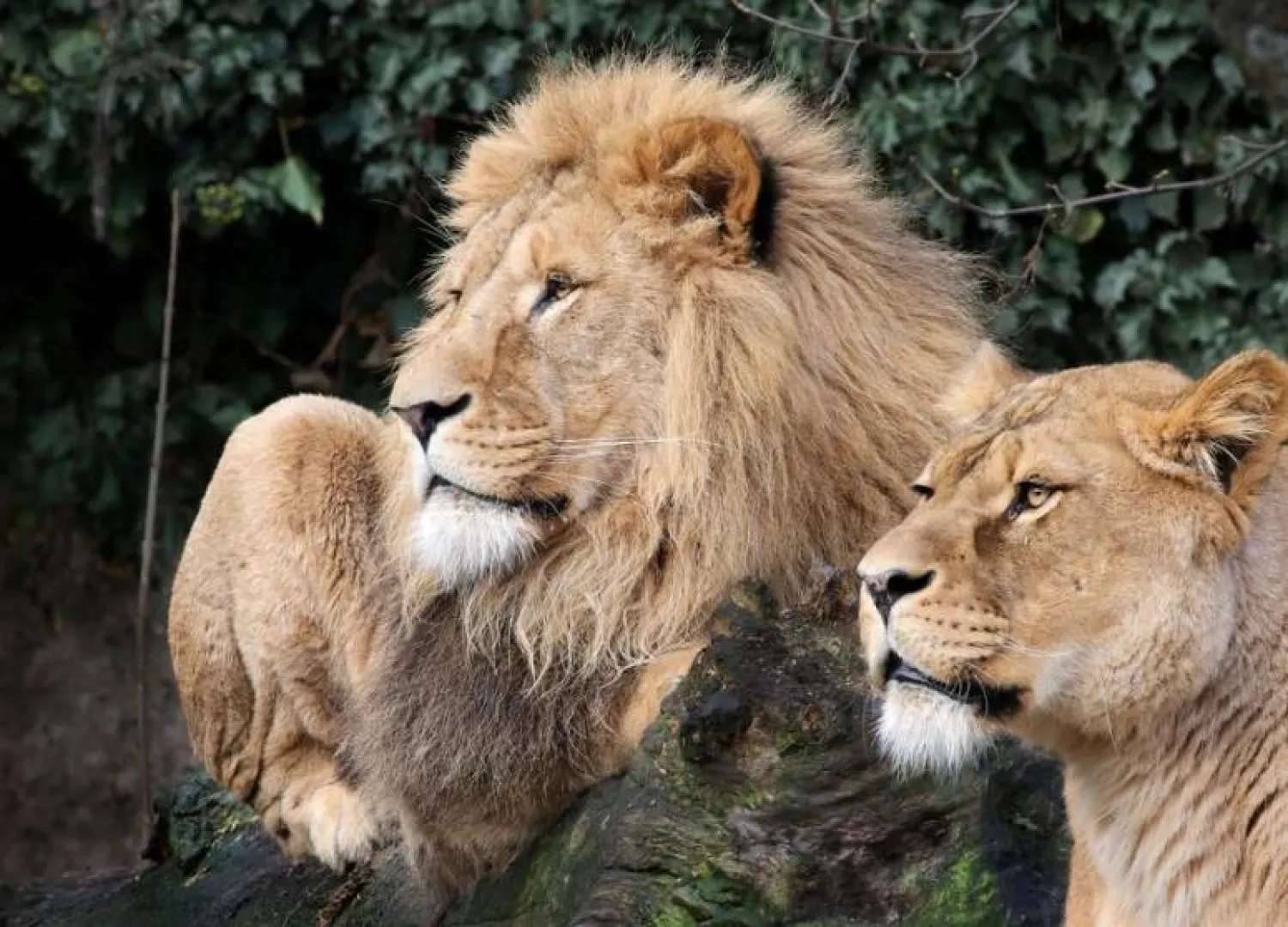

10 Lions Die in Suspected Poisoning at Tanzania Wildlife Reserve

Lions are seen in their counpound at the Artis Amsterdam Royal Zoo in Amsterdam, Netherlands in this handout photo released to media on January 28, 2021. Artis Amsterdam Royal Zoo/Handout via REUTERS
TT

10 Lions Die in Suspected Poisoning at Tanzania Wildlife Reserve

Lions are seen in their counpound at the Artis Amsterdam Royal Zoo in Amsterdam, Netherlands in this handout photo released to media on January 28, 2021. Artis Amsterdam Royal Zoo/Handout via REUTERS

Ten lions were found dead in Tanzania's Ngorongoro wildlife reserve this week and preliminary findings suggest they may have been poisoned, the area's management authority said.

The deaths raise concerns over the conservation of lions in one of Africa's most renowned wildlife ecosystems. Poisoning has been a recurring threat to large ⁠carnivores across parts ⁠of East Africa, often linked to conflicts between predators and livestock owners.

The lions were discovered on September 18 in the Ndutu area of Endulen Ward in Arusha ⁠region, Reuters quoted the Ngorongoro Conservation Area Authority as saying in a statement released late on Saturday.

"Preliminary findings suggest the animals may have died after ingesting poison," the authority said, adding that it had launched an investigation to determine the cause and identify those responsible.

The Ngorongoro Conservation Area, a UNESCO ⁠World ⁠Heritage Site in northern Tanzania, is one of the country's leading tourism attractions. It is home to a wide range of wildlife, including lions, elephants, buffaloes and endangered black rhinos.

Last month, police arrested four suspects in an investigation into the deaths of 18 elephants across the border in Kenya.


Diana's Brother Compares Media Treatment of Harry, Meghan to Late Princess' Ordeal

FILED - 13 February 2018, United Kingdom, Edinburgh: FILE PHOTO - Prince Harry and Meghan, Duke and Duchess of Sussex, attend a reception for young people at Holyroodhouse Palace in Edinburgh. Photo: Andrew Milligan/PA Wire/dpa
TT

Diana's Brother Compares Media Treatment of Harry, Meghan to Late Princess' Ordeal

FILED - 13 February 2018, United Kingdom, Edinburgh: FILE PHOTO - Prince Harry and Meghan, Duke and Duchess of Sussex, attend a reception for young people at Holyroodhouse Palace in Edinburgh. Photo: Andrew Milligan/PA Wire/dpa

The media's treatment of Prince Harry and his wife Meghan is on a par with that faced by his mother Diana, the late princess' brother said in an interview published on Sunday, warning that lessons needed to be learned from that period.

Diana died aged 36 in a 1997 Paris car crash as photographers pursued her on motorbikes, sparking an outpouring of grief and a reckoning over whether the media bore some responsibility for her death after splashing details of her life across front pages for years.

"If you look at an article in a tabloid about Diana or the couple that you were ⁠mentioning, Harry and ⁠Meghan, you know, they can be really, really unpleasant," Diana's brother, Earl Charles Spencer, told the BBC.

"And I think it would be really beholden on people to learn from Diana's example.

"I'm not here to speak for Harry and Meghan, but for anyone who's being destroyed in this way daily, it must be such ⁠a cancerous influence in their life,” Reuters quoted him as saying.

Harry, Diana's youngest son, and Meghan, cited the impact of what they called a toxic media on their lives before they quit royal duties and moved to the United States in 2020.

They also sued much of the British tabloid press - with varying degrees of success - before they moved back to Britain in August.

Spencer has made headlines around the world in the last week after his book, "Swan Song: Diana, My Sister", was serialized in the Daily Mail, accusing her former husband, the now ⁠King Charles, of ⁠sounding "giddily elated" in the hours after her death.

The palace hit back by saying the king "is mindful that the pain of fraternal grief can cloud reason, affect judgment and color memory in ways others do not recognize, even many years after such a loss".

The publication of the book and the return of Harry and Meghan to Britain are another challenge for the king, who is still undergoing treatment for cancer.

Diana's family accused the royals of showing a lack of support or care towards the late princess before her death, a charge that was repeated by Harry, who is now largely estranged from the rest of the royal family.


Brigitte Bardot Widower Slams Sale of Star's Belongings

This photograph shows details of a preview exhibition of personal belongings once owned by late French actress Brigitte Bardot at Maison Drouot in Paris on September 15, 2026, ahead of an auction of her memorabilia and clothing. (Photo by Charlotte SIEMON / AFP)
TT

Brigitte Bardot Widower Slams Sale of Star's Belongings

This photograph shows details of a preview exhibition of personal belongings once owned by late French actress Brigitte Bardot at Maison Drouot in Paris on September 15, 2026, ahead of an auction of her memorabilia and clothing. (Photo by Charlotte SIEMON / AFP)

The widower of French screen icon Brigitte Bardot on Saturday slammed as a "joke" the planned auction of hundreds of the late star's personal belongings organized by her animal welfare foundation.

The sale, featuring more than 300 items ranging from portraits and toiletries to a flamenco guitar and a black tutu, is due to take place Monday at Paris auction house Drouot.

"These are personal items. Why hold this sale? For the animals? It's a joke," Bernard d'Ormale told AFP, adding it amounted to a "disrespect to Brigitte's memory".

"All of this could have been kept for the day when people are able to visit La Madrague," he added, referring to Bardot's famed home in Saint-Tropez.

He said around three-quarters of the items came from Bardot's Paris apartment, with the remainder from La Madrague.

Her belongings should have been preserved as part of her legacy rather than sold to raise funds for the foundation she created, d'Ormale argued, adding that Bardot "would not have agreed to this sale".

The Brigitte Bardot Foundation rejected the criticism, saying the auction was approved by the board in June, including Bardot's widower, who was then its president.

However, d'Ormale said he had not understood the auction would involve such personal items.

The dispute comes days after he was removed as head of the foundation, a role he had held since the star's death in December.

The 85-year-old, who remains on the foundation's board, also complained he no longer has free access to La Madrague.

"I've lived there for 35 years and now they're throwing me out. It's quite something," d'Ormale said.

Founded by the actor in 1986, the Brigitte Bardot Foundation says it has taken in 13,000 animals through four shelters and 150 partner facilities, supports 350 groups in France and operates in 70 countries.


Meet Earth’s Newest Wild Cat Species, the First Named in Over a Century

A Leopardus tilcayo cat, a newly identified species through research led by National Geographic Explorer Paola Nogales Ascarrunz, walks at the Senda Verde animal refuge in the Yungas region, Bolivia, September 1, 2026. (Fernando Faciole/National Geographic/Handout via Reuters)
TT

Meet Earth’s Newest Wild Cat Species, the First Named in Over a Century

A Leopardus tilcayo cat, a newly identified species through research led by National Geographic Explorer Paola Nogales Ascarrunz, walks at the Senda Verde animal refuge in the Yungas region, Bolivia, September 1, 2026. (Fernando Faciole/National Geographic/Handout via Reuters)

A previously unknown cat species has been identified in plain sight: at a wildlife sanctuary in Bolivia, where the small, spotted feline had been living for years.

The discovery, reported Thursday in the journal Current Biology, marks the first time scientists have named and described a new living wild cat species in more than a century.

Bolivian biologist Paola Nogales-Ascarrunz, a National Geographic explorer and one of the study’s lead authors, said a colleague who thought the cat looked unusual invited her to examine it at the sanctuary in the country’s Yungas region, where she volunteered, a couple hours' drive from the administrative capital of La Paz.

A local family had left it there after finding it in the forest and struggling to keep it as a pet. What struck her was its size, she said — smaller than an average house cat, the male, now about 10 years old, measures 18 inches (46 centimeters) from its head to the base of its tail and weighs just 3 pounds (1.4 kilograms). Its light brown coat is patterned with dark, leopardlike spots.

“Knowing other wild cats, it was peculiar,” she said. “He really is tiny.”

To locate the cat in South America’s feline family tree, researchers compared genomes — complete sets of genetic instructions — from over 30 cats across locations including Colombia, Peru and Brazil. Bones and skins preserved in US and European museums supplied DNA to fill the gaps where fresh samples were unavailable.

The analysis revealed that the sanctuary cat belonged to a previously unrecognized species whose lineage split from its relatives about 1.4 million years ago. The last feline species formally identified was the Uruguayan pampas cat in 1923.

“During naturalist expeditions in the 17th, 18th and 19th centuries, this cat was never collected and the species was never properly described,” Nogales-Ascarrunz said.

While some species are named after scientists or explorers, the researchers named this one Leopardus tilcayo, preserving the moniker used by communities in the tropical cloud forests of the Andes Mountains in Bolivia where the animal lives.

“This isn’t an animal that nobody had ever seen before. Local communities knew it existed, but until now science had not recognized it as a separate species,” said Wai-Ming Wong, an expert with the global wild cat conservation group Panthera, in an email. Wong had no role in the new research.

The findings helped unravel a longstanding mystery about South America’s tiger cats, which scientists once classified as a single species because they look so much alike. The researchers' DNA analysis pointed to at least five distinct species — four previously named, plus the newly described tilcayo.

“Even in groups that are very well studied, like the cat family, apparently there’s still a diversity that is hidden,” said evolutionary biologist and study co-author Jonas Lescroart with the University of Antwerp.

The next challenge is finding out more about these tiny cats in the wild.

“We still don’t know how many there are,” Nogales-Ascarrunz said, adding that researchers still need to establish details about the new tiger cat's diet, behavior and habitat. Its presence has been confirmed only in Bolivia’s Yungas forests, but its full range remains unknown.

Scientists hope the designation of the new species will help protect its forest habitat, which faces threats from accelerating deforestation and gold mining.

“We should make haste in doing these kinds of discoveries, because all of this biodiversity is under pressure, and it’s disappearing as we speak,” Lescroart said.
