82-year-old Dies after Beach Fight in Greece over Sun Lounger

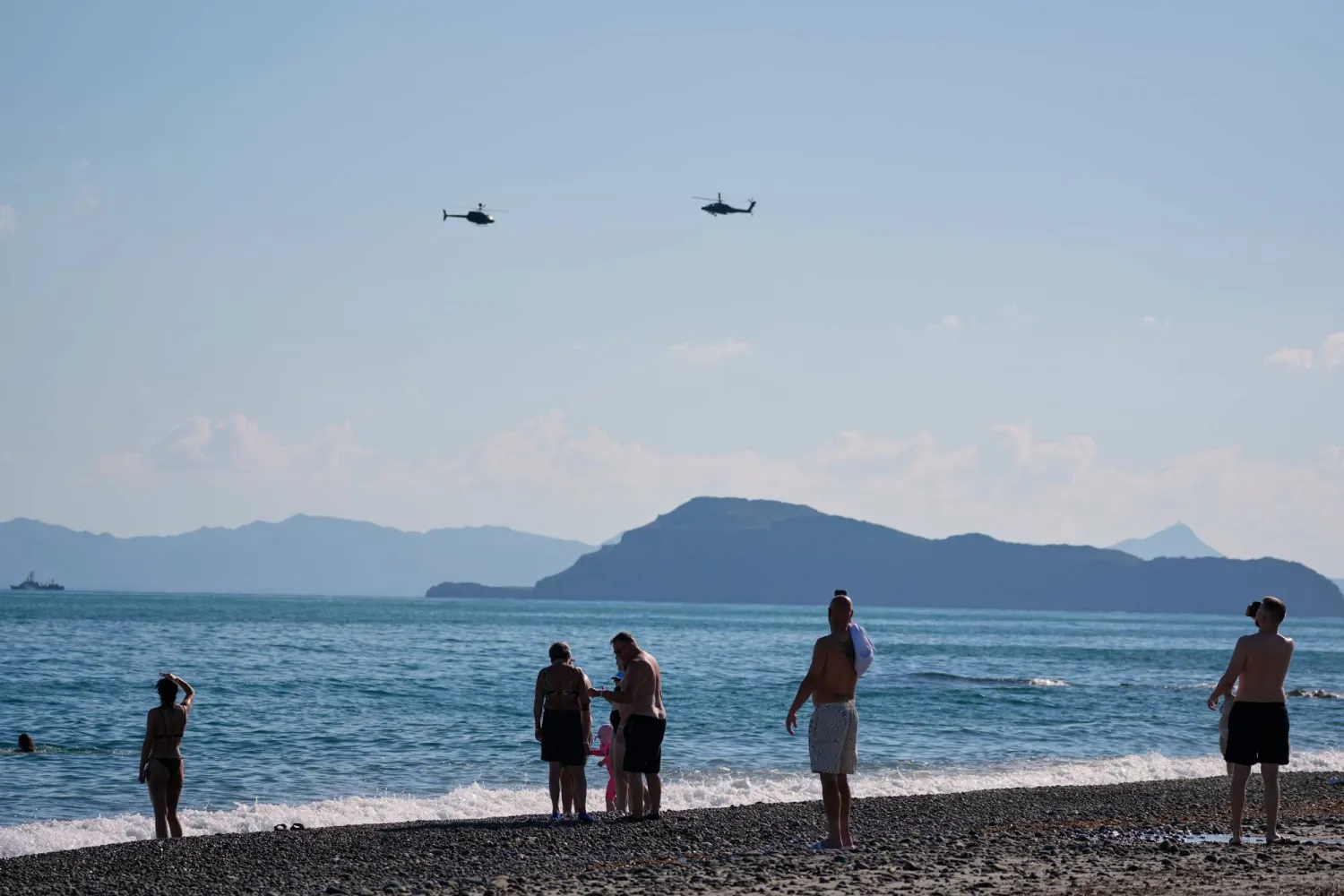
Tourists from a nearby hotel watch military helicopters fly overhead during Medusa 15, a joint military exercise led by Greece and Egypt, at Maleme on the Greek island of Crete, Friday, Sept. 18, 2026. (AP Photo/Thanassis Stavrakis)
TT

82-year-old Dies after Beach Fight in Greece over Sun Lounger

Tourists from a nearby hotel watch military helicopters fly overhead during Medusa 15, a joint military exercise led by Greece and Egypt, at Maleme on the Greek island of Crete, Friday, Sept. 18, 2026. (AP Photo/Thanassis Stavrakis)

An 82-year-old man died Sunday after he got into a fight over a sun lounger on a beach in Greece near Athens, local media reported.

The octogenarian had a dispute with a 76-year-old man and a 21-year-old woman over the sun lounger, with the argument degenerating into a scuffle between the two men, according to police, the ANA news agency and ERT state television channel reported.

The 82-year-old, badly hurt, was transported to hospital from the Vouliagmeni beach resort area where the argument broke out. He was later declared dead at the hospital, AFP said.

Both the 76-year-old man and the 21-year-old woman were arrested, ANA said, with police investigating what happened.


WHO Sounds Alarm Over Lack of Physical Activity Among Teens

 As daylight savings time came to an end today, children play with their dog at sunrise on Higgins Beach, days before Election Day, in Scarborough, Maine, US, November 1, 2026. (Reuters)
As daylight savings time came to an end today, children play with their dog at sunrise on Higgins Beach, days before Election Day, in Scarborough, Maine, US, November 1, 2026. (Reuters)
TT

WHO Sounds Alarm Over Lack of Physical Activity Among Teens

 As daylight savings time came to an end today, children play with their dog at sunrise on Higgins Beach, days before Election Day, in Scarborough, Maine, US, November 1, 2026. (Reuters)
As daylight savings time came to an end today, children play with their dog at sunrise on Higgins Beach, days before Election Day, in Scarborough, Maine, US, November 1, 2026. (Reuters)

A quarter of teens globally engage in basically no physical activity -- not even an hour of exercise a week -- the World Health Organization said Wednesday, warning that this significantly raises health risks.

The WHO's new global estimates found that when asked, one in four adolescents aged 11 to 17 report no active days -- defined as at least 60 minutes of moderate to vigorous physical activity -- in the previous week.

The study, published in The Lancet Global Health, draws on hundreds of population-based surveys from 140 countries and territories, involving more than 3.2 million teens, WHO said.

When extrapolated, the findings amount to some 240 million young people with no active days in the span of a week, the United Nations health agency said.

Overall, adolescents partaking in the studies on average reported being active for 2.7 days a week, while only 14 percent reported being active on all seven days, the estimates showed.

The WHO warned that "physical inactivity is a major risk factor for heart disease, type 2 diabetes and some cancers"

"Helping young people develop active habits early in life is critical to protecting their health and reducing the global burden of these diseases," it said in a statement.

The organization lamented the lack of progress, with physical activity among adolescents remaining "virtually unchanged" in the past 15 years, urging societies to step up.

"For 15 years, the world has made almost no progress in getting young people moving, and girls are being left furthest behind," WHO chief Tedros Adhanom Ghebreyesus said in the statement.

The WHO highlighted a stubborn gender gap when it came to physical activity among teens, with girls far less active than boys in almost every country and region.

According to the estimate, 28 percent of girls reported no active days, compared to 22 percent of boys, while only 11 percent of girls reported being active every day, compared to 17 percent of boys.

There were also stark differences between nations.

While fully 40 percent of adolescents in countries like Namibia, Nepal and the Philippines reported no active days, more than 30 percent of youths in Bangladesh and Serbia reported daily physical activity, the report showed.

"The answer is not to tell adolescents to try harder. It is to build schools, streets and communities where moving, playing and being active is safe, easy and normal," Tedros insisted.

The WHO stressed that physical activity was influenced by the environment in which young people live, pointing to things like modes of transportation, access to safe space and the ability to walk or cycle safely.

The school environment, social norms and lifestyles increasingly centered around screens can also have a big impact on activity levels.

"Countries need policies that make physical activity an easy, safe and accessible part of everyday life," WHO said.


Six Measures Could Save 1.6 Million Lives a Year, Says WHO

Tedros Adhanom Ghebreyesus, Director General of the World Health Organization (WHO), speaks to the media in Geneva, Switzerland, on July 16, 2026. (AP)
TT

Six Measures Could Save 1.6 Million Lives a Year, Says WHO

Tedros Adhanom Ghebreyesus, Director General of the World Health Organization (WHO), speaks to the media in Geneva, Switzerland, on July 16, 2026. (AP)

Implementing a few climate and health measures could save nearly 1.6 million lives a year and generate trillions of dollars for the economy, the World Health Organization said on Wednesday.

The UN agency's report, released days before the COP31 climate change conference kicks off, proposed heat-health warning systems and climate-resilient infrastructure for drinking water and sanitation.

Improved hand hygiene, cleaner household energy sources and more efficient fossil fuel pricing were also on the list.

"The climate crisis is a health crisis, but much of the harm it causes can be prevented with tools we already have," WHO chief Tedros Adhanom Ghebreyesus said in a statement.

The WHO's report said rolling out six concrete measures could provide "a triple dividend" of "healthier people, lower emissions, and stronger economies".

As well as saving lives, the measures could help avoid 16.7 billion tons of carbon dioxide emissions each year, the report said.

The measures could also generate up to $5.4 trillion in fiscal benefits each year, as well as a nearly $4 trillion economic boost by saving lives, avoiding disasters and reducing healthcare costs.

The WHO acknowledged the study relied on ambitious scenarios and that there were data gaps and inherent uncertainties in the projections.

But Tedros maintained that the report showed how "scaling up proven, affordable actions could save millions of lives, with the greatest gains in the countries that need them most".

As global leaders prepare to head to the COP31 in Türkiye next week, he urged them to ensure that protecting health is at "the center of climate action".


‘Fewer and Fewer’: Dry Summer Hits Italy Truffle Season

Truffle hunter Giuseppe Esposito shows a black truffle harvested from the truffle plantation of Boido Tartufi in Pietra Marazzi, near Alessandria, northern Italy on October 27, 2026. (AFP)
TT

‘Fewer and Fewer’: Dry Summer Hits Italy Truffle Season

Truffle hunter Giuseppe Esposito shows a black truffle harvested from the truffle plantation of Boido Tartufi in Pietra Marazzi, near Alessandria, northern Italy on October 27, 2026. (AFP)

After an excessively dry summer, black truffles are becoming few and far between in the misty hills of the Piedmont region in northern Italy.

"The moon is perfect, and yet I only found two little ones last night," Giuseppe Esposito, 69, told AFP as he searched with his dog Attila.

"We needed rain in July or August," he said of the spots where he usually hunts -- the precise location of which he keeps a closely guarded secret even from his wife.

Truffle gathering is an important tradition in rural Italy, and often a source of untaxed supplementary income for local residents, with white truffles worth several thousand euros per kilogram and premium black truffles typically selling for hundreds of euros per kilogram.

Most black truffles now come from truffle plantations or cultivated truffle grounds, where trees have had their roots soaked in a truffle-based slurry to encourage the fungus to grow.

In his woods in Pietra Marazzi, Marco Boido, 49, a truffle dealer and restaurateur in nearby Alessandria, is also disappointed and worried.

"We started the season in a terrible way, we're at minus 50 percent in production," he said -- a month in from the start of the season.

"This year they're much smaller, and more fragrant, that's true," he said.

"If this drought continues, there will be fewer and fewer in our area," Boido said.

- 'Gives you goosebumps' -

A truffle hunter who works for Boido and preferred to remain anonymous said the production of white truffle was also "off kilter" this year.

"The unseasonal heat has dried out the banks of the streams and the dampest valleys," he said.

Another truffle hunter in Umbria in central Italy said that better areas for truffles this year were "more enclosed, cooler mountain valleys, where the moisture held" during the summer.

"The aroma is exceptional and the texture very firm, which is keeping market prices high."

For several years now, Italy has also had to contend with the growing strength of the Spanish truffle industry, where farmers have planted vast truffle orchards and slashed costs.

In 2025, the Italian government once again tried to reform the truffle sector by encouraging more production in truffle plantations.

But the bill faced strong opposition from traditional "trifulai" -- the word for truffle hunters -- and it remains stuck in the Senate.

"We need policies to shift the calendars and to manage the land, so as not to block the water that runs down with the plants," said Fabio Cerretano, president of the Italian federation of truffle gatherers' associations.

In Piedmont, Esposito said he hoped his tradition would continue and spoke of the "emotion" of truffle hunting.

"When you catch the scent of the truffle, when the dog starts digging, and he plants himself there and doesn't give up... it gives you goosebumps."