'Basis for Understanding' Brings Iraqi Kurdistan Closer to New Government

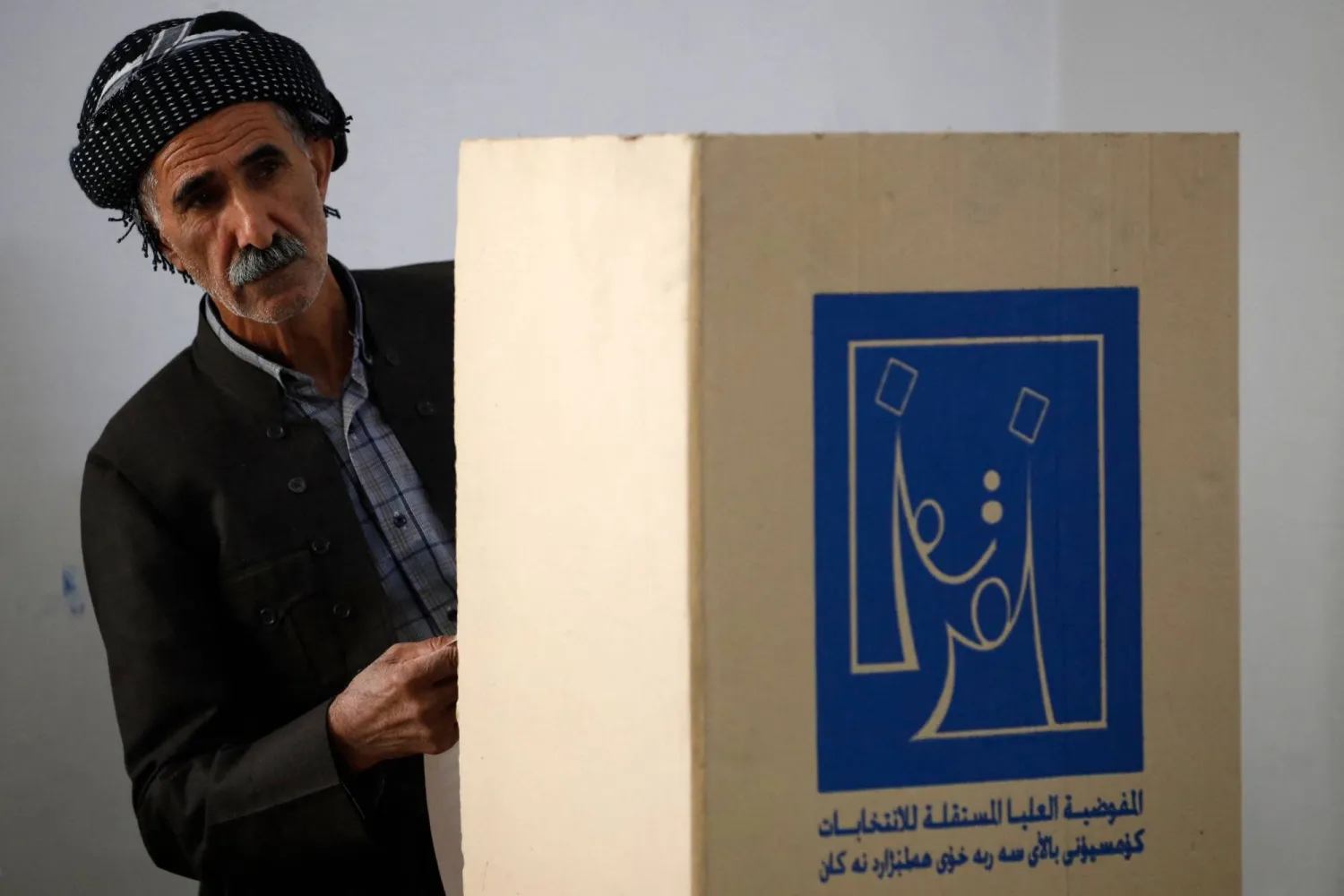
A Kurdish voter prepares his ballot during parliamentary elections at a polling station in Sulaimaniyah in Iraq's autonomous Kurdistan region on October 20, 2024. (Photo by Ahmad Al-rubaye / AFP)
TT

'Basis for Understanding' Brings Iraqi Kurdistan Closer to New Government

A Kurdish voter prepares his ballot during parliamentary elections at a polling station in Sulaimaniyah in Iraq's autonomous Kurdistan region on October 20, 2024. (Photo by Ahmad Al-rubaye / AFP)

Positive signs have emerged in Erbil and Sulaymaniyah indicating that an agreement leading to the formation of a new government in the Kurdistan Region of Iraq may be nearing, after the process was delayed for nearly two years by disputes between the region’s two historic political rivals, the Kurdistan Democratic Party (KDP) and the Patriotic Union of Kurdistan (PUK).

A PUK leader told Asharq Al-Awsat, speaking on condition of anonymity, that “talks are underway these days with the KDP and have begun on a clear basis between the two sides,” noting that “some details still require further consultation.”

The latest understanding between the two parties is based on “maintaining the presidency of the Kurdistan Region and the premiership for the KDP, with their deputies going to the PUK, along with the speakership of parliament,” according to the PUK leader. He added that his party “requires, in order to preserve the historic distribution of posts, that the two deputy positions be granted new powers that expand the partnership in governing the region.”

Regarding the allocation of key portfolios in the new cabinet, the leader said that “the PUK will receive the finance and Peshmerga portfolios, while the oil and interior ministries will go to the KDP.”

In the parliamentary elections held in October 2024, the KDP came first with 39 seats in the Kurdistan Region Parliament, followed by the PUK with 23 seats. The PUK subsequently allied with the New Generation Movement, which won 15 seats, in an effort to balance the scales in negotiations over forming a government with its historic rival.

Elected lawmakers were required to choose the new parliament speaker, deputy speaker, and secretary in a single session held on December 2, 2024. The session was limited to the swearing-in ceremony. Since then, parliament has remained inactive because of disputes between the two main parties.

‘Basis for Understanding’

An atmosphere of optimism is emerging from within the KDP camp. KDP leader Dlawar Faiq told Asharq Al-Awsat that reports of an emerging basis for understanding were “close to being accurate, but no agreement has been reached yet,” particularly because “neither party has made any official announcement about it.” KDP leader Abdul Salam Barwari also told Asharq Al-Awsat that “dialogue between the two parties is continuing, with a serious willingness this time to form the government.”

Last Saturday, Kurdistan Region President Nechirvan Barzani said that “efforts are underway aimed at enabling the Kurdish political parties to reach positive results,” noting that “the two parties are continuing to hold meetings, and we hope these efforts will culminate in understandings that serve the interests of Kurdistan and all its components.”

Since the Kurdistan Region’s parliamentary elections in October 2024, efforts to form a new government have stalled amid disputes between two camps of competing parties seeking greater influence over the anticipated cabinet.

Demands and Conditions

This time, emerging parties such as the New Generation Movement have entered the political competition and become part of the alliance landscape. However, the KDP and PUK continue to dominate the political process in the region.

The PUK-New Generation alliance, which holds 38 of the 100 seats in the Kurdistan Region Parliament, is demanding half of the cabinet, a proposal rejected by the KDP. The KDP argues that the seats held by other parties will give it the advantage, while nevertheless saying it does not object to its historic rival participating in government formation on a fair and balanced basis.

Members of the KDP have floated the possibility of holding new elections unless the PUK agrees to its demands, while some PUK members have raised the possibility of “near-independent rule for Sulaymaniyah from Erbil.”

PUK spokesperson Karwan Gaznayi said at a news conference in Sulaymaniyah on Sunday that his party “remains committed to its demands regarding government formation, but its doors remain open to reaching an understanding.”

Gaznayi added that a meeting between Kurdistan Region Prime Minister Masrour Barzani and his deputy, Qubad Talabani, had been “positive,” but had not produced an agreement on forming the new government. The distribution of posts was also not discussed at the meeting, he said, stressing that the PUK’s alliance with the New Generation Movement remains in place.

‘Balanced Government’

PUK leader Ahmed Al-Harki told Asharq Al-Awsat that a meeting of the party’s Political Bureau last Saturday and another meeting of its Leadership Council the following day reaffirmed the need to continue consultations and seek an understanding over the formation of the new government. He stressed that the government should be balanced and that no side should monopolize power.

PUK leader Soran Al-Daoudi told Asharq Al-Awsat that “the past few days have seen rapprochement with the KDP, as both sides have demonstrated their desire to reach an understanding and then agree on a balanced cabinet.”

“Nevertheless, forming the government requires further effort and pressure to achieve this as soon as possible,” Al-Daoudi added.


Sudan’s Military Again Detains International Criminal Court Fugitive Haroun, Lawyers Say

Governor of South Kordofan Ahmed Haroun addresses the participants of Civil Administrative Conference during the visit by Sudan's President Omar al-Bashir to Kadogli capital of South Kordofan State August 23, 2011. (Reuters)
TT

Sudan’s Military Again Detains International Criminal Court Fugitive Haroun, Lawyers Say

Governor of South Kordofan Ahmed Haroun addresses the participants of Civil Administrative Conference during the visit by Sudan's President Omar al-Bashir to Kadogli capital of South Kordofan State August 23, 2011. (Reuters)

Sudan’s military authorities on Sunday once again detained a former senior Islamist official who is wanted by the International Criminal Court over atrocities related to the Darfur conflict in the early 2000s, two defense lawyers said.

Ahmed Haroun, a senior security official during the rule of longtime ruler Omar al-Bashir, and later chairman of the former ruling National Congress Party, was detained in Omdurman, the sister city of the capital, Khartoum, according to two lawyers on his defense team. The lawyers had said earlier he was detained in the eastern province of Kassala.

The lawyers, who spoke on condition of anonymity because they weren’t authorized to brief the media, said Haroun’s whereabouts were unknown.

Haroun was detained in April 2019 when a monthslong uprising forced the military ouster of al-Bashir and his government.

He had been detained along with the former president and other senior officials, including those who are wanted by the ICC, in a Khartoum prison. The military declined to hand them over to the international court.

The conflict in Darfur broke out when rebels from the territory’s ethnic central and sub-Saharan African community launched an insurgency in 2003, complaining of oppression by the government in Khartoum.

Haroun was accused by the ICC of crimes against humanity and war crimes including murder, rape, persecution, forced transfer of the population and torture in Darfur at least between 2003 and 2004.

Haroun has denied the charges. He walked away from the prison after the facility was attacked in April 2024 during the war between the army and the notorious paramilitary Rapid Support Forces.

The lawyers said no reasons were given for Haroun’s re-detention, but they linked it to his recent comment in a podcast in which he said his party and the military might not be aligned, but are united in the fight against the RSF in the war that broke out in April 2023 in Khartoum and elsewhere across the country.

The National Congress Party called for the immediate release of Haroun, saying in a statement that he was detained merely for expressing his opinion. The party didn’t address that Haroun is wanted by the ICC.

The latest war has also been marked by atrocities such as mass rape and ethnically motivated killings. The United Nations and international rights groups say these acts also amount to war crimes and crimes against humanity, especially in Darfur, which has been facing a bitter onslaught by the RSF. The RSF's multiday attack on el-Fasher in Darfur last year bore “hallmarks of genocide,” according to UN experts.

In the interview on Sudan Podcast, Haroun addressed a wide range of topics, including the ouster of al-Bashir, ties with the military and RSF leaders, a proposal for the future governance of Sudan and the origins of the RSF.

The RSF grew out of the notorious Janjaweed militias, which were mobilized two decades ago by al-Bashir against populations that identify as Central or East African in Darfur.

The interview stirred up outrage among rights and activist groups that were behind the uprising against al-Bashir. The Emergency Lawyers group condemned the interview as a “legal scandal and a direct challenge to international justice.”

The group called for the army to detain Haroun and hand him over to the ICC along with al-Bashir and former Defense Minister Abdel-Rahim Muhammad Hussein.

“Justice for victims of crimes committed in Sudan cannot be held hostage to political or military balances, and ending impunity requires subjecting all accused and wanted persons to judicial accountability, without exception or immunity,” it said.


Production Suspended at Iraq’s Khor Mor Gas Field After Drone Attack

The Khor Mor gas field in Sulaymaniyah province, Iraq, November 27, 2025. (Reuters)
TT

Production Suspended at Iraq’s Khor Mor Gas Field After Drone Attack

The Khor Mor gas field in Sulaymaniyah province, Iraq, November 27, 2025. (Reuters)

Production ‌was halted on Sunday at Iraq's Khor Mor gas field, one of the largest in the Kurdistan region, after a drone attack hit the field, sources said.

Two sources in the region's electricity ministry said production at the field was suspended after a single drone strike hit the LPG storage tank, causing a fire that was still raging. Two security sources said smoke was seen rising from the field.

Employees at the field were evacuated ‌to shelters ‌inside the facility following the attack, the ‌two ⁠ministry sources said.

Iraq's ⁠prime minister and commander-in-chief of the armed forces, Ali al-Zaidi, said the attack did not result in casualties, based on an initial assessment.

A joint statement by the region's natural resources and electricity ministries described the attack on the field as a "terrorist attack," saying they ⁠are working on minimizing its impact.

There was no ‌claim of responsibility for ‌the attack.

The gas field provides supplies for regional power generation.

Some ‌2.8 gigawatts of power generation in the Kurdistan region ‌was lost following the attack, the region's electricity ministry said in a statement.

Joint field operator Dana Gas had previously shut down the main production facilities at the field in July ‌due to credible security threats and regional tensions before restarting production later in the ⁠same month.

Iraq ⁠has been among the countries most affected by Iran’s effective closure of the Strait of Hormuz. Traffic in the strait remains disrupted as ships continue to face attacks in the area.

Baghdad has been striving to balance its ties with neighboring Iran and the US amid the military escalation between the two countries.

However, Tehran has launched attacks against Iranian Kurdish opposition groups in northern Iraq, while Iran-backed armed factions in Iraq launched attacks against Gulf neighbors earlier in the conflict.


US Asks Iraq to Shut Most Iran Border Crossings, Iraqi Foreign Minister Says

Iraqi Foreign Minister Fuad Hussein speaks as he attends a joint press conference with Syrian Foreign Minister Faisal Mekdad (not pictured), in Baghdad, Iraq June 4, 2023. (Reuters)
TT

US Asks Iraq to Shut Most Iran Border Crossings, Iraqi Foreign Minister Says

Iraqi Foreign Minister Fuad Hussein speaks as he attends a joint press conference with Syrian Foreign Minister Faisal Mekdad (not pictured), in Baghdad, Iraq June 4, 2023. (Reuters)

The US Treasury has asked Iraq to close all border crossings with Iran except for two as part of Washington's policy of ‌increasing economic ‌pressure on Tehran, Iraqi ‌Foreign ⁠Minister Fuad Hussein ⁠said in an interview with Al Jazeera.

One of the exceptions is in the Kurdistan region.

"There ⁠are many official ‌and ‌unofficial border crossings with Iran, ‌and closing all ‌of them would be difficult and would affect our economy. The Americans ‌are still demanding the closure of the crossings, ⁠and ⁠we are currently in discussions with them," Hussein said.

Last month, Iraq closed the busy Sheeb border crossing with Iran to review security and install detection equipment to stop smuggling.