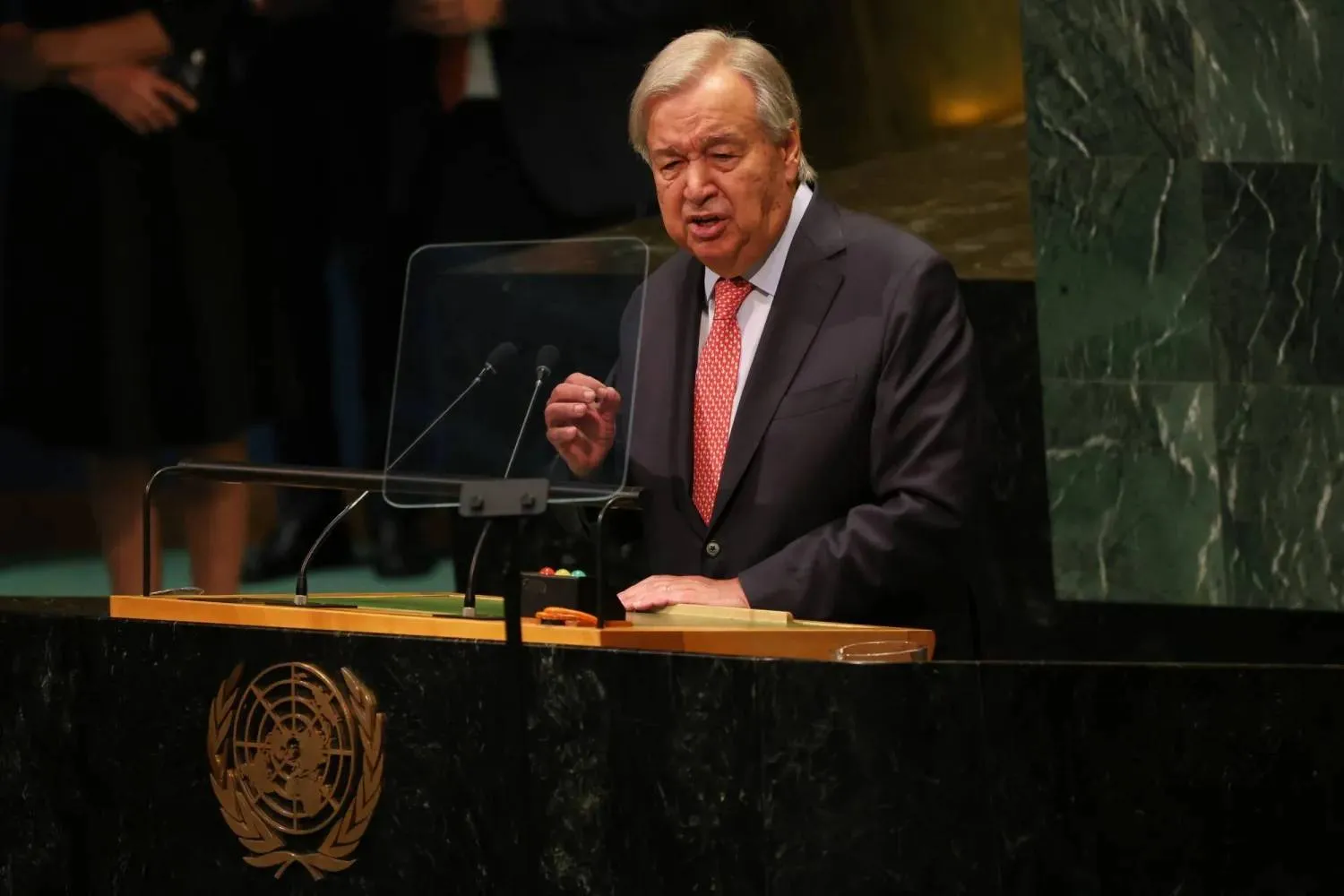
Guterres Calls on China, US to Establish AI Dialogue

United Nations Secretary-General Antonio Guterres during the 81st session of the United Nations General Assembly at United Nations headquarters, Tuesday, Sept. 22, 2026. (AP Photo/Heather Khalifa)  
TT

Guterres Calls on China, US to Establish AI Dialogue

United Nations Secretary-General Antonio Guterres during the 81st session of the United Nations General Assembly at United Nations headquarters, Tuesday, Sept. 22, 2026. (AP Photo/Heather Khalifa)  

UN chief Antonio Guterres called Tuesday for AI superpowers, the United States and China, to start a dialogue on the fast-moving technology's future, as calls grow to rein in the sector’s rapid development amid concerns about its potential impact on humanity.

“Governments with the greatest AI capabilities have the greatest responsibilities to humanity, to establish channels for dialogue, transparency, trust and cooperation,” Guterres said at the General Debate of the 81st Session of the UN General Assembly in New York.

“At a pivotal moment during the Cold War, strategic rivals came to recognize the need to manage shared existential risks,” he noted.

China and the US are currently discussing creating a communication channel for AI concerns in anticipation of a Washington summit meeting between US President Donald Trump and Chinese President Xi Jinping on Thursday.

The talks come as both powers confront rising fears that increasingly capable artificial intelligence systems could wipe out humanity, offering a rare incentive for cooperation despite an intensifying race for technological supremacy.

Power Has Polarized the World

In his final address to the annual high-level gathering at the UN General Assembly, Guterres urged leaders to avoid what he called “the great fracture – the division of the world into two rival blocs with separate economic, technological and security systems.”

He rebuked might-makes-right thinking, telling superpowers to recognize “that their power isn’t so super” — that “military power alone cannot secure peace” and that “no power can solve today’s challenges alone,” according to AP.

The future will be shaped by how the world addresses “four great tests of power” – power over war and peace, power fueling climate chaos, power unleashed by artificial intelligence and “power that concentrates wealth and drives inequality,” he said

The UN Chief said geopolitical divides have deepened, inequalities have intensified and trust has frayed.

“The climate crisis went from distant warning to daily reality. And artificial intelligence (AI) moved at a speed that has blindsided even those who created it,” he noted.

He said that on January 1, when he is no longer Secretary-General, he will keep championing the conviction that peace is possible and that human dignity is universal.

Guterres’ speech opened the main portion of the world's biggest diplomatic meeting of the year. Leaders from the UN's 193 member countries address each other and the international community and air their hopes, plans and grievances.

AI is a major theme at this year's UN General Assembly. Ahead of the week of meetings and speeches in New York, leaders of more than 20 countries urged binding safety measures for advanced artificial intelligence, warning that the technology's development could outpace the ability to control it.

China and the United States were not signatories.

Trump has come out strongly against AI safety measures, vowing on Saturday not to allow the “destruction” of the AI industry over what he calls unjustified fears.

China's President Xi Jinping in July said AI should not be dominated by a single country and urged international cooperation on its development.


South Korea to Withdraw Some Kyiv Embassy Staff as Row Over POW Transfer Deepens

Lawmaker Yu Yong-weon of South Korea’s main opposition People Power Party explains pictures, showing two North Korean POWs who were recently transferred from Ukraine to South Korea, taken during his visit to a POW camp in Ukraine last February, at his office at the National Assembly in Seoul, South Korea, September 28, 2026. (Reuters)
TT

South Korea to Withdraw Some Kyiv Embassy Staff as Row Over POW Transfer Deepens

Lawmaker Yu Yong-weon of South Korea’s main opposition People Power Party explains pictures, showing two North Korean POWs who were recently transferred from Ukraine to South Korea, taken during his visit to a POW camp in Ukraine last February, at his office at the National Assembly in Seoul, South Korea, September 28, 2026. (Reuters)

South Korea said Tuesday it will withdraw some staff from its embassy in Kyiv, deepening a diplomatic row over Ukraine's announcement last month of a transfer of two North Korean prisoners of war that Seoul says was meant to be secret.

The diplomatic dispute between the countries began after Ukrainian President Volodymyr Zelenskyy disclosed the prisoners’ transfer during a Sept. 23 speech at the United Nations. South Korea has accused Ukraine of violating a nondisclosure agreement, but Ukraine denies the countries reached such a deal, further angering Seoul.

South Korea recalled its ambassador to Ukraine earlier this month in protest. Ukrainian Foreign Ministry spokesperson Heorhii Tykhyi told local media at the time that Kyiv remains open to “constructive dialogue” and that “diplomacy must prevail over emotions.”

South Korean Foreign Ministry spokesperson Park Doosoon said Tuesday that the withdrawal of additional embassy staff was due to Ukraine’s “lack of constructive steps” to address Seoul’s grievances, as well as concerns about safety amid intensifying Russian attacks.

Park did not specify how many staff members would withdraw or when. He said South Korea would keep its charge d’affaires and essential personnel in Kyiv to maintain contact with Ukrainian authorities and assist South Korean citizens.

“We are still maintaining communication, and, as I mentioned earlier, our goal is to seek an amicable resolution through close consultation with the Ukrainian side,” Park said. “We conveyed our clear position and requests over the pending issues between the two countries through various channels. It’s now up to the Ukrainian side to provide a response or take appropriate action on those matters.”

The two soldiers Ukraine handed over to South Korea were among thousands of North Korean troops deployed to support Russia’s war against Ukraine. Captured in early 2025, they said in media interviews that they hoped to resettle in South Korea, fearing persecution if they were returned to the North. South Korea, which in its constitution claims to be the legitimate government of the entire Korean Peninsula, has long accepted and financially supported North Korean defectors.

South Korean officials said the nondisclosure agreement was intended to protect the soldiers and their relatives in North Korea, although some experts say President Lee Jae Myung’s liberal government may have also feared that publicizing their arrival could undermine its efforts to improve ties with North Korea.

North Korea’s state media hasn’t commented on the soldiers’ transfer. The North has previously reacted with fury to high-profile defections by its citizens, sometimes accusing South Korea of kidnapping them.

Relations between the Koreas have sharply deteriorated in recent years, with North Korean leader Kim Jong Un taking a hard-line stance toward Seoul and moving to sever inter-Korean ties while accelerating his nuclear weapons program amid a diplomatic stalemate with Washington.


Trump Open to Idea of Joint Meeting with Xi, Putin Next Month

US President Donald Trump speaks with Russian President Vladimir Putin, as they meet to negotiate for an end to the war in Ukraine, at Joint Base Elmendorf-Richardson in Anchorage, Alaska, US, August 15, 2025. (Reuters)
TT

Trump Open to Idea of Joint Meeting with Xi, Putin Next Month

US President Donald Trump speaks with Russian President Vladimir Putin, as they meet to negotiate for an end to the war in Ukraine, at Joint Base Elmendorf-Richardson in Anchorage, Alaska, US, August 15, 2025. (Reuters)

US President Donald Trump said on Monday he is open to three-way arms-control talks with the leaders of China and Russia as soon as next month, raising the prospect of an unprecedented meeting and a major diplomatic gambit for the US president.

"We would have it to talk about nuclear weapons and denuclearization," Trump told reporters outside the White House. "If President Xi wants to have it, I'd have it. I'm sure we'd talk about other things like trade too."

Trump has tried to thaw frosty relations with Beijing and Moscow as those non-Western powers grow closer. A three-way meeting would also raise alarm from Europe to Asia over private deals that weaken Washington's transatlantic and Indo-Pacific alliances.

But a deal struck between the three countries could also lower global tensions. An end to Russia's war in Ukraine could resolve the biggest threat in decades to European security, and a deal on arms would bind the three nations with the biggest stockpiles of nuclear weapons.

In recent days, Trump ‌has moved to ‌warm ties with Russian President Vladimir Putin, announcing a diesel-fuel deal and signing an order on ‌Friday ⁠waiving key sanctions ⁠on Moscow. Trump has also sought stable relations with Chinese President Xi Jinping, who in turn has nurtured close ties with Putin.

So far, Trump has not delivered on a campaign promise to quickly end the war in Ukraine.

The White House has been discussing for weeks a possible meeting between the leaders focused on denuclearization on the sidelines of the November 18-19 Asia-Pacific Economic Cooperation summit in China, according to a person familiar with the matter.

Putin later pitched using such a meeting to negotiate an end to the four-year-old Ukraine conflict in a manner that would favor Moscow, the Wall Street Journal reported on Sunday, citing people familiar with the discussions. Putin's suggestion came during an October 9 phone call with Trump that yielded the ⁠deal on Russian diesel.

Earlier on Monday, the Kremlin said that the potential meeting had come up ‌in talks.

The three leaders have met separately but never held formal talks together.

The White ‌House did not respond to a Reuters request for comment. The Russian and Chinese embassies in Washington also did not reply to requests for comment.

Trump's ‌diesel deal with Putin and the executive order waiving sanctions on Moscow have drawn criticism from Ukrainian President Volodymyr Zelenskiy, who has ‌warned they would embolden Putin and prolong the war.

Speaking about the possible meeting on Monday, Trump said, "I would do it, not so much for Ukraine because Russia, frankly, has been fine on Ukraine." He added that "Zelenskiy is not helping matters much," and that "it's time for somebody else to negotiate on behalf of Ukraine."

Moscow launched one of its broadest air assaults in months overnight, cutting power to more than half a million households and damaging energy ‌infrastructure across Ukraine. Ten people were reported killed.

TRUMP SEEKS NUCLEAR TALKS

Last week, Trump told reporters he thought a denuclearization deal with Russia and China was possible, but that it "doesn't have to be this ⁠year." It's not clear how advanced ⁠any talks between the countries are.

Russia has the most stored nuclear warheads, followed by the United States and China, according to the Stockholm International Peace Research Institute.

The Strategic Arms Reduction Treaty expired earlier this year. The New START treaty, signed in 2010, allowed a single extension, which Putin and former US President Joe Biden agreed to for five years. Any new extension would require an executive decision to voluntarily extend the limits of the treaty.

China's foreign ministry said last week that its "nuclear strength is by no means at the same level with that of the US and Russia" and that it would be "neither fair, reasonable nor realistic to ask China to join the so-called trilateral nuclear disarmament negotiations at this stage."

Trump has already agreed to attend the APEC summit in Shenzhen next month, marking his second trip to China this year and his third visit with Xi over the same period. China, Russia and the United States are all members of APEC.

On Monday, Trump downplayed the idea of another high-profile meeting in China, with North Korean leader Kim Jong Un.

"I get along with him very well, and I'm not sure that anybody's asking for a meeting," he said.

Trump previously said he planned to meet with Kim this year. North Korea has publicly indicated that it is not open to talks aimed at convincing Pyongyang to give up its nuclear weapons.


Alberta Separatists Lose Vote on Leaving Canada

Supporters of the Forever Canadian group, who want Alberta to remain in Canada, react after Alberta residents voted to remain part of Canada in a non-binding referendum on Alberta sovereignty, according to CBC News, in Edmonton, Alberta, Canada, October 19, 2026. (Reuters)
TT

Alberta Separatists Lose Vote on Leaving Canada

Supporters of the Forever Canadian group, who want Alberta to remain in Canada, react after Alberta residents voted to remain part of Canada in a non-binding referendum on Alberta sovereignty, according to CBC News, in Edmonton, Alberta, Canada, October 19, 2026. (Reuters)

Canada's province of Alberta rejected a plan to hold a binding independence referendum, results showed Tuesday, a setback for separatists backed by allies of US President Donald Trump.

Public broadcaster CBC and leading private network CTV projected a comfortable victory for the federalist side, with official results showing more than 76 percent support for national unity with more than a third of ballots counted.

Prime Minister Mark Carney welcomed the result and said Albertans had made a "clear choice" in favor of unity.

"They chose unity, to build together, and to take care of each other," he said in a statement on X.

Carney had campaigned for national stability as the country faced Trump's trade war and annexation threats.

A somber mood took over the restaurant in the provincial capital Edmonton where a leading separatist group watched the returns.

Jeffrey Rath, a top leader of the separatist Alberta Prosperity Project, told reporters his push for an independent Alberta will "absolutely" continue, despite the result from Monday's vote.

"We've learned a lot of lessons from this fight," he said.

Separatist supporter Jour Dain said he was "disappointed in (his) fellow Albertans."

"Honestly, if this continues down this path of remaining in Canada, I'm just going to move," the 40-year-old said, expressing a desire to live in the United States.

At the federalist election night party in Edmonton before the results were announced, a band warmed up ahead of an anticipated positive result.

"It was amazing to see the enthusiasm and resolve among Canadians," said Thomas Lukaszuk, who heads Forever Canadian, the group that campaigned across the province for national unity.

Alberta Premier Danielle Smith, a conservative, said she voted against independence but called the referendum to settle an issue that has divided the province.

She has said a win for the federalists would close the secession question.

- Foreign influence? -

Alberta has the world's fourth-largest proven oil reserves, and much of the separatist momentum has been driven by anger over oil industry management.

Smith has blamed Carney's predecessor Justin Trudeau for igniting the separatist fire, accusing him of trying to crush oil production to advance his pro-climate agenda.

Alberta's independence push has also drawn sustained interest from Trump allies.

US Treasury Secretary Scott Bessent called Alberta a "natural partner" for the United States. Elon Musk, the world's richest person and a top Trump supporter, posted on X this month that Alberta "should separate."

Separatist leaders also held meetings at the US State Department and received advice from Republican political operatives.

- 'Rash decisions' -

Carney, who grew up in Alberta, has worked to improve relations between the province and Ottawa since taking office last year.

He has partnered with Smith on advancing a new pipeline to export more Alberta bitumen overseas, a project considered a nonstarter during Trudeau's tenure.

Alberta Prosperity Project leader Mitch Sylvestre told AFP earlier Monday that Carney had "threatened" the province in the closing days of the campaign.

Carney's message was "voting against Canada is dangerous," Sylvestre said, calling that "very unreasonable."

Haley Erdegard, a 44-year-old who voted in Edmonton, voiced discomfort with the idea advanced by some separatists that Alberta is forced to share too much of its oil revenue with the rest of Canada.

"I think we probably need to put some more work towards cooperation before making rash decisions about trying to start our own country," she told AFP.