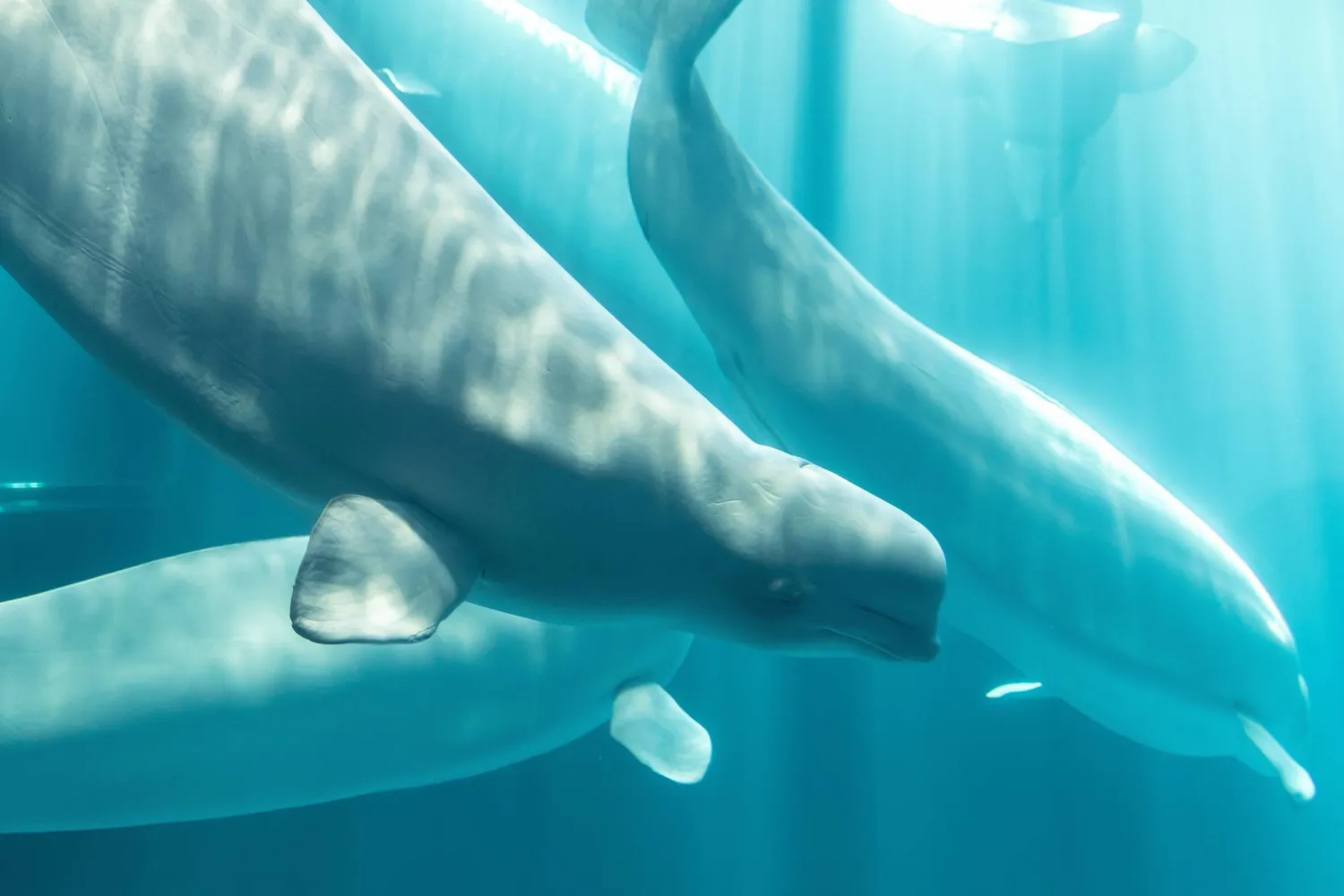
Another Beluga Whale Dies at Chicago Aquarium after Rescue Mission from Canada Park

This photo provided by Shedd Aquarium shows a beluga whale named Osiris at Shedd Aquarium in Chicago, Aug. 20, 2026. (Rachel Mittelstaedt/Shedd Aquarium via AP)
TT

Another Beluga Whale Dies at Chicago Aquarium after Rescue Mission from Canada Park

This photo provided by Shedd Aquarium shows a beluga whale named Osiris at Shedd Aquarium in Chicago, Aug. 20, 2026. (Rachel Mittelstaedt/Shedd Aquarium via AP)

A third beluga has died at a Chicago aquarium after being rescued this summer from a shuttered Canadian marine park in a complex international operation that moved 30 whales to aquariums in the US and Spain.

Osiris, a 26-year-old female whale, died on Monday, Chicago's Shedd Aquarium said in a statement. The death comes less than a week after a fourth beluga, named Jelly Bean, died since it was rehomed at Oceanogràfic de València in Spain.

The deaths were sudden and unexpected as their health wavered amid the challenges of adjusting to a new home, according to statements from the aquariums.

Beluga whales are particularly vulnerable to changes in their environment, like climate change, pollution and other sources of stress, according to the National Oceanic and Atmospheric Association. Beluga whales native to the Cook Inlet on Alaska's coast are classified as an endangered species, and their population rapidly declined by nearly 80% from 1979 to 2018.

“When Shedd was asked to help with this rescue, we understood that these animals arrived with significant vulnerabilities and that the outcome for every individual could not be guaranteed,” The Associated Press quoted the Shedd Aquarium as saying in a statement.

The Shedd Aquarium took in 10 of the 30 belugas and four dolphins stranded at Marineland, an Ontario park that closed years ago and could no longer care for them. The Canadian government signed off on a last-minute agreement to move its last captive whales out of the country earlier this year, saving them from euthanasia.

The belugas came from the Marineland park and zoo in Niagara Falls, Ontario, which announced in early 2023 that it was for sale and closed to the public in late summer 2024.

Twenty whales — 19 belugas and one killer whale — had died at Marineland since 2019, according to provincial government data obtained through freedom of information laws and official statements.

The rescued belugas were moved in custom-made slings and temperature-controlled containers, Shedd staff told The Associated Press. Aquarium personnel traveled to Marineland to examine their health records in preparation for the move. They have monitored their health minute-by-minute since they arrived, the aquarium staff said.

Peekachu and Rain died at the Shedd in late August and early September after arriving from Canada. Another beluga that had lived at the aquarium for decades died around the same time.

Osiris was a “whale of clinical concern” since she arrived, according to the aquarium. The whale did not eat as consistently as her fellow animals, which complicated the efforts to keep her well-fed and hydrated, according to the statement.

“Osiris experienced periods of meaningful progress, both nutritionally and socially, but her overall condition remained closely monitored,” the aquarium stated.

Osiris' caretakers noticed sudden changes in her behavior and breathing patterns the morning of her death, according to the aquarium. She was moved to the medical habitat, but “her condition declined rapidly,” and she “passed away despite lifesaving efforts.”

A beluga sent to Spain died suddenly Jelly Bean, the whale that died at Oceanogràfic de València, also died “suddenly and unexpectedly,” according to José Rafael Serra, a spokesperson for the facility. The whale “experienced feeding difficulties, prompting the veterinary team to intensify her monitoring,” despite periods of improvement, Serra said in an email.

The Spanish aquarium took in two of Marineland's beluga whales, including Jelly Bean. The Georgia Aquarium and SeaWorld locations in San Diego and San Antonio have also accepted whales from the Canadian park.

The two rescued whales at the Georgia Aquarium showed decreased appetites and were examined, but no issues were found, the aquarium said in a social media post Friday. The whales at SeaWorld are in “stable health,” according to AnneMarie Iturrizaga, a spokesperson for the company that owns the parks.

The Shedd Aquarium notified the NOAA of Osiris’ death Monday, according to John Chu, a spokesperson for NOAA Fisheries. Within 30 days of the whales’ deaths, the aquarium must formally submit their names and causes of death, and on request, provide copies of necropsy reports, Chu said in an email earlier this month.

The Shedd Aquarium said it will conduct necropsies into the whales and will share the results when they are confirmed.

Andrew Trites, the director of the University of British Columbia’s Marine Mammal Research Unit, said it was concerning that the four belugas had died “so shortly after arriving in their new homes."

The belugas were in small, confined spaces on the flights out of Marineland, but that's not out of the ordinary for them, Trites said. The whales often swim in narrow spaces between sheets of ice, and “should be reasonably well adapted to that sort of condition,” he said.

“Four animals have died so shortly after arriving in the new homes, and that’s what stands out to me as being surprising," Trites said.



Scan Reveals Four-Letter Code to 400-Year-Old Lock from Welsh Shipwreck

Scientists crack code to 400-year-old padlock from shipwreck (Amgueddfa Cymru)
TT

Scan Reveals Four-Letter Code to 400-Year-Old Lock from Welsh Shipwreck

Scientists crack code to 400-year-old padlock from shipwreck (Amgueddfa Cymru)

Scientists have used cutting-edge technology to crack the four-letter code of a brass combination lock from that lay buried on a beach in Wales for more than four centuries.

The 16th-century padlock, recovered from the wreckage of the Ann Francis, had remained firmly sealed since the vessel was wrecked off the South Wales coast in 1583, according to The Independent.

Now, a collaborative team from Amgueddfa Cymru – Museum Wales and Cardiff University has used modern-day technology to reveal the historic combination that once secured the cargo: ANCE.

Researchers believe the intricate device guarded a captain's chest containing Spanish silver, high-value textiles, or sensitive maritime correspondence before the ship ran aground in the Bristol Channel.

The breakthrough comes after museum conservators enlisted engineers at Cardiff University's School of Engineering to use micro-computed tomography (CT), a scanning technique normally used to examine bones and other body tissues.

The scans produced 3D images of the lock, which were then used to crack the code.

Dr. David Williams, a research associate at Cardiff University's Musculoskeletal Biomechanics Research Facility, explained: “By creating a detailed 3D image of the internal mechanism, I could see how the notches lined up with the letters and identify the exact combination.”

He added: “We normally use this technology to study bones and other biological structures, so investigating a 400-year-old padlock was certainly a first for us.”

After waiting for the museum team to test the code, Dr Williams described receiving confirmation that they had done so was “incredibly satisfying.”

He said: “It's not every day you get to solve a 400-year-old mystery.”

The Ann Francis was returning from a trading voyage to Spain when it was engulfed by a ferocious storm on the evening of 28 December 1583.

Driven off course by high winds, the ship grounded and broke apart on Margam Beach, near Port Talbot.

While Elizabethan combination locks have been recovered in Britain before, experts described this example as uniquely significant because it can be tied directly to a securely dated shipwreck.

The padlock was discovered near a stash of Spanish silver coins and a pair of brass coin-checking weights.

Alastair Willis, Senior Curator for Numismatics and the Welsh Economy at Amgueddfa Cymru, said: “Elizabethan combination locks are known in Britain, but this one is in exceptionally good condition and is associated with a dated wreck, making it a unique find and the code a tantalizing mystery to solve.”

“Of course, now we’ve solved it, we are left wondering if the code meant something to its owner,” she added.

The padlock forms part of the wider Ann Francis treasure hoard, which was recovered over a 21-year period between 1996 and 2017 by metal detectorist Peter Hughes.

The cracked padlock is now on public display at the National Waterfront Museum in Swansea alongside other recovered treasures, including rare gold coins from the reign of Ferdinand and Isabella of Spain, and an Elizabethan boatswain's whistle.


Officials Search for Bear that Killed a Mother, Daughter in British Columbia

This photograph taken on October 31, 2026 shows a bear walking at Dachigam National Park in Srinagar. (Photo by TAUSEEF MUSTAFA / AFP)
TT

Officials Search for Bear that Killed a Mother, Daughter in British Columbia

This photograph taken on October 31, 2026 shows a bear walking at Dachigam National Park in Srinagar. (Photo by TAUSEEF MUSTAFA / AFP)

Selah Reed's family first knew something was wrong when the 20-year-old missed a routine Saturday night call with her sister.

When no one had heard from Reed or her mother, Jenny Balcarras, by the next morning, they asked the Royal Canadian Mounted Police to check on their home in Bella Coola on British Columbia's central coast. Balcarras' car was gone and the doors were locked. They found the car at a trailhead up the road, but Balcarras and Reed were nowhere to be found.

Family members across Canada and the US started mobilizing. Jenny Balcarras' brother, Matt, headed north from Vancouver Island, and his brother left from Calgary. They met and drove through the night but got a call late Monday that their sister had been killed, likely by a grizzly.

When they arrived at the trailhead Tuesday morning, ready to join the search for Reed, her remains had also been found. The search was now a tragic recovery effort.

The killings of Jenny Balcarras, 48, and her daughter happened only 3 to 4 kilometers (1.8 to 2.4 miles) from where a grizzly attacked a group of schoolchildren and teachers last year as they walked on a trail. Eleven were injured, two of them critically, in the Nov. 20, 2025, attack.

Jeff Tyre, an inspector with the Conservation Officer Service, said that aggressive bear was never captured, but officials were able to collect its DNA. Officials have set new traps in the hopes of catching the bear involved in last weekend’s attack and to learn whether it was the same bear from a year ago. They also are not sure whether more than one bear was involved.

Terry Webber, chief administrative officer for the Nuxalk Nation, said the killings were triggering for the families who were traumatized by last year’s attack.

“Our community is still healing,” he said, adding that they’ve imposed a curfew and are providing mental health services for the community. “Our priority is to ensure they’re safe and ensure our community is supported.”

The delay in finding the remains of the two women was complicated by difficult terrain, even though it was close to the trailhead, and the grizzly bear's behavior.

Searchers found Jenny Balcarras first, then her daughter. The search was helped by more resources and a cadaver dog, Matt Balcarras said.

Searchers found his niece's remains in a bear cache — a place where bears stash food, sometimes by digging a small hole and covering it with branches and vegetation to keep other animals and birds away.

“Even though it was within 100 or so meters (330 feet), locating remains in a cache is difficult,” The Associated Press quoted him as saying.

By the time officials located his niece, she could only be identified by her clothing, he said. His sister was in a similar condition, but they knew who she was thanks to several tiny tattoos, he said.

“There's no obvious body to identify,” he said. “The coroner’s investigation will include DNA and dental work. But there is no doubt that the remains that were found are theirs.”

Grizzly bears are common in the area surrounding the Bella Coola community, officials said.

Conservation officials maintain a hotline where people can report problem bears, but no calls had been received recently, Tyre said during a media briefing.

Balcarras, an art therapist, had moved to Bella Coola during the summer. She had previously lived in Alaska, where her children were born, and was “the central organizing person in our family,” Matt Balcarras said.

“In classic, strong single-mother style, she scraped together a career and a life for herself and her kids,” Balcarras said. She was small in stature but strong in character and physical abilities, he said.

She was comfortable living among the wildlife, he said.

“She lived in the Bush when her kids were babies,” he said. “She and my niece were not naive or foolish or uninformed. They’ve lived in these areas and have been around animals of countless types for years and years and decades.”


2026 ‘Most Likely’ to Be Second-Hottest Year on Record, Says EU Monitor

Vehicles drive over the Woodhead reservoir amid a drought near Manchester, England, Aug. 13, 2026. (AP)
TT

2026 ‘Most Likely’ to Be Second-Hottest Year on Record, Says EU Monitor

Vehicles drive over the Woodhead reservoir amid a drought near Manchester, England, Aug. 13, 2026. (AP)

The world is on track for 2026 to be the second-hottest year on record as an exceptionally strong El Nino weather pattern turbocharges human-driven global warming, the EU's climate monitor said Friday.

This year still has a "20 percent chance of tying or exceeding" 2024 as the warmest ever seen, the Copernicus Climate Change Service said in a monthly bulletin.

Global temperatures are now "virtually certain" to exceed 1.5C above pre-industrial levels in 2026, Copernicus said.

The four-year average from 2023 to 2026 is also expected to top 1.5C, the preferred limit set in the Paris Agreement to avert the worst impacts of climate change.

The world experienced its warmest October on record, with average global surface air temperatures 1.75C above pre-industrial times, an era defined as 1850-1900, Copernicus added.

It was the third straight month exceeding 1.5C.

"October has continued the pattern of remarkable global warmth, with record global and surface ocean temperatures," said Samantha Burgess, strategic lead for climate at the European Centre for Medium-Range Weather Forecasts (ECMWF), which operates Copernicus.

"An exceptionally strong El Nino is adding further heat to a climate already warmed by human activities," she said.

The latest bulletin comes as nations prepare to meet on Monday for the UN's two-week COP31 climate summit in Türkiye after a year marked by deadly floods in Nepal, searing heatwaves in Europe and major wildfires in Indonesia.

- El Nino has yet to peak -

Global forecasters have been warning for months that this El Nino, which is expected to peak later this year, would likely become the strongest ever observed.

The intensifying weather phenomenon set an all-time temperature record in a key Pacific zone last month, Copernicus said.

The warming phase of a natural climate cycle, El Nino temporarily raises sea temperatures in the tropical Pacific, triggering changes in weather that can increase the risk of drought and flooding, and exacerbate man-made global warming.

Forecasters say El Nino could help make 2027 the hottest year on record.

Nations agreed at the 2015 UN climate talks in Paris to keep global warming "well below" 2C above pre-industrial levels, while pursuing efforts to limit it to 1.5C.

But the United Nations declared in September that the long-term 1.5C target would be missed in a matter of years.

Scientists say it is crucial to reduce greenhouse gas emissions from fossil fuels to limit the period of "overshoot" above 1.5C and bring temperatures back down as quickly as possible.