Meta Leans into AI, Smart Glasses amid Privacy Pushback

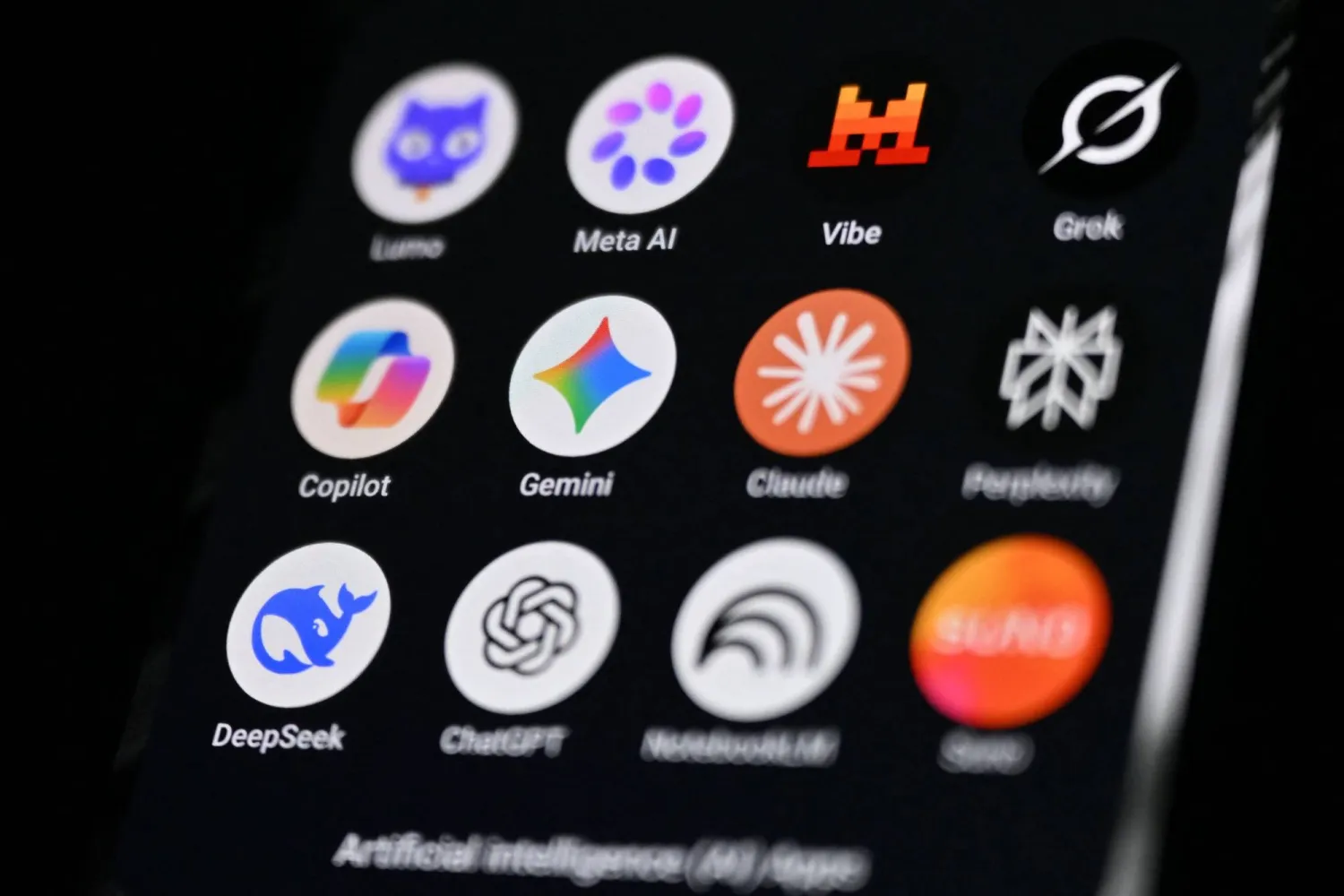
 (FILES) This photograph shows a handheld smartphone displaying the icons of some of the main artificial intelligence based apps, including LLMs, chatbots and generative AI, with logos (from L) of Proton AG's Lumo, Meta AI, Mistral Vibe (formerly Le Chat), xAI's Grok, Microsoft's Copilot, Google's Gemini, Anthropic's Claude, Perplexity, Deepseek, OpenAI's Chat GPT, Google's Notebook LLM and generative AI music app Suno, in Saint-Mande, east of Paris, on July 15, 2026.  (Photo by Martin LELIEVRE / AFP)
(FILES) This photograph shows a handheld smartphone displaying the icons of some of the main artificial intelligence based apps, including LLMs, chatbots and generative AI, with logos (from L) of Proton AG's Lumo, Meta AI, Mistral Vibe (formerly Le Chat), xAI's Grok, Microsoft's Copilot, Google's Gemini, Anthropic's Claude, Perplexity, Deepseek, OpenAI's Chat GPT, Google's Notebook LLM and generative AI music app Suno, in Saint-Mande, east of Paris, on July 15, 2026. (Photo by Martin LELIEVRE / AFP)
TT

Meta Leans into AI, Smart Glasses amid Privacy Pushback

 (FILES) This photograph shows a handheld smartphone displaying the icons of some of the main artificial intelligence based apps, including LLMs, chatbots and generative AI, with logos (from L) of Proton AG's Lumo, Meta AI, Mistral Vibe (formerly Le Chat), xAI's Grok, Microsoft's Copilot, Google's Gemini, Anthropic's Claude, Perplexity, Deepseek, OpenAI's Chat GPT, Google's Notebook LLM and generative AI music app Suno, in Saint-Mande, east of Paris, on July 15, 2026.  (Photo by Martin LELIEVRE / AFP)
(FILES) This photograph shows a handheld smartphone displaying the icons of some of the main artificial intelligence based apps, including LLMs, chatbots and generative AI, with logos (from L) of Proton AG's Lumo, Meta AI, Mistral Vibe (formerly Le Chat), xAI's Grok, Microsoft's Copilot, Google's Gemini, Anthropic's Claude, Perplexity, Deepseek, OpenAI's Chat GPT, Google's Notebook LLM and generative AI music app Suno, in Saint-Mande, east of Paris, on July 15, 2026. (Photo by Martin LELIEVRE / AFP)

Meta has spent billions to stay competitive with artificial intelligence, but the tech giant faces growing pushback as CEO Mark Zuckerberg prepares to announce new products built for the AI era on Wednesday.

The company will kick off its annual Connect conference from its Menlo Park headquarters at 4:00 pm PT (2300 GMT) Wednesday, and Zuckerberg will deliver a keynote address to the developer-focused event, said AFP.

Earlier this month the social media giant launched Muse, its first agentic app for consumers which is designed to perform tasks on behalf of humans, like a digital personal assistant.

After a user connects various personal accounts -- whether financial, health-related or shopping -- they can ask Meta to perform tasks like signing up for services, booking appointments and making calls.

Amazon blocked Meta this week from using AI bots to shop for users automatically, while other businesses including Instacart, Shopify and Expedia have announced partnerships to integrate their services into Muse.

The Muse agent is built on Meta's own AI models and is designed to compete with OpenAI's ChatGPT and Anthropic's Claude.

The company had its first pair of interactive smart glasses in 2021, about a year before OpenAI sparked a global AI frenzy with its release of ChatGPT, and since then the devices have become more and more advanced.

- 'Pervert glasses' -

Last year, Meta unveiled a pair of augmented reality "display" glasses which project images on the lenses.

And earlier this year, the company released self-branded AI glasses, apart from its partnership with eyewear manufacturer EssilorLuxottica, which produces multiple Ray-Ban-branded Meta glasses.

However, their novelty quickly became clouded by privacy concerns, with critics dubbing the eyewear as "pervert glasses."

At last year's Connect, Meta's chief product officer Chris Cox brushed aside such concerns and told news outlets, including AFP, that "social norms" would form around the use of smart glasses.

More recently, Meta has said a recording indicator light would always be visible to people nearby, and that tampering with the indicator light would disable the camera.

The company is reportedly working on a new pair of audio-only glasses, and has also been rumored to be developing a new generation of mixed reality glasses.

Meta has also been battling children's safety and privacy issues around the world.

In August, the company settled a lawsuit with dozens of attorneys generals in the US who accused Meta of violating state and federal laws regarding consumer protections and children's online privacy.

As part of the settlement, Meta agreed to pay up to $18 billion in fines and enact restrictions for teenagers.

Meta faces social media restrictions and bans for younger users around the world, as well as thousands of potential personal injury lawsuits in the US that are still making their way through state courts.


‘Grand Theft Auto’ Set for Blockbuster Return After 13 Years

An advertisement for the video game "Grand Theft Auto VI" (GTA VI) is seen in Tokyo on November 4, 2026. (AFP)
TT

‘Grand Theft Auto’ Set for Blockbuster Return After 13 Years

An advertisement for the video game "Grand Theft Auto VI" (GTA VI) is seen in Tokyo on November 4, 2026. (AFP)

Fans of the violent "Grand Theft Auto" video game franchise are just two weeks away from getting their hands on the latest edition, which has taken almost a decade to make and has become the most expensive title in history.

The franchise allows players to act out gangster fantasies – shoot ups, crashing cars -- in fictional renderings of US cities where the soundtrack piped through in-game radio is almost as important as the cutting-edge visuals.

GTA VI, which comes 13 years after its predecessor, is expected to break sales records when it lands on November 19 thanks in part to a monumental marketing campaign that kicked off in late 2023 with the first official trailer.

"It is going to be the biggest entertainment launch of all time," Chris Dring of The Game Business outlet told AFP.

The previous edition, GTA V, is still the second-biggest selling game ever -- it took just three days to rack up $1 billion in sales, two days less than the movie "Avengers: Endgame".

The budget of GTA VI has reportedly ballooned to over $1 billion --- far higher than any other game or film -- and projections have it on track to make several billion in its first week, which would smash all records for any cultural product.

- 'Top creators' -

"GTA VI" has two main protagonists, former drug-runner Jason and newly released ex-con Lucia, who try to survive in Vice City, a reimagining of Miami.

Lucia is the first playable woman character in a main edition of the almost 30-year history of a franchise.

During the 1990s and 2000s the game's graphic depictions of violence and misogyny became notorious -- tabloid media outrage boosting the title's notoriety and helping sales to skyrocket.

Rockstar Games has spent eight years developing the sixth edition, a process beset by difficulties including the leak of development footage and code for the game online in 2022.

But expectations are sky-high.

"They've spent a long time on this game, but they are probably the top game entertainment creators in the world," said Dring.

Analysts expect the game to have an impact on the entire video game sector, including on console sales and accessories.

Several other studios delayed the release of new games to avoid being caught in the hype cycle around GTA VI.

Analysis firm Sensor Tower said the game had already generated around $750 million from pre-sales.

Surveys suggested almost one-third of the 49 million people who use PS5 and Xbox Series consoles in the United States intended to buy the game.

"The purchase intent that we're seeing on 'Grand Theft Auto' is far away above any other game we've ever tracked," said Mat Piscatella of consultancy Circana.

"For me, it's the game of the decade," Jocelin Lebeau, 39, a gamer who works for the French military, told AFP at a recent event in Paris. "I'm ready to buy it sight unseen."


North Korea’s Army of World-Class Hackers Is Secret Weapon That Took Down Binance

A TV screen showing a reporting about the hack at Binance, is seen during a news program at the Seoul Railway Station in Seoul, South Korea, Wednesday, Nov. 4, 2026. (AP)
TT

North Korea’s Army of World-Class Hackers Is Secret Weapon That Took Down Binance

A TV screen showing a reporting about the hack at Binance, is seen during a news program at the Seoul Railway Station in Seoul, South Korea, Wednesday, Nov. 4, 2026. (AP)

North Korea rewards its top hackers, tasked with heists like the Binance crypto hack that netted a cool $6.3 billion, with perks such as a spacious apartment in the capital of Pyongyang and huge hard currency awards, despite grueling hours of work.

Leader Kim Jong Un has assembled an army of world-class hackers using such incentives in a program more than a decade old that picks 200 of the smartest middle school students each year to study computer engineering, defectors and analysts say.

A fraction eventually become hackers in an investment that has paid off dramatically, as the group has evolved from the early days when it ran illegal gambling websites to pulling off the world's biggest cyber heist last month.

"They are actually one of Kim Jong Un's secret weapons," said Kim Heung-kwang, a North Korean defector who trained hackers of behalf of the state before fleeing to South Korea in 2004.

"There is no other country grooming hackers like this, systematically searching for the smartest children, solely to turn them into operatives," he added. "Whether they want to be a hacker or not does not matter."

The FBI and Binance have said North Korea was responsible for the Binance hack, but Pyongyang has denied that. Blockchain investigation firms have attributed it to a North Korean group known as "TraderTraitor".

The denial is part of a pattern in which the North dismisses such blame over the years as fabricated political provocations.

SYSTEMIC SELECTION

North Korea set up a cyber unit in 1998 but elevated its status after Kim came to power and declared in 2013 that cyber warfare was, along with nuclear weapons and missiles, an "all purpose sword" crucial to the country's ‌strike capability.

Candidate selection begins ‌in middle school as early as 11 or 12 years of age, with authorities picking about 150 to 200 children a year ‌to study ⁠computer science, said ⁠Kim Heung-kwang, the former trainer, and two defectors who worked in IT.

At 17, the top performers are sent to North Korea's best universities and undergo further screening before a chosen few finally enter the military's cyber unit as hackers, they added.

They are trained in areas such as cryptocurrency protocols and reverse-engineering foreign hardware devices in addition to more conventional topics such as advanced mathematics and foreign languages, one of them said.

Those who do not become hackers are trained to turn out software or apps for Western firms via remote jobs.

"While South Korea's best students may pursue medicine or other prestigious careers, North Korea channels top talent into nuclear and cyber programs and essentially guarantees their future," said Lim Jongin, professor emeritus at the school of cybersecurity at Korea University.

Other privileges on tap for the hackers are travel abroad to allied countries, such as China, where they can more freely access the internet.

Successful exploits can earn as much as 30% of the heist's profits in US dollars for the hackers' military unit, and they can even receive a flat in the capital where their ⁠parents can also stay, Kim said.

"There are accounts that successful cyber personnel are given apartments in Pyongyang," Lim said, adding that the flats could ‌range to as much as 132 sq m (1,420 sq ft).

Such performers are also eligible for membership of the ruling party and high-status ‌marriages into elite families, said one of the defectors.

But it is a small group. The North's cyberwarfare operations employ about 8,400 people, South Korea's National Intelligence Service estimated in 2024.

North Korean state media do not publicly ‌celebrate such hackers' achievements, but they regularly highlight students who show talent for programming.

In 2015, North Korea opened the Mirae Scientists Street in the capital, in the construction of which Kim Jong Un ‌had been closely involved, state media said.

Hackers' formal designation in the North was "scientist" or "researcher", said one of the defectors.

STATE ADVANTAGE

Other hacking groups associated with North Korea include the Lazarus Group, also known as APT38, which the US accused in 2022 of having stolen hundreds of millions of dollars worth of cryptocurrency from the Ronin blockchain network. The FBI has said TraderTraitor is affiliated to Lazarus.

State backing makes the North's hackers more dangerous and harder to repulse, as they face no consequences for hack after hack, enabling them to perfect their strategies, analysts said.

"In the world of cyber crime, often, if you make a mistake ... that is all law enforcement needs to ‌get you," said Alec Zebrick, senior manager for Asia-Pacific global services at Chainalysis.

But North Korea's hackers "are doing this for the regime, so they're going to continue, even after successes," he added.

"Even after failures, they'll continue, because it's very hard for the international community to take action ⁠against them."

Other groups that have engaged with North Korea ⁠IT workers who earn funds for the Kim regime by landing remote technology jobs at Western companies describe them as highly organized, polite in their interactions and avid users of AI.

"There clearly was a structure you would see in military. Strict times, cleaning boots, very orderly," said YouTuber Deeveeaar, who has claimed to have hacked into cameras watching North Korean IT workers at their jobs.

"To say they 'use a lot of AI' is an understatement. AI is the very backbone of their operation," he said, citing use of paid ChatGPT accounts, Claude Code and Cursor, among many AI tools.

"They write code with it, alter their resumes and help make new ones. And even forge documents and identities."

Binance said the hackers used a bogus job interview and software hidden in an advertisement to compromise staffers' computers before using an internal AI tool to seize control of systems.

In 2025, a sanctions monitoring team drawn from 11 United Nations members said TraderTraitor had obtained both ChatGPT and DeepSeek accounts.

TOUGH WORKING CONDITIONS

Yet the lifestyle of a hacker or elite technology worker for North Korea is grueling, particularly when given a mission or sent abroad, say former IT workers and human rights groups.

Living in cramped spaces, often working stretches longer than 10 hours a day, constant surveillance and strict targets are among the downsides, said former IT workers interviewed for a report last year by advocacy group PSCORE.

"There is always pressure to keep earning money," said the group's executive director, Nam Bada. "The stress is extreme, and because of the psychological strain people develop health problems they didn't have before."

IT workers must meet a monthly target in dollars, or face humiliation and other punishments, he said.

Still, the hackers' success is likely to embolden the North Korean leader as they get better and grow more ambitious, analysts say.

"We see more and more them leaning towards what we call 'big game hunting'," said Zebrick.

"So they're targeting some of these larger organizations, potentially have larger vaults of funds, that they could potentially get. These are harder targets," he added.

"However, as we can see with the Binance case, the payout certainly can make it worth their time."


OpenAI Launches GPT-6 Cyber with 'Critical' Cybersecurity Rating

FILE PHOTO: OpenAI logo is seen in this illustration created on June 11, 2026. REUTERS/Dado Ruvic/Illustration/File Photo
TT

OpenAI Launches GPT-6 Cyber with 'Critical' Cybersecurity Rating

FILE PHOTO: OpenAI logo is seen in this illustration created on June 11, 2026. REUTERS/Dado Ruvic/Illustration/File Photo

OpenAI released GPT-6 Cyber, a model built to find and exploit security flaws, to a small group of vetted customers on Thursday, rating it "Critical" in cybersecurity under its safety framework.

The model is meant to help security researchers find vulnerabilities, test how they could be exploited and fix flaws before attackers do, Reuters quoted OpenAI as saying, amid increasing attempts to misuse AI by malicious cyber actors.

Here are more details:

OpenAI said ⁠its researchers used ⁠the model to find 81 previously unknown Firefox vulnerabilities that Mozilla classified as high severity. Mozilla has begun releasing fixes.

It also helped develop working exploits for 948 Linux kernel vulnerabilities, including 588 that ⁠were previously unknown, OpenAI said.

The company has also disclosed 304 critical Linux findings to maintainers, along with proposed patches.

OpenAI has raised its cybersecurity classification for GPT-6 Cyber to "Critical" under its safety framework, from "High" for GPT-5.6 Cyber.

The company said it is seeing more attempts to misuse AI, including by malicious cyber actors and groups seeking to distill ⁠its ⁠models.

GPT-6 Cyber is available to select customers of Daybreak Red, OpenAI’s access tier for advanced, authorized security work such as penetration testing and exploit development, OpenAI said.

Access to GPT-6 Cyber will be expanded to all approved Daybreak Red customers over the coming weeks, it added.

OpenAI is also making its earlier GPT-5.6 Cyber model available to all Daybreak Red customers starting Thursday.